Recommended AI Voice Cloning Apps With Fast Processing
Fast AI voice cloning, compared: instant vs trained clone times and real-time vs offline generation from vendor docs, plus consent checks and a speed test.
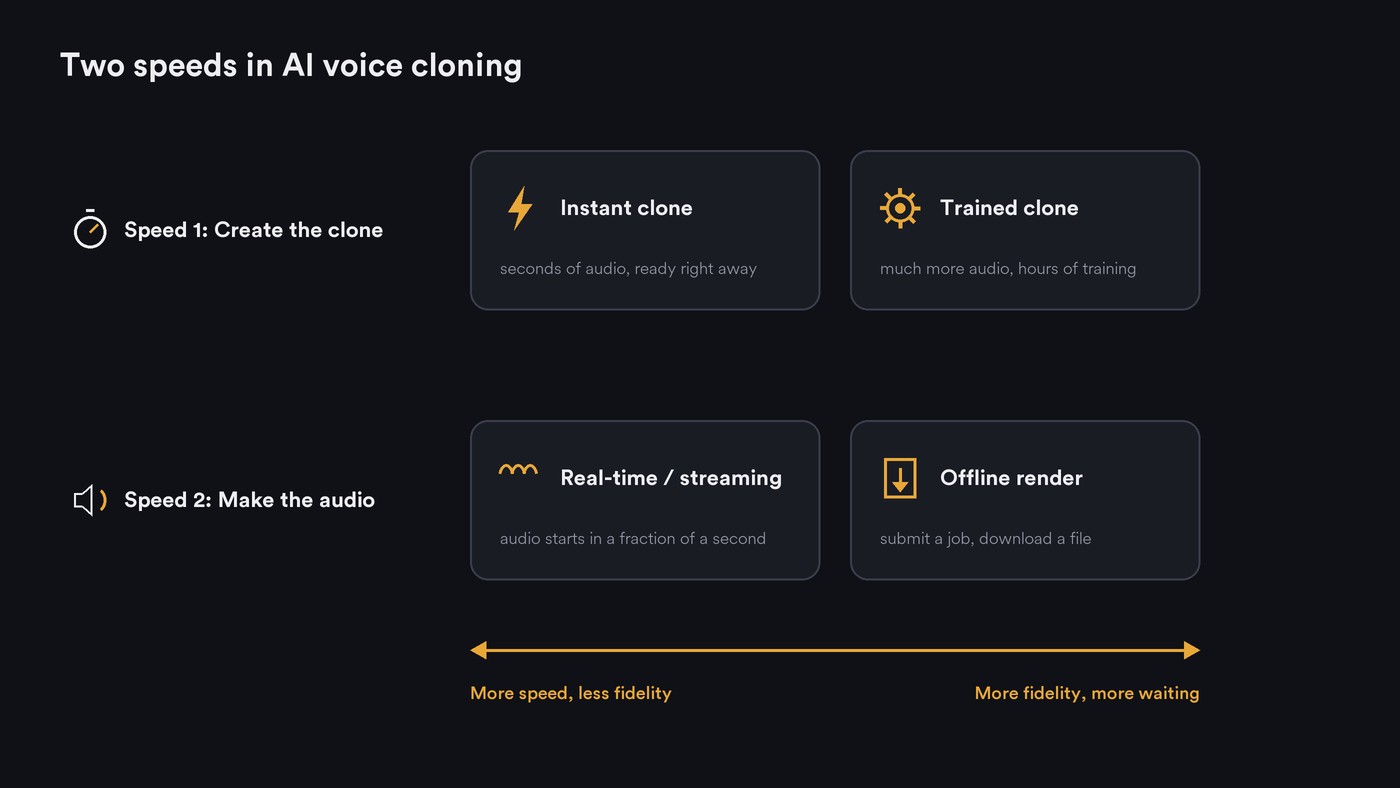
Fast AI voice cloning comes down to two separate speeds: how long an app takes to build the clone, and how long it takes to turn a script or a recording into finished audio. If you need recommendations for AI voice cloning apps with fast processing, shortlist ElevenLabs, Speechify's API, Kits.ai, Voice-Swap and Soundverse, then time them yourself.
Every timing below comes from the vendor's own page, checked on 21 and 22 November 2026. Queues and plans change, so the number that matters for a client deadline is the one you measure.
The two speeds that matter in fast AI voice cloning
Speed 1: time to create the clone. An instant (zero-shot) clone copies a voice from seconds to a couple of minutes of audio and is usable almost as soon as the upload finishes. A professional or trained clone fine-tunes a model on far more audio, as a background job that takes hours.
Speed 2: time to generate or convert audio. Streaming starts playback within a fraction of a second, which voice agents and live tools need. An offline render takes a job and hands you a file when it's done.
For a 30-second spot, clone and render time matter more than latency; for an interactive brand voice, latency is the whole spec. For the engineering behind streaming, see our explainer on how AI audio platforms achieve low-latency processing.
Recommended AI voice cloning apps, by what their own docs say about speed
ElevenLabs: instant clones from a minute or two, trained clones in hours
For spoken voice, ElevenLabs publishes the most detail. Its Instant Voice Cloning docs recommend about 1 to 2 minutes of clean audio and say that, in the app, each file must be at least 5 seconds long, with at least 10 seconds in total. Going past about 3 minutes, they add, brings little improvement.
Professional Voice Cloning is the slow lane: a bare minimum of 30 minutes of audio, ideally 2 to 3 hours, a voice verification step, then fine-tuning that the docs say usually takes 3 to 6 hours depending on the queue. The same page's status guide says the dataset and fine-tuning stage can take 6 to 24 hours, so plan around the longer figure when a client is waiting.
For generation, the ElevenLabs models page lists Eleven v4 Turbo and Flash v2.5 at about 100 ms and Eleven v3 Conversational at about 165 ms. Those are medians that exclude application and network latency, so the time to first audio you measure will be higher.
Best for: spoken voiceover, multilingual reads and voice agents.
Speechify API: a 10 to 30 second sample, with consent in the same flow
Speechify's developer voice cloning docs describe cloning your own voice, or one you have the speaker's permission for, from a 10 to 30 second sample. Speechify issues a one-time phrase, the speaker reads it aloud, and the API checks that recording before returning a voice ready to synthesize with. The docs add that cloning isn't available in some jurisdictions. This is the developer API, separate from the consumer reading app.
Best for: teams building their own app or pipeline who want consent capture handled by the API.
Kits.ai: singing clones with no training time, pro models in hours
Kits.ai is built for singers. Its Instant Voice Cloning announcement describes zero-shot singing voice conversion from 15 to 30 seconds of reference audio with no training time. Kits' help center is candid about the trade-off:
"The quality from IVC is not as robust as our default Professional Training option but is a good method to get started or trial through voices quickly for your projects." (Kits.ai Help Center)
Its Professional Voice Cloning article, updated 19 August 2026, asks for a 15 to 30 minute dataset and a few hours' wait, recommends 10 to 60 minutes of dry, monophonic vocals, and says training takes anywhere from 30 minutes to multiple hours depending on data size.
Best for: producers who need sung demos, harmonies and backing vocals.
Voice-Swap: custom singing models in 30 minutes to two hours
Voice-Swap's guide to custom voice models asks for at least 20 minutes of dry, lossless training audio, with 40 minutes recommended. It says training takes between 30 minutes and two hours, depending on the data and how busy its servers are. Finished models also appear in its VST/AU plugin. The post is undated, so confirm the current figure in the app.
Best for: singers who want their own model inside a DAW.
Resemble AI: no longer an option for voice generation
Older shortlists still name Resemble AI. Its product notice now says: "We’ve stopped offering voice generation as a commercial product and are now focused on AI detection, watermarking and multimodal security."
Soundverse: a fast singing clone for new songs
Train Voice Clone builds a voice from one recording with at least 15 seconds of singing, without a long training run, for the AI Song Generator to sing new songs in. Details below.
Speed vs fidelity: what an instant clone gives up
- Less audio means less likeness. ElevenLabs, Kits.ai and Soundverse all present their trained option as the higher-fidelity one. ElevenLabs' docs say instant clones work well for most voices but may struggle with uncommon accents or unique voices, and suggest a professional clone when that happens.
- The fastest generation model isn't always the best-sounding one. ElevenLabs says Multilingual v2 has higher latency and cost per character than its Flash models but delivers superior quality where lifelike speech matters.
- Recording quality beats recording length. ElevenLabs says how the audio was captured matters more than its total runtime, and that the model copies noise and mouth clicks along with the voice.
A practical split for agencies: instant clones for scratch reads, pitches and animatics; trained clones for anything that airs, with a day in the schedule for verification and the queue.
Consent checks you can't skip
Fast apps still put a consent gate in front of cloning, and that gate takes time you need to schedule:
- ElevenLabs Professional Voice Cloning only clones your own voice. Even with consent, you can't clone someone else's voice into your account; the speaker creates and verifies the clone in their own account and shares it with you. A failed verification means waiting 24 hours or contacting support, so book the talent's time for verification as well as recording.
- Speechify's API needs the consent phrase read by the same person as the sample, and each phrase is single-use and short-lived, so the speaker has to be there when you create the voice.
- Soundverse keeps Start Training disabled in Train Voice Clone and Train Voice Model until you confirm the voice is yours or that the singer has given explicit consent.
Before you upload anything, get a signed release naming the client, uses, term and territories. Laws differ by country, so read our overview of voice cloning consent laws by country; for the license side of client work, see our guide to AI voice cloning services that allow commercial use.
How to test voice cloning speed yourself
- Use one reference recording for every app. Clean, dry, one speaker. ElevenLabs suggests -23 dB to -18 dB RMS with a true peak of -3 dB, a sensible target anywhere. Trim copies to each app's recommended length.
- Write a 30-second script that matches the job. Include the brand name, a price, one hard product name, a question and one excited line. Read it against a stopwatch to confirm the length.
- Time clone creation. Start the clock at upload and stop it when the voice can be selected. For trained clones, log submission, verification and ready times.
- Time generation. Click generate, stop when the file is downloaded. For streaming APIs, also log time to first audio, since published figures leave out your network.
- Repeat at three different times of day. ElevenLabs and Voice-Swap both say their training times depend on how busy they are.
- Listen blind. Have someone who knows the speaker rank outputs for likeness, pronunciation and artifacts.
- Log everything. App, plan, clone time, render time and retries; rerun before big projects.
Where Soundverse fits
Soundverse is an AI music platform that takes you from idea to audience, and its voice tools are built for singing. If your job is spoken voiceover, a speech-first tool from the list above fits better.
Train Voice Clone is the fast lane: one recording with at least 15 seconds of singing, a name, a consent checkbox, and the AI Song Generator can sing new songs in that voice. Train Voice Model is the detailed lane: at least 10 minutes of clean solo recordings and a training quality from 10 epochs (Fast) to 350 (Studio). Its FAQ says a model is ready hours after you press Start Training, not minutes. The finished model works in Voice Swap, which re-sings an existing vocal in a new voice while keeping the performance, and runs on every plan, Free included. Both training tools need the Creator plan or above.
Licensing is set by plan: the Free plan is for personal use, and the Creator plan comes with a royalty-free license.
This walkthrough shows Agent One training a voice clone from one studio take, then the AI Song Generator singing a new song in that voice.
FAQ
What is the fastest way to clone a voice with AI?
Instant, or zero-shot, cloning. Speechify's API works from a 10 to 30 second sample, Kits.ai's Instant Voice Cloning from 15 to 30 seconds of reference audio with no training time, and ElevenLabs accepts as little as 10 seconds in total while recommending 1 to 2 minutes. Expect less likeness than a trained clone.
Is real-time voice cloning the same as instant voice cloning?
No. "Instant" describes how fast the clone is created, while "real-time" describes how fast audio comes out once the clone exists, measured as latency. ElevenLabs offers both instant clones and generation models with median latency around 100 ms, yet its professional clones still take hours to fine-tune.
Can an agency clone a client's spokesperson?
Only with the spokesperson's explicit, documented consent, and some platforms need the speaker to take part in verification. On ElevenLabs Professional Voice Cloning, the speaker creates and verifies the clone in their own account and shares it with you. Write the scope of use into a signed release before anyone records.
Sign up for Soundverse free and time a singing voice clone against the rest of your shortlist. More guides on the Soundverse blog.