How Do Distribution Platforms Handle Copyright Claims?
How distributors handle copyright claims: takedowns, held royalties, account freezes, counter-notices, six distributors' policies and a checklist.
Distribution platforms handle copyright claims through notice and takedown. When a rights holder or a store reports a release, the distributor pulls it from stores or stops delivery, holds its earnings and asks the uploader for proof of rights. Valid proof can bring the release back. Silence usually means removal, and repeat cases can close an account.
This guide covers the store and distributor side, with each policy page as it read on 21 November 2026. Claims on other people's YouTube videos run through a separate system, explained in our guide to how distribution platforms handle Content ID and monetization. This is general information, not legal advice.
Where copyright claims against a release come from
A claim can start in four places, and they often overlap.
- A rights holder writes to your distributor. TuneCore's terms (last updated 31 July 2026) take infringement notices under the US Digital Millennium Copyright Act (DMCA) and EU rules through a named copyright agent.
- A rights holder writes to a store. Spotify's Intellectual Property Policy has a web form for copyright notices. Ditto's claim guide (updated 20 October 2026) says one store's notice is enough: once a store tells Ditto, it starts its infringement process across all platforms.
- The store finds it. Spotify's policy says: "In addition to reports from users and rights holders, we leverage a combination of automated and manual signals to detect and remove content that may infringe on another's intellectual property." Its AI protections update of 25 September 2025 lists mass uploads, duplicates, SEO hacks and artificially short tracks as spam tactics, and says vocal impersonation is only allowed when the impersonated artist has authorized it.
- The distributor's own review. RouteNote's guide to direct samples says a release with a sample of someone else's track is referred back until you show permission from the original creator. DistroKid's agreement says cover versions won't appear in any store until it hears that the licences are in place.
How notice and takedown works under the DMCA
TuneCore's and Spotify's notice requirements mirror the US process, which the US Copyright Office sets out in four steps:
- Notice. The rights holder identifies the work and the material, states a good-faith belief that the use isn't authorized, and confirms under penalty of perjury that they can act for the owner.
- Takedown. The service removes or disables the material quickly and tells the uploader.
- Counter-notice. An uploader who believes the removal was a mistake or misidentification can ask for reinstatement.
- Restore or court. The service restores the material after no less than 10 and no more than 14 business days, unless the claimant reports that it has filed a court action.
Outside the US the rules differ, and TuneCore's terms also cite EU Directives 2000/31/EC and 2019/790. Distribution contracts also let distributors act on much less than a formal notice.
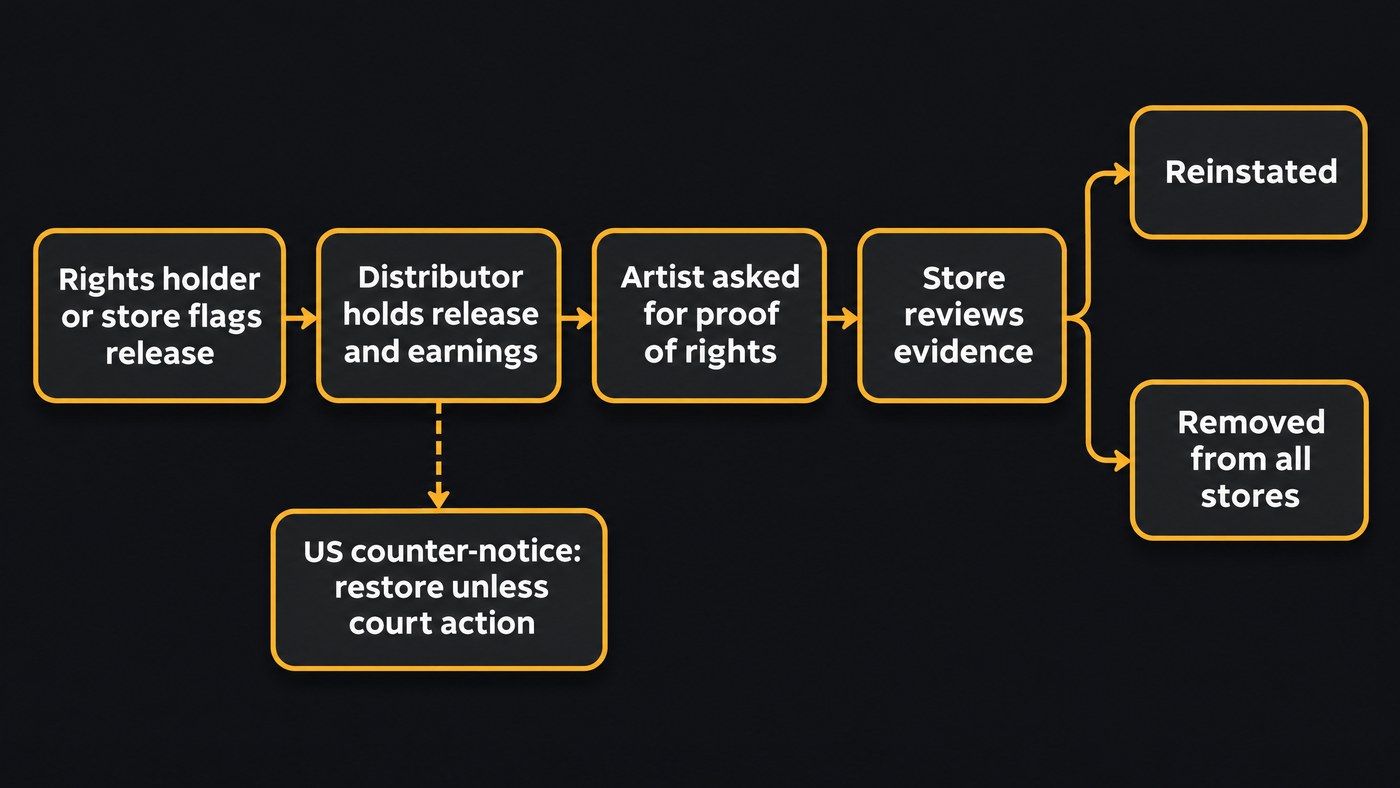
How distributors respond to copyright claims
- Takedown or blocked delivery. DistroKid's Distribution Agreement (dated 8 June 2021) lets it decline to distribute, or remove, recordings when it receives legal claims or reasonably believes they may arise. CD Baby's Artist Agreement (last updated 14 August 2024) lists removal reasons that include a takedown notice from someone claiming the rights, content whose rights you can't document on request, and complaints from its partners.
- A deadline to prove your rights. Ditto gives the artist 5 working days for claims from Spotify or Apple Music and 2 working days for claims from other stores. No answer, or an admission, means removal from all platforms. If evidence arrives, Ditto forwards it and the store decides, and Ditto warns that Spotify may keep content offline until both sides agree, even with evidence.
- Held or forfeited earnings. DistroKid can withhold money linked to the recording until the claim is resolved and deduct its legal costs. Its agreement is blunt: "You will forfeit any monies that are attributable to your fraud, infringement or other illegal activity." TuneCore's distribution terms let it stop posting income, block withdrawals and claw back past earnings tied to infringement or other "Improper Conduct". CD Baby can suspend payments and withhold up to your potential liability while a claim is pending.
- Account action. Amuse's page on frozen and deactivated accounts (updated 16 October 2026) names stolen beats, unauthorized samples or remixes and unauthorized use of famous artists' names. A frozen account can't upload. Serious violations can freeze royalties and reserve them for the stores or the rightful owners; a deep-frozen account can ask for its funds four months after suspension. Spotify says it terminates repeat infringers in appropriate circumstances, and TuneCore says it can close infringers' accounts.
Distributor policy pages, checked 21 November 2026
- DistroKid: its help-centre article on DMCA takedowns and counterclaims blocked automated reading for us, so we relied on the agreement. It bars samples and remixes without written permission from both the songwriters and the owners of the original recordings.
- TuneCore: it forwards your counter-notice, with your contact details, to the claimant, who then has 10 days to say it has filed for a court order; otherwise TuneCore may reinstate. For AI music, it accepts content only from platforms that publicly represent their training material as licensed or lawfully obtained and permit commercial distribution, rejects tracks that imitate real artists without authorization, and bans what it calls "GenAI Flooding".
- CD Baby: removal and payment holds as above. Objections to a statement must reach CD Baby within 18 months.
- Ditto: it says it must stay impartial and follow each store's procedure, so the store makes the final call.
- Amuse: account freezes and royalty reserves as above.
- RouteNote: sample permission has to come from the original creator by email to its moderation team, with your release's UPC and your username. Screenshots of conversations aren't accepted, and it rejects high-profile samples used without permission.
What happens with false claims, and how to dispute one
The law puts risk on bad-faith claims. The Copyright Office says anyone who knowingly makes a material misrepresentation in a notice or a counter-notice can be liable for damages, costs and attorneys' fees. Spotify warns that fraudulent reports may end the reporter's account, and TuneCore can terminate users who make false or bad-faith allegations.
When a claim lands on your release:
- Find out who claimed and where. The distributor's email should name the store or the claimant. Check spam folders.
- Answer before the deadline, even if only to say documents are coming.
- Send proof that a stranger can verify: signed sample and beat licences, cover licences, split sheets, invoices, dated project files and stems, and the release history with ISRCs.
- Ask the other party to confirm directly. A co-writer or sample owner emailing the distributor carries more weight than a screenshot.
- Counter-notify only when you're sure. It's a sworn statement and your details go to the claimant.
- Don't re-upload the same audio elsewhere while the claim is open. Spotify treats duplicates as spam.
- Get a lawyer when a catalogue or significant earnings are at stake.
A checklist to prevent copyright claims
- Clear every sample in writing with both the recording owner and the publisher before delivery.
- License covers before release. Remixes, medleys and translated lyrics need the publisher's permission, as our guide to how cover songs are handled in distribution explains.
- Check beat terms. A non-exclusive lease means other artists release the same beat; see exclusive vs non-exclusive deals.
- Keep evidence per release: project files, stems, dated drafts, contracts and payment receipts in one folder.
- Register ownership early. Register songs with your PRO (step-by-step guide) and keep one ISRC per recording.
- Use one distributor per release in each store.
- Read your distributor's AI rules and never imitate a real artist's voice without permission.
- Screen masters and samples against released recordings before upload.
Where Soundverse fits
Soundverse is an AI music platform that takes you from idea to audience. It isn't a distributor: claims, takedowns and disputes stay between you, your distributor and the stores.
It helps with the checks around them. Copyright Checker, on every plan including Free, fingerprints a master or sample and reports any match with a known released recording, with title, artist, label and ISRC where known, so you know whom to ask for permission. Soundverse calls it a recognition check, not legal clearance, and it doesn't compare melodies or lyrics, so covers and interpolations may not be flagged.
Music Business Agent can search YouTube, SoundCloud and Audiomack for re-uploads, sped-up or slowed rips and fake artist profiles of your songs, each with its link, so you can file your own claims.
Licensing is set by plan: the Free plan is for personal use, and the Creator plan comes with a royalty-free license.
FAQ
Can a distributor remove my release without proof of infringement? Yes. DistroKid's and CD Baby's agreements let them remove content on a claim or a reasonable belief that one may arise. You can still respond with evidence, and the store usually makes the final decision on reinstatement.
Do I get paid while a copyright claim is open? Usually not for the claimed release. Distributors can hold the related earnings until the claim is resolved, and DistroKid and TuneCore say money tied to infringement is forfeited or returned.
How long does a DMCA counter-notice take? In the US the service restores the material after 10 to 14 business days unless the claimant reports a court action. TuneCore gives the claimant 10 days to show it has filed.
Does a claim at one store affect my release everywhere? Often, yes. Ditto starts its process across all platforms when one store notifies it, and removes the release everywhere if you can't show your rights.
Sign up for Soundverse free and run your next master through Copyright Checker before it goes to your distributor. More release guides on the Soundverse blog.