How Are Cover Songs Handled During the Distribution Process?
How cover song distribution works in 2026: US mechanical licenses, what DistroKid, TuneCore and CD Baby require, YouTube Content ID and AI voice rules.
In cover song distribution, your distributor treats the track as your new recording of someone else's song. You mark it as a cover, credit the original songwriters and secure a mechanical license for US downloads, which some distributors buy for you. Streaming services pay the songwriter's share of streams themselves. Changed lyrics or translations need the publisher's permission.
Below: the US compulsory license, what DistroKid, TuneCore and CD Baby ask for (checked 7 November 2026), covers outside the US, YouTube, and AI-made covers. It's a practical guide, not legal advice.
How cover song distribution works, step by step
A cover has two layers of rights. The song (lyrics and melody) belongs to its songwriters and publishers. Your recording of it belongs to you.
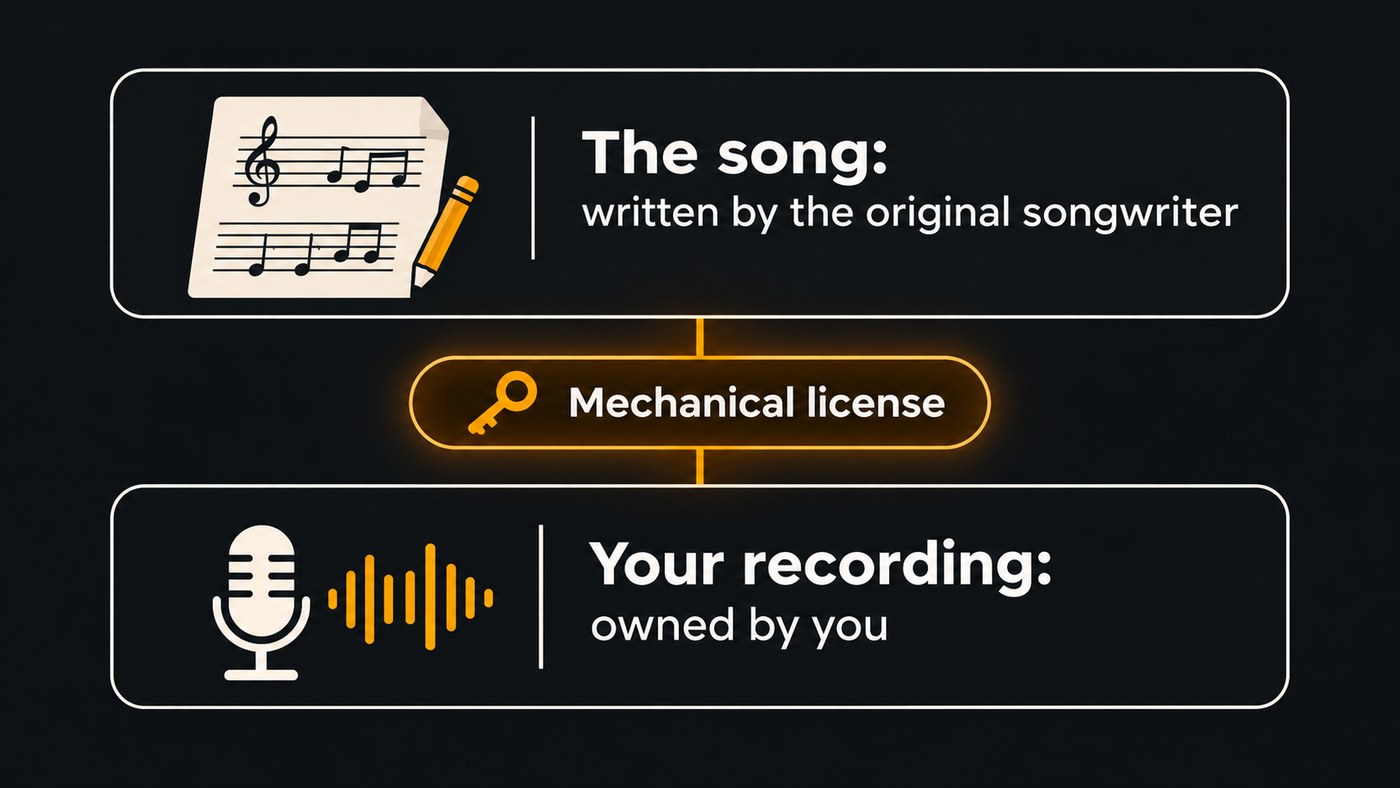
- Check it really is a cover. A cover is your own new recording of a song someone else wrote, and DistroKid and CD Baby both require that the song was already released in the US.
- Mark it as a cover on the upload form. DistroKid asks you to choose "Another artist wrote it (it's a cover song)"; CD Baby asks you to select "Cover Song" as the composition type.
- Credit the original songwriters. TuneCore requires every original songwriter credited with the role "Songwriter". CD Baby also asks for the original publisher as it appears on your license.
- Secure the mechanical license. Depending on the distributor, you buy it at upload or bring your own (details below).
- Pass review. The distributor checks the license and metadata alongside everything else. At DistroKid, licensing alone can take up to 14 business days, and the release isn't submitted until it's approved.
The US compulsory license, in plain terms
Section 115 of the US Copyright Act lets anyone record and distribute a song once recordings of it have been distributed to the public in the US with the copyright owner's authority. You don't need the songwriter's personal OK, only the license, correct credits and the statutory payment.
The law lets you arrange the song to fit your style, with a firm limit: "the arrangement shall not change the basic melody or fundamental character of the work" (17 U.S.C. § 115(a)(2)). In practice:
- Fine: an acoustic take on a club track, a new tempo, a different key, your own production.
- Needs the publisher's permission: new or rewritten lyrics, a translation into another language, a changed melody. DistroKid's cover article says language changes are probably not okay, and CD Baby lists translations among derivative works.
- Not licensable this way: a song that was only released inside a film score or game soundtrack, or only outside the US, according to DistroKid.
The Copyright Royalty Judges set the 2026 US rate for physical copies and permanent downloads at 13.1 cents per song or 2.52 cents per minute of playing time, whichever is larger (Federal Register, December 1, 2025). A four-minute cover owes 13.1 cents per US download; a seven-minute one owes 17.64 cents.
Streaming works differently. Streaming services that operate under the US blanket license send usage data and royalties to The MLC, which pays the songwriters and publishers who are its members. That's why CD Baby says no mechanical license is needed for a cover to be on Spotify or Apple Music, even though its own policy still requires a download license. Our guide to distributor royalty splits explains where the songwriter money flows.
What distributors require for cover songs
- DistroKid buys the license for you through the Harry Fox Agency. Its cover song article (updated August 27, 2026) lists a fee of $1 a month per cover, billed as $12, and DistroKid deducts the songwriter's fee from your US sales. You must buy a DistroKid license for every cover upload, even if you already hold one from another agency. Cover releases aren't sold in India, Pakistan, Mexico or Canada, though they still stream there.
- TuneCore expects you to get the license before release, from the Harry Fox Agency or its partner TuneLicensing, according to its covers article (updated November 6, 2026). A mechanical license doesn't let you register the song for publishing, since you aren't one of its writers.
- CD Baby requires at least a mechanical license for digital downloads, from a service such as Easy Song or the publisher, and asks for the license ID and provider on the form. Its cover song article (updated October 20, 2026) also tells you to limit distribution to the territories your license covers.
Rush options, compared in our fast-track release guide, shorten a distributor's review queue; licensing time comes on top.
Covers outside the United States
- The US license stops at the border. CD Baby says a standard compulsory license covers the US only, and that selling elsewhere needs a license from the song's owner naming those territories.
- Local societies collect elsewhere. TuneCore explains that outside the US, stores may withhold the mechanical share of sales and pay it to local collecting societies and publishers. Streaming services pay local societies directly.
- India has its own rule. TuneCore notes that Indian copyright law doesn't allow cover licenses until five years after the original recording was made, and that covering an Indian or Bollywood song needs explicit permission from the rights owners, usually the label and publisher.
Titles, credits and sound-alikes
Stores reject covers that could pass for the original. The Apple Music Style Guide (October 2026 revision) sets the clearest rules:
- The original artist's name must not appear in any artist field.
- Track titles must not mention the original artist, so no "Originally Performed By", "In the Style of", "Tribute to" or "Cover of".
- Sound-alikes, and covers or tributes that sound very similar to the original, aren't accepted.
TuneCore gives "All Along the Watchtower (Cover)" and "All Along the Watchtower (Acoustic Version)" as correct titles, and says sound-alike covers get hidden by stores with no refund. DistroKid adds that stores may reject covers that mimic the original artist's name or album art. Use your own artwork and an arrangement that is audibly yours.
What doesn't count as a cover
A cover license covers the composition only. These need separate permission:
- Samples, or any audio you didn't record, including a downloaded karaoke or instrumental track. That needs a license from whoever owns the recording.
- Remixes and interpolations. DistroKid says its cover license doesn't apply to either.
- Medleys and mashups, which DistroKid lists as unlicensable through covers.
- Parodies that aren't fair use. DistroKid, citing the Harry Fox Agency, says a lyric swap that doesn't comment on the original might not count as fair use.
Cover songs on YouTube and Content ID
Upload a video of your cover to YouTube and the song's publisher can claim it through Content ID. YouTube's help page on monetizing eligible cover videos says YouTube Partner Program members can share revenue from covers that publishers have claimed, paid pro rata, and an eligible video shows a "Sharing ad earnings" notice.
Registering your cover recording in Content ID is another matter, and distributors disagree. CD Baby excludes covers from its Social Video Monetization even when fully licensed. TuneCore excludes karaoke, sound-alike and tribute covers, and covers of traditional or public domain songs. DistroKid says covers are eligible through its Social Media Pack extra. Check before you pay for a Content ID add-on.
AI-made covers and voice rules
An AI-assisted cover is still a cover, so the license rules above apply unchanged. The voice raises a second set of rules:
- Spotify: "Vocal impersonation is only allowed in music on Spotify when the impersonated artist has authorized the usage." (September 25, 2025)
- DistroKid (updated August 19, 2026): music can't mimic or copy someone else's voice, likeness or identity without permission.
- YouTube said on November 14, 2023 that music partners can request removal of AI-generated music that mimics an artist's unique singing or rapping voice.
- TuneCore only distributes music made with generative AI models trained on fully licensed datasets, and even its authorized GrimesAI voice program forbids covers that use those stems.
The workable route is to sing the cover yourself, or use an AI model of your own voice or of a singer who has given explicit consent. Our guide to voice clone vs voice training shows both ways to model your own voice.
Where Soundverse fits
Soundverse is an AI music platform that takes you from idea to audience. Licensing a cover and delivering it to stores run through your distributor and a licensing service.
Copyright Checker fingerprints a track and reports whether it matches a known, commercially released recording. Run your backing track or any sample through it before upload. It doesn't reliably flag covers or similar melodies, and a clean result is a recognition check, not clearance.
Train Voice Clone learns a voice from one recording with at least 15 seconds of singing, and training can't start until you confirm the voice is yours or the singer has given explicit consent. Release Planner builds a dated rollout, so you can leave room for licensing.
Licensing is set by plan: the Free plan is for personal use, and the Creator plan comes with a royalty-free license. That applies to what you make on Soundverse; it can't license a song someone else wrote.
The Copyright Checker part of this walkthrough starts at 1:22 and runs a track from input to result.
FAQ
Do I need a license to put a cover song on Spotify? In the US, streaming services pay the songwriter side of streams under their own licenses, and CD Baby says streaming alone needs no mechanical license. Distributors set their own rules, though: DistroKid and CD Baby both require a license for every cover, so budget for one.
Can I change the lyrics or translate a cover? Not under a compulsory license, which allows an arrangement but not a change to the song's basic melody or fundamental character. New lyrics and translations are derivative works, so ask the publisher first.
How long does a cover take to go live? Expect licensing on top of normal review and store processing. DistroKid says the license alone can take up to 14 business days, so upload five to six weeks before your release date.
Can I release an AI cover in a famous singer's voice? Not without that artist's authorization. Spotify allows vocal impersonation only when the artist has authorized it, and DistroKid bans uploads that mimic someone's voice without permission. Use your own voice, or a voice model made with the singer's explicit consent.
Sign up for Soundverse free and plan your cover's release with time for licensing. More release guides on the Soundverse blog.