Explain the Difference Between Exclusive and Non-Exclusive Distribution Deals
Exclusive vs non-exclusive distribution explained: what each deal covers, advances and recoupment, switching, Content ID, beat leases and clauses to check.
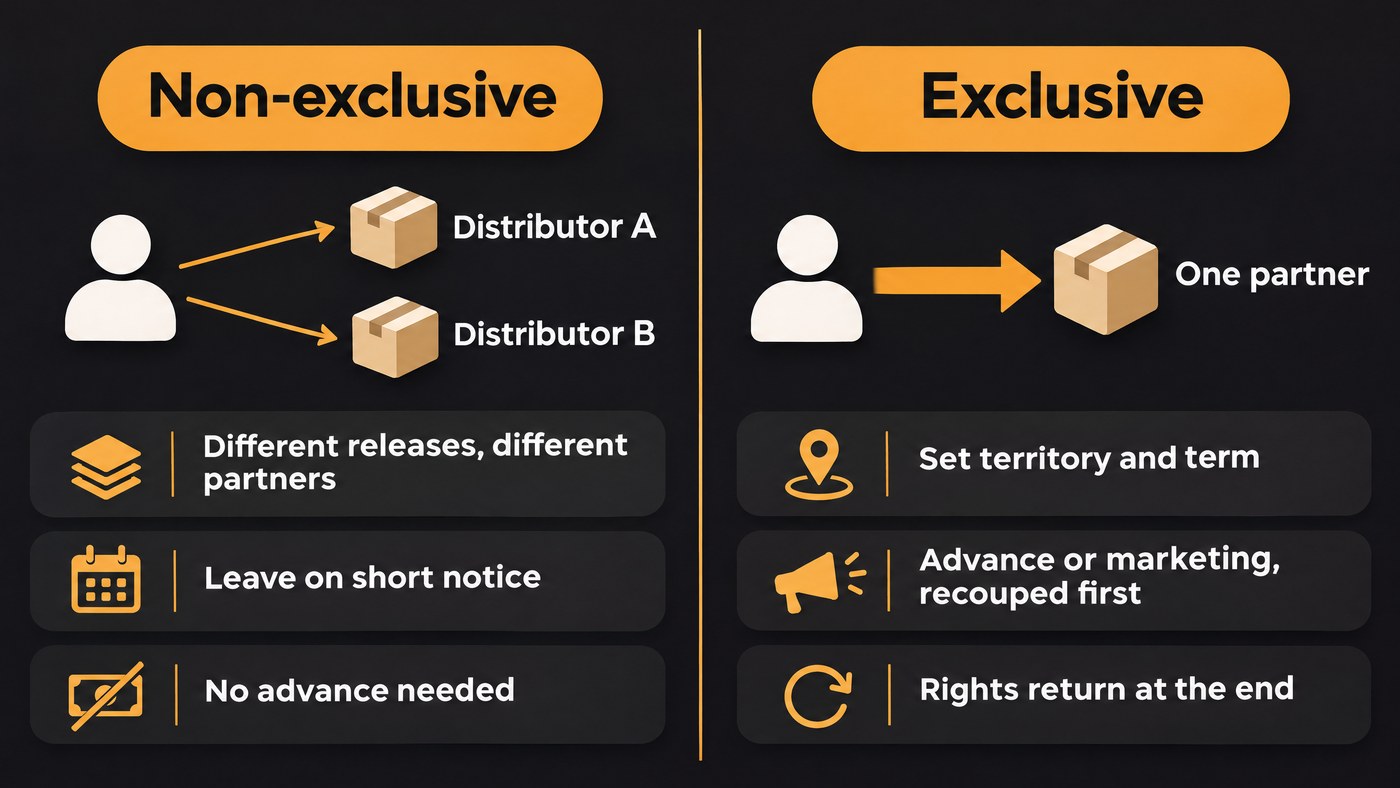
The difference in exclusive vs non-exclusive distribution is who else may distribute your recordings. A non-exclusive deal lets you use other distributors and leave on short notice, as with DistroKid and CD Baby. An exclusive deal makes one company your only distributor for a set territory and term, usually in return for an advance, marketing or label services.
Exclusivity is something you trade, so the question is what you get for it. We read each company's own agreement or FAQ on 19 November 2026. This is general information, not legal advice.
Exclusive vs non-exclusive distribution: the two definitions
Non-exclusive. You license the distributor to deliver your recordings to stores but keep the right to give the same rights to someone else. DistroKid's agreement (dated 8 June 2021) says: "The rights granted by you to DistroKid are non-exclusive. Be advised, however, that if you send your Recording(s) to the same Digital Stores via DistroKid and a separate service, the double listing of your Recordings may cause complications and/or problems in those Digital Stores." CD Baby's Artist Agreement (last updated 14 August 2024) grants "the nonexclusive right, during the “Term”" and throughout the territory you choose.
In practice, non-exclusive means you can put different releases with different distributors, or move. It doesn't mean you should deliver the same release to Spotify twice.
Exclusive. One company gets the sole right to distribute the recordings the contract covers. Amuse publishes the terms and conditions of its exclusive deal (last updated 10 January 2025). Under clause 1.1 you grant the rights to distribute the recordings to streaming and social platforms "on an exclusive basis", and to collect the label share of public performance income on an exclusive basis, while sync licensing is non-exclusive and needs your approval each time. Physical distribution stays with you.
A non-exclusive DIY deal can't sit on top of someone else's exclusive one: CD Baby's agreement asks you to confirm you haven't assigned rights in the recordings to a third party, such as a record label, "that obtained exclusive rights in and to such sound recordings."
What exclusivity usually covers
- Territory. Amuse's rights apply "throughout the Territory", which a deal can set as worldwide or a list of countries. AWAL's FAQ says you can remove certain territories or releases from its service without ending the whole agreement.
- Term. A fixed period, a rolling term, or a term that runs until money is repaid. The length may sit in a separate deal summary; Amuse's public terms leave it to the Heads of Terms.
- Which recordings. One single, an album, the back catalogue or future releases. Amuse's terms automatically include "All remixes, instrumentals and alternative versions", and stop you from re-recording the covered tracks during the term without approval.
- Stores and income types. Streaming, download and social platforms, performance income, sync and physical can each be inside or outside the deal. Amuse's grant covers some exclusively, some non-exclusively, and leaves physical out.
- YouTube Content ID. Content ID works with one administrator per track, so the contract should say who that is. Amuse's clause 1.5 even lets it keep recordings out of Content ID. Our guide to distributors and social media monetization explains the one-administrator rule and how to get your own channel allowlisted.
How each deal affects revenue share, advances and marketing
Non-exclusive DIY distribution
You pay a fee or give up a percentage, and nobody advances you money or plans a campaign. DistroKid's agreement says it posts 100% of the money it receives from your stores to your account, after payment fees and the fees for optional services you opt into. CD Baby's agreement points to the fees and charges listed on its website. For how those splits compare across models, see our breakdown of typical music distribution revenue splits.
Label services and advance deals
These deals add money or people and take a bigger cut or exclusivity in return:
- AWAL describes its standard deal as a distribution licence with a 30-day rolling term and a 15% share of revenue. If funding or an AWAL Recordings partnership is offered, its FAQ says: "This usually involves a few more percentage points and a recoupable balance from the project’s earnings". The label services it lists include funding, digital marketing, press and radio promotion, sync licensing and physical distribution.
- Amuse's exclusive deal pays you the "Licensor Share of Revenues" only after "Agreed Costs" are recouped in full from your share, and its earlier Fast Forward or Early Access advances are recouped the same way.
Advances inside non-exclusive deals
An advance can tie you to a company even without exclusivity. DistroKid may offer qualifying artists an "Accelerated Payment", an advance on royalties that is recoupable from future earnings; if the agreement ends before it is recouped, DistroKid can keep your account active and collect until it is. beatBread, which funds catalogues and new music, says that if you don't recoup within the estimated timeframe or set term, the deal continues until the balance is recouped, and its standard contract includes a buyout clause priced by a formula fixed in advance.
Switching distributors and takedowns
With a non-exclusive deal you can leave on the contract's notice. CD Baby's term runs until either side ends it on 24 hours' written notice, and its agreement calls your termination notice "permanent and irreversible". DistroKid's term is a year that renews automatically, and after it ends DistroKid tells stores to remove your recordings. Moving without losing your stream counts depends on matching audio and metadata; our guide to uploading tracks to all major streaming platforms covers transfers and track-linking.
With an exclusive deal you can't move the covered recordings until the term ends, and leaving early can cost money. In Amuse's terms:
- Rights return to you on expiry or termination, apart from licences already granted to third parties during the term.
- Amuse keeps the exclusive right to collect store and performance income earned during the term for six months afterwards.
- If Amuse ends the deal over your breach, you repay unrecouped Agreed Costs and advances on demand.
Plan the overlap. Start the new distributor's delivery before the old one takes the release down, and keep Content ID with one administrator throughout.
The other meaning: exclusive vs non-exclusive licences for beats and libraries
The same words appear in beat licensing, but there they describe the licence a buyer gets, not who distributes the finished song. TuneCore's Beat Licensing 101, by Chris Dampier, VP TuneCore Publishing, puts it simply: "In some cases a license may be exclusive, meaning no one else can use the beat, or non-exclusive, meaning many artists could be licensing the same beat in different tracks."
The guide lists usage caps and limited terms as typical of non-exclusive leases, and no caps or term limits for exclusives. It adds that an exclusive licence still doesn't transfer the producer's composition rights. If your song is built on a non-exclusive lease, other artists may have released songs on the same beat, which is why leased beats are kept out of Content ID.
Music libraries use the terms in a third way: whether you can sell the same track through other libraries. Our guide to selling royalty-free tracks to music libraries compares Pond5's non-exclusive model, Shutterstock's buyouts and Music Vine's mix.
A checklist of clauses to read before you sign
- Term. Fixed, rolling or until recouped? Does it renew automatically, and how much notice ends it?
- Territory. Worldwide or a list? Any countries carved out or held by another partner?
- Rights granted. Is it a licence or an assignment? Which recordings, including future releases, remixes and alternative versions? Which income types?
- Exclusivity. Per release or the whole catalogue? Any limits on releasing other music or re-recording during the term?
- Recoupment. What is recoupable (advance, marketing, agreed costs, fees), from which share, and can one release's costs be recouped from another's income?
- Exit and notice. How do you terminate, what happens to an unrecouped balance, is there a buyout, and how long does the company keep collecting after the term?
- Content ID. Who administers it, can you opt out, and will they allowlist your channel?
Then get legal advice for any deal with an advance, exclusivity or a long term. Amuse's own terms make the artist confirm "it has sought independent legal advice with respect to this Agreement prior to signing."
Where Soundverse fits
Soundverse is an AI music platform that takes you from idea to audience. It isn't a distributor or a label and doesn't deliver music to stores.
Exclusive agreements such as Amuse's require recordings to be "fully cleared". Before you sign, run each master, beat and sample through Copyright Checker: it fingerprints the audio and shows the title, artist, label and ISRC, where known, of any released recording it matches. Soundverse calls it a recognition check, not legal clearance. Labels can use it to screen demos before signing. After a switch, Music Business Agent can check stores such as Spotify, Apple Music, JioSaavn and Amazon Music and list where your release is live, missing or mislabeled, and search YouTube, SoundCloud and Audiomack for re-uploads of your songs.
Licensing is set by plan: the Free plan is for personal use, and the Creator plan comes with a royalty-free license.
FAQ
Can I use two distributors at the same time? Yes, if both deals are non-exclusive, as long as each release goes through only one of them. DistroKid warns that listing the same recordings twice in the same store "may cause complications and/or problems".
Is an exclusive distribution deal the same as a record deal? Not necessarily. Amuse's exclusive terms license your recordings for the term and return the rights at the end. Other contracts assign rights outright, so check whether the grant clause says "license" or "assign".
Should an independent artist sign an exclusive deal? Only if you get something for it, such as an advance, a marketing budget or a team. If an exclusive offer pays no advance and adds no services, a non-exclusive distributor gives you the same delivery and more freedom to leave.
Do exclusive beat licences and exclusive distribution deals have anything to do with each other? No. A beat licence decides who may use a producer's beat; a distribution deal decides who delivers your recording. You can release a song on an exclusive beat through a non-exclusive distributor.
Sign up for Soundverse free and check your masters with Copyright Checker before you sign anything. More release and rights guides on the Soundverse blog.