How AI Music Platforms Handle Artist Rights in 2026
Explore how AI music platforms in 2026 ethically protect artist rights and royalties.
How AI Music Platforms Handle Artist Rights
In 2026, the intersection of artificial intelligence and the music industry has reached an inflection point. While AI music platforms have become essential tools for producers, artists, and record labels, questions around ownership, compensation, and fairness remain urgent. Musicians are now more aware than ever that technology must serve creativity without eroding artistic rights.
Why are artist rights at risk in AI music platforms?
AI music platforms use enormous datasets to generate original compositions. In the early years of AI-generated music, some systems scraped online libraries, social media, and streaming sites for training data, often without obtaining proper licenses. This led to ethical concerns and legal disputes. By 2026, regulatory pressure and industry awareness have pushed businesses to ensure compliance with copyright law and ethical AI standards.
Unregulated platforms risk violating artist copyrights by creating works too close to existing songs or using audio samples from unlicensed sources. Ethical AI music practices counter this by introducing transparency in data sourcing and compensation. As discussed in how AI-generated music is transforming the industry, protecting creative integrity is essential for sustainable innovation.

What ethical principles guide modern AI music frameworks?
The idea of ethical AI music centers around three pillars: informed consent, accurate attribution, and recurring compensation. Consent ensures artists agree to their data being used for model training. Attribution publicly recognizes contributors whose styles inform the generated output. Recurring compensation ensures that artists earn royalties whenever AI models derived from their works produce revenue-generating outputs.
These principles align with global digital rights initiatives in 2026. Laws in major markets, including the U.S., Europe, and parts of Asia, now require proof of licensed datasets in commercial AI training. Music tech companies have responded by developing transparent infrastructures that track data lineage and automate royalty distribution.
How do AI music platforms ensure copyright protection?
To comply with AI copyright legislation, advanced platforms are adopting traceable and auditable frameworks. This means every piece of generated music comes with a verifiable record of how it was made—what data was used, how it was processed, and which artists influenced its creative direction.
Some companies use blockchain-based verification, while others employ embedded watermarks. For instance, the watermarking and traceability features discussed in Soundverse’s AI Magic Tools show how technology can protect creators while enabling commercial scalability.
For a practical overview, watch our guide on creating Deep House music and tutorial on making music from the Soundverse channel.
How are royalties distributed for AI-generated content?
Royalty management remains one of the most complex aspects of AI-generated music ethics. Traditionally, royalties depend on performance rights organizations, labels, and streaming analytics. However, AI-generated content requires an entirely new royalty model. These systems must calculate proportional contributions, even if the inputs come from thousands of micro-sources.
The Content Partner Program offered by some platforms introduces a solution: artists or rights holders provide their licensed audio data and receive usage-based royalties whenever the AI system draws from their catalog to train or generate outputs. This model transforms artists from passive data sources into active stakeholders in AI music production.
Why are transparency and explainability so crucial today?
Transparency makes the difference between ethical innovation and creative exploitation. By making AI models explainable, developers can demonstrate which datasets influenced a particular track. This allows artists, labels, and auditors to understand how creative styles evolve algorithmically.
Explainable AI is also critical for legal defense. In cases of alleged copyright infringement, having a clear trace of attribution helps differentiate between coincidental similarity and unlawful replication. In 2026, such explainability is becoming a standard compliance metric across AI music platforms, particularly in Europe under revised Digital Rights Acts.
How to make AI music ethical and legally compliant with Soundverse The Ethical AI Music Framework
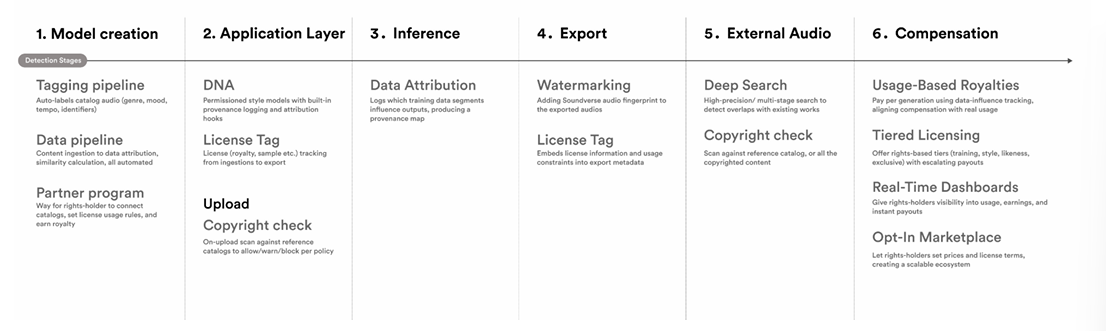
Soundverse’s Ethical AI Music Framework represents an industry-leading solution for balancing innovation with artist rights. It’s an end-to-end infrastructure designed to break away from black-box AI systems by embedding transparency, consent, and compensation into every phase of music generation.
This six-stage pipeline includes:
Stage 1: Licensed Data Sourcing – Soundverse does not scrape unlicensed content. All data used in training is obtained via legal channels and verified through licensing agreements.
Stage 2: Permissioned Models (DNA) – Powered by Soundverse DNA, each model is trained on authorized artist catalogs. Artists can license their “sonic DNA” and monetize their sound without sacrificing control.
Stage 3: Explainable Inference – The system provides clear attribution by mapping AI outputs to their source inspirations, allowing transparent tracking.
Stage 4: Traceable Export (Watermarking) – Each exported AI-generated track carries unique, embedded identification marks, ensuring provenance across digital ecosystems.
Stage 5: Deep Search (External Scanning) – The platform routinely scans external music libraries to detect unlicensed usage, protecting both creators and enterprise users.
Stage 6: Recurring Compensation – Through the Content Partner Program, artists receive proportional royalties every time the model uses their data in training or generation.
Together, these capabilities turn ethical innovation into operational reality. Labels can verify compliance, artists can track attribution, and corporate clients can create safely knowing every sound is rights-cleared.
How does Soundverse Trace enhance artist rights protection?
Soundverse Trace functions as a comprehensive trust layer for music AI workflows. It embeds attribution and royalty tags at each lifecycle stage—from the original dataset to the final exported file. In a market increasingly concerned with ethical AI use, this level of traceability ensures both transparency and enforceable accountability.
The technology also integrates with partner tools in the Soundverse suite. As explored in Soundverse introduces Stem Separation AI Magic Tool, the platform supports production efficiency while upholding ethical compliance, enabling users to remix or sample AI-generated tracks within clear rights frameworks.
To complement this, you can explore the “Explore” Tab tutorial to understand how discovery and rights-managed AI content function together on Soundverse.
How is the music industry adapting to AI-driven ethics in 2026?
The music industry’s shift toward AI accountability has reshaped licensing relationships. Record labels now negotiate AI-specific clauses that define whether their catalogs can be used for model training. Artists, inspired by success stories within ethical AI frameworks, increasingly partner directly with platforms like Soundverse rather than relying exclusively on traditional publishers.
This trend is covered in detail in music industry trends, showing how hybrid licensing ecosystems are replacing one-time payments with recurring royalty participation. The result is a fairer distribution model where human creativity and algorithmic efficiency coexist.
What does the future hold for AI-generated music ethics?
By 2026, AI-generated music ethics have evolved from voluntary principles to regulatory norms. Governments, labels, and tech innovators are aligning around shared goals: consent-based data usage, transparent attribution, and recurring compensation. The next frontier involves cross-border recognition of AI music rights and standardized reporting tools.
Platforms that fail to implement ethical measures risk exclusion from large-scale partnerships and potential legal challenges. Those adopting transparent frameworks, such as Soundverse’s Ethical AI Music Framework, will lead the charge toward a responsible and equitable AI music economy.
Empower Your Music Career with Soundverse AI
Create, remix, and publish music while maintaining full control over your artistic rights. Soundverse makes it simple to compose original tracks with AI that respects creators.
Start Creating with Soundverse
Related Articles
- How AI-Generated Music is Transforming the Music Industry — Explore how AI technologies are reshaping music creation, distribution, and copyright management across the industry.
- Navigating the World of Royalty-Free and Copyright-Free Music Using Soundverse AI — Learn how creators can find and use royalty-free and copyright-free music effectively with Soundverse AI tools.
- Copyright-Free vs. Royalty-Free Music: What Creators Should Know — Understand the key differences between copyright-free and royalty-free music, and how they impact your content strategy.
- AI Music Generator and Human Composers: A Future Together — Discover how AI and human creativity can coexist, producing unique collaborations that redefine modern music composition.
Here's how to make AI Music with Soundverse
Video Guide
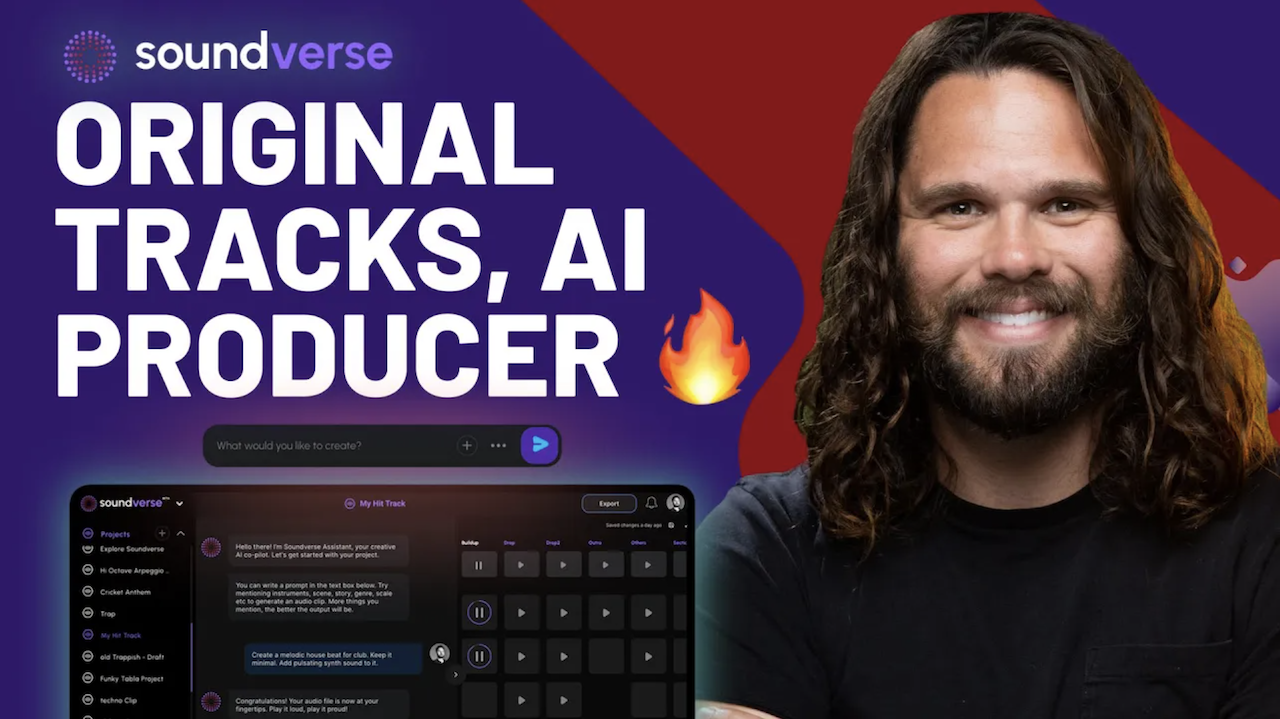
Here’s another long walkthrough of how to use Soundverse AI.
Text Guide
- To know more about AI Magic Tools, check here.
- To know more about Soundverse Assistant, check here.
- To know more about Arrangement Studio, check here.
Soundverse is an AI Assistant that allows content creators and music makers to create original content in a flash using Generative AI. With the help of Soundverse Assistant and AI Magic Tools, our users get an unfair advantage over other creators to create audio and music content quickly, easily and cheaply. Soundverse Assistant is your ultimate music companion. You simply speak to the assistant to get your stuff done. The more you speak to it, the more it starts understanding you and your goals. AI Magic Tools help convert your creative dreams into tangible music and audio. Use AI Magic Tools such as text to music, stem separation, or lyrics generation to realise your content dreams faster. Soundverse is here to take music production to the next level. We're not just a digital audio workstation (DAW) competing with Ableton or Logic, we're building a completely new paradigm of easy and conversational content creation.
TikTok: https://www.tiktok.com/@soundverse.ai
Twitter: https://twitter.com/soundverse_ai
Instagram: https://www.instagram.com/soundverse.ai
LinkedIn: https://www.linkedin.com/company/soundverseai
Youtube: https://www.youtube.com/@SoundverseAI
Facebook: https://www.facebook.com/profile.php?id=100095674445607
Join Soundverse for Free and make Viral AI Music

We are constantly building more product experiences. Keep checking our Blog to stay updated about them!