How AI Music Is Made: The Complete Guide to AI Music Creation in 2026
Explore how AI music creation works in 2026 and learn to make instrumental tracks using Soundverse AI Music Generator.
How AI Music Is Made
Artificial intelligence has reshaped nearly every creative domain by 2026, and music stands among its most exciting frontiers. From automated beat generation to generative orchestration, AI music creation has evolved from experimental curiosity to an essential tool for modern producers and digital creators. But how is AI music actually made? What roles do algorithms, data, and human creativity play in transforming text prompts into fully produced soundscapes? This guide breaks down the entire process—from machine learning models to real-world applications—and shows how musicians are openly embracing artificial intelligence in music.
What is AI Music Creation and How Does It Work?
At its core, AI music creation is the process of using algorithms and neural networks to generate, arrange, and produce musical compositions. Instead of recording instruments or manipulating samples manually, musicians interact with smart systems that interpret text, mood, genre, and rhythm to output coherent sound.
AI systems use generative music technology based on machine learning. They are trained on massive datasets featuring melodies, rhythms, and timbres across thousands of songs. These models learn statistical relationships between musical components—like how scales, chords, and progressions form naturally pleasing sequences. Once trained, the algorithm can produce fresh music that aligns with a particular genre or theme without copying existing works.
The introduction of transformer-based models around 2025 dramatically enhanced this process. By 2026, next-generation AI composers are capable of understanding requests with astounding nuance—producing ambient tracks for wellness apps or cinematic loops for video games using only text inputs.
What Technologies Power Artificial Intelligence in Music Production?
Several technologies underpin this new creative wave:
- Machine Learning Models: Deep networks analyze musical data. They learn the relationships among tempo, scale, instrument type, and atmosphere.
- Natural Language Processing (NLP): This interprets descriptions like "dreamy tropical vibe" or "lofi jazz beat" and translates them into musical parameters.
- Generative Adversarial Networks (GANs): GANs assist in refining sound textures by pitting two neural networks against each other—one creating and one judging.
- Audio Synthesis Engines: These transform digital patterns into playable audio samples, acting as virtual instruments.
- Music Automation Tools: These manage transitions, looping, and arrangement to create smooth playback experiences.
Together, these components enable AI platforms to deliver realistic, structured music that rivals human-made productions in quality and diversity. The rapid growth of tools matches trends seen in AI Music Creation 2026: Hybrid Workflows for Composers and UMG & Splice To Collaborate On Next Generation Of AI-Powered Music Creation Tools.
Why Is AI Music Creation Popular in 2026?
In 2026, AI music creation has become mainstream because it resolves critical bottlenecks in music production. Traditional composition often demands expensive studio setups and extensive time investments. AI models now reduce turnaround time from days to minutes.
Creators also enjoy remarkable flexibility: they can instantly switch between genres, adjust intensity, or generate variations for different social media formats. Many influencers use AI-generated background music for content creation, as seen in recent discussions on Soundverse AI Magic Tools and royalty-free AI soundtracks.
Moreover, AI-driven creation democratizes music production. Non-musicians can express emotions and ideas through sound without traditional skill barriers. This inclusivity defines 2026's creative economy, empowering podcasters, filmmakers, and app developers alike. Platforms such as Best AI Music Generators in 2026 demonstrate how accessible and user-friendly this innovation has become.
For a deeper perspective, explore The AI Tech Wave Coming in 2026 Will Transform Music Creation.
How Do Machine Learning and Generative Music Technology Collaborate?
Machine learning music production involves training algorithms to predict plausible musical patterns. Generative music technology expands that concept by promoting creativity instead of mere mimicry.
Imagine an AI trained on thousands of jazz performances. It doesn’t just reproduce old songs—it understands the grammar of jazz improvisation. When prompted, the system invents novel solos or rhythm sections coherent to jazz style while sounding totally new.
Modern systems rely on hybrid architectures that merge reinforcement learning with transformers. Reinforcement learning allows the AI to evaluate its own compositions against quality metrics: harmony, groove, mood consistency. By adjusting these self-assessments, generative systems autonomously improve future tracks.
This collaboration yields authentic musical output rather than robotic noise—a hallmark of 2026’s advances in creative AI. See related discussions in How AI Music Generators Are Evolving in 2026 for technical insight.
For a deeper dive, watch our guide on how to make music and how to make deep house music from the Soundverse Tutorial Series.
What Kind of Music Can Be Made with AI?
AI music creation covers an extensive range:
- Background tracks for videos and games
- Meditation and wellness soundscapes
- Advertising and commercial jingles
- Loop-based ambient beats
- Genre-specific productions like lo-fi, EDM, or cinematic orchestration
For deeper exploration of genre-focused creativity, check resources such as How to Create EDM with Soundverse AI and Creating Meditation Music. These methods show AI’s adaptability to emotion and scene. For more workflow insights, explore our Soundverse “Explore” tab tutorial.
How Does AI Music Differ from Human Composition?
While humans compose from intuition and emotion, AI interprets structure statistically. Yet modern AI composers simulate expressive depth using emotional datasets—an effect sometimes called algorithmic empathy. Developers train models on emotionally charged recordings to detect micro-subtleties of tension, release, and coloration.
The outcome feels surprisingly organic. However, human input remains essential. Producers still curate AI outputs, infuse personal style, and decide final arrangements. In 2026, the prevailing philosophy isn’t "AI replacing artists" but rather "AI amplifying artists." As stated in What AI Means for the Music Industry in 2026 - YouTube, creativity remains rooted in emotion even amidst technological progress.
What Are Music Automation Tools and Why Are They Important?
Music automation tools serve as the bridge between AI generation and user workflow. They oversee pattern repetition, auto-balancing, and dynamic rendering so producers can focus on creativity instead of technicality.
These tools often include loop engines, stem handlers, and genre filters. For instance, Soundverse introduced advanced looping with its Loop Mode—mirroring transitions perfectly for background music usage. Combined with AI’s quick generation time, automation tools make scalable and adaptive production achievable for streaming platforms and advertising campaigns.
For insights into stem manipulation, explore Soundverse's Stem Separation Magic Tool, which demonstrates how AI isolates vocals, drums, or melodies for remixing purposes. Also reference Saving Country Music's New Policy on AI Music for 2026, showcasing growing adoption in mainstream distribution workflows.
How to Make AI Music with Soundverse AI Music Generator
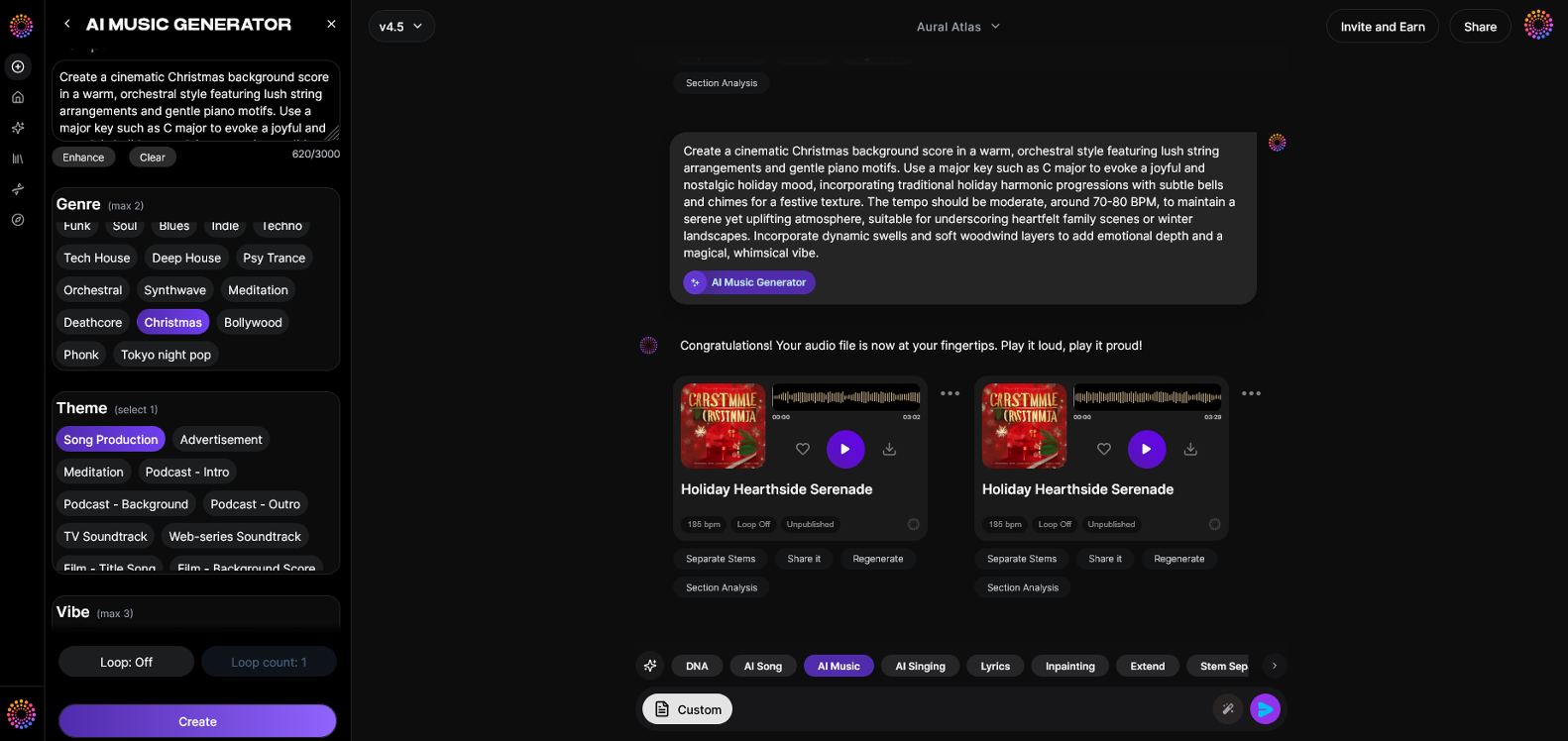
Now that you understand how AI music creation works, here’s how to make it instantly using Soundverse AI Music Generator.
Soundverse’s AI Music Generator is designed to create fully produced instrumental music from text prompts. It specializes in crafting background tracks, beats, and soundscapes without vocals, providing seamless looping options. The generator gives users detailed control over genre, mood, and instrumentation through V4 and V5 model versions.
Step 1: Feature Overview
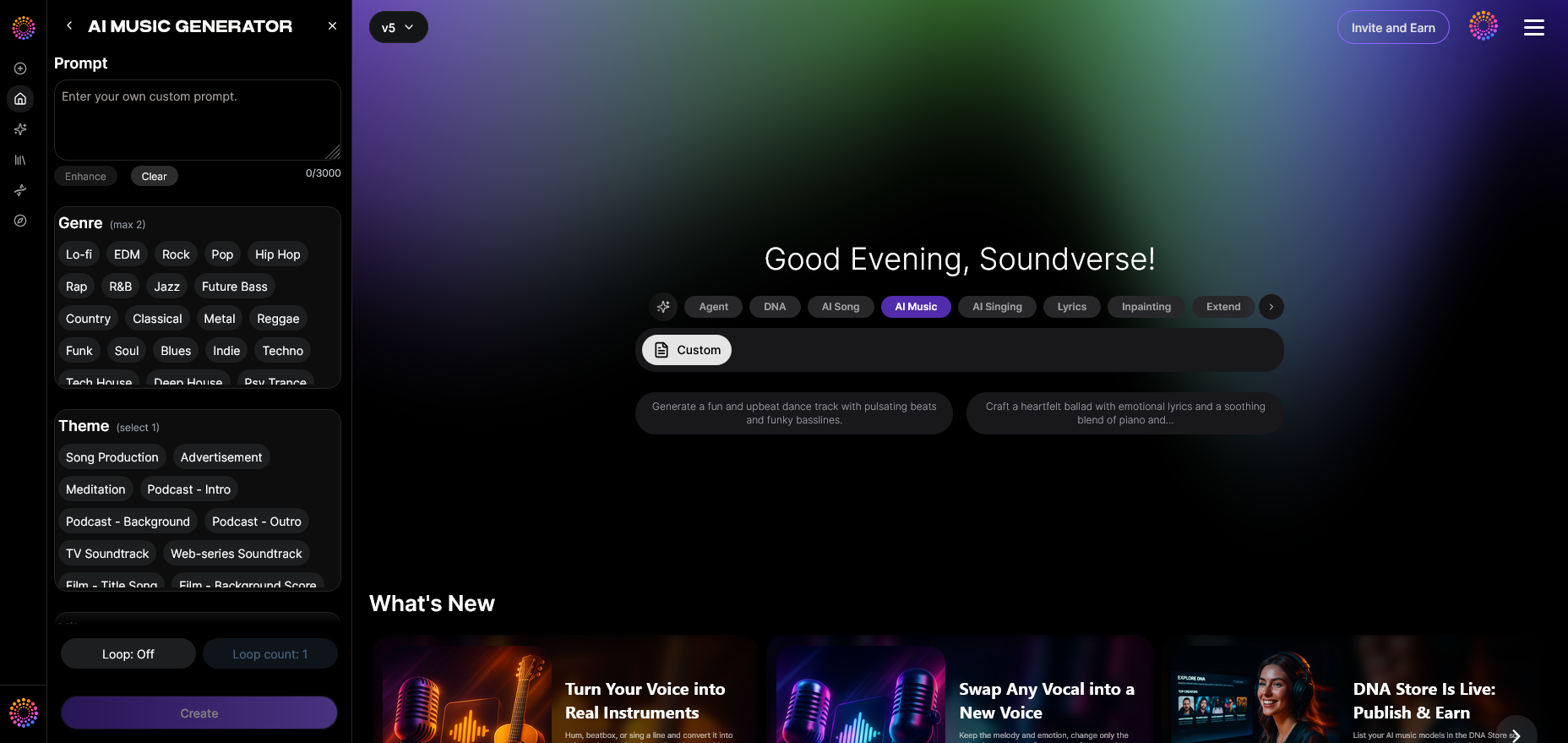
Access the AI Music Generator from the Soundverse main menu. This tool appears under the Music Creation section along with related features such as the AI Song Generator and AI Singing Generator.
Step 2: Description Input
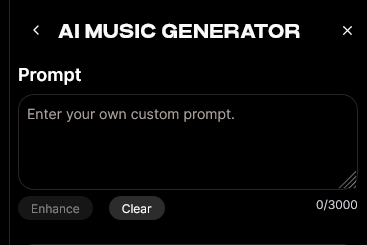
Enter a text description explaining what kind of music you want. For example, you might type “calm piano track for morning meditation” or “energetic electronic beat for gaming intro.” The AI interprets the prompt to define harmonic structure and instrumentation.
Step 3: Style & Duration
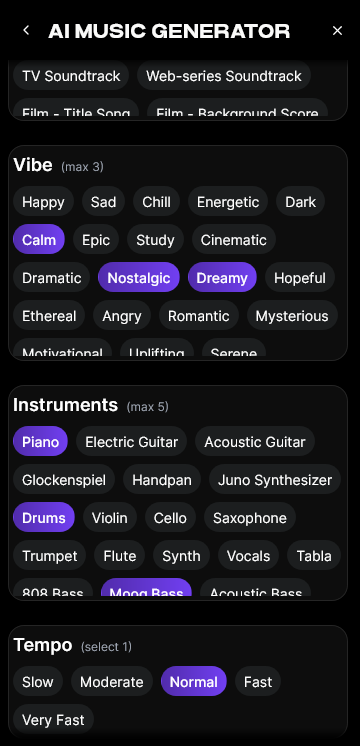
Select your desired genre and duration. Options include cinematic, ambient, lo-fi, jazz, EDM, and many more. Specify track length from a few seconds to several minutes depending on your production needs.
Step 4: Generation
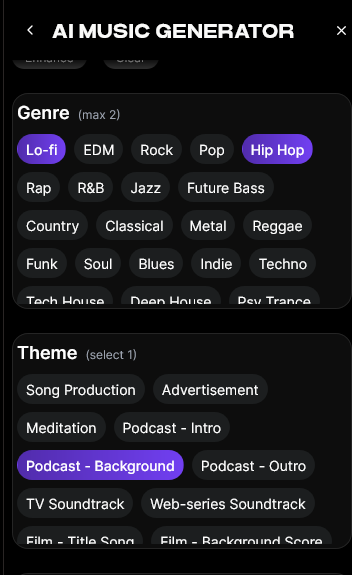
Click Generate to initiate the creation process. Soundverse’s algorithm processes your description asynchronously and returns an instrumental track that matches your criteria. The system’s architecture integrates Loop Mode to ensure seamless repetition for ongoing playlists or in-game use.
Step 5: Export Options

When the track is ready, download it directly. You can use it as background music for videos, podcasts, apps, or meditation sessions. The output is fully produced and instantly usable.
Soundverse’s workflow makes AI music creation not just accessible but professional. Instead of struggling with complex digital audio workstations, users only need creativity and a few words.
The Broader Impact of AI Composers on the Music Industry
By 2026, AI composers serve not only creators but also industry-level operations. Studios employ AI to prototype soundtrack ideas, while individual artists experiment with hybrid compositions. The rise of collaborative AI-human songwriting inspires unique fusion genres blending algorithmic precision with human emotion.
Discussions around ethics, originality, and ownership continue, but the momentum favors integration. Tools like Soundverse and comparable services such as Mubert or Soundraw have proven that smart music generation can democratize creativity while maintaining artistic value. As summarized in Music Industry Trends 2026, AI is not just a trend—it is an infrastructure supporting tomorrow’s creative economy.
Start Creating Your Own AI Music Today!
Transform your musical ideas into full compositions instantly with Soundverse’s AI-powered tools. Whether you're a beginner or pro, explore endless possibilities in AI music creation and elevate your sound effortlessly.
Related Articles
- How AI-Generated Music Is Transforming the Music Industry — Discover how AI is revolutionizing the way music is produced, shared, and experienced across the globe.
- Generate AI Music with Soundverse Text-to-Music — Learn how to turn simple text prompts into unique musical creations using Soundverse’s text-to-music technology.
- The Role of AI Music in Film and Television — Explore how AI music creation is reshaping the soundtrack and scoring process in entertainment media.
- AI Music Generator and Human Composers: A Future Together — See how human creativity and AI technology are joining forces to create the next era of musical innovation.
Here's how to make AI Music with Soundverse
Video Guide
Here’s another long walkthrough of how to use Soundverse AI.
Text Guide
- To know more about AI Magic Tools, check here.
- To know more about Soundverse Assistant, check here.
- To know more about Arrangement Studio, check here.
Soundverse is an AI Assistant that allows content creators and music makers to create original content in a flash using Generative AI.
With the help of Soundverse Assistant and AI Magic Tools, our users get an unfair advantage over other creators to create audio and music content quickly, easily and cheaply.
Soundverse Assistant is your ultimate music companion. You simply speak to the assistant to get your stuff done. The more you speak to it, the more it starts understanding you and your goals.
AI Magic Tools help convert your creative dreams into tangible music and audio. Use AI Magic Tools such as text to music, stem separation, or lyrics generation to realise your content dreams faster.
Soundverse is here to take music production to the next level. We're not just a digital audio workstation (DAW) competing with Ableton or Logic, we're building a completely new paradigm of easy and conversational content creation.
TikTok: https://www.tiktok.com/@soundverse.ai
Twitter: https://twitter.com/soundverse_ai
Instagram: https://www.instagram.com/soundverse.ai
LinkedIn: https://www.linkedin.com/company/soundverseai
Youtube: https://www.youtube.com/@SoundverseAI
Facebook: https://www.facebook.com/profile.php?id=100095674445607
Join Soundverse for Free and make Viral AI Music

We are constantly building more product experiences. Keep checking our Blog to stay updated about them!