How Do AI Lyric Generators Influence the Songwriting Process?
How AI lyric generators influence songwriting: faster first drafts, rhyme help, the sameness risk, keeping your voice, co-writing splits and disclosure.
AI lyric generators have the most influence at the start of the songwriting process. They turn a title or a feeling into a first draft in seconds, suggest rhymes and alternative lines, and make it cheap to try ten angles on a chorus. The costs show up later: generic lines, a voice that drifts from yours, and murkier credit.
Used well, they speed up the searching and leave the parts that are about you, the details, the phrasing and what the song is really about, in your hands. Studies and policies below were checked on 14 November 2026.
How AI lyric generators change the songwriting process
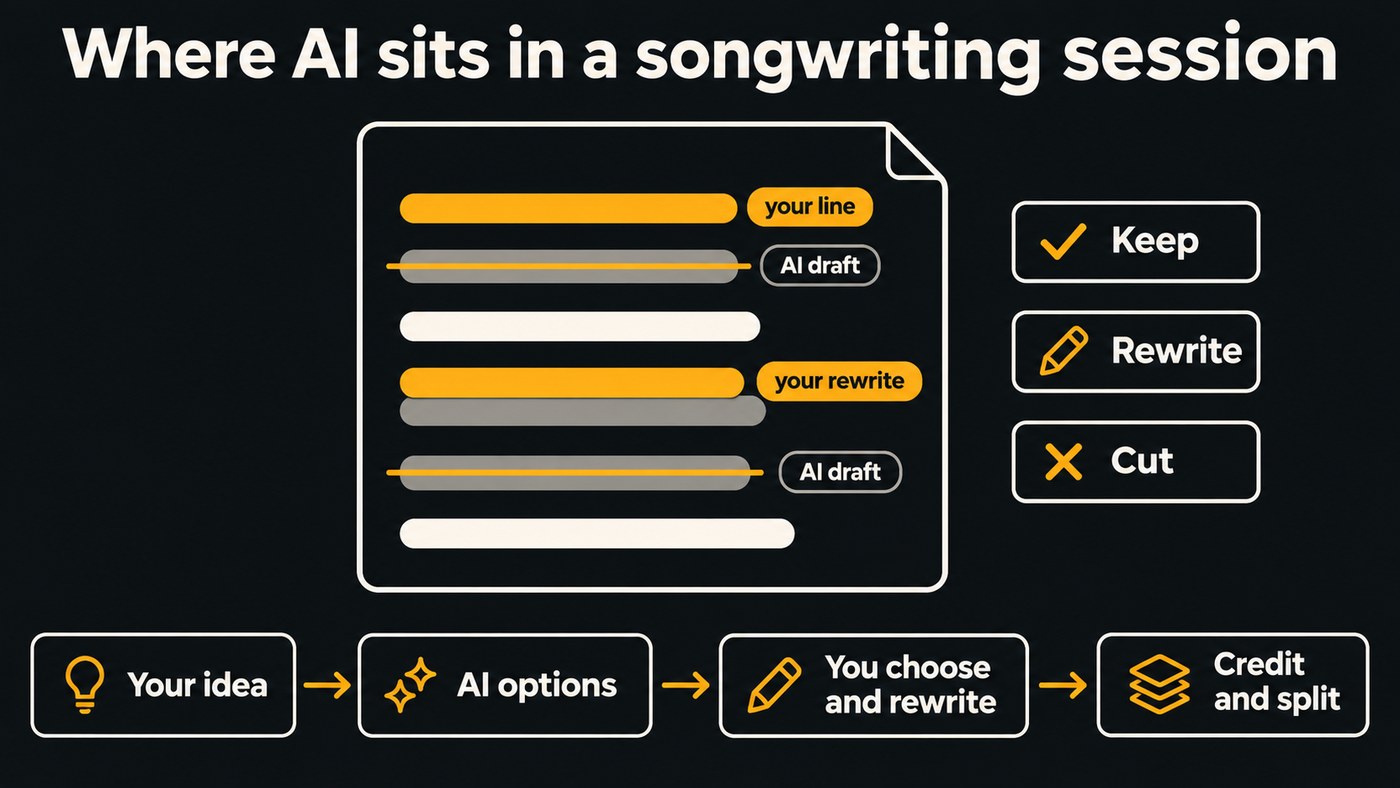
The biggest shift is from writing every line to choosing between lines: picking, cutting and rewriting.
Early adopters saw this first. In a 2020 study of the AI Song Contest, Cheng-Zhi Anna Huang, Ed Newton-Rex and colleagues followed 13 teams, 61 people in all. Because the models were hard to steer, teams generated large numbers of samples and curated them afterwards. Today's tools take plain-English instructions, but the curation job remains.
In a session, that shows up in five places:
- The blank page. A title, a feeling or a situation becomes a full draft to react to.
- Angles. The same story from three points of view, or as a letter or a confession.
- The missing section. When a song stalls at the bridge, you can see five ways to turn the mood.
- Line surgery. Ten alternatives for a line with the right meaning and the wrong rhythm.
- Hearing it early. Paste the words into a song generator and hear them sung before you book a session.
How far each tool lets you steer the words varies; see which AI music generators allow the most control over lyric generation.
Where they help: first drafts and brainstorming
The most useful thing an AI lyric generator does is end the blank page. Even a bad draft gives you something to argue with.
It works best when you feed it material only you have:
- Specifics. "A night bus home after my sister's wedding, her bouquet on the seat next to me" gets sharper lines than "a sad song about love".
- A point of view. Who is singing, to whom, and what do they want?
- Constraints. Section, length, tense, and words you don't want to see.
Then ask for options rather than answers: "Give me 15 titles for this idea" or "rewrite line 3 so it ends on an open vowel". You still choose.
Rhyme and syllable help, with limits
Generators are quick at rhyme candidates, including near rhymes, and at roughing out lines of similar length. They're weaker at counting sung syllables and putting stresses on the beat, because they read spelling rather than sound. Our guide to how AI lyric generators handle rhyme schemes and rhythm explains why and gives prompts that tighten it up. The short version: ask for a scheme and a syllable count per section, then speak every line over a click before you trust it.
The sameness risk
The biggest creative cost is that AI suggestions pull different writers toward the same lines.
- Vishakh Padmakumar and He He (ICLR 2024) had people write essays with a base model (GPT-3), a feedback-tuned model (InstructGPT) or no model. Writing with InstructGPT made different authors' work more similar and reduced lexical and content diversity. The effect came mainly from the text the model contributed; the participants' own sentences were unaffected.
- Barrett R. Anderson, Jash Hemant Shah and Max Kreminski (C&C 2024) ran a 36-person study in which people who brainstormed with ChatGPT produced less semantically distinct ideas across the group than people using another creativity tool, even though each came up with more ideas, in more detail.
Neither study is about songs, but the lesson carries over: sameness gets in through the lines you take from the model, not the ones you write.
Nick Cave made the point from the other side. In January 2023 a fan sent him a ChatGPT song written in his style, with a chorus of stacked opposites: sinner and saint, darkness and light, hunter and prey. His reply in The Red Hand Files, Issue #218 included this line: "What makes a great song great is not its close resemblance to a recognizable work."
Signs a draft is leaning generic: abstract nouns such as dreams, fire and shadows where a real object should be, rhyme pairs you've heard a hundred times, stacked opposites, and no names, places or times of day. One fix: ask the generator for the 20 most predictable lines on your topic, then ban them.
Losing your own voice
Your voice is a set of small habits: the words you'd actually say, the details you notice, what you leave out. A generator writes toward the most likely next word, which pulls against habits that are yours.
There's a quieter risk too. In the Anderson, Shah and Kreminski study, ChatGPT users felt less responsible for the ideas they generated. For a songwriter, that's the line you sing on stage that doesn't feel like yours.
Habits that protect your voice:
- Write the core first: the title, the one line you know is true, and the story in two sentences.
- Keep a voice file of your own phrases and images, and paste from it into prompts.
- Ask for questions, not lines. "Ask me ten questions about the night this happened" gets your memories onto the page.
- Rewrite every kept line out loud. If you wouldn't say it, don't sing it.
- Set a limit. Three drafts, then close the tool and finish by hand.
Whether this is collaboration or automation is its own debate: see is AI music generation creative collaboration or automation.
Co-writing etiquette and splits when AI was involved
Co-writing runs on trust, so be upfront about AI.
- Say it before the session. If you plan to use a generator, tell your co-writers and agree whether it's in the room at all.
- Flag AI lines as you go. "That chorus line came from the tool" takes five seconds and saves an argument later.
- Split between the humans. On 28 October 2025, ASCAP, BMI and SOCAN announced aligned policies to accept registrations of partially AI-generated works, which combine AI-generated content with human authorship. Works created entirely with AI tools aren't eligible. The announcement doesn't say how to divide shares, so agree the split between the human writers on a split sheet before anyone registers the song.
- Keep the paper trail. Save prompts, drafts and your edits, with dates.
That paper trail matters for copyright too. The U.S. Copyright Office's report on AI and copyrightability, announced 29 January 2025, concludes that AI outputs are protected only where a human author has determined enough of the expression, and describes what can count: "This can include situations where a human-authored work is perceptible in an AI output, or a human makes creative arrangements or modifications of the output, but not the mere provision of prompts." A lyric you rewrote line by line is likely in a different position from one you pasted unchanged. For the wider picture, read how AI tools handle copyright and ownership.
Rights and disclosure
Disclosure is moving into release metadata. On 25 September 2025, Spotify said it would support a DDEX industry standard for AI disclosures in music credits, so artists can show where AI played a role, such as vocals, instrumentation or post-production. An update to the same post says a beta launched on 16 April 2026 lets artists disclose through their label or distributor, with credits for contributions such as vocals, lyrics or production shown in Song Credits on mobile. Spotify adds that it depends on artist disclosure and that not every distributor offers it yet.
In practice:
- Disclose honestly when a distributor, platform, publisher or co-writer asks, and use AI credits where your distributor offers them.
- Don't prompt for a living artist's style by name, and never paste another writer's lyrics in to be reworked.
- Read your generator's terms on who owns the output.
Where Soundverse fits
Soundverse is an AI music platform that takes you from idea to audience, built for independent artists who release music. Its AI Lyrics Writer drafts a whole song or just an Intro, Verse, Chorus, Bridge or Outro from a theme of up to 3,000 characters, with an optional mood and genre (one of 64). Drafting from its panel uses no tokens, so you can try several angles. Soundverse pitches the result as a first draft to shape, and advises rewriting anything too close to an existing song. The panel has no separate controls for syllable counts or rhyme schemes.
Once your rewrite is done, AI Song Generator in Custom mode sings your lyrics word for word, so you hear your version, not the draft. For another language, Translate Lyrics covers 11 languages, and its Match syllables option aims to keep each line singable on the same tune.
Licensing is set by plan: the Free plan is for personal use, and the Creator plan comes with a royalty-free license.
This walkthrough of Soundverse's Create tools shows AI Lyrics Writer from 1:13, drafting lyrics from a topic, mood, section and genre.
FAQ
Is it cheating to use an AI lyric generator? Not if you're honest about it with collaborators and platforms that ask. Writers have long used rhyming dictionaries, and a generator is a stronger version of that help. The line is crossed when unedited AI lines are passed off as your own, or the tool imitates a living writer.
Do I have to disclose that AI helped write my lyrics? There's no single rule. Disclose when a distributor, platform, publisher or co-writer asks, and use AI credits where they're offered. Spotify, for example, shows AI credits for lyrics in Song Credits when artists disclose through their label or distributor.
Can I copyright lyrics I wrote with AI? In the U.S., the Copyright Office says the parts you wrote, and creative arrangements or changes you made to AI output, can be protected, but prompts alone aren't enough. Rules differ by country, so check locally before a commercial release.
How do we split a song if one co-writer used AI? Split between the human writers and agree it before registration. ASCAP, BMI and SOCAN accept registrations of works that combine human authorship with AI-generated content, but not works made entirely with AI.
Sign up for Soundverse free and draft your next chorus with AI Lyrics Writer, then make it yours. More songwriting guides on the Soundverse blog.