How Do AI Lyric Generators Ensure Rhyme Schemes and Rhythmic Structure in Songs?
How AI lyric generators handle rhyme schemes, syllables and stress, where they still slip, and how singer-songwriters get lines that sit on the beat.
AI lyric generators mostly don't guarantee rhyme schemes or rhythmic structure. A language model predicts likely words from patterns in the lyrics and poems it learned from, steered by your prompt and section tags, and some tools add rhyme dictionaries, syllable counters or melody constraints on top. End rhymes usually land. Syllable counts and stress slip more often.
That gap matters to a singer-songwriter: a line can rhyme on paper and still trip over the beat. Research details below come from the linked papers, checked on 7 November 2026.
How AI lyric generators produce rhymes
A language model writes one token at a time, choosing what's likely to come next given everything before it. Tokens are chunks of text: whole words, or pieces of longer ones. That's the root of the problem. The model sees spelling, not sound.
Rhyme still works most of the time, because the training text is full of rhyming songs and poems. The model learns which endings tend to pair up at line ends, like "tonight" and "light", without ever hearing them.
PhonologyBench, a benchmark by Ashima Suvarna, Harshita Khandelwal and Nanyun Peng posted to arXiv in April 2024, tested six models, including GPT-4 and Claude-3-Sonnet, on syllable counting and finding rhymes. The models did surprisingly well for text-only systems, but the authors report: "we observe a significant gap of 17% and 45% on Rhyme Word Generation and Syllable counting, respectively, when compared to humans." They also found rhymes for common words more reliably than for rare ones, and argue that splitting words into subword tokens can strip away their sound structure.
The same tokenization issue shows up in poetry research. ByGPT5, presented at ACL 2023 by Jonas Belouadi and Steffen Eger, named mismatched tokenization as one likely limitation of earlier attempts at rhyme and meter, and its token-free model outperformed ChatGPT at writing verse in those styles.
What that means in practice:
- Familiar pairs win. Fire/desire, heart/apart and night/light tend to turn up again and again, and common words are where models rhyme best.
- Spelling can fool the model. "Love" and "move" look like a rhyme and aren't one. The CMU Pronouncing Dictionary gives them as L AH1 V and M UW1 V.
How they handle rhythm: syllables, stress and meter
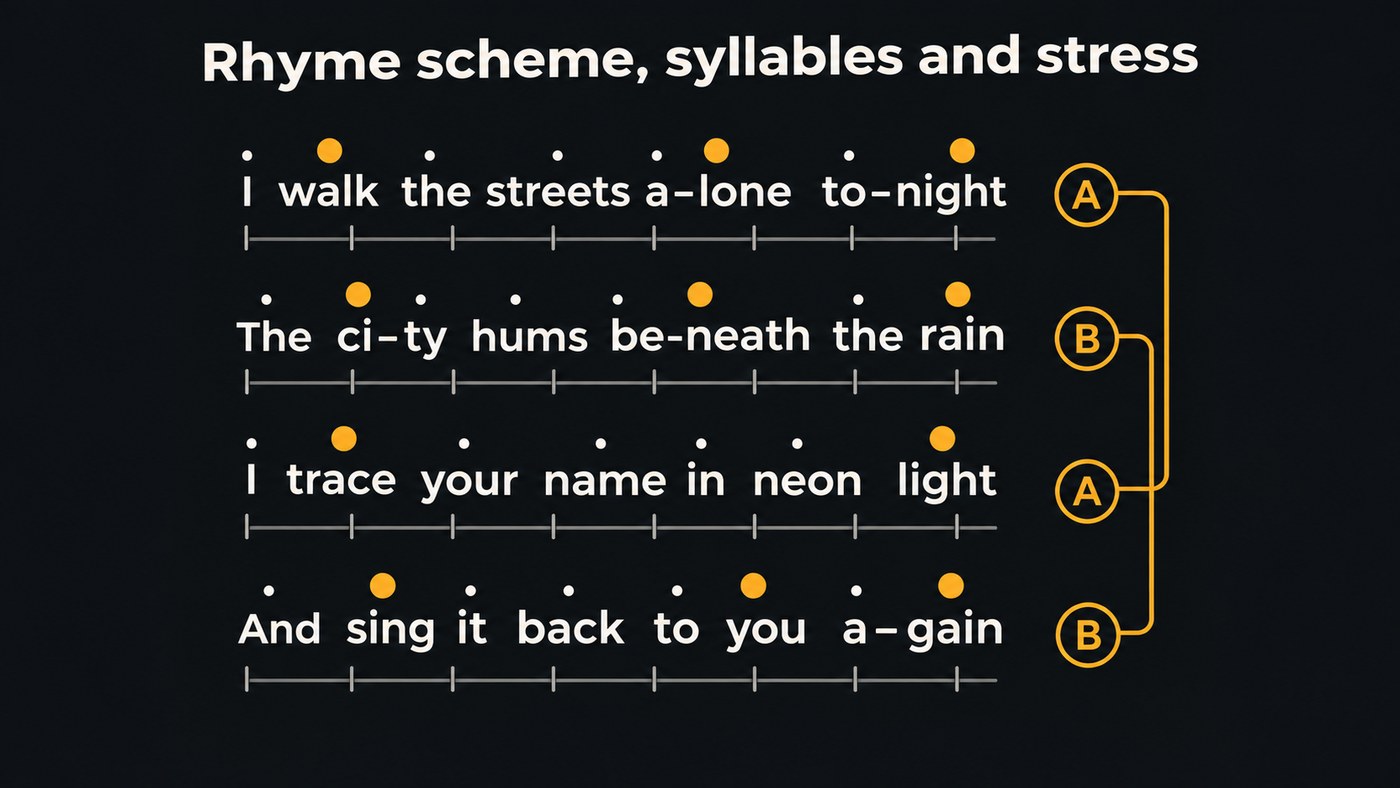
Rhythm in a lyric comes from two things: how many syllables each line has, and where the stressed syllables fall. Both are harder for a text model than rhyme: in PhonologyBench, the gap to humans on syllable counting was more than twice the gap on rhyme.
- Syllable counts are ambiguous. The CMU Pronouncing Dictionary, Carnegie Mellon's open dictionary of over 134,000 North American English words (version 0.7b), lists "fire" as two syllables and "every" as three. Singers often sing them as one and two. A line that counts as eight on paper can sing as seven or nine.
- Stress decides whether a line grooves. The dictionary marks every vowel 0 for no stress, 1 for primary and 2 for secondary. "Remember" comes out as R IH0 M EH1 M B ER0, so its weight sits on "mem". Put "re" on the downbeat and the line feels wrong, however good the words are. Some words even change meaning with stress, like the dictionary's own example, "progress".
- Longer sentences are harder. PhonologyBench found syllable-counting accuracy fell on sentences with more than one clause. Short, plain lines are easier to count and to sing.
A lyric generator that doesn't know your tempo or melody can only aim for lines of similar length. The melody settles the rest later.
The techniques that actually enforce structure
When a tool does more than hope, it uses one or more of these methods.
- Section tags and templates. Labels such as [Verse], [Chorus] and [Bridge] give the model, and later the singing model, a map of the song. Soundverse's AI Song Generator, for example, takes section tags like [Verse] and [Chorus] in its Lyrics box.
- Constraints in the prompt. "ABAB, eight syllables a line" is an instruction the model tries to follow, not a rule anything checks.
- Control codes in training. PoeLM, by Aitor Ormazabal and colleagues (EMNLP Findings 2022), trained a model on ordinary text where each phrase was labelled with its length and end rhyme. At generation time you ask for a meter and rhyme scheme as codes, and the model writes to them.
- Generate, filter, re-rank. PoeLM then generated 3,000 candidates per poem, threw out any with the wrong number of lines or syllables, the wrong rhyme sound, or two rhyming lines ending on the same word, and kept the most fluent survivor. In Spanish, 30.9% of its candidates met every constraint; a plain language model managed none. The paper also notes that older systems wrote lines right to left so the rhyme word gets chosen first.
- Melody-guided writing. For lyrics written to an existing tune, Yufei Tian and colleagues (ACL 2023) turned the melody's phrasing and rhythm into constraints during generation. They describe writing to a melody as harder than free lyric writing because "the music imposes additional constraints onto the lyrics."
Structure is guaranteed only where something checks it, whether that's a filter, a pronunciation dictionary or a melody. Everything else is a strong suggestion. For how individual song generators expose these controls, see which AI music generators allow the most control over lyrics.
What happens when the lyrics meet the music
In a full-song generator, a second model sings the words, and that's where rhythm really gets settled. The music model writes or follows a melody and spreads your syllables across its notes, holding one vowel over several notes or squeezing extra words into a bar.
- A line with too many syllables gets crammed or rushed, and a stressed word can land off the beat.
- A line with too few gets padded with held vowels, which can sound lovely or lazy.
- Uneven verses produce uneven melodies. If verse one runs eight syllables a line and verse two runs eleven, the second verse rarely sits on the same tune.
If you'd rather the music follow your rhythm, give it the melody. Soundverse's Melody to Song Generator takes 5 to 60 seconds of a tune you hum, sing or play and builds a song that follows it, singing your lyrics word for word. Write the words to the phrasing you hummed, one syllable per note unless you want a held vowel.
Where they still slip
Read every draft for these:
- Eye rhymes such as love/move, which rhyme only on paper.
- The same pairs every song: fire/desire, heart/apart, night/light.
- Twisted word order to reach a rhyme, as in "to the city I did go".
- Stress on the wrong syllable, so the natural spoken accent fights the beat.
- Syllable drift between verse one and verse two.
- Meaning traded for the rhyme, where the line lands the sound and says nothing.
- Other languages. PhonologyBench tested English only, so have a native speaker check rhymes and syllables in Hindi, Spanish or Japanese lyrics.
How to get tighter rhyme and rhythm from any AI lyric generator
- Name the scheme for each section. "Verse: ABAB. Chorus: AABB, last line repeated" is clearer than "make it rhyme".
- Give syllable counts and a stress pattern. "Eight syllables a line, stress on 2, 4, 6 and 8", or write it out as da-DUM da-DUM da-DUM da-DUM.
- Paste one line of your own and ask for the rest to match its length and rhythm.
- Ask the model to show its work. Have it list each line's syllable count and end word, then check them yourself. A count you can see is a count you can catch.
- Ban the obvious rhymes by name, and ask for near rhymes instead.
- Speak it over a click before you sing it. Lines that trip when spoken trip when sung. Our guide to writing song lyrics that connect covers matching words to rhythm and melody.
- Fix lines, don't regenerate songs. Keep what works and rewrite the one line that doesn't, by hand or with a targeted follow-up request.
- Hear it sung. The singing model is the final judge of rhythm. Our guide to getting started with an AI lyrics writer and singing generator walks through that loop for a demo.
Where Soundverse fits
Soundverse is an AI music platform that takes you from idea to audience, built for independent artists who release music. Its AI Lyrics Writer drafts a whole song or just an Intro, Verse, Chorus, Bridge or Outro from a theme, in one of 8 moods and 64 genres, and drafting from its panel uses no tokens. To be clear about the limits: the panel has no separate controls for syllable counts or rhyme schemes. Ask for changes in a follow-up chat message, using the prompts above, and check the result yourself.
When the words are right, AI Song Generator's Custom mode sings them exactly as written. For a version in another language, Translate Lyrics has a Match syllables option that aims to give each translated line the original's syllable count, so it can sit on the same melody. If you also want the arrangement handled, see choosing an AI tool for both lyric writing and full song arrangement.
This walkthrough of Soundverse's Create tools shows AI Lyrics Writer from 1:13, drafting lyrics from a topic, mood, section and genre.
FAQ
Do AI lyric generators check their own rhymes? Only if they're built to. Research systems such as PoeLM reject candidates with the wrong rhyme sound or syllable count before you see them. Unless a tool says it runs a check like that, assume the rhymes come from patterns the model learned and read them yourself.
Can AI write lyrics to fit a melody I already have? Research systems can turn a melody into writing constraints, as Tian and colleagues did. In everyday tools, the reliable route is to count the syllables and stresses in each phrase of your melody and give the model those numbers line by line. Or go the other way and give a song generator your melody along with your lyrics.
Why does the AI singer rush some of my lines? Usually the line has more syllables than the lines around it, or more than the melody has notes. Trim a word, move the stressed syllable onto a strong beat, or split the line in two.
Sign up for Soundverse free and draft your next verse with AI Lyrics Writer. More songwriting guides on the Soundverse blog.