Recommended Distributors That Offer Easy Social Media Monetization
Social media monetization for musicians: YouTube Content ID, Meta, TikTok and Snapchat, which distributors include each, their fees and the risks.
If you want a distributor that offers easy social media monetization, CD Baby and TuneCore bundle it: CD Baby includes YouTube Content ID and Facebook and Instagram video income with every release, keeping 30%, and TuneCore takes 20% of TikTok, Facebook, Instagram and YouTube earnings. Amuse Plus and Pro charge no Content ID fee, and Ditto includes it in Pro.
Social income works differently from streams, and the catches sit in the details: claims on your own videos, beats you've leased, and tracks registered twice. Every term below comes from the platform's or distributor's own page, read on 19 November 2026. For the full cost of each plan, see our comparison of distribution pricing models.
How social media monetization works for music
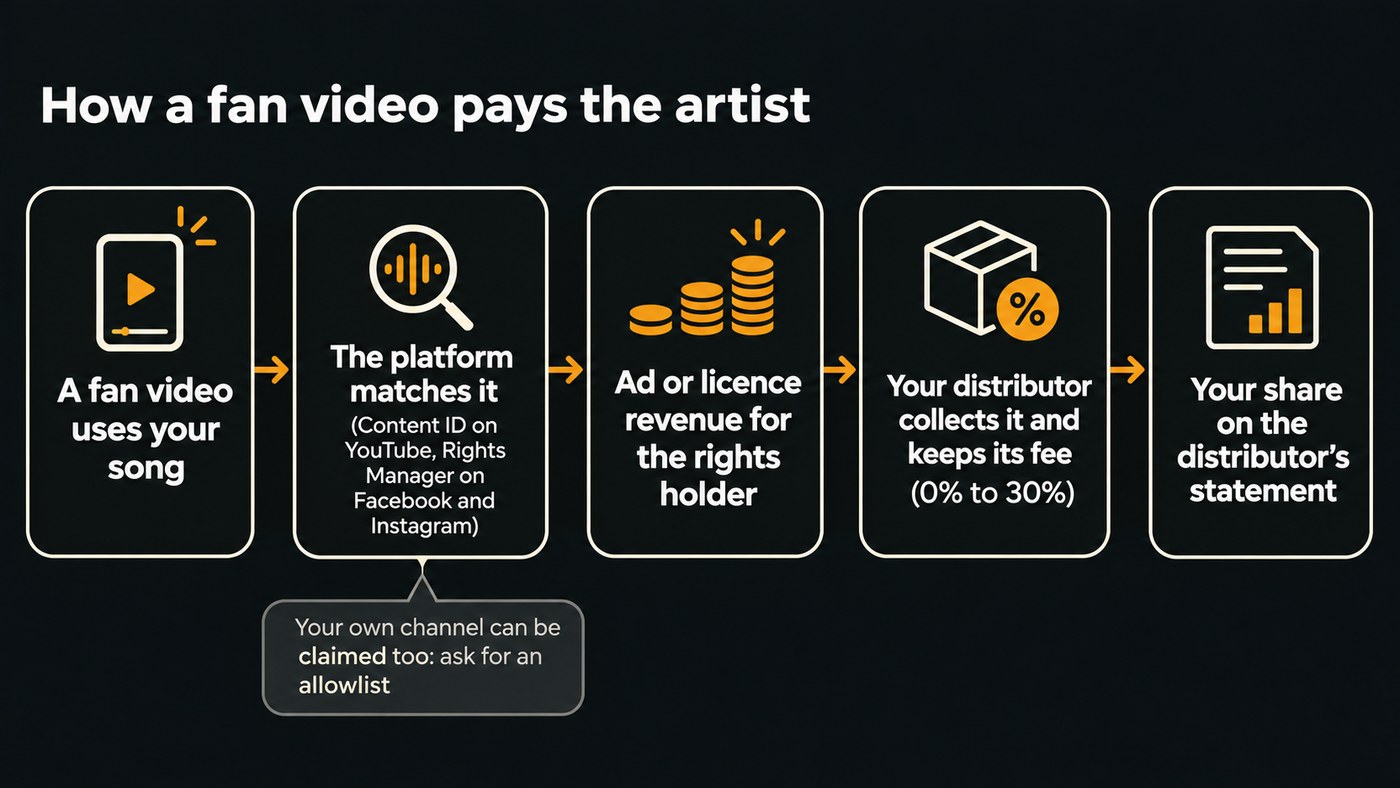
Each platform handles your song inside other people's videos in its own way. For YouTube and Snapchat, the platforms' own pages route independent artists through a distributor or label, and the distributor collects what comes back.
YouTube: Content ID and Art Tracks
YouTube's page on how Content ID works says every upload is scanned against reference files from copyright owners. A match gets a claim, and the owner's settings decide whether the video is blocked, monetized with ads (sometimes sharing revenue with the uploader) or only tracked, and that can differ by country. YouTube approves owners of a substantial body of original material that's often uploaded, so most artists get in through a distributor's account.
Art Tracks are the other half. YouTube's help page describes an Art Track as an automatically generated YouTube version of an album track, the recording plus its cover art, available only to label and distributor partners that deliver through a DDEX feed. TuneCore's stores page says you earn when those Art Tracks are streamed.
Facebook and Instagram
Meta's Music Revenue Sharing announcement (25 July 2022, updated 5 October 2022) says the system runs on Rights Manager, Meta's matching tool. Video creators get 20% of in-stream ad revenue on eligible Facebook videos, with separate shares going to music rights holders and to Meta. The video must last at least 60 seconds and have a visual component.
The rights holder's share reaches you through your distributor. DistroKid's distribution agreement lets it authorise user-generated-content services including YouTube, Facebook and Instagram, TuneCore's stores page lists Meta for posts and Reels, and CD Baby's social video service covers music in Facebook and Instagram Stories videos.
TikTok and CapCut
TikTok's help centre and newsroom, and the SoundOn distribution site, didn't load for us on 19 November 2026, so we can't quote TikTok's own terms or rates. Distributors document the delivery side. TuneCore's stores page lists TikTok, alongside TikTok Music and Resso, and CapCut, and says a TikTok listing gives fans permission to use your music in their posts. Its TikTok page mentions a typical two-month delay before earnings show up. TuneCore's 20% social fee covers TikTok, and CD Baby, Ditto and UnitedMasters also name TikTok among their platforms.
Snapchat
Snap's creator guide is direct about the route in: "To get your songs in Snap Sounds, you can go through independent distributors like Distrokid or CD Baby, or work with your label to ensure they’re delivering your catalogue to Snap." Snap's newsroom post of 13 April 2023 lists its music licensing partners, DistroKid and UnitedMasters among them, and TuneCore's stores page lists Snapchat. Snap's pages describe Sounds as licensed clips fans add to Snaps and Stories; they don't publish what a use pays.
Which distributors include social monetization, and on what terms
- CD Baby: included, 30% of social video income. Its YouTube page says YouTube monetization is included with distribution, with Art Tracks for every song, and its Social Video Monetization service covers Facebook and Instagram Stories too. The SVM addendum (last updated 22 October 2024) sets a 30% administration fee on what CD Baby collects, and you leave by opting out in your account and giving written notice. The release fee is paid once.
- TuneCore: included, 20% fee. Every plan on its pricing page lists YouTube Content ID and unlimited releases to social platforms, with a 20% fee on TikTok, Facebook, Instagram and YouTube earnings. Its stores page adds CapCut and Snapchat.
- DistroKid: opt-in, 20% on YouTube Money. Its distribution agreement says that if you opt into its separate Content ID service, such as YouTube Money, it deducts 20% of the money from videos detected that way.
- Ditto Music: Content ID on Pro and Labels. Its Content ID page says you add Content ID to any release in the Release Builder. Pro costs $59 a year.
- Amuse: the fee depends on the plan. Social and UGC distribution is included, and Content ID carries a 15% royalty fee on Artist ($23.99) and none on Plus ($39.99) or Pro ($59.99).
- UnitedMasters: an add-on. DEBUT+ ($19.99) and SELECT ($59.99) list YouTube Content ID Monetization as an add-on, without a price on the page.
- AWAL: by application. Its FAQ says AWAL is YouTube Certified and collects royalties for your music in user-generated videos on YouTube, under its standard 15% share of the revenue it collects.
The risks to check before you opt in
- Claims on your own and your clients' videos. Once a track is in Content ID, YouTube can claim every matching upload, your own channel included, plus any client you made music for. YouTube's allowlist exempts channels, but only partners using Studio Content Manager can use it, so ask your distributor to add your channel and your clients' channels. Claims made before a channel is allowlisted aren't released automatically, and if several partners own an asset, each one must allowlist the channel.
- Leased beats and type beats. Ditto puts it plainly: "We can't register your music for Content ID if it is under Public Domain, has previously been sent to Content ID using a different provider, or if you purchased or leased any beats under a Non-Exclusive Licence." YouTube's eligibility rules also exclude content licensed non-exclusively, production loops and sound-alike recordings. If you sell non-exclusive leases of a beat, keep that beat out of Content ID, or your buyers' videos get claimed.
- Samples. CD Baby's SVM addendum makes you promise that opted-in tracks contain no sample or beat owned by someone else.
- One administrator per track. Ditto won't register music already sent to Content ID through another provider, and CD Baby's addendum requires that the track isn't opted in with any other collector. When you switch distributors, opt out at the old one first.
- Wrong claims cost access. YouTube warns that claimants who repeatedly make erroneous claims can have their Content ID access disabled. Register only tracks you fully control.
- AI-made tracks. Content ID needs rights nobody else holds. If an AI tool made the track, check that its terms give you that; our comparison of AI music platforms for distribution goes through each one's terms.
A short decision guide
- You want everything switched on with no admin: CD Baby or TuneCore. CD Baby charges once per release and keeps 30% of social video income; TuneCore charges yearly and keeps 20%.
- You care most about your cut on YouTube: Amuse Plus or Pro charge no Content ID fee, and Ditto includes Content ID in Pro.
- You're already on DistroKid: opt into YouTube Money and expect 20% of that income to go to DistroKid.
- You sell beats or score clients' videos: keep leased beats and client tracks out of Content ID, or get the buyers' channels allowlisted first.
- You post videos with your own songs: confirm your distributor will allowlist your channel before you opt in.
- You haven't picked a distributor yet: our guide to affordable distribution apps for new content creators covers price, phone apps and what you give up at the lowest tier.
Where Soundverse fits
Soundverse is an AI music platform that takes you from idea to audience. It doesn't deliver music to stores or social platforms and doesn't register tracks for Content ID; your distributor does that. It helps with the checks on either side.
Run a beat, a sample or a final master through Copyright Checker before you opt it in. It fingerprints the audio and reports whether it matches a released recording, with title, artist, label and ISRC where known; Soundverse calls it a recognition check, not legal clearance. AI Music Video Generator, on Creator and above, turns a finished track you have the rights to into a vertical 9:16 video for Shorts and Reels. Music Business Agent can search YouTube, SoundCloud and Audiomack for re-uploads and sped-up or slowed rips of your songs, each with its link.
Licensing is set by plan: the Free plan is for personal use, and the Creator plan comes with a royalty-free license.
This video shows Agent One researching channels and playlists, planning a release in Google Sheets and uploading a visualizer to YouTube as Private.
FAQ
Will Content ID claim videos on my own YouTube channel? It can. Allowlisting happens in YouTube's Content Manager, which most artists reach through a distributor, so ask yours to allowlist your channel before you opt in. Claims made before that aren't released automatically.
Can I register a song made on a leased type beat for Content ID? No. YouTube excludes content licensed non-exclusively, and Ditto says it can't register music built on beats bought or leased under a non-exclusive licence. Buy an exclusive licence first, or leave Content ID off for that track.
Do I get paid every time someone uses my song on Instagram or TikTok? Not at a fixed rate per use. Meta shares in-stream ad revenue on eligible Facebook videos, and the TikTok and Snapchat pages we could read publish no rates. Your distributor's statement shows what each platform paid.
Can two distributors collect social income for the same track? No. Ditto won't register a track already in Content ID through another provider, and CD Baby requires that opted-in music isn't with any other collector. Pick one and opt out everywhere else.
Sign up for Soundverse free and check your next beat with Copyright Checker before it goes into Content ID. More release guides on the Soundverse blog.