What Are the Common Ethical Considerations Regarding Training Data for AI Audio Models?
AI audio training data ethics explained: consent and pay, the Suno, Udio and GEMA cases, opt-out limits, voice, dataset bias and EU AI Act disclosure.
AI audio training data ethics comes down to five questions: did the artists, performers and rights holders whose recordings were used agree, were they paid, can they opt out, whose voices and musical cultures the dataset includes or leaves out, and can anyone see what went in. Courts and licensing deals are now answering the first two.
We checked every filing, ruling and rule below on its official page on 19 November 2026. The law differs by country and keeps moving, so read this as general information, not legal advice.
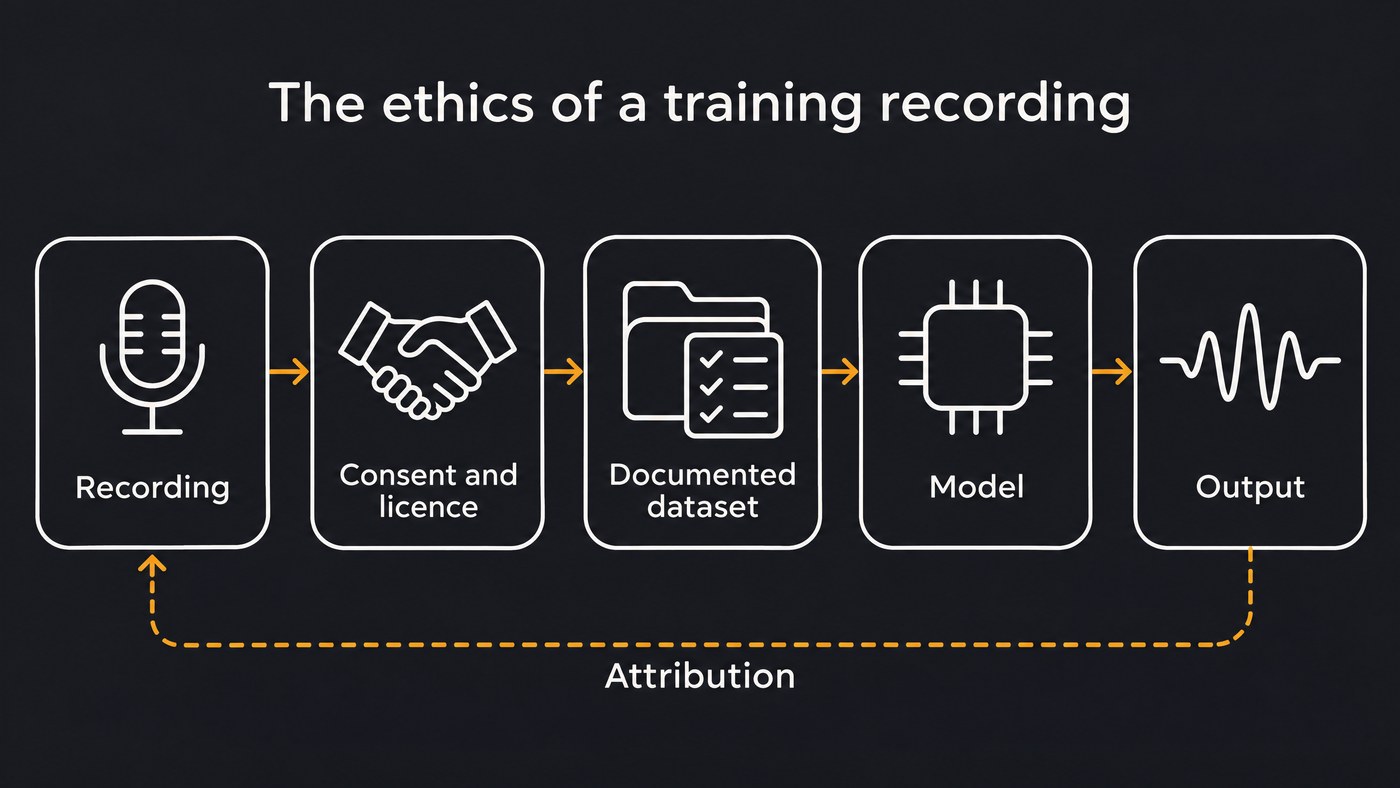
Consent and compensation: whose permission a recording needs
One track carries several layers of rights: the songwriter and publisher hold the composition, the label or artist holds the master, and the singers and players hold their performance and, in many places, a say over their voice. Training on a recording touches every layer at once.
So "we licensed it" can mean very different things. A label licence may not cover the songwriters, and it says nothing about whether a session singer agreed to have her voice learned by a model unless her contract does. An ethical training set needs permission before use, payment that reaches the people on the record, and a real way to say no.
The record companies put their side plainly in their complaint against Suno: "There is nothing that exempts AI technology from copyright law or that excuses AI companies from playing by the rules." Courts and negotiators have treated that position very differently so far.
Copyright and licensing of AI training data: lawsuits and settlements
The main cases, from filings and the parties' announcements:
- Labels v. Suno (US). Record companies from Universal, Sony and Warner sued Suno in federal court in Massachusetts on 24 June 2024, seeking an injunction and statutory damages of up to $150,000 per work infringed. An amended complaint filed on 25 August 2026 names UMG Recordings, Capitol Records and Sony Music Entertainment as plaintiffs, so the case is still open.
- Universal and Udio. On 30 October 2025 the two companies announced that they had settled their copyright litigation and signed licences for recorded music and publishing for a new platform due in 2026.
- Warner and Suno. WMG's release of 25 November 2025 says the deal settles their litigation and gives artists and songwriters an opt-in for the use of their name, image, likeness, voice and compositions in new AI songs.
- GEMA v. OpenAI and GEMA v. Suno (Germany). On 11 November 2025 the Munich Regional Court found that OpenAI had stored and reproduced lyrics from GEMA's repertoire without a licence; OpenAI has appealed. On 31 July 2026, GEMA reports, the same court ruled that Suno needed GEMA licences for training on its repertoire and for storing and reproducing the works, applying US as well as German law. GEMA says Suno disputes that it owes such fees.
So a European court treats training on music as needing a licence, the main US case is still being argued, and deals are moving faster than judgments. Labels and publishers sign those deals, so whether money reaches performers depends on their own contracts. For who owns the output, see how AI tools handle copyright and ownership.
Opt-out mechanisms and their limits
In the EU, rights holders can reserve their works against text and data mining under Article 4(3) of the 2019 copyright directive. The EU's Code of Practice for general-purpose AI, published on 10 July 2025, commits signatories of its copyright chapter to follow robots.txt as specified in IETF RFC 9309 and other appropriate machine-readable protocols, to publish information about their crawlers, and to give rights holders a point of contact and a way to complain. (EUR-Lex blocked our reader, so this comes from the Code's own text.)
Opt-outs help, with four limits for music:
- They look forward. A reservation added today tells crawlers what not to take next. It doesn't reach a model trained last year.
- They protect places, not songs. robots.txt covers your website, not copies of your track on video sites, lyric sites and fan uploads.
- They depend on who signs. The Code is voluntary, and a company training outside the EU may follow other rules.
- They put the work on artists. An opt-out assumes use until you object. The Warner and Suno opt-in reverses that for voice and likeness.
Voice and likeness in training data
A singer's recordings carry an identity as well as a performance. Fine-tuning on one singer gives a model whose whole purpose is that person's voice. That needs the singer's explicit, specific consent: which model, which songs, who may use it, for how long, and how to withdraw.
Warner's deal already lists voice as its own permission. In practice:
- Add an AI clause to session and feature agreements that says whether the stems may train a voice model, and pay for that use separately.
- Never strip vocals from released songs to build a dataset of someone else's voice.
Our guide to training an AI on a specific vocal timbre starts with consent and recording rights for that reason, and the same rule applies to faces when you make visuals: see the ethics of AI in music video production.
Cultural representation and bias in audio datasets
Meta's MusicGen model card admits it directly: "The source of data is potentially lacking diversity and all music cultures are not equally represented in the dataset."
A study by Atharva Mehta and five co-authors, last revised on 6 May 2025, found that only 5.7% of the total hours in existing music datasets come from non-Western genres. Testing MusicGen and Mustango on Hindustani classical and Turkish makam music, they found that fine-tuning on small datasets showed promise but that adapting across traditions is far from simple.
Voices are skewed too. The Sound Check audit by William Agnew and colleagues (17 October 2024) examined seven prominent audio datasets and found them biased against women, carrying toxic stereotypes about marginalized communities, and holding significant amounts of copyrighted work.
The risk runs both ways. Under-representation can turn a raga or a maqam into a costume over Western harmony, while scraping field recordings or ritual music to fix it repeats the consent problem where it hurts most. Fair practice is to document coverage by tradition, license from the musicians and archives, pay them, and involve them in how the music is tagged. Our explainer on how neural networks generate music from text prompts shows where tags enter a model.
Transparency: dataset disclosure and the EU AI Act summary
The EU AI Act requires providers of general-purpose AI models to publish a summary of their training content on a template the European Commission released on 24 July 2025. According to the Commission's Q&A:
- The duty applies from 2 August 2025; models already on the market before then have until 2 August 2027.
- A summary covers content types, audio included, the public and private datasets, and for scraped data the crawlers, the collection period and the top 10% of domains scraped (less for smaller companies).
- The AI Office can enforce it from 2 August 2026, with fines of up to 3% of worldwide annual turnover or 15 million euros, whichever is higher.
The Commission has separate guidelines on which models count as general-purpose, so check whether a given music or voice model is covered. Model cards are the voluntary version, and each lab decides what goes in.
Data provenance and attribution research
Provenance means knowing where each recording came from, under which terms, and who performs on it. The Sound Check team built a web tool that lets artists see whether their work is in popular audio datasets.
Attribution asks which training tracks shaped a particular output. A Sony AI paper by Woosung Choi and colleagues, first posted on 23 June 2025, applied unlearning-based training data attribution to a text-to-music diffusion model and found the method can be adapted to music models. The authors frame it as groundwork for crediting artists, not a finished system.
What artists can do about AI training data now
- Read the terms of every platform you upload to, including the clause on training.
- Reserve your rights where you control the files: AI-crawler rules in your site's robots.txt and a plain rights-reservation statement.
- Register your works and recordings with your collecting society, publisher and distributor, with full credits. Registered works are what a society like GEMA can license and enforce for you.
- Check the datasets with the Sound Check tool, and ask AI vendors for their documentation or EU training summary.
- Write AI terms into contracts for sessions, features and catalogue deals.
- Guard your voice data: keep voice models private, and train only on your own voice or a singer who agreed in writing.
Where Soundverse fits
Soundverse is an AI music platform that takes you from idea to audience, built for independent artists who release music. It gives you control over the voice data you bring. Train Voice Clone and Train Voice Model won't start training until you confirm the voice is yours or that the singer has given explicit consent, and models from Train Voice Model start Private, so only you can use them unless you make one Public.
Copyright Checker fingerprints a track and tells you whether it matches a known, commercially released recording, with title, artist, label and ISRC where known. Soundverse calls it a recognition check, not legal clearance: a sensible first step before you build on a sample of unknown origin.
Licensing is set by plan: the Free plan is for personal use, and the Creator plan comes with a royalty-free license.
FAQ
Is it legal to train AI music models on copyrighted songs? It depends on the country. A Munich court ruled against OpenAI over lyrics in November 2025 and, GEMA reports, against Suno in July 2026. In the US the labels' case against Suno was still open in August 2026, while Universal has settled with Udio and Warner with Suno.
Can I get my music out of a model that has already been trained? An opt-out alone usually won't do it, because it governs future collection. Ask the provider directly and, in the EU, use the complaint channel that Code of Practice signatories commit to offer.
Do AI companies have to say what they trained on? In the EU, providers of general-purpose AI models must publish a training-content summary, with enforcement from 2 August 2026. Beyond that, the main sources are voluntary model cards, which each lab writes for itself.
Sign up for Soundverse free and run Copyright Checker, which works on every plan, before you build on a sample. More guides on the Soundverse blog.

