What Are the Ethical Considerations When Using AI for Music Video Production?
AI music video ethics in practice: consent for faces and voices, YouTube and Meta AI labels, training data, credits, stereotypes, energy and a checklist.
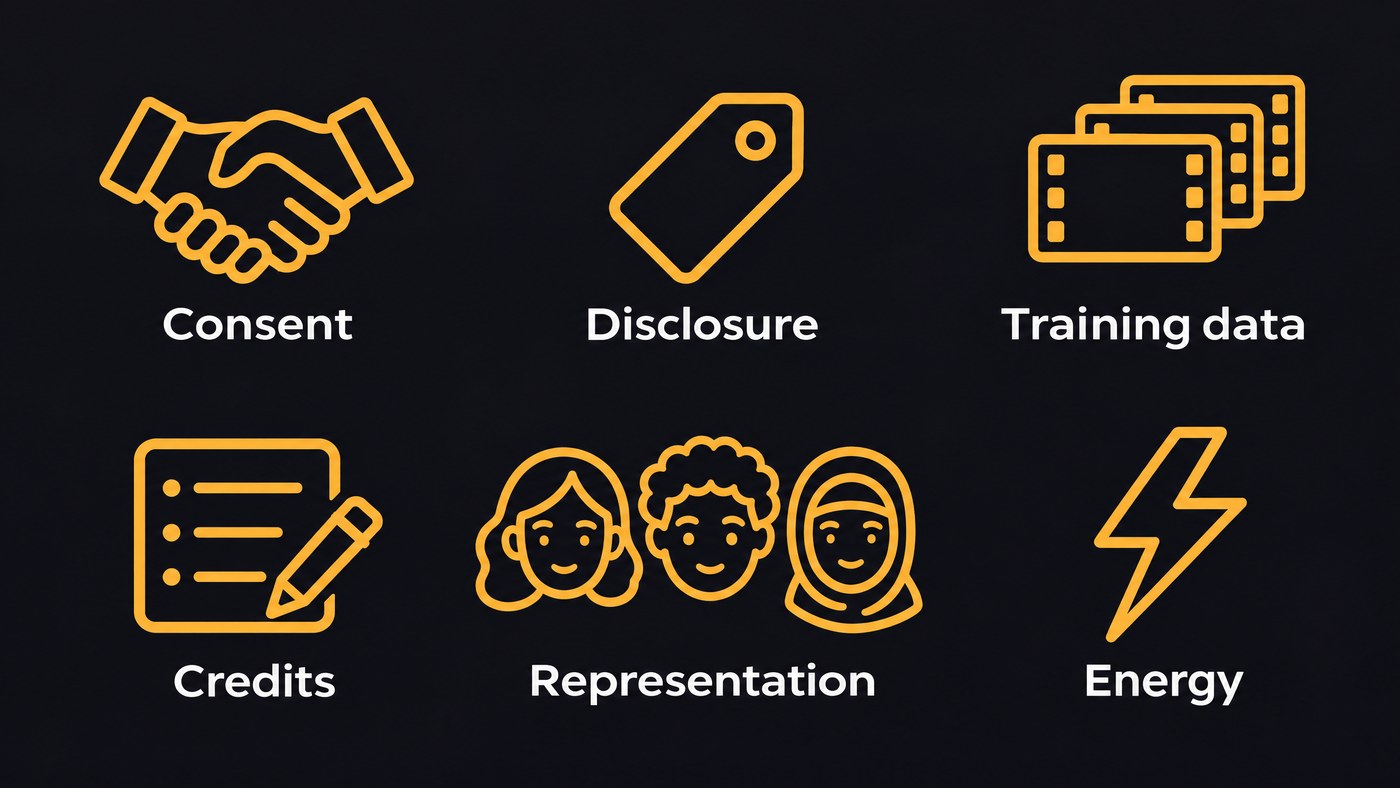
AI music video ethics comes down to six questions: did the people whose faces and voices appear agree, are viewers told what is synthetic, whose work trained the model, who gets credit, do the generated people fall into stereotypes, and how much energy the renders use. Get consent in writing, label realistic AI footage, and credit every human involved.
This guide is for artists, labels and directors. We checked every rule and law below on its official page on 19 November 2026; they change often, and this isn't legal advice.
Consent and likeness: faces, voices and lookalikes
If a real person can be recognized on screen, you need their permission, whether it's your own artist, a former band member or a fan in a crowd photo used as a reference. A prompt that describes a famous singer closely enough to identify them raises the same problem as uploading their photo.
YouTube's privacy guidelines let a person ask for removal of AI-generated or altered content that looks or sounds like them. YouTube weighs whether it's realistic, whether it was disclosed, whether the person is uniquely identifiable, and whether it's parody, satire or in the public interest. Its separate likeness detection tool, which channel owners and managers over 18 set up with an ID and a short selfie video, scans new uploads for their face.
The law is moving too. Tennessee's ELVIS Act, signed on 21 March 2024, added "voice" to the state's Protection of Personal Rights law, which already covered name, image and likeness (Tennessee governor's office). California's AB 2602, signed on 17 September 2024, requires contracts to spell out uses of AI digital replicas of a performer's voice or likeness.
Good consent is written, names the song, the use (an AI performance, a face on a character, a cloned vocal), the platforms and how long the video stays up, and covers reference photos, since an image reference is how most tools copy a face. File it with the release paperwork, and treat a cloned voice the same way.
Deceased performers and tribute videos
A late singer can't give consent. California's AB 1836, signed the same day as AB 2602, prohibits commercial use of digital replicas of deceased performers in films, TV shows, video games, audiobooks, sound recordings and more without the consent of the performer's estate. YouTube's privacy process also accepts complaints from a close family member on behalf of a deceased person.
For a tribute, talk to the estate or family before you write a prompt. If permission isn't possible, honor the person without replicating them: a written dedication, archive footage you have permission to use, or an illustrated figure that doesn't pretend to be them.
Misleading "performance" footage of a real artist
A generated clip of a real artist singing on a stage they never played is the case most likely to mislead fans. YouTube's disclosure rules list making a real person appear to say or do something they didn't do among the things that must be labeled, but a label doesn't make an unauthorized fake acceptable.
Even with your own artist's consent, keep AI performances and real ones apart. Don't cut generated "live" shots into concert footage, and don't post a generated lip-sync clip as behind-the-scenes. Fans treat performance footage as proof that something happened.
Disclosure: the most practical part of AI music video ethics
- YouTube. Its disclosure page requires a label for realistic AI content, including AI-generated music and realistic scenes that didn't happen; clearly fantastical content doesn't need one. You set it under "AI use" in YouTube Studio's Attributes section. Channels that keep skipping disclosure risk penalties, including removal.
- Facebook, Instagram and Threads. Meta wrote on 6 February 2024: "We'll require people to use this disclosure and label tool when they post organic content with a photorealistic video or realistic-sounding audio that was digitally created or altered, and we may apply penalties if they fail to do so." (Meta) The label has been called "AI info" since July 2024.
- The EU. Under Article 50 of the AI Act, deployers must disclose deepfakes with clear and perceivable labels from 2 August 2026, according to the European Commission. For evidently artistic or fictional work, the Act limits the duty to disclosing that generated content exists, in a way that doesn't spoil the work.
Then say it in words. A description line such as "Visuals generated with AI. The singer's likeness is used with her permission." tells fans what is synthetic and what was agreed. Our AI music video workflow shows where disclosure fits in the upload.
Training data: the artists and filmmakers behind the models
Every video model learned from footage someone shot. The UK government set out the dispute in its consultation of 17 December 2024: how copyright law applies to AI training is disputed, rights holders struggle to control or get paid for the use of their work, and AI developers find the law hard to navigate, with the uncertainty undermining investment. It proposed letting rights holders reserve their rights, and published a report and impact assessment on 19 March 2026 (GOV.UK).
Many artists reject unlicensed training outright. The Statement on AI training, signed by musicians, actors and writers, reads: "The unlicensed use of creative works for training generative AI is a major, unjust threat to the livelihoods of the people behind those works, and must not be permitted."
While it's unsettled:
- Ask each vendor what its video models were trained on, and favor vendors that publish an answer.
- Don't prompt for a living director's or animator's signature style by name.
- Decide about your own videos. YouTube's third-party training setting is off by default; channel owners can switch it on and pick which AI companies may train on their public videos.
Crediting the humans in an AI music video
Credit the director who wrote the treatment and approved the cut, the editor and anyone who fixed shots by hand, the people whose likeness or voice appears, the illustrators whose reference art shaped a character, and the songwriters and performers on the track. Name the tools in one line next to the disclosure.
Keep a production log of prompts, references, consent forms and versions. It backs up your credits and records the human choices. Our comparison of AI music videos and traditional editing explains how rights differ from a shoot.
Cultural representation and stereotypes in generated people
Ask a model for "a crowd" or "a doctor" and it fills the gaps from its training data. A study by Federico Bianchi and nine co-authors, last revised on 7 June 2023, found that text-to-image models produced stereotypes even when prompts avoided identity and demographic words, and that neither counter-prompts nor platform guardrails removed them (arXiv). It tested image models; run the same review on video.
In a music video, that shows up as the same kind of face in every lead role, or a culture reduced to costume and backdrop. Cast on purpose, as precisely as you'd brief a casting director, and check who the model added on its own. Our guide to keeping faces, clothes and locations consistent helps hold that cast steady from shot to shot. When a song draws on a culture or language, involve people from it in the treatment and the review, especially for dress, ritual and sacred imagery.
The environmental cost of AI video
A study posted on 23 September 2025 by Julien Delavande, Regis Pierrard and Sasha Luccioni measured open-source text-to-video models and found that latency and energy grow quadratically with resolution and clip length, and linearly with the number of denoising steps (arXiv). It doesn't cover commercial services, but the rule holds for planning: draft short and at low resolution, regenerate only the shot that failed, and render the final once.
An AI music video ethics checklist
- Written consent from every recognizable person, covering faces, voices and reference photos.
- Estate or family permission for anyone who has died, or no replica.
- No generated performances of real artists who haven't agreed.
- Rights to the song and to every image you upload.
- Platform AI disclosure switched on for realistic content, plus a plain description line.
- A vendor whose training-data answer you can live with.
- Credits for every human contributor, and the tools named.
- A representation pass over every generated person.
- Low-resolution drafts, one final render, and a production log kept with the release files.
Where Soundverse fits
Soundverse, an AI music platform that takes you from idea to audience, builds several of these checks into its video tools. AI Music Video Generator writes a script and quotes the cost for your approval before any scene is filmed, so a person signs off on what gets made. Its page asks that you hold the rights to the song and every image reference, and that a lip-synced lead uses a face you own or have permission to use.
The Lip Sync page is blunt: get consent before you animate a real person, and never use it to impersonate an artist. It also notes that realistic human faces are blocked, so illustrated and anime-style characters work best. Music Video Storyteller writes a story from your song's sections and lyrics and can cast you from your own photo, so the lead can be you rather than a lookalike.
Licensing is set by plan: the Free plan is for personal use, and the Creator plan comes with a royalty-free license.
FAQ
Do I have to label an AI music video on YouTube? If it looks realistic, yes. YouTube's list includes AI-generated music and realistic scenes that didn't happen. Clearly fantastical visuals don't.
Can I make an AI music video starring a famous artist? Not without their permission. A realistic synthetic likeness of an identifiable person can be removed under YouTube's privacy process, and laws such as Tennessee's ELVIS Act protect voice and likeness. Use original characters, or your own artist with written consent.
Is it ethical to use AI video models trained on other people's footage? It's contested. Many artists call unlicensed training unjust, while the UK government notes that AI developers face legal uncertainty. Ask vendors what they trained on and credit the people who made your video.
Do I need to credit the AI tool in my music video? YouTube and Meta ask you to disclose realistic AI content, not to name the tool. Naming it is honest and costs nothing, but credit the people first.
Sign up for Soundverse free and plan your next video with Music Video Storyteller. More guides on the Soundverse blog.