How Do Neural Networks Generate Music From Text Prompts?
How neural networks generate music from text: text encoders, audio codecs, token and diffusion models, guidance, lyrics, prompt words and the limits.
Neural networks generate music from text in three steps: a text encoder turns your prompt into numbers, a generator builds compressed audio guided by those numbers, and a decoder turns that into sound. The generator is usually either a transformer predicting audio tokens one after another or a diffusion model that refines noise into music.
Below, each stage in plain English, with published research systems as examples; commercial generators rarely disclose theirs. Papers and model cards were read on 19 November 2026. For the wider contrast with chatbots, see generative AI for text vs audio.
Step 1: A text encoder turns the prompt into numbers
A pretrained text encoder converts your prompt into vectors, lists of numbers that capture what the words mean in context. Two kinds are common:
- Language-model encoders. Meta's MusicGen (Copet and colleagues, June 2023) uses the encoder of Google's T5 and also tested FLAN-T5 and CLAP. Stable Audio Open uses a T5-based encoder of 109 million parameters.
- Joint text-audio embeddings. CLAP and Google's MuLan are trained so a music clip and a description of it land close together in one space. MuLan learned from 44 million recordings, about 370,000 hours. MusicLM (Google, January 2023) conditions on MuLan's embedding of the audio during training and on its embedding of your text at generation time, so it can learn from music that has no captions. AudioLDM uses the same trick with CLAP.
Either way, the model can only act on words that appeared alongside sounds in its training data.
Step 2: An audio tokenizer compresses sound
Raw audio runs to tens of thousands of numbers a second, so it's compressed first.
- Neural codecs such as Google's SoundStream (2021) and Meta's EnCodec (2022) pair an encoder with a residual vector quantizer and a decoder. Short frames of audio become a few discrete codes from learned codebooks, and the decoder rebuilds a waveform from them. In MusicGen, EnCodec turns 32 kHz audio into 50 frames a second, each described by four codes from codebooks of 2,048 entries.
- Continuous latents skip the codes. Stable Audio Open (Stability AI, July 2024) uses an autoencoder that turns 44.1 kHz stereo into 64 channels at 21.5 frames a second.
Everything the model makes passes through that decoder, so it caps sound quality. Our post on tokenization and music composition in AI goes deeper on codecs.
Step 3: Two ways to generate music from text
Autoregressive token models: MusicLM and MusicGen
These treat music like text: predict the next token, append it, repeat.
- MusicLM works in stages: semantic tokens from a model called w2v-BERT set long-term structure, then SoundStream tokens add acoustic detail. It was trained on about 280,000 hours of music and outputs 24 kHz audio.
- MusicGen uses one transformer and staggers EnCodec's four codebooks in a "delay" pattern, so 30 seconds of audio takes 1,500 prediction steps. Its model card lists 20,000 hours of training music.
Token models suit continuations and melody input, but they build left to right, so an early wrong turn carries forward.
Latent diffusion: AudioLDM and Stable Audio Open
Diffusion models start from random noise in the latent space and remove it over many steps, each guided by the text.
- AudioLDM (Liu and colleagues, January 2023) builds its latent space on CLAP and targets general text-to-audio.
- Stable Audio Open adds timing conditioning: it generates up to 47 seconds of 44.1 kHz stereo and fills the rest of its window with silence. A diffusion transformer of 1,057 million parameters does the denoising over 100 sampling steps.
Diffusion shapes the whole clip at once, which helps timing, but the window caps the length of a single run.
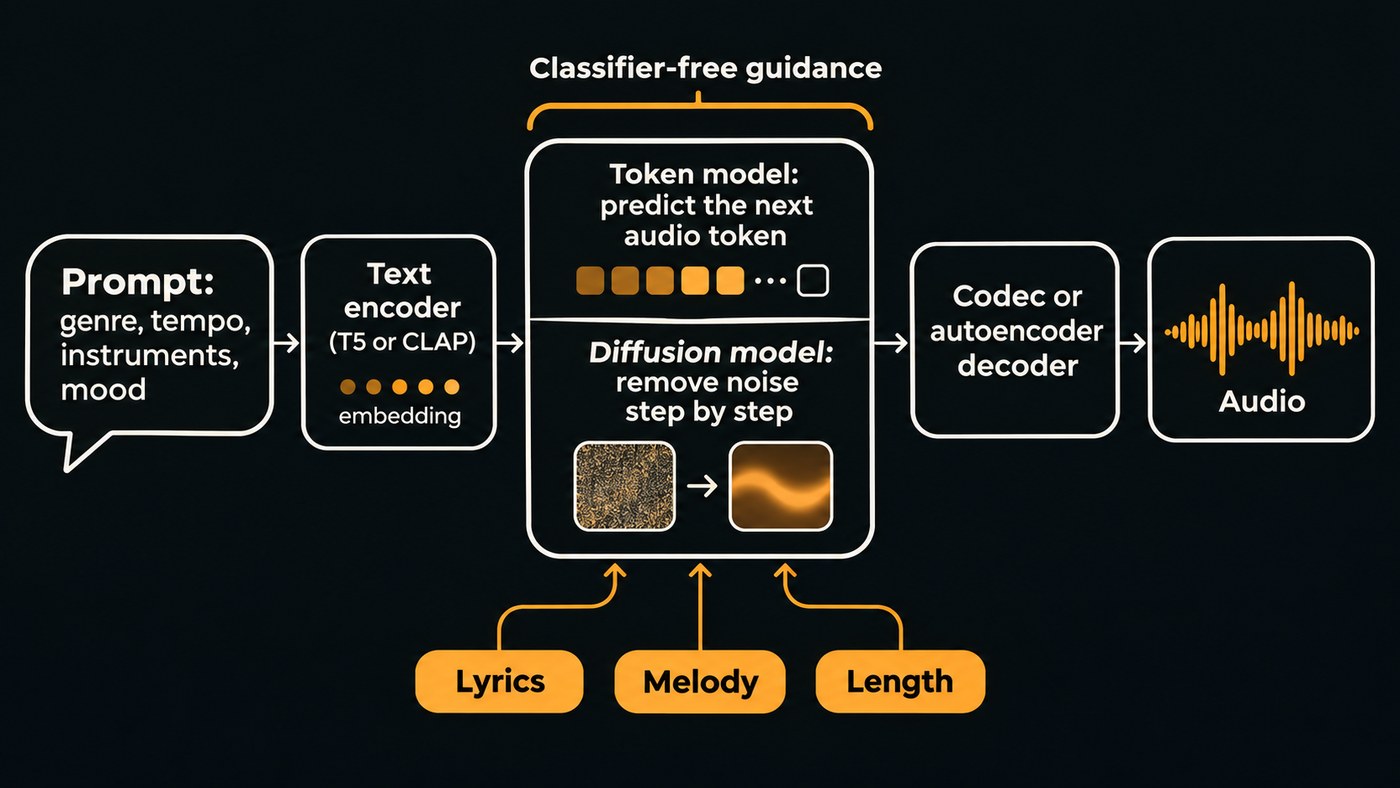
How conditioning and classifier-free guidance steer the output
Conditioning is any input the generator listens to: text, a melody, a target length. In Stable Audio Open, text and timing enter through cross-attention, layers that let the generator look up the relevant parts of the prompt at each step. MusicGen can also take a melody as a chromagram, and MusicLM can restyle a hummed or whistled tune.
Classifier-free guidance makes the prompt count for more. Jonathan Ho and Tim Salimans described it in 2022: train one model both with and without the condition, then combine the two predictions at generation time, trading diversity for sample quality. MusicGen drops the text from 20% of training examples and generates with a guidance scale of 3.0; Stable Audio Open uses 7.0. Stronger guidance pushes harder toward the prompt, at the cost of variety between takes.
How do generative AI models translate natural language prompts into musical structures?
Mostly by association: unless trained on explicit structure, a model learns which sounds tend to follow which rather than reading "verse, chorus, bridge" as instructions. MusicLM's authors state the limit plainly: "Some limitations of our method are inherited from MuLan, in that our model misunderstands negations and does not adhere to precise temporal ordering described in the text."
Real structure needs extra conditioning:
- Timing, as in Stable Audio Open's length control.
- Section labels with lyrics. YuE, an open lyrics-to-song model from 2025, found that text given only at the start of a sequence fades as the audio grows: degradation begins around 3,000 tokens and turns into complete failure beyond 6,000. Its fix pairs each section label and its lyrics with that section's audio, the same idea as writing [Verse] and [Chorus] tags into a lyric.
- A melody or reference that pins tune and form in time.
How does artificial intelligence actually generate original melodies from text prompts?
In audio models, nobody writes the melody as notes first. It emerges from the tokens or latents the generator samples, shaped by the genre, mood and instruments in the prompt and by patterns learned from training music. Each run samples a different path, so the same prompt gives a new tune every time.
On originality, MusicLM's authors ran a memorization study and found its generated token sequences differed significantly from the matching training sequences. If you need a specific melody, give the model one by humming it or loading MIDI.
Lyrics and vocals: the second problem
Lyrics must be sung word by word, in time and in tune, which many text-to-music models don't attempt. MusicGen's model card says it can't generate realistic vocals; vocals were stripped from its training data using tags and HT Demucs stem separation. Stable Audio Open's authors say it can't produce intelligible speech because it isn't conditioned on spoken words.
Song models add a lyric input. OpenAI's Jukebox (2020) conditioned on artist, genre and unaligned lyrics. YuE lists the hard parts: singing changes phonemes, durations and prosody compared with speech, paired lyrics-vocal-accompaniment data is scarce, and accompaniment can drown the vocal and hurt intelligibility. So YuE predicts a vocal token and an accompaniment token at every step, using stem separation on part of its training data to get them.
Why prompts with genre, tempo, instrument and mood words work better
Generators learn which sounds go with which words from the captions and tags paired with their training audio, so prompts in that vocabulary hit strong associations. MusicGen merged metadata such as key, tempo and instrument tags into its training descriptions. Stable Audio Open built its training prompts from metadata like genres and tags. YuE tagged tracks by genre, instrument and mood.
What follows for your prompts:
- Lead with genre and subgenre, then tempo in BPM, three to five instruments, mood and vocal type.
- Describe what you want, not what you don't. Write "solo piano and strings" rather than "no drums".
- Keep one scene per prompt. In Stable Audio Open's tests, prompts joined by connectors such as "then", "while" and "after" often lost one of the sounds.
- Match the model's language. MusicGen's model card says it was trained on English descriptions and performs worse in other languages.
- Generate several takes. The same card admits: "It is sometimes difficult to assess what types of text descriptions provide the best generations. Prompt engineering may be required to obtain satisfying results."
A prompt in that shape: melodic house, 122 BPM, warm analog bass, plucked synth arpeggio, airy female vocal chops, late-night mood.
Limits: long structure and prompt adherence
- Short windows. Stable Audio Open tops out at 47 seconds per run, and MusicGen's paper evaluates 30-second clips. YuE stretches to five minutes, but longer songs often rely on extensions, where seams and drift appear. Our post on the hurdles of long-form AI music explains why.
- Prompt adherence. Negation, ordering and multi-part prompts are weak spots in the papers above, and MusicGen's card says it doesn't perform equally well across music styles and cultures and sometimes collapses to silence at the end.
Where Soundverse fits
Soundverse is an AI music platform that takes you from idea to audience, built for independent artists who release music. AI Music Generator makes instrumentals from a text prompt plus tags for up to two genres, a theme, up to three vibes, up to five instruments and a tempo, and Enhance can expand a short idea. AI Song Generator adds vocals: Describe mode writes the lyrics, and Custom mode sings your own words as written, with section tags such as [Verse] and [Chorus].
Soundverse v9 is on Pro and Max, decides each song's length itself, and can build a song on a 5 to 60 second hummed melody in Melody to Song Generator. Each run makes one take, so sharpen the prompt and generate again when one misses.
Licensing is set by plan: the Free plan is for personal use, and the Creator plan comes with a royalty-free license.
This walkthrough shows AI Song Generator making a full song from one sentence at 0:05, and AI Music Generator making an instrumental from a prompt at 0:17.
FAQ
Do AI music generators understand music theory? Not as rules. They learn patterns of keys, chords and rhythm from audio, which usually yields music that follows theory, but nothing checks it. Naming a key or a BPM tends to work when those words appeared in training captions.
Why does the same prompt give a different song each time? Generation samples from probabilities, so each run takes a different path through the tokens or the noise. Guidance narrows the spread without removing it.
Are token models or diffusion models better for music? Neither wins every task. Token models suit continuations and melody input, while diffusion shapes a whole clip at once and handles length through timing conditioning.
Sign up for Soundverse free and try a prompt built the way this guide describes. More guides on the Soundverse blog.
