Is It Possible for AI Voice Synthesis to Mimic Specific Vocal Styles or Genres?
Can AI voice synthesis mimic vocal styles and genres? How models copy belting, rasp and rap flow, where they fail, and why a singer's voice needs consent.
Yes, AI voice synthesis can mimic vocal styles and genre conventions such as belting, breathy pop, rasp, rap flow, falsetto and the hard-tuned sound, because they are learnable patterns of pitch, timing and tone. It is weaker on fast ornaments, genre-specific diction and extreme techniques, and copying one living singer's voice needs that singer's permission.
The details below come from published papers and each company's own documentation, checked on 14 November 2026. The useful question is which part of a voice you want copied, because that changes the tool, the result and the rules.
Style vs identity: the two things AI can copy
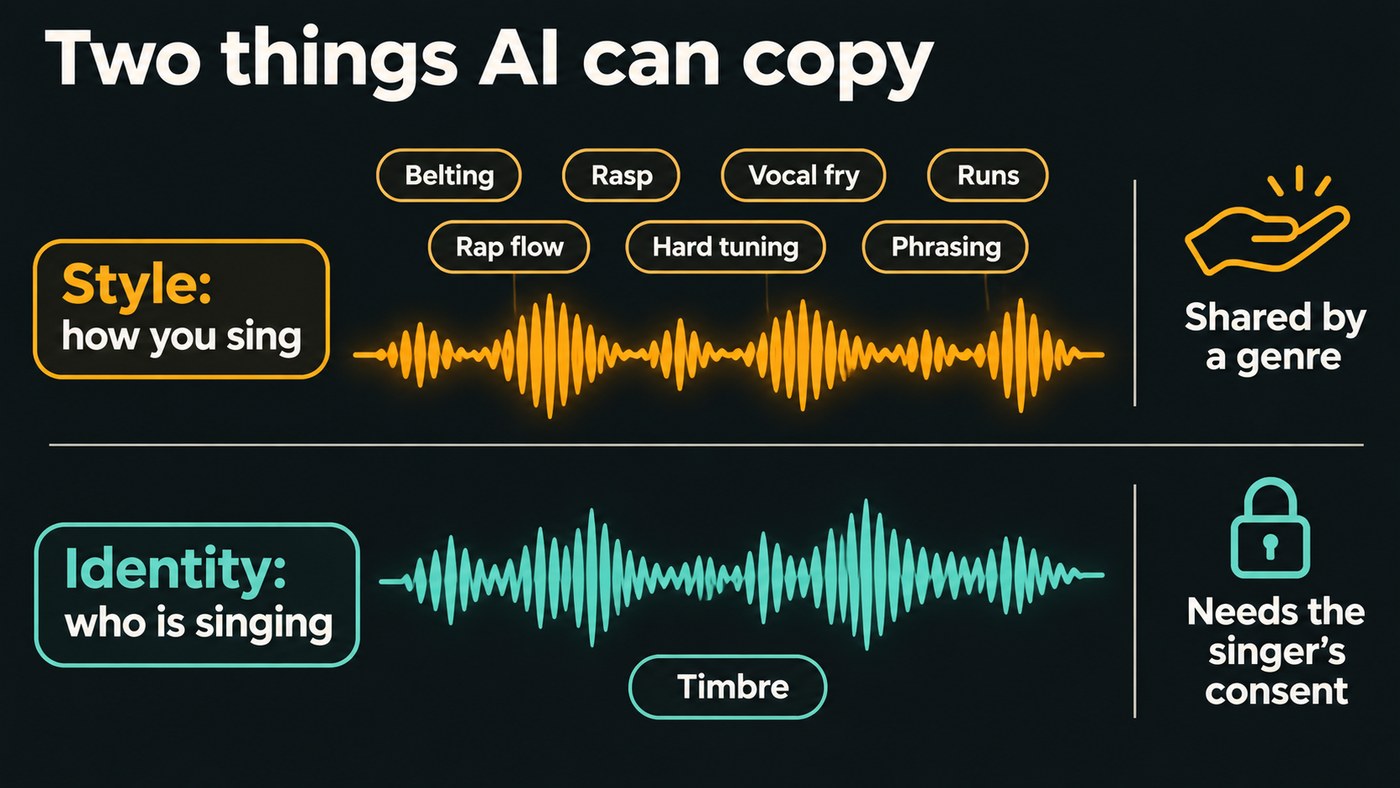
Every vocal carries two layers.
Style is how someone sings. It is the shared vocabulary of a genre:
- belting and chest-voice power in pop, musical theatre and rock
- rasp and grit in rock, soul and country
- vocal fry at the start of phrases in pop and R&B
- melisma, the runs across several notes on one syllable, in gospel and R&B
- rap flow: where syllables land against the beat and how the rhymes push the line
- the hard-tuned, stepped pitch of a lot of modern pop and trap
- phrasing: singing behind the beat, scooping into notes, clipping line endings
Identity is who is singing: timbre, the colour that makes two singers on the same note sound like two people.
Researchers draw the same line. The TCSinger paper (2024) treats timbre and style as separate targets and defines style as singing method, emotion, rhythm, technique and pronunciation. The organisers of the Singing Voice Conversion Challenge 2023 note that a person's singing style can't be seen from their speech alone.
A genre's style is something every singer learns from. A specific person's timbre belongs to that person.
How can AI models mimic specific vocal styles or genres?
There are four main routes, and each one copies style in a different way.
1. Genre conditioning in song generators
Full-song generators learn from recordings what vocals in each genre tend to sound like, and a genre tag or prompt steers the output toward that pattern. OpenAI's Jukebox paper (30 April 2020) described the mechanism plainly: "We can condition on artist and genre to steer the musical and vocal style, and on unaligned lyrics to make the singing more controllable."
That sentence also shows where the risk sits: a genre gives you a style, while an artist label pulls toward one person's identity. For how these controls behave in current tools, see how AI music generators handle genre and mood control.
2. Style presets and reference voices in singing generators
Singing generators turn your lyrics into a vocal in a chosen style. Soundverse's AI Singing Generator has eight built-in voices: female pop, male pop, rap, hip-hop, rock, metal, vocal chops and choir. Its style list shows 24 options, and its own page says styles such as Gregorian Chant or ASMR Singing have no voice of their own and are sung in one of the eight, usually female pop. A style label is only as good as the voice data behind it, so test the exact style you need.
3. Singing voice conversion: you supply the style
Voice conversion changes who is singing and keeps how it was sung. Pitch, timing, phrasing, runs and breaths come from the source take, and the model swaps the timbre. Sing a gospel run and the converted vocal keeps it; if you can't sing the run, conversion won't add it.
In the SVCC 2023 listening tests, the top system reached human-level naturalness, yet no team matched the target singers on similarity, and converting into a voice known only from speech was harder than converting into one known from singing.
4. Note-based vocal synths with style parameters
Vocal synths sing the notes you draw and expose style as parameters. ACE Studio's docs list a Dynamic envelope that runs from soft to powerful, plus Air (raspier and brighter), Falsetto, Tension and Energy. Some of its AI singers add special controls: Rap increases the clarity, speed and rhythm of the articulation, and Chinese Opera adds that tradition's melismatic and ornamental sounds. The same docs warn that extreme values may give unexpected results.
Research is moving toward named techniques. The GTSinger corpus (2024) holds 80.59 hours of singing from 20 professional singers in nine languages, with phoneme-level labels for six techniques: mixed voice, falsetto, breathy, pharyngeal, vibrato and glissando. For the engines underneath, read how AI voice synthesis generates singing vocals.
Where AI style mimicry works and where it breaks
Usually convincing:
- broad genre feel: pop polish, R&B smoothness, moderate rock grit, rap cadence on a steady beat
- soft versus powerful delivery, breathiness and falsetto, which many tools expose as direct controls
- vibrato and slides between notes
- the hard-tuned sound, which is mostly a pitch-correction setting (a very fast retune) you can add after the vocal
Often weak:
- Ornamentation. Fast runs, gospel melisma, Indian gamakas and the fine pitch bends of Arabic or Turkish singing need quick, precise pitch movement, and models tend to smooth it out. The TCSinger authors note that current models often fail to produce singing rich in stylistic nuance for singers they haven't heard.
- Genre-specific diction. Country vowels, Jamaican patois, regional rap slang and switching languages mid-line. ACE Studio's docs say each AI voice generates its phoneme timing from its own accent and singing style, so a voice built in one accent carries that accent into another genre.
- Extreme techniques. Growls, screams, heavy vocal fry, yodelling and belts at the very top of a range. None of them is among GTSinger's six labelled techniques, and parameters pushed that far tend to produce artefacts.
- Personality. Ad-libs, laughs, the line a singer half-speaks.
When a style breaks, sing that passage yourself and convert or comp it in. Our guide to the common challenges of expressive AI vocals walks through each failure and its repair.
The consent line: a genre is shared, a singer's voice is not
Borrowing a genre's techniques is how singers have always learned. Making a vocal that listeners could take for a specific living singer needs that singer's permission, and platforms now write this into their rules:
- Spotify added an impersonation policy for AI voice clones on 25 September 2025: "Vocal impersonation is only allowed in music on Spotify when the impersonated artist has authorized the usage." (Spotify Newsroom)
- YouTube announced on 14 November 2023 that music partners can request removal of AI-generated music that mimics an artist's unique singing or rapping voice. (YouTube Official Blog)
- Bandcamp set its policy on 13 January 2026: music generated wholly or in substantial part by AI is not permitted, and using AI tools to impersonate other artists or styles is prohibited, so prompting for another artist's style is out there too. (Bandcamp)
Soundverse draws the same line. Voice Swap only works with voices that are yours or that you have permission to use, and Train Voice Clone won't start until you confirm the voice is yours or that the singer has given explicit consent. For a model of your own voice, our comparison of the best AI tools to clone a specific vocal timbre covers the options.
The working rule: name techniques, not singers. "Raspy chest-voice chorus, breathy verses, a short run on the last word" gets you the genre. "Sounds exactly like [famous singer]" asks for someone's identity.
How to get a genre's vocal style without copying a singer
- List the techniques. For classic soul, that might be chest-voice belts, rasp on held notes and call-and-response ad-libs.
- Pick the route. Genre tags in a song generator to sketch, style presets in a singing generator for a vocal on its own, a vocal synth for note-level control, or conversion when you can sing it.
- Sing the hard parts. Runs, tricky diction and extreme sections usually sound better sung and converted than generated.
- Keep your own voice as the identity. Train a clone of your voice, then pair it with a genre you rarely sing. Soundverse's voice clone page suggests a Quick Style tag such as Bossa-Nova or Synthwave in AI Song Generator's Custom mode.
- Let production finish the style. Hard tuning, saturation, doubles and the right reverb do much of a genre's work.
- Check the weak spots. Solo the runs, the consonants and the loudest notes.
Where Soundverse fits
Soundverse is an AI music platform that takes you from idea to audience, built for independent artists who release music. AI Singing Generator sings your lyrics as an a cappella vocal in a pop, rap, hip-hop, rock, metal, choir or vocal-chops voice, or in a voice like a reference of 30 seconds or more that you have the rights to. Train Voice Clone learns your voice from one take with at least 15 seconds of singing, so AI Song Generator can sing new songs in it, including styles you don't usually sing. Voice Swap keeps your performance and changes the voice, carrying a style you can sing into a voice you're allowed to use. AI Remix remakes a finished song in a new genre, and on Pro and Max, Soundverse v9 is the newest song model. Licensing is set by plan: the Free plan is for personal use, and the Creator plan comes with a royalty-free license.
This demo shows AI Singing Generator turning lyrics into an a cappella vocal with no instrumental, guided by a vocal reference.
FAQ
Can AI sing exactly like a famous singer?
Models can get close to a well-known timbre, but releasing that without the singer's permission breaks Spotify's impersonation policy and can be removed on YouTube. Sing the techniques you admire in your own voice instead.
Can AI do metal screams or growls?
Partly. Some tools, including Soundverse's AI Singing Generator, offer a metal voice, but extreme techniques are where synthesis breaks first. For a release, record the screams yourself.
Does voice conversion change my singing style?
No. Conversion keeps your pitch, timing and phrasing and changes the timbre. To get a different style, change the performance you feed in, or use a singing generator or vocal synth with style controls.
Which AI approach gives the most control over vocal style?
Note-based vocal synths, because you draw every note and shape parameters such as tension and breathiness. Conversion comes next, since the style is whatever you sing. Our comparison of the best AI singing generator platforms goes through the options.
Sign up for Soundverse free and try a vocal style on your own lyrics.
More vocal guides on the Soundverse blog.