Building AI Music Pipelines: A 2026 Guide to Scalable, Ethical Music Automation
Explore how to build AI music pipelines for ethical, automated music production in 2026.
Building AI Music Pipelines
Artificial intelligence continues to redefine creative workflows, and music production is no exception. As generative audio platforms mature, building effective AI music pipelines has become a core priority for technologists and developers seeking to streamline complex, multi-step musical creation. In 2026, the emphasis has shifted toward ethical infrastructure—where machine learning in music supports creativity without compromising artist rights or transparency.
What are AI music pipelines?
AI music pipelines are structured processes that connect multiple stages of music automation—from data preparation and model training to generation, attribution, and output delivery. In essence, a pipeline transforms raw musical information into usable, high-quality generative outputs. Each stage is interdependent, allowing scalable automation and dynamic customization based on user or artist input.
A typical pipeline for generative audio includes:
- Data sourcing – Gathering legal and high-quality music data for machine learning models.
- Model training – Using machine learning in music to understand sonic features and compositional patterns.
- Inference and generation – Transforming user prompts or descriptions into coherent compositions.
- Attribution and verification – Embedding metadata to confirm the origins and contributors.
- Export and delivery – Preparing generated tracks for release, mixing, or integration into media projects.
This structured approach ensures both creative freedom and ethical compliance, forming the backbone of modern automated music production systems.
Why are AI music pipelines crucial for 2026?
As the global AI music ecosystem expands, data ethics and transparency have become non-negotiable. In 2024 and 2025, rapid experimentation led to numerous black-box models that lacked explainability or attribution. In 2026, the focus has evolved into building responsible infrastructures that respect intellectual property and ensure compensation for creators.

Key reasons AI music pipelines now matter more than ever:
- Scalability: Reliable pipelines handle vast audio datasets while maintaining artistic integrity.
- Consistency: By controlling every stage, developers can manage output quality and stylistic coherence.
- Ethical relevance: New frameworks guarantee consent-based data and recurring artist rewards.
- Compliance: Enterprise users must ensure licensing compliance within automated workflows.
- Innovation enablement: Transparent pipelines promote research in generative audio and hybrid human-AI composition.
For those tracking ongoing innovation, related articles such as how AI-generated music is transforming the music industry have documented real-world adoption among production houses and composers. Industry forecasts like Music tech predictions for 2026 also highlight AI’s growing influence in music and gaming ecosystems.
How do AI music pipelines enable ethical generative audio?
Ethical generative audio depends on building AI music pipelines that guarantee every step is explainable, traceable, and fair. Instead of scraping random datasets or training unlicensed models, ethical pipelines implement structured safeguards—including consent validation and compensation tracing.
In practice, every interaction layer—training, inference, and export—must be auditable. Traceable metadata tags coupled with watermarking technologies prevent misuse and assure artist recognition. Additionally, explainable inference allows users to understand why a particular musical output exists and which creative elements contributed to it.
With new partnerships and standards emerging in 2026, companies are embracing transparent frameworks to align AI composition with creative accountability. For example, platforms like Bandcamp continue to advocate for musician-centered AI approaches.
What technologies drive modern AI music pipelines?
Music automation integrates a diverse range of technologies. Key innovations include:
- Machine learning architectures: Neural networks and transformers optimized for time-series and spectral audio data.
- Feature embedding and style transfer: Converting timbral signatures or rhythmic DNA into recurrent embeddings for model conditioning.
- Generative diffusion models: Capable of producing nuanced textures and genre-specific outputs.
- Automated evaluation metrics: Systems that assess musicality, coherence, or diversity automatically.
- Rights tracking layers: Blockchain-like registries or embedded watermarking systems for attribution and monetization tracking.
These technologies converge to form a seamless, intelligent workflow that pushes generative audio beyond simple novelty. For developers and composers, this means turning experimentation into production-ready, royalty-safe music assets that align with long-term licensing standards. For a deeper dive, watch our guide on creating Deep House music from the Soundverse Tutorial Series.
What challenges occur when building AI music pipelines?
While the benefits are evident, challenges persist in 2026 as the industry seeks balance between creativity and compliance:
- Data licensing complexity – Negotiating rights for training data remains difficult.
- Model opacity – Many deep-learning models still struggle to provide intuitive interpretability.
- Attribution tracking – Ensuring consistent tagging across outputs is an ongoing technical hurdle.
- Scalable integration – Coordinating generations across multiple pipelines demands high interoperability.
- Ethical enforcement – Verifying consent retrospectively is impractical without transparent data groundwork.
Research initiatives continue to refine these mechanisms, ensuring AI composition frameworks can coexist with traditional music industries. Articles such as navigating the world of royalty-free and copyright-free music using Soundverse AI further demonstrate how integrated transparency safeguards creative trust. According to AI Music Analysis 2026, descriptive AI and auto-tagging contribute to automated metadata precision—key components for transparency.
How to make AI music pipelines transparent and traceable
Building transparent pipelines requires deliberate engineering choices. Foundational steps include:
- Define licensed datasets – Only use verified, permissioned recordings.
- Design explainable models – Incorporate features that can be mapped to identifiable sources.
- Implement watermarking – Embed ownership metadata across all generated outputs.
- Activate global search layers – Scan external platforms for derivative works to ensure compliance.
- Introduce recurring compensation programs – Automate payments for licensed contributors.
Transparent design promotes sustainability, encouraging cumulative participation in generative ecosystems instead of extractive, opaque practices.
Now that you understand the principles behind AI music pipelines, here is how to create and manage them effectively using Soundverse’s ethical infrastructure.
How to make AI music pipelines with Soundverse The Ethical AI Music Framework
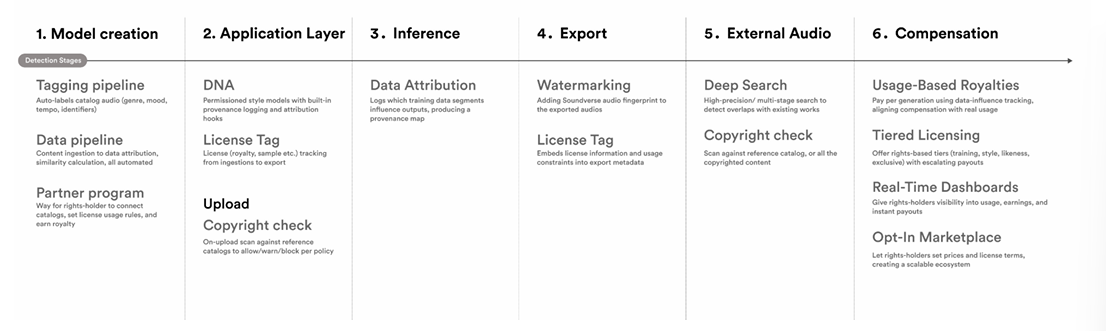
The Ethical AI Music Framework by Soundverse represents the industry-standard infrastructure for building transparent and ethical AI music pipelines. It’s specifically crafted to bridge innovation with artist integrity, eliminating the opacity that characterizes typical black-box models.
Six-Stage Architecture
Soundverse’s framework follows a clear six-stage pipeline:
- Licensed Data Sourcing – Uses only consented and licensed datasets; no scraping involved.
- Permissioned Models (DNA) – Artists train their own models, preserving stylistic identity while ensuring authorized generative use.
- Explainable Inference (Attribution) – Each output maintains traceable references linking back to contributors.
- Traceable Export (Watermarking) – The generated music includes embedded, verifiable watermarks.
- Deep Search (External Scanning) – Actively monitors external platforms for unauthorized usage of outputs.
- Recurring Compensation (Partner Program) – Provides continuous, automated rewards to the creators whose content powers generation models.
This structure creates a circular music ecosystem—where automation enhances production but remains ethically grounded. Videos like How to Make Music from the Soundverse Tutorial Series showcase practical implementations of such frameworks.
Integration Across Products
Beyond the core framework, Soundverse provides complementary tools that extend pipeline capabilities:
- Soundverse DNA – The artist-trained generative engine enabling AI composition based on sonic identity.
- Soundverse Trace – The trust layer embedding watermarking and external deep-search verification.
- Soundverse API – Programmatic access for developers to integrate DNA and Trace into their production systems.
Developers or audio technologists can easily connect these components using asynchronous workflows: upload, process, and receive results with transparent metadata. There’s no real-time preview—everything operates through secure, permissioned processing for audit readiness.
Practical Applications
Enterprise users leverage The Ethical AI Music Framework to:
- Ensure legal compliance in creative automation.
- Protect artist rights during AI training.
- Sustainably monetize catalog styles.
- Provide transparent auditing of AI outputs for partners and rights holders.
By 2026, the framework has become foundational for companies scaling ethical music automation pipelines globally. To explore further applications, check related guides such as generate AI music with Soundverse text-to-music or Soundverse Assistant: your AI music co-producer. For another look at workflow design, see our Explore Tab walkthrough on YouTube.
Start Building Your Own AI Music Pipeline Today
Unlock next-level creativity with Soundverse's intelligent tools that help you compose, mix, and produce music seamlessly using AI-powered workflows. Bring your musical ideas to life faster and smarter.
Try Soundverse Free
Related Articles
- Soundverse Introduces Stem Separation AI Magic Tool — Discover how Soundverse’s advanced AI stem separation tool revolutionizes the way producers work with complex sound layers.
- How AI-Generated Music Is Transforming the Music Industry — Explore the impact of AI-generated music on modern production trends and the future of independent creators.
- Soundverse Assistant: Your AI Music Co-Producer — Meet the Soundverse Assistant, an intelligent creative partner that streamlines song composition and arrangement tasks with precision.
- Generate AI Music with Soundverse Text-to-Music — Learn how to turn text prompts into fully produced tracks using Soundverse’s powerful text-to-music engine.
Here's how to make AI Music with Soundverse
Video Guide
Here’s another long walkthrough of how to use Soundverse AI.
Text Guide
- To know more about AI Magic Tools, check here.
- To know more about Soundverse Assistant, check here.
- To know more about Arrangement Studio, check here.
Soundverse is an AI Assistant that allows content creators and music makers to create original content in a flash using Generative AI. With the help of Soundverse Assistant and AI Magic Tools, our users get an unfair advantage over other creators to create audio and music content quickly, easily and cheaply. Soundverse Assistant is your ultimate music companion. You simply speak to the assistant to get your stuff done. The more you speak to it, the more it starts understanding you and your goals. AI Magic Tools help convert your creative dreams into tangible music and audio. Use AI Magic Tools such as text to music, stem separation, or lyrics generation to realise your content dreams faster. Soundverse is here to take music production to the next level. We're not just a digital audio workstation (DAW) competing with Ableton or Logic, we're building a completely new paradigm of easy and conversational content creation.
TikTok: https://www.tiktok.com/@soundverse.ai
Twitter: https://twitter.com/soundverse_ai
Instagram: https://www.instagram.com/soundverse.ai
LinkedIn: https://www.linkedin.com/company/soundverseai
Youtube: https://www.youtube.com/@SoundverseAI
Facebook: https://www.facebook.com/profile.php?id=100095674445607
Join Soundverse for Free and make Viral AI Music

We are constantly building more product experiences. Keep checking our Blog to stay updated about them!