Billboard Chart Eligibility Rules Explained: Everything Musicians Need to Know in 2026
Learn the Billboard chart eligibility rules shaping 2026 rankings for songs & albums.
Billboard Chart Eligibility Rules Explained
Understanding Billboard Chart Eligibility Rules in 2026
Navigating the Billboard chart eligibility rules has become a crucial part of music marketing and release strategy for artists and labels in 2026. With the rise of AI-generated music, streaming manipulation concerns, and hybrid distribution models, Billboard has tightened its standards to ensure fairness and to reflect genuine listener engagement.
This guide breaks down what makes a song or album eligible for Billboard rankings, how chart rules have evolved since 2024, and how tools like Soundverse Trace enable musicians and rights-holders to maintain transparent music attribution—especially for AI-driven creations.
What are Billboard Chart Eligibility Rules?
Billboard chart eligibility rules define which musical works—songs, albums, or streaming releases—qualify to appear on official Billboard charts, such as the Hot 100, Billboard 200, or genre-specific charts. These rules determine how Billboard calculates chart positions based on:
- Sales and Streams: Physical and digital album sales, track downloads, and verified streams via recognized platforms.
- Airplay Metrics: Audience data from licensed radio stations and digital broadcasters.
- Engagement Authenticity: Prevention of artificial inflation through bots, looping streams, or playlist raids.
For an artist or label, mastering these guidelines ensures that marketing efforts convert into measurable chart success rather than wasted potential.

How Have Billboard Chart Rules Evolved Since 2024?
Between 2024 and 2025, the music industry witnessed rapid shifts toward automation and digital-first releases. As AI-generated music became accessible through platforms such as Soundverse AI, Billboard adapted its systems to handle provenance, licensing transparency, and fair play.
By 2026, Billboard introduced new clauses to manage the balance between human and AI-made content:
- Verification of Authorship: AI-assisted songs must include verifiable metadata identifying creators, rights-holders, and training sources.
- Exclusion of Inauthentic Streams: Billboard now cross-validates stream sources to eliminate automated bots. The organization’s verification model also aligns with updates such as Billboard Changes Chart Rules to Give Paid Streaming More Power.
- Phased AI Recognition: Certain AI compositions are accepted if rights attribution follows official ethical training frameworks, such as the Soundverse Content Partner Program.
These regulations are setting new benchmarks for transparency and levelling the playing field for independent creators.

Which Songs and Albums Are Eligible for Billboard Charts in 2026?
To qualify under Billboard’s current chart rules, artists and distributors must meet several criteria:
- Official Release Through Recognized Channels: Music must be distributed via authorized digital service providers (DSPs) like Spotify, Apple Music, Amazon Music, or equivalent services.
- Verified Metadata: Each track must include accurate ISRC and UPC codes, ensuring identification across sales and streaming platforms.
- Rights Transparency: Billboard now requires songs, especially those involving AI contributions, to list licensing and origin metadata.
- Fan Engagement Validity: All user engagement metrics must come from bona fide streams, airplay, and purchase data.
- Exclusivity Handling: Exclusive drops (limited-time album launches or fan-only streams) can count, but only when open to public access during release week.
Artists who integrate transparent attribution frameworks—like Soundverse Trace—gain an edge in compliance and trust, ensuring every stream is recognized as legitimate.
Why Are Billboard Rankings More Important Than Ever in 2026?
Billboard rankings are a reflection of music success in the digital age. By 2026, these charts influence playlist placement, sponsorships, sync licensing deals, and artist discovery algorithms. In a marketplace flooded with AI-assisted releases, authenticity is now a competitive asset.
Proper compliance with music industry guidelines around accuracy, metadata, and rights attribution translates to real-world visibility. Billboard’s stricter approach ensures that:
- Viral songs stay ethically sourced.
- Artists get credited for genuine popularity.
- Regulators and rights-holders maintain transparency in royalties.
This aligns perfectly with other ongoing shifts highlighted in resources such as Music Industry Trends and AI Music in the USA.
How Billboard Measures Streams and Sales in 2026
Streaming and sales remain the core metrics for Billboard rankings, but in 2026, the verification technology behind these measurements is more advanced than ever.
- Paid Streams vs. Free Streams: Billboard differentiates between paid subscription streams and ad-supported streams. Premium listens carry greater weight in chart points. According to Billboard Announces Major Chart Rule Change - HipTV, ad-supported streams now require 2,500 plays to equal one album unit.
- Global Chart Integration: Cross-territory data integration now includes international affiliates with standardized datasets.
- AI Detection: Billboard uses metadata audits to confirm whether track origins comply with registered creators and dataset transparency frameworks.
For artists experimenting with AI music generation platforms like Soundverse Magic Tools, the presence of embedded watermarking or attribution proof ensures your AI-assisted track isn’t flagged as unverifiable.
For a deeper dive, watch our guide on creating Deep House music and tutorial on how to make music.
How to Make Your Release Billboard-Compliant
Musicians aiming for Billboard recognition in 2026 should prioritize transparency, licensing, and accurate dataset documentation. Here’s what experts recommend:
- Secure Proper Licensing: Register works with relevant collecting societies and maintain accurate ownership splits.
- Maintain Digital Metadata Integrity: Ensure ISRC/UPC codes match across stores and streaming services.
- Use Verified Attribution Systems: Adopt trusted copyright management platforms like Soundverse Trace to embed licenses within your audio files.
- Avoid Stream Manipulation: Prevent repeat bots, playlist farms, or artificial promotion tactics.
- Monitor Royalty Attribution: Track payout channels to ensure all rights-holders receive fair shares.
Without compliance, a single data gap can disqualify an otherwise viral track.
How to Ensure AI Music Follows Billboard Chart Rules
As AI composition tools grow, Billboard requires definitive proof of authorship and rights sourcing. Under the current music industry guidelines, AI-generated songs are valid for charts only if creators can demonstrate transparency in their process.
That’s where provenance verification technology like Soundverse Trace becomes essential.
How Billboard Chart Rules Intersect with AI Music Ethics
In parallel with the Billboard updates, 2026 established stronger industry ethics frameworks ensuring fair compensation for creators behind training datasets. The Ethical AI Music Framework—developed initiatives like Soundverse’s Content Partner Program—encourage respect for human artistry in machine learning models.
By using verifiable metadata embedded directly into AI outputs, artists can demonstrate that their content meets both ethical and commercial compliance standards.
For example, AI-generated songs can now leverage embedded license tags confirming any underlying dataset consent—a game-changer for chart qualification.
How to Align AI Music with Billboard Eligibility Using Soundverse Trace
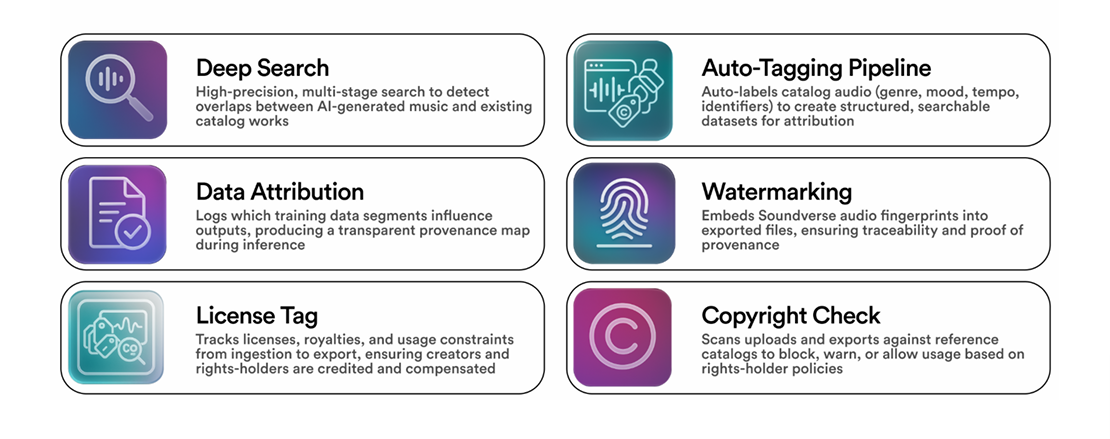
How to make Billboard chart eligibility rules compliant music with Soundverse Trace
Soundverse Trace is a dedicated trust layer for AI music that enforces attribution, rights protection, and transparency from inception to release. It ensures that every sound, stem, or audio file generated or exported carries immutable proof of provenance.
Key capabilities include:
- Deep Search: High-precision scanning and comparison (1:1, 1:N) to detect overlap or reused audio.
- Data Attribution: Tracks which training data influenced an output for clear author credit.
- Audio Watermarking: Embeds inaudible fingerprints proving ownership and origin.
- License Tagging: Preserves rights metadata from ingestion to export, ensuring downstream recognition.
Artists and producers working in AI composition benefit by confirming their catalog integrity before submission to distributors. This automation translates directly into Billboard compliance, as each verified Soundverse output preserves traceable metadata.
For rights-holders, Trace automates royalty distribution or takedown processes when infringements occur. In other words, beyond creative control—it’s an administrative safeguard ensuring Billboard’s new verification models accept your data as legitimate.
If your artistic workflow involves multiple AI collaborators, the integration with the Soundverse Assistant further simplifies submission readiness.
Why Transparency Tools Are the Future of Billboard Eligibility
In 2026, transparency is no longer optional; it is the currency of credibility. The Billboard chart system, powered by advanced AI validation protocols, now requires every claim of authorship or dataset ownership to have proof. Therefore, technological ecosystems like Soundverse Trace have become the backbone of compliance.
Soundverse’s model reflects an ongoing maturity in the intersection of music and machine learning—bridging innovation with integrity. When artists use AI responsibly and transparently, Billboard rewards them with visibility that cannot be achieved through shortcuts.
Get Your Music Chart-Ready with AI
Use Soundverse AI to fine-tune your sound, ensure quality production, and prepare tracks that meet Billboard chart eligibility rules. Start creating radio-ready music today.
Start Creating with Soundverse
Related Articles
- How AI-Generated Music is Transforming the Music Industry — Explore how artificial intelligence is reshaping the way artists produce, distribute, and monetize their music.
- Navigating the World of Royalty-Free and Copyright-Free Music Using Soundverse AI — Learn how to find and generate music that fits copyright standards while staying legally safe as a creator.
- What AI Can Generate Songs — Discover the different AI tools and technologies available to automatically generate music and lyrics.
- The Role of AI Music in Film and Television — See how artificial intelligence is shaping soundtracks and background scores in modern visual media.
Here's how to make AI Music with Soundverse
Video Guide
Here’s another long walkthrough of how to use Soundverse AI.
Text Guide
- To know more about AI Magic Tools, check here.
- To know more about Soundverse Assistant, check here.
- To know more about Arrangement Studio, check here.
Soundverse is an AI Assistant that allows content creators and music makers to create original content in a flash using Generative AI. With the help of Soundverse Assistant and AI Magic Tools, our users get an unfair advantage over other creators to create audio and music content quickly, easily and cheaply. Soundverse Assistant is your ultimate music companion. You simply speak to the assistant to get your stuff done. The more you speak to it, the more it starts understanding you and your goals. AI Magic Tools help convert your creative dreams into tangible music and audio. Use AI Magic Tools such as text to music, stem separation, or lyrics generation to realise your content dreams faster. Soundverse is here to take music production to the next level. We're not just a digital audio workstation (DAW) competing with Ableton or Logic, we're building a completely new paradigm of easy and conversational content creation.
TikTok: https://www.tiktok.com/@soundverse.ai
Twitter: https://twitter.com/soundverse_ai
Instagram: https://www.instagram.com/soundverse.ai
LinkedIn: https://www.linkedin.com/company/soundverseai
Youtube: https://www.youtube.com/@SoundverseAI
Facebook: https://www.facebook.com/profile.php?id=100095674445607
Join Soundverse for Free and make Viral AI Music

We are constantly building more product experiences. Keep checking our Blog to stay updated about them!
Image Steps: []