Best AI Vocal Synthesizers for Cinematic Sound Design?
Best AI vocal synthesizers for cinematic sound design: AI choirs, whispers, morphing voices and voice-to-instrument tools, and when a sampled choir wins.
For cinematic sound design, the strongest AI vocal synthesizers are Synthesizer V Studio 2 Pro with Dreamtonics' Choir Voices for sung ensembles, ACE Studio for unison stacks and voice-to-instrument conversion, and VOCALOID7 for whispers and robotic styles. Add morphing tools such as Vocoflex or Neutone Morpho, and keep a sampled choir for evolving textures.
Sound design here means voices used as texture and drama under picture: a trailer choir swelling into a hit, a horror whisper, a not-quite-human creature, a hummed motif returning as a duduk. Each tool below is checked against its maker's own pages, read on 19 November 2026. Dreamtonics blocks automated readers, so its details come from its pages as captured on the Wayback Machine between 11 and 15 November 2026. For the wider picture of AI in this work, see how AI is used in audio and sound design.
What cinematic sound design needs from an AI vocal tool
- Choirs that sing your words, in parts, from a handful of voices to a full section.
- Wordless pads and swells: long "ah" and "oo" sustains that can crescendo into an impact.
- Whispers and breath for horror, tension and close-up intimacy.
- Morphing and vocal FX for creatures, machines and voices that drift between people.
- Voice-to-instrument, so a motif you hum becomes strings, winds or percussion.
- Material to stretch and freeze with granular and spectral processing afterwards.
No single tool covers all six, which is why most cues end up layered.
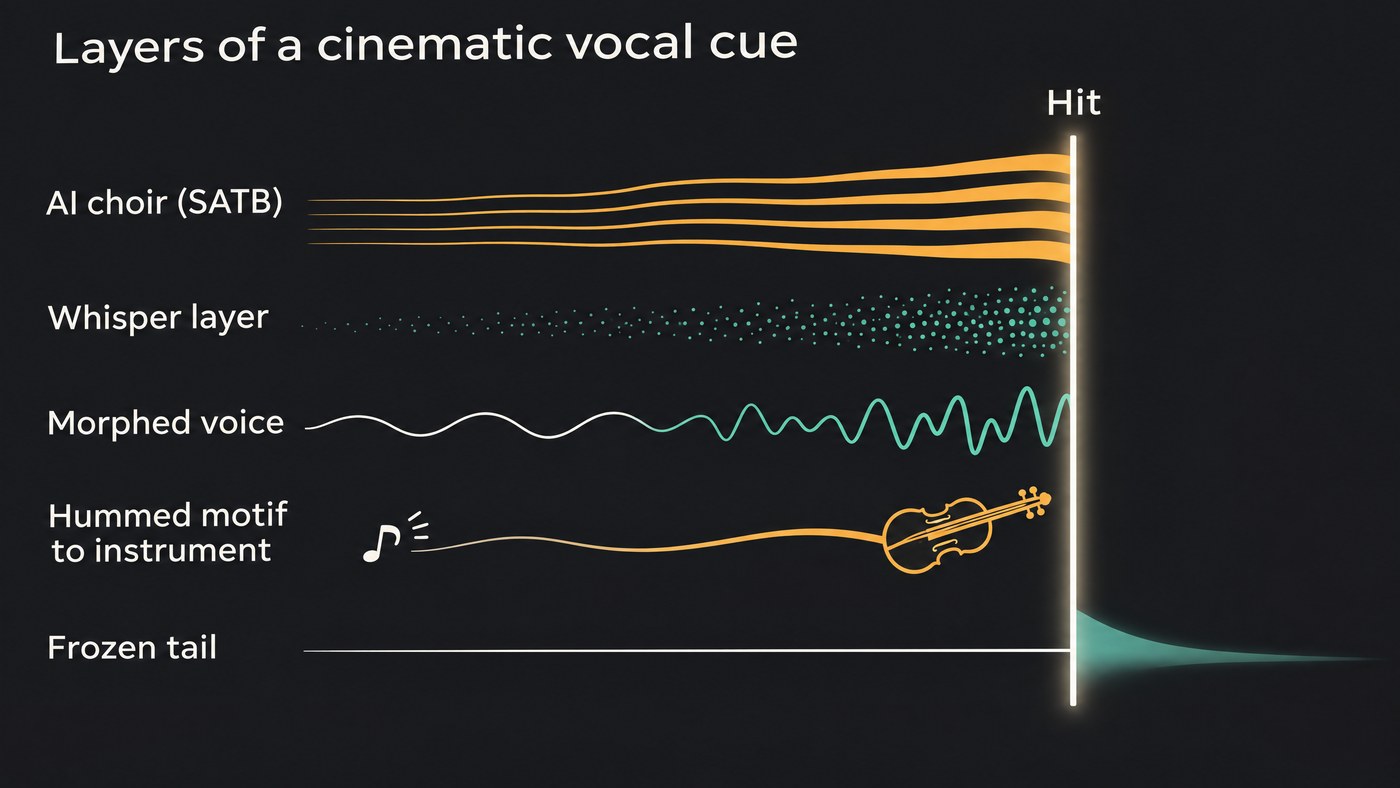
The best AI vocal synthesizers for cinematic sound design
Synthesizer V Studio 2 Pro with Choir Voices (Dreamtonics)
Dreamtonics' Choir Voices page lists three collections that run inside Synthesizer V Studio 2 Pro. Collection 2, with soprano, mezzo-soprano, tenor and baritone voices, is the one Dreamtonics tailors to classical, operatic and cinematic scoring. Each part scales from a single soloist to a 16-member ensemble, with sliders for pitch and timing dispersion, so the same line can be a tight stab or a loose, breathing wash. The choirs sing English, Mandarin, Japanese, Spanish, Cantonese and Korean lyrics.
The user manual's Unison and Choir page adds Shuffle Members to swap singers and their positions, Choir Spread to vary each note's start, pitch and phrase end, and Split Unison into Tracks when you want to edit singers one by one. For whisper layers, lowering the Voicing parameter makes any Synthesizer V voice more whisper-like.
Dreamtonics frames the difference from samples this way: "Traditional choir sample libraries rely on pre-recorded phrases, syllables, or articulations, which limits flexibility and often requires complex layering or editing to approximate new lyrics or expressions." Each collection was $179, with a 7-day trial, as captured.
Best for: trailer and score choirs that must sing specific words in specific parts.
ACE Studio
ACE's Unison Mode, called Choir Mode up to version 2.1.1, combines several AI voices on one track. Offset adds small timing differences, Spread sets the stereo width, Gain balances each voice, and you can save the setup as a preset and add the Room effect for space.
For a stab choir, ACE's Choir Rehearsal guide suggests voices including Clara Epic, a cinematic female soprano, plus opera voices Karolyn, Aaron and Robert. You can also import a choral score as MusicXML. Singers that support it get an Opera control that adds bel canto resonance for a grander tone.
ACE's Voice Changer has an Instruments tab that turns a vocal region into instrument sounds, with a practical warning: "If you want to convert to instrument sounds, please note that regular singing vocals as the input source may not produce ideal instrument sounds due to the significant differences in their expressive forms." Sing the way the instrument plays. ACE 2.0 also added AI instruments including violins, cellos, trumpets and the duduk, and a Video Composer that generates music and sound effects to match an imported video.
Best for: fast unison stacks and hybrid vocal-orchestral sketches in one app.
VOCALOID7 (Yamaha)
The VOCALOID7 page lists more than 100 style presets, running from lead and chorus vocals to robotic voices, each recalling a combination of parameters and effects. The LUCI voicebank includes a Whisper voice type alongside Normal and Power. The page lists no unison or ensemble feature, so build stacks track by track.
Best for: Cubase users who want whispered or robotic layers without leaving the DAW.
Vocoflex (Dreamtonics)
Vocoflex, as its product page read when captured on 15 November 2026, morphs a live or recorded voice between target voices, which Dreamtonics pitches for exotic, superhuman effects. You can automate the movement in your DAW or steer it from a MIDI controller with waypoints, and its license names sound and character design among the uses. The page also lists its limits: no choirs, distorted input or background music.
Best for: creature and character voices built from your own performance.
DDSP-VST and Neutone Morpho: voice into instrument and texture
DDSP-VST, a free plugin from Google's Magenta team, morphs audio into a range of instruments and, unlike MIDI notes, keeps the nuances of pitch and dynamics. You can play it like a synth, train your own model from a couple of minutes of audio with its free web trainer, and Magenta suggests trying it on percussive and nature sounds for stranger results.
Neutone Morpho is a real-time tone morphing plugin that resynthesizes the input in a different style while keeping the overall shape of the sound. Its models range from African drums to old radio transmissions, you can train your own, and the free version includes five models. Version 1.1.4 is dated 12 March 2026.
Best for: turning a hummed line or a breath into textures no singer could make.
Prompt-based generators
ElevenLabs' music prompting guide suggests putting "a cappella" before a vocal description, as in "a cappella male chorus", to get vocals on their own. Its sound design examples include a cathedral bell that slowly turns out to be a choir as it decays. It's useful for one-off textures, but gives you far less say over words and voicing than a vocal synth.
When a classic sample library is the better choice
Spitfire's Eric Whitacre Choir was recorded with 22 singers at The Hall at AIR Studios, conducted by Whitacre, and holds 170 techniques in its Choir section plus 111 Evolutions in its Evo Grid, sounds that change over time. That's about 200 GB of a real choir, from vowels whose colour shifts with mouth shape to shorts and rhythmic passages.
- Pick samples for wordless pads, choral effects and evolving beds, where a recorded ensemble often sounds richer than a model.
- Pick an AI choir when the text matters: lyrics, a translated line, an invented language, or a note you need to move at 2 a.m. before a review.
- Use both when you can: sampled textures underneath, an AI choir singing the words on top.
Granular and spectral tools are a separate step. Most are classic DSP rather than AI, and they work as well on an AI vocal as on a recording, so render first, then stretch, freeze, reverse or granulate.
How to build a cinematic vocal cue, step by step
- Hum the motif first and convert it to an instrument to test it, with ACE's Voice Changer, DDSP-VST or Soundverse Voice to Instrument.
- Write the choir in parts, one per track, with open vowels on the long notes. Our guide to multi-part AI vocal harmonies covers voice leading and phasing.
- Set size and looseness. Few singers and tight dispersion for a stab; more singers and wider spread for a wash.
- Layer a whisper track a few dB under the choir, on the same text, with the consonants kept tight.
- Add one inhuman layer: a morphed lead from Vocoflex or Neutone Morpho, or a robotic VOCALOID7 style.
- Print everything, then mangle the prints: reverse a swell into the hit, freeze a tail, granulate a whisper.
- Check against picture, leaving room for dialogue and effects.
Where Soundverse fits
Soundverse is an AI music platform that takes you from idea to audience, built for independent artists who release music. AI Singing Generator has a Choir style, and its page pitches it to film, game and trailer composers who need a choir layer under a cue without booking a choir; Vocal Chops gives a chopped texture for builds. Gregorian Chant, Vocoder and the whispering styles have no voice of their own and are sung in one of eight built-in voices, usually female pop, so audition before relying on them. Voice to Instrument, on every plan, plays a sung, hummed or beatboxed line on models such as sitar, bansuri, flute, tabla and dholak.
In AI Studio, Reverb One's FREEZE builds washes of up to about nine seconds, Sampler One plays a vocal across the keys, slower and lower below its root, and AI Sound Effects Generator makes booms and rising sweeps from a description. Soundverse doesn't write SATB parts or offer per-singer dispersion, so use Synthesizer V or ACE Studio for those.
This walkthrough of Soundverse's Create tools shows AI Singing Generator from 0:31 and AI Sound Effects Generator from 0:50.
FAQ
Can AI make a realistic choir for a film score? For sung text, yes: Synthesizer V's Choir Voices and ACE Studio's Unison Mode both build ensembles you can edit note by note. For wordless choral effects and evolving textures, a sampled choir recorded from a real ensemble often still sounds richer.
What's the best AI tool for horror whispers? Synthesizer V gets more whisper-like as you lower Voicing, and VOCALOID7's LUCI has a Whisper voice type. Keep the whisper layer quiet and tight under the main line. For breath detail, see whether AI can replicate breathiness and subtle vocal artifacts.
Can I turn my voice into an orchestral instrument? Yes, with ACE's Voice Changer Instruments tab, DDSP-VST or Soundverse Voice to Instrument. Sing like the instrument plays, since ACE warns that ordinary singing converts less well.
Can I use AI vocals in a commercial trailer? Read each tool's terms. Dreamtonics' choir FAQ says music made with its collections is royalty-free and lists film and game soundtracks among the uses. For music you make on Soundverse, one rule applies. Licensing is set by plan: the Free plan is for personal use, and the Creator plan comes with a royalty-free license.
Sign up for Soundverse free and try a choir layer under your next cue. More sound design and vocal guides on the Soundverse blog.