AI Music Industry Trends 2026: The Future of Artificial Intelligence in Music
Explore AI music industry trends in 2026 and how Soundverse’s Ethical AI Music Framework shapes music innovation and ethics.
AI Music Industry Trends 2026
What are the major AI music industry trends shaping 2026?
The AI music industry in 2026 stands as one of the most transformative periods in the history of digital sound creation. Over the last two years, rapid advances in machine learning, generative models, and ethical frameworks have completely reshaped how artists, producers, and tech companies interact with music. The focus has shifted away from merely generating audio to building transparent ecosystems that safeguard artists’ rights while enhancing creative potential.
The primary keyword driving industry conversations is AI music industry trends—a term representing the merging of innovation, transparency, and ethical design in modern music technology. Below are the key developments that define this evolution.
1. Ethical AI Becomes a Business Priority
After the controversies in 2024 and early 2025 regarding unauthorized music dataset scraping, the music sector demanded accountability. By 2026, ethical AI is no longer a niche concept but a central pillar of industry operations. Companies emphasize licensed datasets, artist consent, and transparent monetization systems. The future of music AI now revolves around continuous collaboration between creators and algorithms rather than exploitation.
2. Artist-Driven AI Models Overtake Generic Generators
Earlier AI tools generated music in a vacuum—beautiful, but disconnected from artist DNA. In 2026, AI systems like Soundverse DNA and similar licensed models have introduced artist-driven training. This approach transforms AI into a co-producer instead of a music copier. Musicians can train models with their catalog and style, enabling users to create new compositions inspired by their work while generating royalties for every use. It marks a sustainable milestone for artist empowerment.
3. Explainable AI and Attribution Layers Become Standard
Transparency is now the main measure of trust in music AI. Advanced layers of explainability allow producers to trace generated segments back to their source data and understand how AI arrived at its creative decisions. Attribution isn’t just a technical feature—it’s a necessary component of copyright compliance. Tools like Soundverse Trace provide auditable outputs, assuring enterprises that generated tracks truly respect intellectual property laws.
4. Music Technology 2026 Integrates Multimodality
Audio generation isn’t isolated anymore. Music platforms now combine lyrical AI, visual content generation, and emotion-based sound scoring to create full-spectrum productions. As seen in evolving collaborations across video content production (example), creators are building emotionally coherent projects guided by adaptive soundtracks. This multimodal blending is driving demand for AI music production tools that can interpret theme, vibe, and narrative context.
5. Deep Search and External Scanning for IP Protection
One of the notable music innovation trends of 2026 is deep search—an emerging standard across major music platforms. It allows automated scanning of external outputs to detect copyright violations or duplicate training data. This ensures music generated by AI remains compliant and distinct from preexisting material. Systems featuring traceable watermarks and searchable metadata have become vital components of modern licensing workflows.

6. Recurring Compensation Models Define Monetization Ethics
The monetization model of generative music drastically evolved. Instead of one-time payments or royalties based on manual tracking, AI infrastructure now incorporates recurring, usage-based compensation directly tied to attribution data. Through frameworks such as Soundverse’s Content Partner Program, artists benefit whenever their licensed material contributes to an AI-generated production.
How is artificial intelligence transforming the creative process?
By 2026, AI is deeply integrated into songwriting, composition, and arrangement. Producers no longer rely solely on idea generation; instead, they use intelligent co-creation systems that interpret detailed prompts to design soundscapes. These systems provide creative alternatives that reflect the emotional intent described by text inputs.
For instance, producers can describe a desired track—“a futuristic ambient sound evoking isolation”—and the AI interprets tone, structure, and instrumentation to produce a composition aligned with that concept. This workflow aligns with advancements outlined in Soundverse’s AI Magic Tools, showcasing how prompt-driven creativity leads to hyper-personalized music experiences. For a deeper dive, watch our guide on creating Deep House music.
What role does data licensing play in music technology 2026?
In past years, the lack of clarity around dataset sourcing brought ethical friction. Unlicensed musical data led to lawsuits that hindered adoption across major media organizations. In 2026, the conversation has shifted: licensed data sourcing and permissioned models are fundamental to trust and compliance.
Companies building music AI models now invest in large-scale agreements with labels and distributors. They integrate verified catalogs through secure pipelines to guarantee artists’ participation and fair pay. This leads to verifiable creative collaboration rather than unauthorized imitation, establishing the necessary balance between innovation and legality.
Learn more about growing trends in generative music through Generative AI in Music Market Analysis and see insights from AI in Music Market Size and Growth Forecast.
How have emerging technologies changed music distribution?
The distribution of AI-generated tracks increasingly leverages blockchain and watermarking technologies. These traceable exports ensure every copy carries embedded attribution details, allowing direct ownership verification and royalty automation. As creators and enterprises seek transparent contract execution, blockchain-connected watermarking offers a trust layer matching the modern expectations of ethical music tech.
Music AI in 2026 favors ecosystem interoperability. Artists can now distribute their AI-generated works directly to streaming platforms, metadata intact, ensuring royalties are automatically processed. This automation reflects core innovations driving the future of music AI beyond simple song creation—toward secure, recurring ownership structures. More insights on the evolution of creative distribution appear in Music industry predictions for 2026.
How to make AI music industry trends actionable with Soundverse The Ethical AI Music Framework
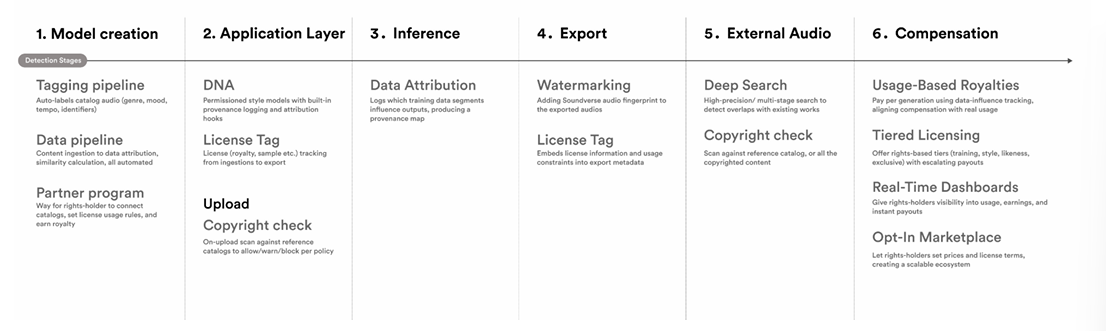
Now that you understand the leading movements influencing the future of artificial intelligence in music, let’s explore how to bring them to life with Soundverse.
Soundverse’s Ethical AI Music Framework builds the foundation for secure, transparent, and monetizable AI music creation. Its six-stage pipeline is designed specifically for enterprise and professional users requiring full compliance while fostering artist protection.
1. Licensed Data Sourcing
AI models under this framework rely exclusively on licensed, consensually provided material. There is no dataset scraping—only direct involvement from rights holders.
2. Permissioned Models (DNA)
These permission-based systems define artist identities and musical DNA, enabling consistent creative reproduction without compromising originality or violating ownership.
3. Explainable Inference (Attribution)
Every generated output is fully explainable. With embedded metadata, users and auditors can track how the AI generated specific musical sections, ensuring authentic transparency in creative processes.
4. Traceable Export (Watermarking)
Each exported audio track includes watermarking technology to maintain strong chain-of-custody integrity. This ensures that copyrights are respected when compositions enter broader distribution channels.
5. Deep Search (External Scanning)
Soundverse scans external repositories to detect possible infringements or overlapping data sources proactively, protecting both creators and enterprise adopters.
6. Recurring Compensation (Partner Program)
Through the Content Partner Program, contributors to Soundverse’s model training systems earn ongoing royalties linked to usage attribution. It is an ethical monetization approach that rewards creativity long after upload.
For professionals looking to explore additional AI production capabilities, Soundverse offers integrated tools such as Soundverse Assistant, enabling seamless project automation; Stem Separation AI Magic Tool, enhancing audio rearrangement for remixes; and inspiration-based guides like How to Create EDM with Soundverse AI that demonstrate genre matching with ethical frameworks.
Join the Future of AI Music Creation Today
Empower your creativity with Soundverse’s cutting-edge AI music tools. Generate professional-quality tracks, experiment with genres, and explore limitless musical possibilities.
Start Creating with Soundverse
Related Articles
- How AI-Generated Music Is Transforming the Music Industry — Discover how artificial intelligence is reshaping music production, collaboration, and audience engagement worldwide.
- AI Music Generator and Human Composers: A Future Together — Explore how AI complements human creativity, enabling artists to innovate and co-create in exciting new ways.
- AI Ranks Soundverse’s AI Singer #1: The Ultimate AI Singing Platform Dominating 2025 — Learn how Soundverse’s AI singing technology is setting industry standards and redefining vocal generation for 2025 and beyond.
- The Role of AI Music in Film and Television — See how AI-driven compositions are revolutionizing soundtracks and production workflows in the entertainment industry.
Here's how to make AI Music with Soundverse
Video Guide
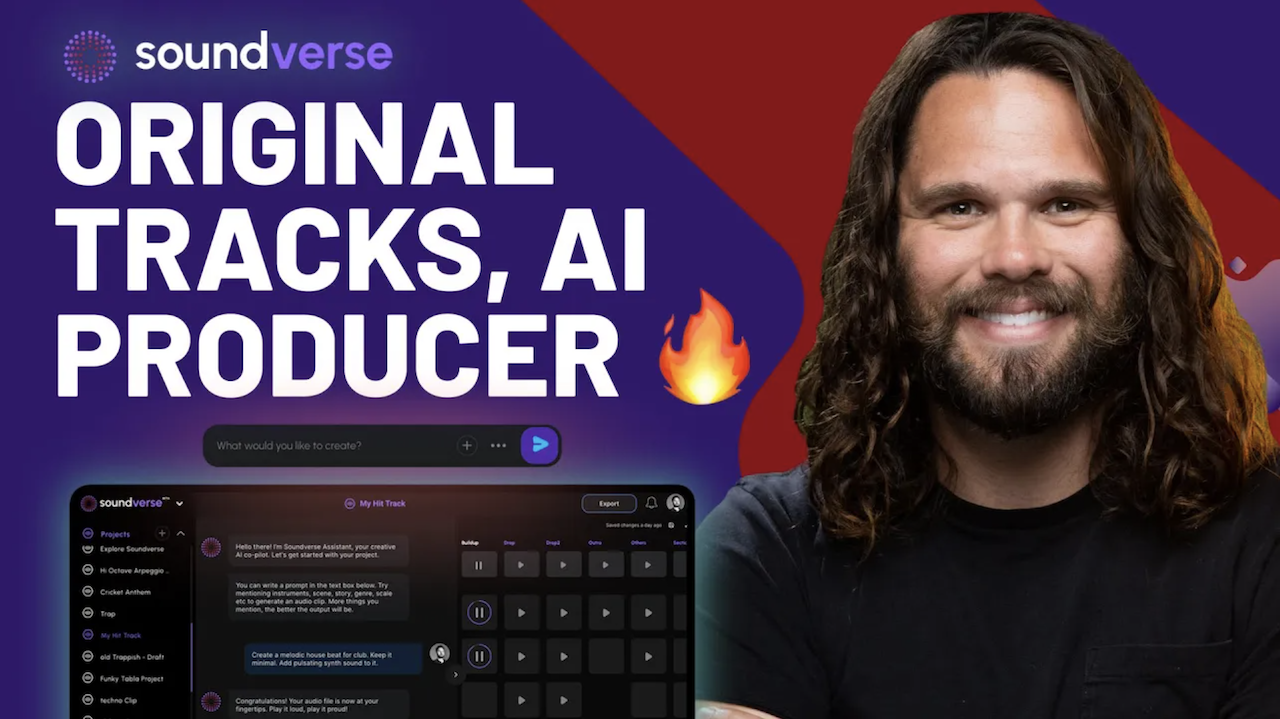
Here’s another long walkthrough of how to use Soundverse AI.
Text Guide
- To know more about AI Magic Tools, check here.
- To know more about Soundverse Assistant, check here.
- To know more about Arrangement Studio, check here.
Soundverse is an AI Assistant that allows content creators and music makers to create original content in a flash using Generative AI. With the help of Soundverse Assistant and AI Magic Tools, our users get an unfair advantage over other creators to create audio and music content quickly, easily and cheaply. Soundverse Assistant is your ultimate music companion. You simply speak to the assistant to get your stuff done. The more you speak to it, the more it starts understanding you and your goals. AI Magic Tools help convert your creative dreams into tangible music and audio. Use AI Magic Tools such as text to music, stem separation, or lyrics generation to realise your content dreams faster. Soundverse is here to take music production to the next level. We're not just a digital audio workstation (DAW) competing with Ableton or Logic, we're building a completely new paradigm of easy and conversational content creation.
TikTok: https://www.tiktok.com/@soundverse.ai
Twitter: https://twitter.com/soundverse_ai
Instagram: https://www.instagram.com/soundverse.ai
LinkedIn: https://www.linkedin.com/company/soundverseai
Youtube: https://www.youtube.com/@SoundverseAI
Facebook: https://www.facebook.com/profile.php?id=100095674445607
Join Soundverse for Free and make Viral AI Music
 We are constantly building more product experiences. Keep checking our Blog to stay updated about them!