Recommended Affordable Music Distribution Apps for New Content Creators
Affordable music distribution for new artists: free tiers, yearly plans under $25, one-time fees, what each gives up, phone apps and a 3-release plan.
The most affordable music distribution apps for new content creators are RouteNote Free, which costs nothing and keeps 15% of your earnings, and yearly plans under $25: Ditto Music Starter ($19), UnitedMasters DEBUT+ ($19.99), TuneCore CORE ($22.99), Amuse Artist ($23.99) and DistroKid Musician ($24.99). For one song only, CD Baby charges $9.99 once and keeps 9%.
Every price here comes from the company's own pricing or help page, read on 19 November 2026, in US dollars before tax. For an artist putting out a first song, the trade-offs matter more than a few dollars a year: how long delivery takes, whether you can set a date for pre-saves, when you can cash out, and whether you can release from your phone. For five-year break-even math, our comparison of music distribution pricing models runs the numbers.
Affordable music distribution, sorted by how you pay
Free, with a revenue cut
- RouteNote Free. No fees, and you receive 85% of what the release earns. RouteNote's support hub (updated 6 March 2026) says Free and Premium can go to the same stores. You can upgrade one release to Premium for $10 as a single, then $9.99 a year from the following year, and keep 100% of streaming and download revenue.
Yearly plans with unlimited releases
- Ditto Music Starter, $19 a year. One artist, unlimited releases, free pre-save smartlinks and automatic royalty splits. There's no free plan, though the pricing page invites you to try before you pay.
- UnitedMasters DEBUT+, $19.99 a year. You keep 100% of royalties, split earnings with Split Pay, build pre-save pages with MasterLinks and cash out from your Wallet to a bank or PayPal at any time. UnitedMasters says a release can go out in as little as five business days.
- TuneCore CORE, $22.99 a year. TuneCore's plans are now called CORE, PRO ($43.99) and PRO+ ($84.99). CORE includes scheduling your own release date, revenue splits and YouTube Content ID, and earnings from TikTok, Facebook, Instagram and YouTube carry a 20% fee.
- Amuse Artist, $23.99 a year. Pre-saves and smartlinks come with every plan. If you stop paying, your music stays live and Amuse keeps 25% of earnings until you subscribe again.
- DistroKid Musician, $24.99 a year. Unlimited uploads, royalty splits and free promo tools, and you keep 100% of earnings.
A one-time fee per release
- CD Baby, $9.99 per single or $14.99 per album. No yearly fee. CD Baby keeps 9% of digital distribution revenue, says it pays weekly, and includes a free UPC, ISRCs and YouTube Content ID.
Inside an app you may already use
- SoundCloud Artist, $39 a year. Distribution with 100% royalties, capped at two distributed tracks a month. Artist Pro ($99 a year) removes the cap. A free SoundCloud account can upload to SoundCloud but can't distribute to other platforms.
What you give up at the lowest price
The cheapest plan on each service saves money by trimming something. These six are the ones a first release feels.
- Delivery time. RouteNote's release timing article, updated 16 November 2026, says its moderation team is approving content within 20 to 22 working days, and stores then take 7 to 14 days to ingest a release. It adds: "Please be aware that releases containing AI-generated or AI-assisted content may be subject to additional review and therefore may take longer than our standard moderation timeframe." Amuse, by contrast, says its ASAP release typically reaches stores within 24 hours.
- Your release date, and with it pre-saves. A pre-save campaign needs a date in the future. DistroKid's pricing page lists custom release and preorder dates on Musician Plus ($44.99), not on Musician. Amuse's Artist plan needs 14 days of lead time for a scheduled date, against 7 on Artist Pro.
- Splits. If a producer or co-writer gets a share, check the fee. DistroKid, TuneCore CORE, Ditto Starter and UnitedMasters DEBUT+ include splits. Amuse Artist charges 15% on splits with collaborators who aren't on Amuse.
- Support. TuneCore lists a response time of 3 business days on CORE and 1 on PRO. Amuse rates human support as "Fast" on Artist and "Priority", under 24 hours, on Artist Pro.
- Payout minimums. RouteNote pays once you have at least $50, between the 15th and 20th of the month, by PayPal, bank transfer or Payoneer. Ditto's withdrawal guide, dated 7 September 2026, says: "You'll need at least £25 in your account to withdraw a payout." Amuse and UnitedMasters let you cash out anytime. DistroKid's and TuneCore's help centres blocked automated reading when we checked, so ask about their thresholds before you sign up.
- Store and platform reach. SoundCloud Artist stops at two distributed tracks a month. Amuse charges a 15% royalty fee on YouTube Content ID on Artist and none on Plus or Pro.
Which distribution apps work from your phone
Most distributors now have an app, but not every app can create a release.
- DistroKid. iPhone and Android apps. Its app page says you can upload unlimited songs, track stats and follow your payouts from the phone.
- Ditto Music. A free iOS and Android app for members, with uploads, scheduled releases, release status and royalty withdrawals.
- Amuse. Web, iOS and Android apps, and you manage your plan in whichever one you bought it from.
- RouteNote. Apps on both platforms, but a support article dated 29 October 2026 says you can create a release in the iOS app and not yet in the Android app.
- UnitedMasters. Says its tools work on any device, including releasing songs and managing payouts.
- TuneCore and CD Baby. We found no release-upload app on either site, so plan on a computer browser.
Check the file the app wants before you upload from a phone. Amuse asks for WAV or FLAC, and RouteNote takes FLAC or MP3 at 320 kbps or higher.
A starter plan for your first three releases
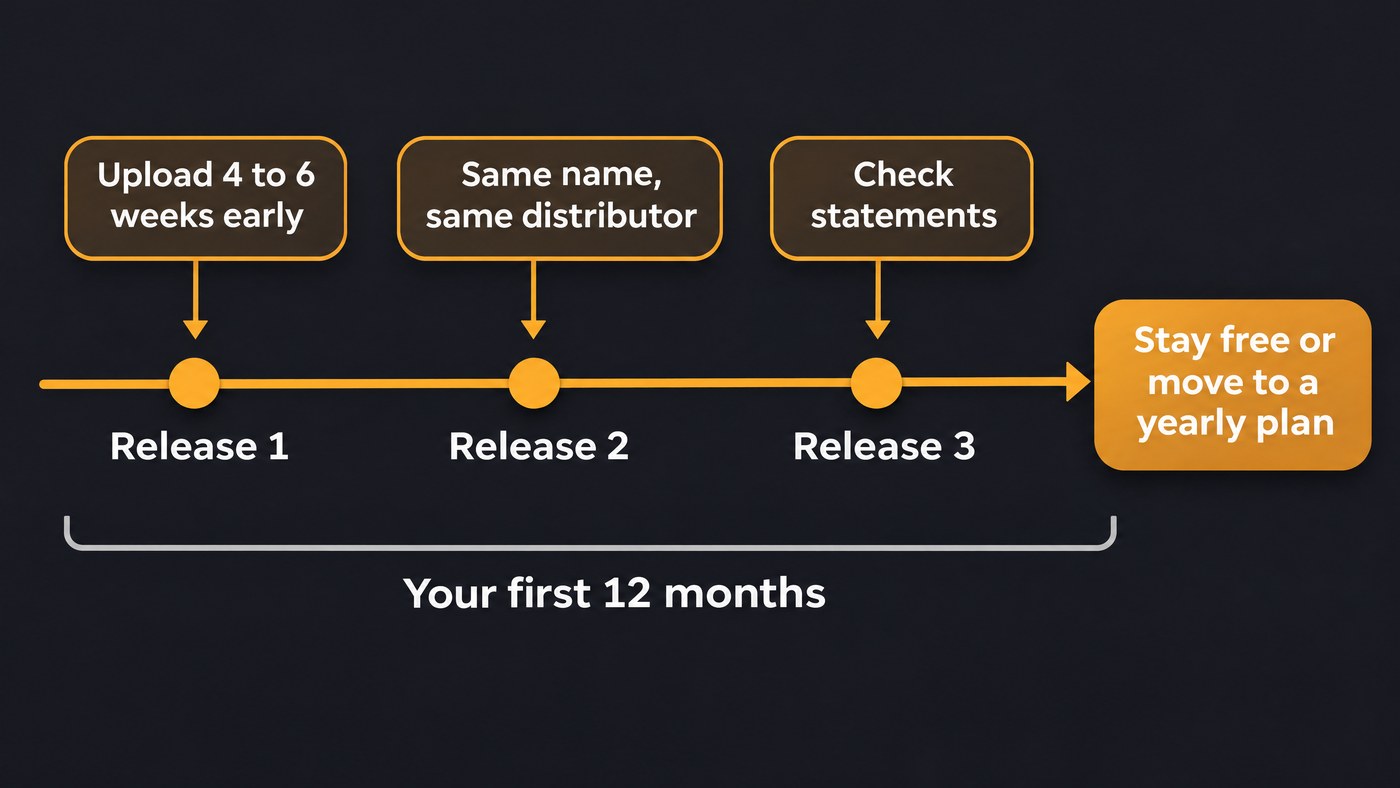
- Count before you pay. If three releases in the next 12 months is realistic, a yearly plan wins: three singles on CD Baby cost $29.97, more than any plan above under $25. Not sure a second song is coming? Start on RouteNote Free or a single CD Baby release.
- Release one: a single, uploaded four to six weeks early. On RouteNote, give it about seven weeks, since moderation plus store ingestion can run that long right now. Share your pre-save link as soon as the distributor provides one. Our guide to choosing a distributor for your first single covers artist profiles and release dates.
- Release two, six to eight weeks later. Keep the artist name spelled exactly the same and use the same distributor, so both songs land on one profile and one statement.
- Release three, then read your statements. Once a 15% cut would cost more than a yearly fee, switch. Against Ditto's $19 Starter plan, that point is about $127 of earnings a year.
- Keep every master file, the artwork and each song's ISRC in one folder, so moving distributors later doesn't reset your streams.
Affordable music distribution services for a singer-songwriter starting out
The same shortlist works, with three extra checks for songwriters.
- Covers. A cover needs a license for the song before release. Amuse sells cover song licensing at $14.99 per track, and CD Baby lists it among its services. Our guide to how cover songs are handled in distribution explains the rest.
- Co-writers. Agree each person's share in writing, then pick a plan where splits are free for collaborators who aren't on the same service.
- Your songwriting royalties. A distributor collects money for the recording. Royalties for the song itself are collected separately, so register your songs too; see registering with performance rights organizations.
For one acoustic single to test the waters, CD Baby's $9.99 or RouteNote Free costs least. For an EP plus singles in your first year, Ditto Starter, UnitedMasters DEBUT+ or TuneCore CORE keeps everything under one yearly fee.
Where Soundverse fits
Soundverse is an AI music platform that takes you from idea to audience. It doesn't deliver songs to Spotify or any other store; the distributor you choose does that.
It helps with the planning and checking around a release. Release Planner turns a finished track and a release date into a day-by-day, platform-split rollout with pre-save, smart link and playlist pitch deadlines. Set Audience Size to under 1k and the steps suit a first release. It runs on every plan, including Free, and writes the plan without posting anything.
After release day, the Music Business Agent can run a store-by-store release check across stores such as Spotify, Apple Music, JioSaavn and Amazon Music, then list where your release is live, missing or mislabeled.
Licensing is set by plan: the Free plan is for personal use, and the Creator plan comes with a royalty-free license.
This walkthrough shows Release Planner turning a track and a few release details into a day-by-day rollout plan.
FAQ
What is the cheapest music distribution app for a new artist? RouteNote Free costs nothing upfront and keeps 15% of earnings. Among the yearly plans we checked, Ditto Music Starter was the lowest at $19. For one song you won't follow up soon, CD Baby's $9.99 one-time fee is the cheapest paid option.
Can I release music from my phone? Yes. DistroKid, Ditto Music and Amuse all have iOS and Android apps. RouteNote's iOS app can create a release, but its Android app can't yet.
Is free distribution worth it for a first single? It can be, if you have time. RouteNote's current moderation queue is 20 to 22 working days, and it pays out once you reach $50. If you want a set date and a pre-save campaign sooner, a yearly plan under $25 is the safer start.
Should I use two distributors to reach more stores? No. Send each recording through one distributor, so its streams and earnings stay on one profile and one statement. Pick the service whose store list covers what you need.
Sign up for Soundverse free and plan the rollout for your first release. More release guides on the Soundverse blog.