How Do I Choose Between Different Music Distribution Providers for My First Single?
How to choose a music distributor for your first single: release dates, your Spotify profile, costs after year one, splits and AI rules, with prices.
To choose a music distributor for your first single, start with how many songs you'll release in the next 12 months. Then check four things: whether you can set the release date, how it creates your Spotify artist profile, what it costs after year one, and how it handles splits and AI-made music.
Prices and policies below come from each company's own pages, checked on November 7, 2026, in US dollars. They're here to show the trade-offs, so confirm the current numbers before you pay.
Start with your next 12 months, not this one song
A first single is rarely the only release. The cheapest choice for one song can be the most expensive for five.
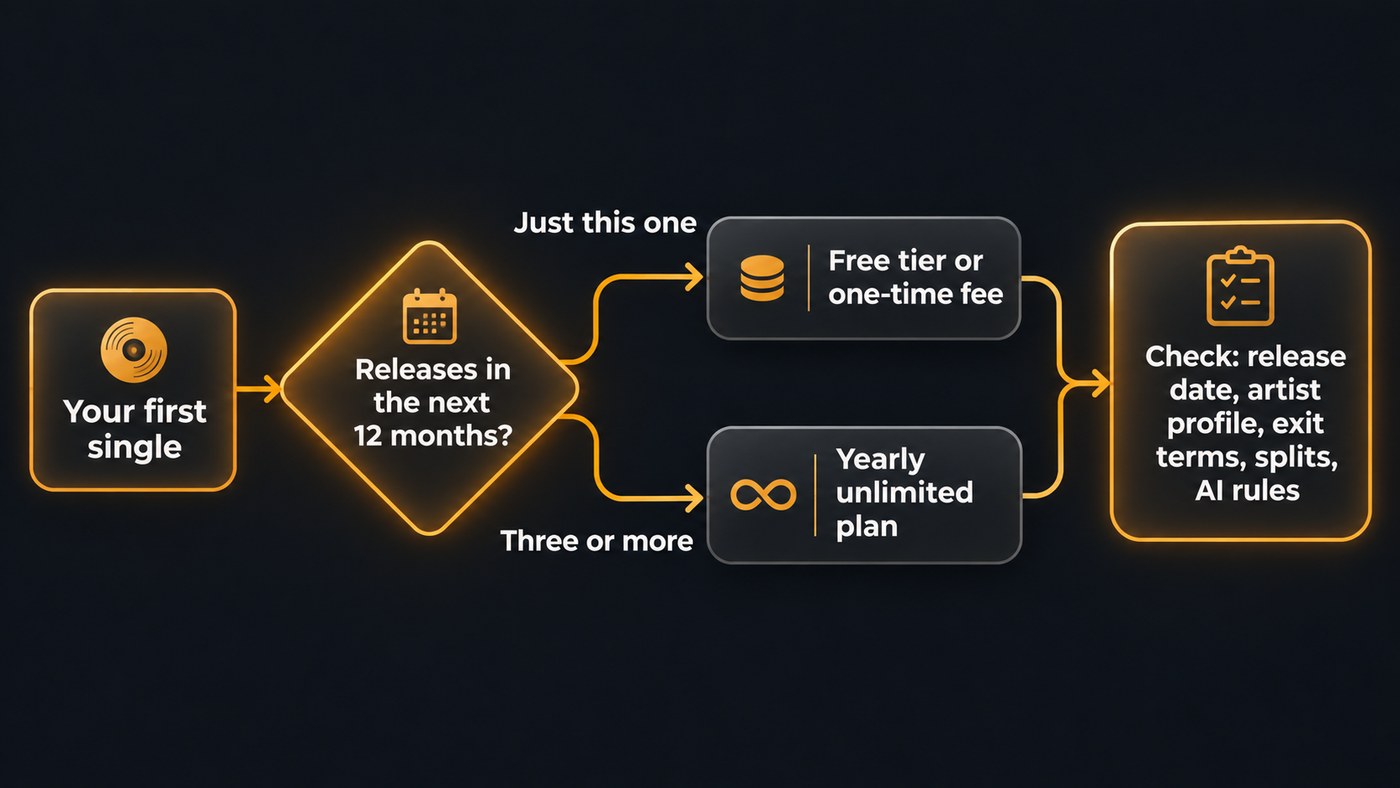
- Just this song for now. A one-time fee or a free tier fits. CD Baby charges $9.99 once for a single, with no annual fees, and keeps 9% of digital distribution revenue. RouteNote Free has no fees and pays you 85%. Soundrop charges $4.99 per song and keeps 15%.
- Three or more releases this year. A yearly unlimited plan wins quickly. Ditto Music Starter costs $19 a year, Amuse Artist $23.99, DistroKid Musician $24.99 and TuneCore Rising Artist $24.99. Three singles on CD Baby already cost $29.97.
- Not sure yet. Start where moving up is cheap. RouteNote lets you upgrade a release from Free to Premium, which costs $10 for a single and $9.99 a year from the following year, and then pays 100% of streaming and download revenue.
Can you set the release date you need?
For a first single, control over the date matters more than speed. Spotify's pitching guide says a song pitched at least 7 days before release goes onto your followers' Release Radar playlists, and you can only pitch songs that haven't come out yet. A release sent out "as soon as possible" can miss that window entirely.
Check what each plan allows before you pick:
- Amuse needs 14 days of lead time for a scheduled release on its Artist plan, 10 on Artist Plus and 7 on Artist Pro.
- DistroKid lists customizable release and preorder dates on Musician Plus, at $44.99 a year.
- TuneCore lists scheduled releases on Rising Artist, its $24.99 plan.
Aim to upload three to four weeks before release day. That leaves time to fix a rejected cover or a metadata error and to write the pitch. If you've already missed that window, our guide to music distributors with fast-track releases explains what a rush option can and can't do.
Will it set up your Spotify artist profile cleanly?
Your first single creates your profile. Spotify's help centre is direct about it: "Your artist profile is created automatically when your music is first uploaded to Spotify." A mistake here can put your song on another artist's page, or put theirs on yours.
- Search your artist name on Spotify, Apple Music and YouTube Music before you upload. Spotify's March 15, 2026 post introducing Artist Profile Protection names another artist using the same name as one reason releases end up on the wrong profile. If your name is taken, change it before your first release.
- Pick "new artist" in the upload form rather than selecting an existing profile with a similar name.
- Claim Spotify for Artists before release day. Spotify's access guide says to ask your distributor for your artist link, and that with a distributor on its preferred list you automatically get access when you submit a request. On Spotify's provider directory, checked November 7, 2026, DistroKid, CD Baby, Amuse, RouteNote, TuneCore and LANDR are marked preferred, and Ditto Music is listed without the tag.
What does it cost after year one?
A first single usually stays online for years, so read the exit terms before you pay.
- DistroKid removes releases after a lapsed membership unless they have its Leave a Legacy extra, which its help centre lists at $29 for a single.
- Amuse keeps your music live after you end your subscription and charges a 25% royalty commission until you subscribe again.
- Ditto Music says in its help centre that releases are at risk of removal if you stop paying, though they aren't taken down automatically.
- CD Baby has no annual fees, so there's nothing to lapse.
- RouteNote Free has no fees at all, while Premium renews at $9.99 a year from the second year.
Who else gets paid?
If a producer, co-writer or featured singer is owed part of the single, pick a distributor that pays them directly. DistroKid includes royalty splits on every plan, TuneCore includes revenue splits on Rising Artist, and Amuse's Artist plan charges 15% on splits with collaborators who aren't on Amuse (they're free on Artist Plus and Artist Pro). Agree the percentages in writing before you upload.
YouTube and social income is the second check. TuneCore includes YouTube Content ID on Rising Artist and lists a 20% fee on earnings from TikTok, Facebook, Instagram and YouTube. Amuse's Artist plan has a 15% YouTube Content ID fee. If your beat is a non-exclusive lease, leave Content ID off, because other artists may lease the same beat and their videos would get claimed.
Does it accept how the song was made?
If you used AI tools anywhere in the single, read each distributor's AI rules before you pay. Spotify's announcement on AI protections, published September 25, 2025, says it supports an industry standard for AI disclosures in song credits, submitted through labels and distributors. It adds: "Not all distributors enable artists to disclose yet, but we intend to expand this more broadly over time." Ask your distributor whether it supports disclosure.
The same announcement says vocal impersonation is only allowed on Spotify when the impersonated artist has authorized it. Our posts on whether DistroKid allows AI-generated music and the AI music distribution checklist cover what else to check.
A quick way to decide
Score each distributor on your shortlist against these six points:
- Total cost for your next 12 months of releases, not just this single.
- Release date control that leaves at least 7 days for a pitch, ideally three to four weeks.
- Preferred status on Spotify's provider list, for quick Spotify for Artists access.
- Exit terms you can live with in year three.
- Splits and Content ID terms that suit your collaborators and your beat license.
- Support you can reach. TuneCore, for example, publishes response targets of 3 business days on Rising Artist, 2 on Breakout Artist and 1 on Professional.
Pick the cheapest service that passes all six, and send the single through that one only. Spotify's September 2025 announcement lists duplicates among the spam tactics its music spam filter targets.
Where Soundverse fits
Soundverse is an AI music platform that takes you from idea to audience. It doesn't deliver your single to stores: that still runs through the distributor you choose. It helps with the release around it.
Release Planner takes your track and release details and writes a day-by-day, platform-split rollout with pre-save, smart link and playlist pitch deadlines, and it picks a release day if you leave the date empty. It runs on every plan, including Free. The playlist pitch generator writes Spotify and Amazon Music pitches and curator emails that name real playlists it found on the web; you paste and send them yourself.
With the Soundverse Computer Use Extension for Chrome, Agent One can go through your distributor dashboard or the stores you name and report which ones show the release, or upload the track to SoundCloud as Private for you to check.
Licensing is set by plan: the Free plan is for personal use, and the Creator plan comes with a royalty-free license.
This walkthrough shows Release Planner turning a finished song into a day-by-day rollout plan.
FAQ
What is the best music distributor for a first single? The one that fits your next year of releases. For one song with no budget, RouteNote Free or CD Baby's $9.99 one-time fee is the cheapest start. If more releases are coming, a yearly plan from Ditto, Amuse, DistroKid or TuneCore usually costs less per song.
Is it worth paying for distribution for just one song? Only if the terms beat the free option for you. RouteNote Free costs nothing and keeps 15%, while CD Baby charges $9.99 once and keeps 9%. A yearly plan for a single song makes sense only if you'll release again within the year.
Can I switch distributors after my first single? Yes. Keep your master file, artwork and the single's ISRC, and give the new distributor identical metadata so streams stay attached to the same recording. Ask the new distributor how it handles the move before you take anything down.
How far ahead should I upload my first single? Three to four weeks before release day. A Spotify pitch needs at least 7 days before release to reach Release Radar, and Amuse's Artist plan needs 14 days for a scheduled date.
Sign up for Soundverse free and plan the rollout for your first single. More release guides on the Soundverse blog.