What Role Does AI Play in Creating Custom Soundtracks for Video Games?
AI game music explained: how adaptive scores work, where AI helps with themes, stems, loops, SFX and NPC voices, plus middleware, store rules and rights.
AI game music tools now help small teams sketch themes, build loopable layers and stems, make sound effects and voice placeholder lines. The adaptive logic that decides what plays when still lives in middleware such as FMOD or Wwise, or in the game engine, and a composer still shapes the theme, the transitions and the final mix.
We checked every page cited here on 21 November 2026. For a tool-by-tool comparison, see our guide to the best AI music tools for gaming soundtracks.
How game music differs from a song or a film score
A song or a film cue has a fixed length. Game music waits for the player, who may spend 90 seconds or 40 minutes in one area, so a game score is built from parts that a system recombines at runtime:
- Horizontal re-sequencing. The score is cut into sections (explore, tension, combat, victory) and the game jumps between them, usually on a bar line so the switch sounds composed.
- Vertical layering. One cue is written as stacked stems (pads, percussion, brass) that share tempo and length. A game value such as threat level fades layers in and out while the music keeps playing.
- Stingers. Hits of one to four bars for events, such as an item found or a guard alerted, played over or between cues.
- Loops that hold up. A town theme may repeat for half an hour, so the join has to be sample-accurate and the material has to survive repetition.
Fatigue is the hard part. The usual fixes are longer loops, variations of a phrase picked at random, and planned drops to ambience or silence.
Where AI fits in game scoring today
AI tools make audio files, not adaptive behaviour. Their role sits in five places:
- Sketching themes and variations. Generate rough instrumentals for each area or state from a text brief, then choose the motif worth developing, with variations at the same tempo and key in calm, tense or heroic moods.
- Stems and loopable layers. Some generators can make music meant to repeat. Stem separators split a mixed cue into layers, and stem generators add a missing part, such as a percussion layer for combat. Separated stems can carry bleed from other instruments, so solo each one before you build on it. Our guide to editing audio stems covers the clean-up.
- Sound effects. Text-to-SFX tools make interface clicks, foley and ambience, and video-to-SFX tools time effects to a cutscene.
- Adaptive and procedural systems. Many adaptive scores are rule-based: middleware choosing between authored files. itch.io's creator quality guidelines class dynamic music with NPC pathfinding and procedural level generation as traditional game AI that needs no disclosure. Music generated by a model during play is a different case, covered under store rules below.
- Voices for NPCs. Text to speech covers placeholder dialogue and, with the right consent, final lines. Our guide to AI voice cloning software for character voices compares the options.
How Can AI Tools Assist in Background Music Generation for Gaming Environments?
Background music for environments (a forest, a space station, a menu) is where AI saves the most time, because these cues are long and need many versions.
- Generate one bed per area at a shared tempo and key, so the game can crossfade between areas without a clash.
- Ask for loop-ready output where offered, or trim to whole bars.
- Extend instead of regenerating when a bed is too short, so the material stays the same.
- Put ambience on its own track, so the game can swap wind or machinery hum separately.
- Plan the silence. A bed that drops to ambience for a minute makes its return land.
The middleware that makes music interactive
AI-made files become adaptive only once something controls them.
FMOD Studio. FMOD's event authoring documentation (version 2.03) describes parameter sheets that let a game parameter trigger instruments, which is how layers follow intensity. Multi instruments hold a playlist of alternative files instead of one, a simple defence against loop fatigue. Transition regions can be quantized, so a jump to combat happens only on the beats or bars you choose, and their offset setting is built with music in mind: "Relative mode is frequently used with music, to allow the playback position to transition at arbitrary points within a bar or phrase and arrive at the same relative position within the destination bar or phrase." With no tempo markers, FMOD assumes 120 BPM in 4/4, so set your cue's real tempo in the event.
Wwise. Audiokinetic's Wwise has its own interactive music system, but its documentation blocked our requests on 21 November 2026, so plan from its Help pages directly.
Engine audio. Unity's AudioSource.PlayScheduled page (Unity 6000.6) calls scheduling clips on the audio clock the preferred way to stitch music, because it doesn't depend on the frame rate; its example joins 16-bar segments at 140 BPM. Unreal Engine 5.9's MetaSounds documentation includes a guide to creating procedural music with MetaSounds.
What stores say about AI-made game audio
Steam. Valve's Content Survey says it isn't concerned with efficiency tools in your development environment. It asks about AI used to create content that ships with your game and is consumed by players, sound included. Pre-generated content is reviewed like any other content; for content generated while the game runs, you also describe the guardrails that stop it producing illegal material.
itch.io. The same guidelines ask creators to tag generative AI content in the AI Disclosure section of the project's edit page. itch.io says it strictly enforces disclosure on game asset, soundtrack, physical game, comic and book pages because of legal ambiguity over rights, and that untagged pages may be delisted.
Other storefronts and console platforms set their own terms, so read them before launch.
Rights and credits for composers
The U.S. Copyright Office's Part 2 report (29 January 2025) concludes that "the outputs of generative AI can be protected by copyright only where a human author has determined sufficient expressive elements." That can include creative arrangement or modification of an output, but not the mere provision of prompts. A composer who writes the theme and arranges AI-made layers leaves a clearer human contribution than a folder of raw generations.
Put these in the composer's contract and your records:
- Permission and scope. Whether AI tools may be used, and for what: temp tracks, sketches, sound effects or final cues.
- Tool terms. Each tool's plan decides commercial use. A free plan may cover personal use only.
- Prompts. No living composer's name or a famous game's theme in a prompt. Describe instrumentation, tempo and mood instead.
- Credits. Credit the composer for the score, and keep AI-assisted elements on record rather than hidden.
- A log per cue. Tool, plan, date, prompt and the human edits made. It answers Steam's survey and itch.io's disclosure in minutes.
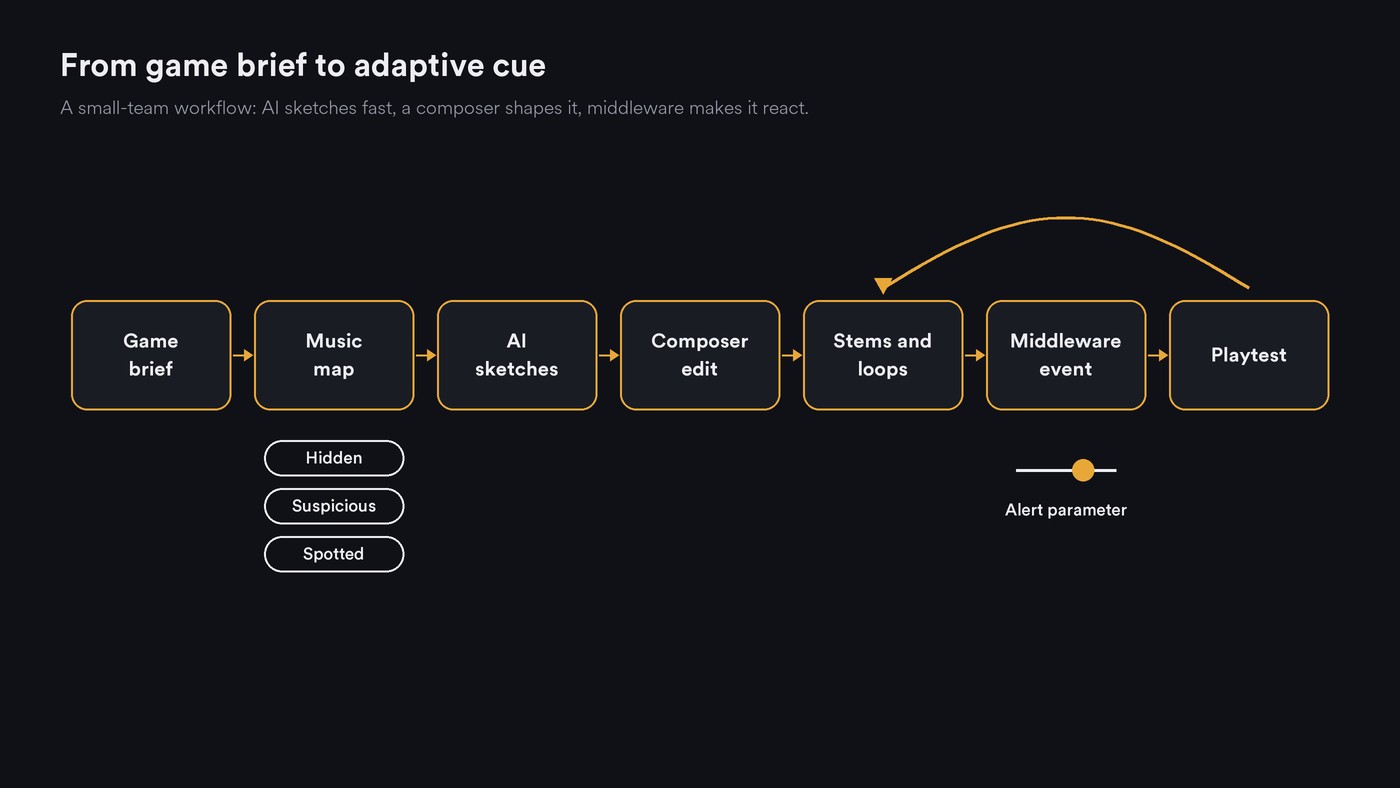
A small-team workflow: from game brief to an adaptive cue in the engine
Take a stealth level with three music states.
- Write the music brief. States: Hidden, Suspicious, Spotted, plus stingers for "guard alerted" and "escaped". How long players stay in each state sets loop length.
- Fix the grid. One tempo and key for the level, say 90 BPM in E minor, 4/4. A bar lasts 2.667 seconds, so an 8-bar loop runs 21.333 seconds: exactly 1,024,000 samples at 48 kHz, which makes sample-accurate loop points easy.
- Sketch with AI. Generate several takes per state at that tempo and key, and drop any whose tempo or key drifts.
- Hand over to the composer. Pick the motif, rewrite or replay it, and set the harmony that ties the states together.
- Build the layers. Hidden is the base; Suspicious adds percussion; Spotted adds brass and a faster pulse. Every stem starts at bar 1 and runs the same length.
- Cut loops and stingers. Trim to whole bars and render two-bar stingers in key. Our guide to looping music for smooth playback covers the join.
- Implement. In FMOD, put the layers on tracks in one event, add a 90 BPM tempo marker, drive layer volumes from an Alert parameter and quantize transitions to the bar. Without middleware in Unity, schedule segments with PlayScheduled.
- Playtest for fatigue. Sit in each state for 20 minutes; if a loop grates, add variations.
- Log and disclose. Fill in store disclosures from the per-cue log.
Where Soundverse fits
Soundverse is an AI music platform that takes you from idea to audience. For game teams it covers the sketches and the audio assets, not the middleware. AI Music Generator has a Gaming theme with vibes such as Epic, Mysterious or Calm; on Creator and above, one additional engine has a Type control set to Loop for music made to repeat, and a Length setting from 15 seconds to five minutes. Extend Music continues a cue in the same style, tempo and key. Stem Separator splits a cue into 2 or 6 stems, or every part with MIDI on Creator and above, and AI Stem Generator (Creator and above) adds one new part such as Percussion or Brass. AI Sound Effects Generator makes clips from 0.5 to 30 seconds, and AI Speech Generator voices character lines.
Licensing is set by plan: the Free plan is for personal use, and the Creator plan comes with a royalty-free license.
This walkthrough of Soundverse's Create tools shows AI Music Generator from 0:17, AI Speech Generator from 0:39 and AI Sound Effects Generator from 0:50.
FAQ
Will AI replace composers on game projects? AI makes drafts and assets quickly, but someone still has to design how the music reacts to play, write a theme worth remembering and judge fatigue in playtests. US copyright also rewards that human part.
Do I need to disclose AI-generated music on Steam? If it ships with the game, yes. Steam's Content Survey covers AI-made content that players consume, sound included, and music generated during play also needs a description of your guardrails. itch.io asks for its AI Disclosure tag as well.
Can AI generate game music in real time? It can, and Steam treats that as live-generated content with extra review questions. Many adaptive scores don't need it: middleware switching between authored files gives tight timing and predictable results.
What format should AI-made game music be delivered in? WAV at your project's sample rate, such as 48 kHz, one file per stem, trimmed to whole bars, with tempo and key in the file name.
Sign up for Soundverse free and sketch the first theme for your game. More guides on the Soundverse blog.