What Makes AI Music Safe for Commercial Projects in 2026
Learn why AI music licensing makes commercial music usage safe in 2026.
What Makes AI Music Safe for Commercial Projects
Artificial intelligence has revolutionized the music industry over the past few years. As we enter 2026, AI-generated audio has become a mainstream component of content creation, advertising, film, and gaming. Yet, a recurring concern continues to surface—is AI music truly safe for commercial use?
For creators, businesses, and marketers who depend on clean licensing paths, the question is not just about creativity but compliance. With global legislation tightening around intellectual property and AI-generated media, reliable AI music licensing is now more critical than ever.
Why Is AI Music Licensing Important for 2026?
The past few years have seen rapid evolution in AI composition tools—from simple beat generators to full-text-to-music platforms like Soundverse. These systems can compose, arrange, and produce high-quality tracks in seconds. But as adoption has scaled, so have copyright concerns.
AI training data typically includes vast volumes of existing music. Without proper attribution, AI models risk generating outputs that could overlap with copyrighted material. In 2024 and 2025, several disputes emerged around AI music being flagged as derivative, leading to content removals and brand reputation damage.
In 2026, responsible AI music licensing frameworks like that offered by Soundverse have become the trusted method to mitigate these risks. Proper licensing doesn’t just assign ownership—it ensures that every sound, sample, or composition is traceable and transparent.
What Makes AI Music Copyright Safe for Commercial Use?

Commercial safety revolves around three fundamentals:
- Clear Ownership Attribution: Ensures every generated track can be linked back to its source data.
- Rights Metadata Preservation: Safeguards royalty and usage information throughout the audio lifecycle.
- Regulatory Compliance: Aligns music creation with modern copyright frameworks and ethical AI laws introduced globally in 2026.
This triad ensures copyright safe audio output. When creators publish or use AI-generated works in campaigns, film, social videos, or apps, they can trust that underlying datasets have been ethically sourced and properly licensed.
How Has AI Music Licensing Evolved Since 2024?
Between 2024 and 2025, AI music licensing was largely reactive—brands sought clearance after audio was created. The shift in 2026 is proactive licensing, with built-in transparency during the generation process itself. AI systems are now expected to embed license data directly inside the waveform file or metadata at export.
Furthermore, legal precedents around AI training data have led to stronger data governance frameworks. AI companies must disclose which datasets influence generation outcomes. This transparency has made it easier for businesses to safely deploy royalty-free AI music without hidden liabilities.
If you’ve explored industry trends recently, you’ll notice that tools like Soundverse not only embraced this change early but have become pioneers in compliant AI creativity. (See also How AI-Generated Music Is Transforming the Music Industry for context.)
What Does “Royalty-Free” Actually Mean in the Context of AI Music?
“Royalty-free” often causes confusion. In AI contexts, royalty-free doesn’t necessarily mean “free of cost.” It implies that once you’ve obtained the license, you can use the music across multiple projects without ongoing payments. The critical nuance lies in the source: for AI-generated sound to be truly royalty-free and legally safe, it must originate from datasets cleared for commercial use.
If a model was trained on copyrighted tracks without permission, any song it creates could be disputed. This is why AI-generated music rights verification and transparent licensing systems have become a non-negotiable requirement in 2026.
How to Identify Copyright-Safe AI Music
Selecting safe AI music isn’t just about sound quality—it’s about background legitimacy. Here’s what responsible creators check for:
- Transparency Reports: Platforms should reveal their dataset sources.
- Attribution Logs: Look for systems that can show how the music was influenced by underlying data.
- Watermarking or Traceability: Invisible but verifiable data fingerprinting embedded within the track confirms originality.
- Closed Licensing Loop: The audio’s metadata must persist through export and delivery, validating usage rights whenever the track surfaces online.
Platforms meeting all these checks—especially those using licensed datasets through frameworks like Soundverse’s Content Partner Program—give creators full confidence for commercial music usage.
For an in-depth comparison of AI music platforms, you can explore resources like Mubert Alternatives: Soundverse and Soundraw Alternatives. These breakdowns illustrate how different vendors handle attribution and data transparency.
What Are the Legal Risks of Ignoring Proper AI Music Licensing?
Without proper licensing, businesses expose themselves to takedown notices, demonetization, or even lawsuits. In 2026, content distribution platforms like YouTube and TikTok now integrate AI-detection systems capable of scanning for reused copyrighted patterns. If your soundtrack overlaps with existing material, you risk content removal and loss of ad revenue.
Even creators who unknowingly use unlicensed AI audio could face restrictions. Hence, working with traceable, copyright-safe AI tools significantly minimizes compliance risk while safeguarding revenue streams.
For a deeper dive, watch our guide on creating Deep House music and learn how licensing-safe workflows can integrate with creative tasks.
How Soundverse Trace Makes AI Music Safe for Commercial Projects
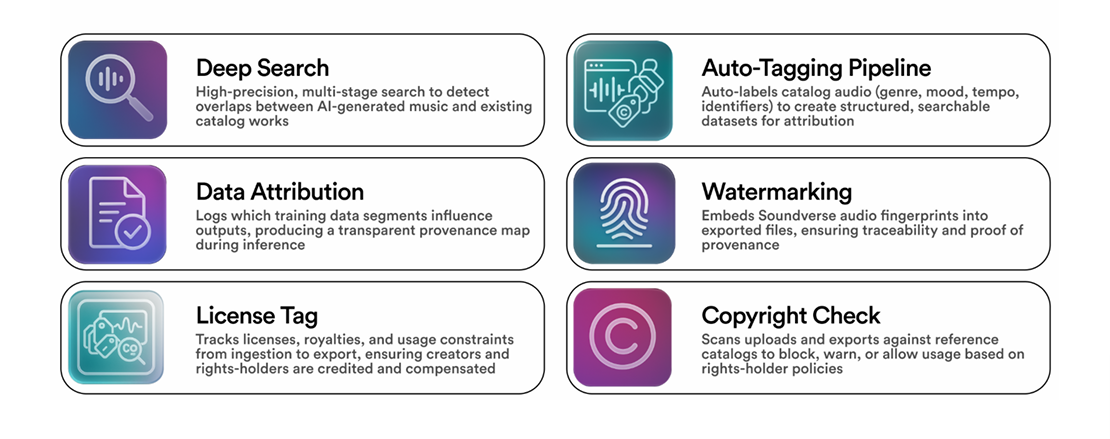
Soundverse Trace is a new trust layer designed specifically for legal and creative transparency in AI audio. Instead of treating licensing as an afterthought, it embeds assurance into every stage of music creation—from dataset ingestion to export.
Official Feature Overview:
- Deep Search: Enables high-precision (1:1 and 1:N) scanning to detect content overlaps between generated output and existing catalogues. This ensures your resulting audio remains original.
- Data Attribution: Logs which training data contributed to a particular output, offering definitive visibility into source influence.
- Audio Watermarking: Embeds inaudible digital fingerprints into every track, allowing for persistent traceability even after editing or resampling.
- License Tagging: Preserves all rights metadata within the file, guaranteeing that downstream usage—be it video or podcast—retains valid commercial clearance.
Through Soundverse Trace, creators can verify provenance, automate payouts to rights-holders, and avoid copyright conflicts. In practice, it’s an integrity shield for anyone using AI-generated pieces in advertising, film, or corporate content.
How Soundverse Connects Ethics and Innovation
Beyond Trace, Soundverse integrates these principles into its broader Ethical AI Music Framework. This six-stage pipeline transforms opaque model training into a consent-based ecosystem. Every contributor whose data powers AI creation receives proper attribution and recurring royalties through the Content Partner Program—a transparent system that rewards collaboration rather than exploitation.
This infrastructure ensures that innovation serves both creators and consumers, establishing AI music copyright not as an obstacle but as a sustainable structure for the modern creative economy.
Why Brands Prefer Soundverse for Commercial AI Music Usage
By combining artistic flexibility with compliance integrity, Soundverse positions itself as a trusted source for enterprises seeking scalable, secure, and compliant sound generation. Content teams benefit from reduced risk, verified metadata, and automated license retention—all essential for international campaigns that demand precision.
For creators eager to explore different genres safely, Soundverse also offers dynamic AI composition tools. You can learn to produce styles such as jazz, EDM, or country music while ensuring each track passes legal verification layers.
For additional tutorials, explore our guide on making music or learn how to use the “Explore” Tab for AI music discovery.
Start Creating Safely with AI Music Today
Generate original, royalty-free tracks with Soundverse and ensure your commercial projects remain legally sound and creatively inspired. Elevate your content with confidence in every beat.
Sign Up for Free
Related Articles
- Enhancing YouTube Content with Royalty-Free and Copyright-Free Music Using Soundverse AI: Learn how to legally enrich your YouTube videos with AI-generated music that’s free from copyright complications.
- Navigating the World of Royalty-Free and Copyright-Free Music Using Soundverse AI: Discover how to choose and use royalty-free tracks for any project while staying compliant with licensing standards.
- Copyright-Free vs. Royalty-Free Music: What Creators Should Know: Understand the differences between copyright-free and royalty-free music to make safe licensing decisions for your creative work.
- The Role of AI Music in Film and Television: Explore how AI-generated compositions are reshaping soundtrack production and licensing in media industries.
Here's how to make AI Music with Soundverse
Video Guide
Here’s another long walkthrough of how to use Soundverse AI.
Text Guide
- To know more about AI Magic Tools, check here.
- To know more about Soundverse Assistant, check here.
- To know more about Arrangement Studio, check here.
Soundverse is an AI Assistant that allows content creators and music makers to create original content in a flash using Generative AI.
With the help of Soundverse Assistant and AI Magic Tools, our users get an unfair advantage over other creators to create audio and music content quickly, easily and cheaply.
Soundverse Assistant is your ultimate music companion. You simply speak to the assistant to get your stuff done. The more you speak to it, the more it starts understanding you and your goals.
AI Magic Tools help convert your creative dreams into tangible music and audio. Use AI Magic Tools such as text to music, stem separation, or lyrics generation to realise your content dreams faster.
Soundverse is here to take music production to the next level. We're not just a digital audio workstation (DAW) competing with Ableton or Logic, we're building a completely new paradigm of easy and conversational content creation.
TikTok: https://www.tiktok.com/@soundverse.ai
Twitter: https://twitter.com/soundverse_ai
Instagram: https://www.instagram.com/soundverse.ai
LinkedIn: https://www.linkedin.com/company/soundverseai
Youtube: https://www.youtube.com/@SoundverseAI
Facebook: https://www.facebook.com/profile.php?id=100095674445607
Join Soundverse for Free and make Viral AI Music
We are constantly building more product experiences. Keep checking our Blog to stay updated about them!