What Is Metal AI? Understanding How Artificial Intelligence Transforms Metallurgy in 2026
Explore Metal AI and how it revolutionizes materials science and manufacturing through machine learning and ethical AI frameworks in 2026.
What Is Metal AI?
Artificial intelligence has infiltrated nearly every scientific discipline, and in 2026, its impact on metallurgy and materials science has become transformative. Metal AI refers to the application of machine learning algorithms and data-driven models to predict, optimize, and design metallic materials with unprecedented precision. From alloy development to process automation, Metal AI empowers researchers and engineers to innovate faster, reduce experimental costs, and achieve sustainability in industrial manufacturing.
What is Metal AI?
Metal AI is the fusion of artificial intelligence and materials science that focuses on analyzing and improving metallic structures, properties, and production processes. It combines deep learning, statistical modeling, and computational physics to extract patterns from metallurgical data. This helps scientists simulate the behavior of metals under different conditions—such as heat treatment, stress, or corrosion—and optimize composition without the need for exhaustive physical testing.
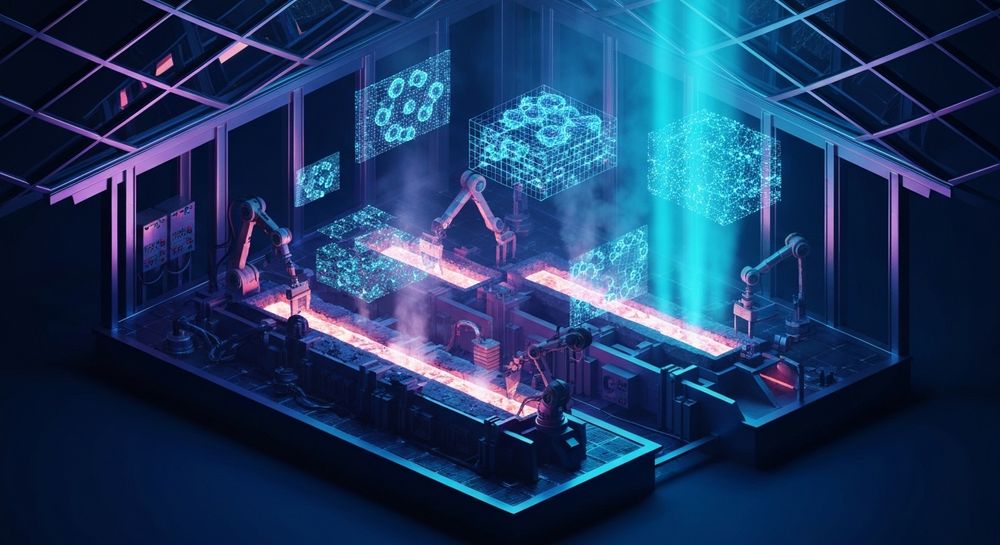
By integrating Metal AI systems into laboratories and manufacturing workflows, organizations can transition from trial-and-error experimentation to predictive design. As of 2026, industries such as aerospace, automotive, and electronics have embedded Metal AI models in their research and development cycles, resulting in lighter, stronger, and more sustainable materials.
How is AI Changing Metallurgy and Materials Science?
The use of AI in materials science is not limited to data processing; it extends to fundamental discovery. Machine learning for metals allows algorithms to identify ideal atomic arrangements or substitute elements that maintain strength while reducing cost or environmental impact. In recent years, AI-driven thermodynamic simulations have accelerated alloy development that once took years into months.

AI-enabled materials pipelines also use generative models to create hypothetical alloys based on target performance metrics like conductivity or durability. These tools are helping metallurgists model new materials virtually and then validate them using real-world production methods. For example, metallurgical AI applications can predict the microstructure evolution of a metal during solidification. This is critical in additive manufacturing, where layer-by-layer melting and cooling determine the final product quality. AI-driven optimization ensures consistency across batches, saving both time and resources. For a deeper dive, watch our guide on creating music using Soundverse’s Explore Tab.
What Are the Practical Use Cases of Metal AI?
Metal AI spans numerous industries and serves various engineering objectives:
- Predictive Alloy Design – Machine learning models evaluate datasets of known alloys and forecast how new compositions will behave under different stresses and temperatures.
- Process Optimization – In smelting and casting operations, AI predicts defects and adjusts parameters automatically to reduce waste.
- Failure Analysis – AI models recognize data patterns leading to corrosion or fatigue, allowing preventive measures in transportation and aerospace sectors.
- Energy Efficiency – AI optimizes energy consumption in heat treatment and rolling mills.
- Quality Control – Vision-based AI systems inspect microscopic defects in metal surfaces far faster and more reliably than manual methods.
These practical applications underline why engineers and researchers in 2026 increasingly integrate AI-driven metallurgical software into their workflows.
Why Is Metal AI Important for Future Manufacturing?
Industrial manufacturing is evolving toward automation and sustainable efficiency. Metal AI is critical because it not only enhances process fidelity but also drives eco-friendly materials innovation. By analyzing large data repositories from material stress tests and environmental exposure, AI can suggest recycling pathways or alloy substitutions that lower carbon emissions without compromising performance. According to the World Economic Forum, AI and circularity will be key to the future of materials in the AI age.
In 2026, many companies are benchmarking their operations using Metal AI systems. Factories that rely on artificial intelligence in manufacturing now experience faster turnaround times, reduced errors, and greater predictive maintenance. The cross-relationship between advanced materials and AI results in smarter production lines capable of self-adjusting to ensure optimal yield.
Machine learning for metals fundamentally shifts how new materials enter the market—from exploration to commercialization—by providing data-backed predictions before costly prototypes are built.
How Does Metal AI Relate to Advanced Materials and AI?
Metal AI is a subset of the broader field known as AI in materials science. Advanced materials research benefits from AI-guided insights into composites, ceramics, and polymers, but metallic systems remain central because of their structural and conductive roles in nearly all industrial contexts.
In 2026, hybrid approaches using both quantum simulations and neural networks are emerging to compute electronic structures more precisely. These methods enable predictive design at atomic levels, integrating principles of physics and chemistry with high-throughput AI screening. As highlighted by The Materials Project and the Rise of AI Driven Materials Science, computational infrastructures are now supporting large-scale AI-driven discovery platforms.
AI-assisted materials discovery thus symbolizes a paradigm shift. Instead of relying solely on human intuition, scientists now leverage computational predictions supported by extensive experimental datasets. The outcome is a generation of smart materials—metals that learn and adapt.
Challenges in Implementing Metal AI
Despite its enormous potential, Metal AI implementation faces challenges:
- Data Limitations: Building consistent datasets of metallurgical measurements is complex.
- Model Interpretability: Machine learning may identify correlations that are not physically meaningful.
- Integration Cost: Linking AI into traditional metallurgical labs requires capital investment.
- Ethical Oversight: Ensuring transparency and fair data use across collaborators is increasingly mandated.
Therefore, ethical frameworks and transparent AI infrastructures are becoming as crucial in material innovation as they are in other creative industries.
How to make Metal AI with Soundverse The Ethical AI Music Framework
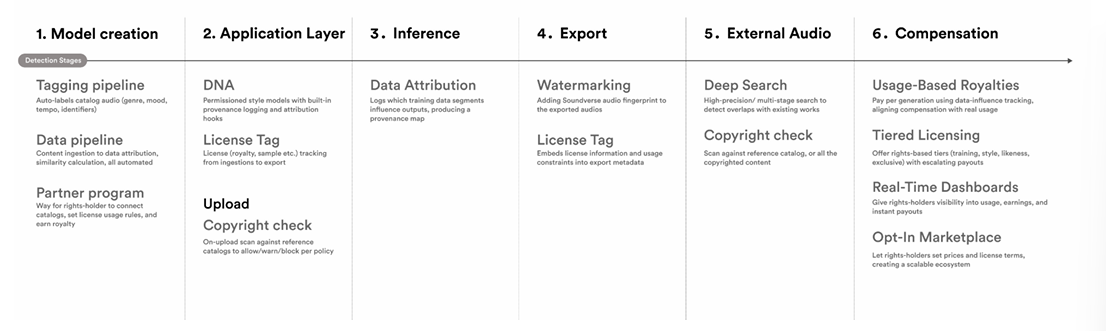
Now that you understand the fundamentals of Metal AI, it’s valuable to explore how ethical AI infrastructures parallel these innovations. Soundverse’s Ethical AI Music Framework demonstrates how transparency and accountability can coexist with cutting-edge machine learning—principles equally relevant to scientific AI applications.
Soundverse developed a comprehensive end-to-end infrastructure known as The Ethical AI Music Framework, which replaces opaque black-box models with a transparent, six-stage pipeline. This structure ensures consent, attribution, and recurring compensation—values that mirror sustainable practices in industrial AI ecosystems.
Core Capabilities:
- Stage 1 – Licensed Data Sourcing: The system only uses authorized and licensed audio datasets, ensuring data provenance integrity.
- Stage 2 – Permissioned Models (DNA): AI is tied to explicit data permissions, maintaining ethical lineage.
- Stage 3 – Explainable Inference (Attribution): Outputs can always be traced back to original contributors.
- Stage 4 – Traceable Export (Watermarking): AI-generated music retains embedded identifiers for transparent distribution.
- Stage 5 – Deep Search (External Scanning): Tracks external usage for auditing and compliance.
- Stage 6 – Recurring Compensation (Partner Program): Contributors receive continuous royalties based on verified attribution.
The same framework philosophy promotes trust in industrial and academic AI research. Just as Soundverse ensures data ethics in music generation, similar transparent methodologies can preserve intellectual integrity in Metal AI development.
Cross-referencing this framework with practical use cases in AI music creation, and industry transformation, reveals that ethical standards for AI innovation transcend domains—from creative art to metallurgical science. For additional insights, visit our Soundverse Tutorial - How to Make Music and Soundverse Deep House Creation Series.
For more insights on AI advancements, explore related content like Soundverse introduces stem separation AI Magic Tool, Music industry trends, and Soundverse Assistant as your AI co-producer.
Experience the Power of Metal AI with Soundverse
Transform your heavy metal soundscapes using Metal AI. Generate riffs, melodies, and intense rhythms effortlessly with Soundverse’s advanced AI music tools.
Start Creating Now
Related Articles
- Create Metal Music with AI – Learn how to craft powerful and authentic metal tracks using AI-driven composition tools and intelligent music generation.
- How AI-Generated Music Is Transforming the Music Industry – Discover how artificial intelligence is reshaping creative workflows and introducing new musical possibilities.
- The Role of AI Music in Film and Television – Explore how AI-generated soundtracks are changing the landscape of cinematic and TV scoring.
- How to Make AI-Generated Music – Step-by-step guide to creating music with AI — from text prompts to polished tracks ready for streaming.
Here's how to make AI Music with Soundverse
Video Guide

Here’s another long walkthrough of how to use Soundverse AI.
Text Guide
- To know more about AI Magic Tools, check here.
- To know more about Soundverse Assistant, check here.
- To know more about Arrangement Studio, check here.
Soundverse is an AI Assistant that allows content creators and music makers to create original content in a flash using Generative AI. With the help of Soundverse Assistant and AI Magic Tools, our users get an unfair advantage over other creators to create audio and music content quickly, easily and cheaply. Soundverse Assistant is your ultimate music companion. You simply speak to the assistant to get your stuff done. The more you speak to it, the more it starts understanding you and your goals. AI Magic Tools help convert your creative dreams into tangible music and audio. Use AI Magic Tools such as text to music, stem separation, or lyrics generation to realise your content dreams faster. Soundverse is here to take music production to the next level. We're not just a digital audio workstation (DAW) competing with Ableton or Logic, we're building a completely new paradigm of easy and conversational content creation.
TikTok: https://www.tiktok.com/@soundverse.ai
Twitter: https://twitter.com/soundverse_ai
Instagram: https://www.instagram.com/soundverse.ai
LinkedIn: https://www.linkedin.com/company/soundverseai
Youtube: https://www.youtube.com/@SoundverseAI
Facebook: https://www.facebook.com/profile.php?id=100095674445607
Join Soundverse for Free and make Viral AI Music

We are constantly building more product experiences. Keep checking our Blog to stay updated about them!