What is data attribution in AI music? Black box vs white box, and where Trace fits
Data attribution traces an AI song back to the music behind it. How black-box and white-box attribution differ, why Trace is black-box, and what comes next.
Quick answer: Data attribution is the work of tracing an AI-generated song back to the music that shaped it, so the people behind that music can be credited and paid. It can be done two ways.
- Black-box attribution treats the AI model as a sealed box. It compares the finished song with existing music and asks what it resembles.
- White-box attribution opens the box. It uses the model's internals and its training records to estimate which training songs actually influenced the output, and by how much.
Soundverse's whitepaper, Towards an Ethical Framework for AI Music, argues that the industry needs both. Soundverse Trace, its music search tool, is black-box attribution. It is in production, and businesses can use it today through the Soundverse Enterprise API. White-box attribution, built into Soundverse's own models, is the next step.
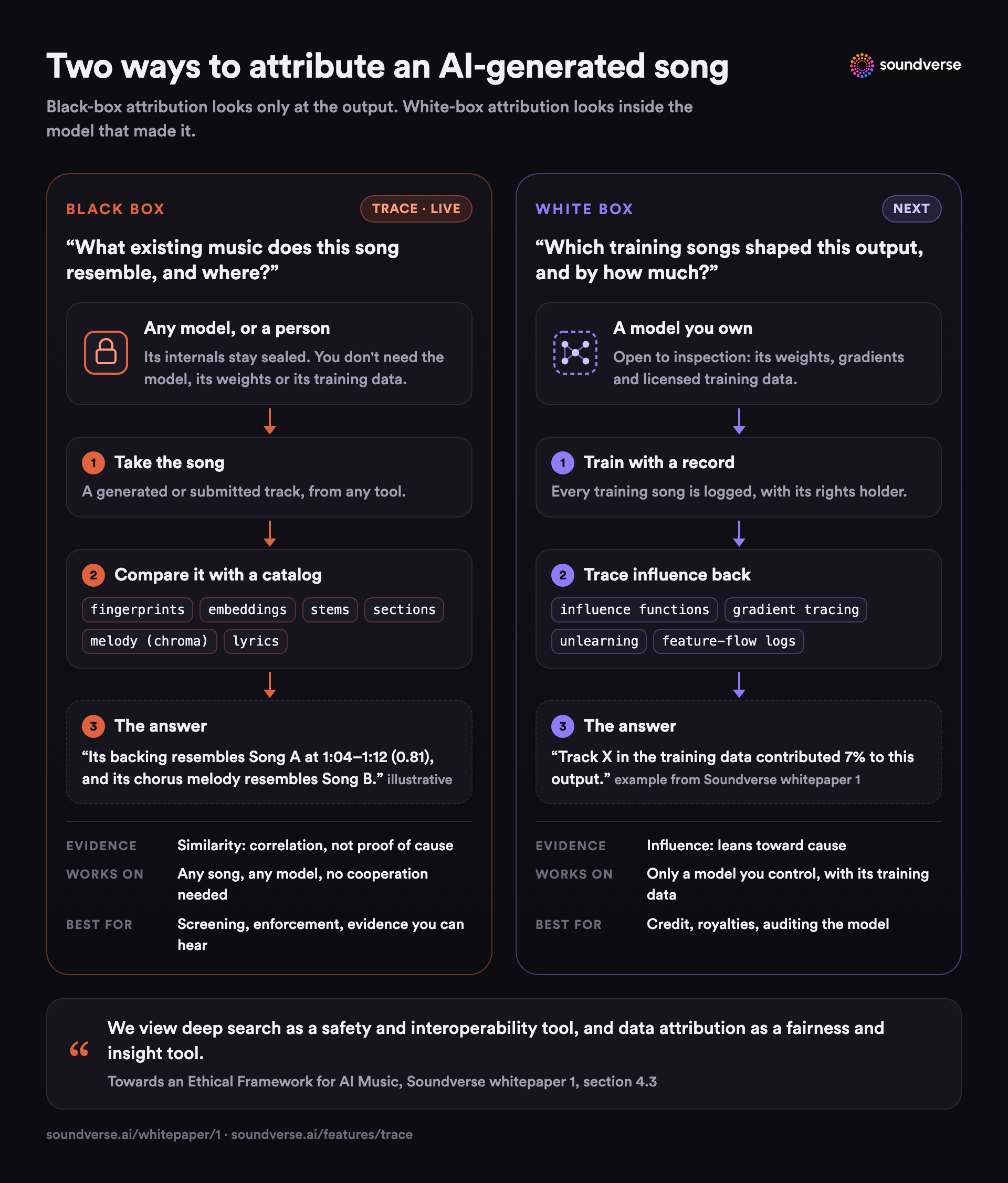 Black-box and white-box attribution answer different questions. Trace covers the black box today; white-box attribution is next.
Why attribution matters now
Generative music models learn from very large collections of recorded music. When one of them produces a new song, a simple question follows: whose music made that possible, and should they share in what it earns?
For most of the short history of AI music, nobody could answer that question. Models were trained on catalogs gathered without consent, and the training sets were not disclosed. Once a song was generated, there was no record of what had shaped it. Rights holders found out about problems after the fact, through audits and lawsuits.
Soundverse's whitepaper describes that gap stage by stage, from collecting training data to paying people. It was published in August 2025 and written by Sourabh Pateriya, Soundverse's founder and CEO; Riley Williams, its co-founder and CTO; and Linnea Sundberg, a Soundverse board member. It describes generation without attribution this way: "there is no logging of which songs or data influenced the music produced, so even licensed datasets cannot guarantee fair payout."
The argument that runs through the paper is simple. If you can't trace influence, you can't pay fairly.
What data attribution is, and isn't
The whitepaper's glossary defines data attribution as "the process or technology of tracing an AI-generated output back to specific pieces of training data that influenced it." Its purpose is to establish who or what in the training data contributed to a melody, a harmony or a style, so those contributors can be credited and rewarded.
The term is easy to confuse with several related tools:
| Tool | The question it answers |
|---|---|
| Data attribution | Which music shaped this AI-generated song, and how much? |
| Audio fingerprinting | Is this the same recording as one already known? |
| Similarity search | What existing music does this song resemble, and where? |
| Watermarking | Was this file marked by a particular system or owner? |
| Provenance | What steps, tools and rights went into making this song? |
Attribution is the hardest of these, because influence inside a neural network is hard to see. The whitepaper explains why: "a music generator learns abstract patterns (chord progressions, rhythmic grooves, timbral textures, etc.) spread across many training examples." A single generated song can carry dozens of small influences: a kick pattern learned from hundreds of dance tracks, a guitar tone from rock records, harmony from jazz standards.
That is why there are two broad ways to approach attribution. They differ in one thing: whether you are allowed to look inside the model.
Black-box attribution: judge the song by what it sounds like
A black box is a system you can only observe from outside. You see what goes in and what comes out, but not how it works inside. Black-box attribution accepts that limit. It takes the generated song and compares it with a catalog of existing music, using similarity as a stand-in for influence.
The whitepaper calls this approach deep search and describes it as "finding resemblance between the AI-generated output and existing songs." It answers the question: "Which existing track(s) does this AI output most closely resemble?"
The tools are well established:
- audio fingerprints, which recognise a known recording;
- embeddings, which turn a stretch of audio into a list of numbers so that similar-sounding passages sit close together;
- chroma, a representation of the notes being played regardless of octave, used to compare melodies;
- source separation, which compares vocals, drums and bass on their own;
- transcribed and translated lyrics.
Its strengths, according to the whitepaper:
- It works on any model. "Deep search operates on the output, so it doesn't matter how the AI generated it." A label can check new AI tracks against its catalog without the AI developer's cooperation.
- It is built on mature technology. Audio matching has years of development behind it, from Shazam to YouTube's Content ID.
- It is easy to understand. A statement like "this AI song has a 90% similarity to song X" reads like a plagiarism report, and it mirrors how infringement cases are usually argued, by showing substantial similarity.
- It scales. It can screen every output, in real time or in batches, without retraining anything.
Its limits, in the paper's words:
- "Correlation, not causation." "An AI track might coincidentally sound similar to a Beatles song even if the Beatles song wasn't in training." In the other direction, a model can be heavily influenced by a track and still produce something that sounds different.
- It inspects only the result. "It's essentially a black-box approach: you treat the model as a music black box and only inspect its output."
- It tends to credit the closest match. It can miss the many smaller influences behind a song.
- It does nothing to improve the model. It is "a policing mechanism rather than a learning one."
White-box attribution: look inside the model
White-box attribution starts from the other end. It needs access to the model itself: its weights, its gradients (the signals a model uses to learn) and a record of its training data. With that access, it tries to answer a causal question: which training songs actually shaped this output, and by how much?
The cleanest version of the idea is easy to state and almost impossible to run. The whitepaper compares the model to "a complex stew: remove one ingredient and see how the flavor changes." To measure a song's influence exactly, you would retrain the model without that song and see how the output changes. For a model trained on millions of songs, that means millions of retraining runs. The whitepaper calls this "utterly impractical."
Researchers have developed methods that estimate the same answer without retraining:
- Influence functions estimate how a model's behaviour would change if one training example were removed. Koh and Liang brought the idea to modern machine learning in 2017.
- Gradient-based methods use the model's gradients to score each training example. TracIn (Pruthi and colleagues, 2020) follows them through training; TRAK (Park and colleagues, 2023) approximates influence at the scale of large models.
- Data Shapley borrows a fairness idea from game theory to share credit among training examples (Ghorbani and Zou, 2019).
- Unlearning makes the model "forget" an example and measures what changes. In 2025, Sony AI researchers applied this to a text-to-music model trained on about 115,000 tracks, and compared the results with similarity-based methods (Choi and colleagues, NeurIPS 2025).
- Logging inside the model. In its own architecture, Soundverse's approach records which training items' features flow into each output, during training and generation. The whitepaper describes this as "tracking token/feature flows."
Why the whitepaper calls this the fairer approach:
- It aims at cause, not resemblance. Done well, it can say that "Track X in the training data directly contributed 7%" to an output.
- It can catch influence you can't hear. A model may have learned a rhythm from a song even if the output doesn't sound like it.
- It links use to payment directly. Royalties can follow measured influence instead of a flat share.
- It can improve the model. For example, it can find training data that has an outsized effect.
Why almost nobody does it yet:
- It has to be built into each model. "We can't just bolt it on; it has to be designed into the system from the ground up." A method built for one model type may not work for another.
- It relies on approximations. Influence methods "become approximate on deep non-convex nets, requiring careful validation," and they can over- or under-credit a song.
- The results can be very fragmented, such as a 0.03% influence from one song, which is hard to pay out.
- Only the model's owner can do it. It needs the model, its gradients and its training records, so an outside party can't run it on someone else's model.
Independent research supports the case for doing both. A study by Deng, Ma and colleagues found that judging by perceived similarity, the test courts usually rely on, picks up the most influential training songs but misses the broader spread of contributions (Computational Copyright, 2023–2024). In other words, similarity is a good alarm but an incomplete basis for paying royalties.
Black box and white box, side by side
| Black-box attribution | White-box attribution | |
|---|---|---|
| The question | What existing music does this song resemble, and where? | Which training songs shaped this output, and by how much? |
| What it needs | The song and a catalog to compare it with | The model's internals and its training records |
| Works on | Any song, from any model or person | Only a model you control |
| What it measures | Similarity: correlation | Influence: leans toward cause |
| Maturity | Proven, deployable today | Active research; model-specific |
| Typical outputs | Matched passages, timestamps and scores | Influence shares for individual training songs or groups of songs |
| Best for | Screening, enforcement, evidence | Credit, royalties, auditing the model |
The whitepaper's summary is the clearest framing: "We view deep search as a safety and interoperability tool, and data attribution as a fairness and insight tool." It predicts that a combination of the two is "likely to become the industry norm."
Where Trace fits: black-box attribution you can hear
Soundverse Trace is the black-box half of that framework, and it is in production. It doesn't need access to the model that made a song. It works the same on a track from Soundverse, from another AI tool, or from a human producer. It compares the song with music you choose, layer by layer, and shows where they match:
- the full mix, the vocals and the accompaniment;
- four separated stems: vocals, bass, drums and other instruments;
- song sections and short melodic phrases, including a phrase moved to another key;
- transcribed lyrics, and lyrics translated to English, so a cover in another language can still be found;
- genre, instrument and style tags.
Each match comes with the passages that line up, timestamps for both songs and a score for each layer. The two passages can be played side by side, so a listener can judge the match by ear.
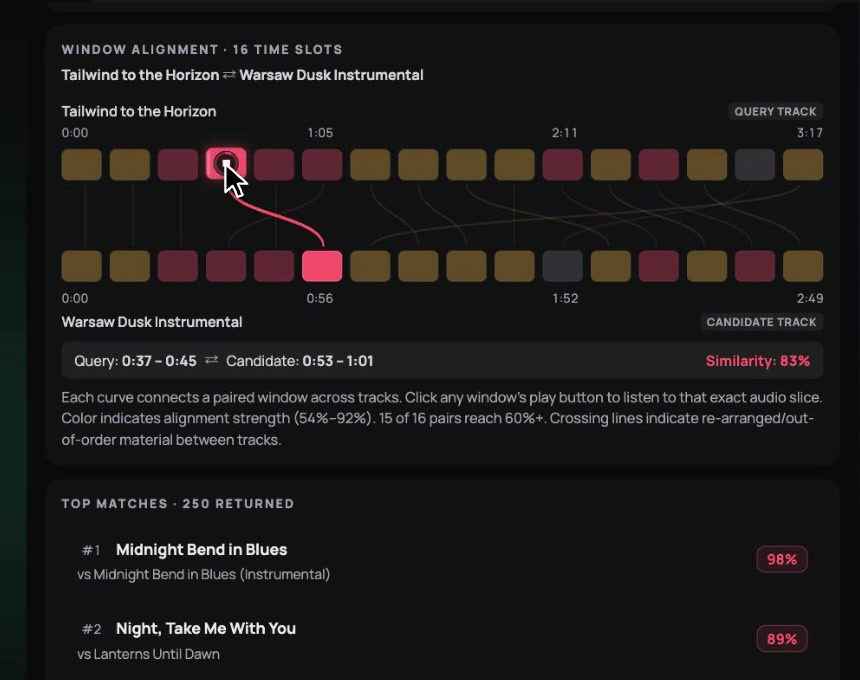 Trace pairs passages of two songs and shows where they line up, with timestamps for both. Demo on sample songs.
This is the point the whitepaper makes about deep search: a rights holder can screen AI tracks against their catalog "without needing the AI developer's cooperation." Trace gives labels, publishers and platforms that capability now, through Trace's endpoints on the Soundverse Enterprise API. In the Soundverse app, Trace is in preview.
Trace also has the limits of any black-box method, and it says so. Its scores measure similarity, not cause. Two songs can sound alike because one copied the other, or simply because both follow the conventions of their genre. Trace's results are evidence for a person's review, not a legal finding.
For how Trace scores songs, its API and a screen-by-screen tour of the interface, read How Soundverse Trace works: a technical deep dive into music similarity search.
What comes next: white-box attribution
Black-box attribution can show that a song resembles another. It can't show why. In the whitepaper's words: "embeddings can flag what sounds alike, but cannot reveal why it sounds alike." Answering that requires looking inside the model, and that is Soundverse's next step.
Soundverse is in a position to do it because it builds and trains its own models. A white-box system can't be bolted onto someone else's model from outside, but a platform that controls its models and the records of their training data can design it in. The whitepaper describes Soundverse's approach:
- Logging influence inside the model. It records which training items' features flow into each output, during training and generation, so every generation can carry a "provenance map" of the data that influenced it. The whitepaper describes this as patent-pending, in-house technology.
- Starting with groups, then single songs. It starts by tracking influence for groups of related songs (cohorts), then moves to individual songs.
- Thresholds instead of dust. The proposed system decomposes an output into its influence components. Only influences above a set threshold, and only a maximum number of songs per output, qualify for royalties. This avoids long tails of tiny shares that cost more to process than they are worth.
- Attribution points. Raw influence percentages are converted into points that add up over time. The whitepaper explains why: raw per-generation influence is "volatile and model-version-dependent." Points keep payouts stable when the models improve, and they let partners settle periodically instead of receiving millions of micro-payments.
A pilot that Soundverse ran with 50 creators in 2024 shaped those choices. Without thresholds, payouts fragmented into tiny fractions; with them, the system was workable. Creators also wanted to see, in near real time, when their music had influenced an output, and they preferred ongoing royalties to one-time buyouts.
The whitepaper is candid about the difficulty. It calls robust attribution that works on any model "unsolved" and an "active research area." It says attribution methods must be validated carefully and may have to be rebuilt when a model's architecture changes. Its stated plan is the combination described above:
- use deep search now, to catch blatant copies before they leave the platform and to let rights holders check any track;
- build model-level attribution behind it, so credit and payment can follow actual influence.
Frequently asked questions
Is data attribution the same as copyright detection? No. Copyright detection, usually based on audio fingerprinting, asks whether a recording matches a known one. Data attribution asks which music influenced a new AI-generated song, even when nothing was copied directly.
Can black-box attribution prove that an AI copied a song? No. It shows resemblance: where two songs match and how closely. Whether the resemblance comes from copying, from training data or from shared genre conventions is a further question, for experts and, if needed, the courts.
Who can do white-box attribution? Only someone with access to the model's internals and its training records, which in practice means the company that built and trained it. That is why it can't be applied from outside to another company's model.
Why not just retrain the model without each song? For a model trained on millions of songs, that would mean millions of full training runs. White-box methods such as influence functions, gradient tracing and unlearning exist to estimate the same answer without doing that.
Does Trace tell me which songs an AI model was trained on? No. Trace tells you what a song resembles in the music you compare it with, and where. Identifying the training songs that shaped an output is the job of white-box attribution.
What is cohort-based attribution? It credits a group of training songs, such as everything in a genre, rather than individual tracks. The whitepaper treats it as a practical interim measure: easy to run, but closer to correlation than to cause.
Further reading
- Soundverse whitepaper 1: Towards an Ethical Framework for AI Music: End-to-End Infrastructure. Section 4 compares data attribution and deep search; section 5.5 covers the status of influence-based attribution.
- Soundverse whitepaper 2: The Spectrum of Creation, on authorship and rights across the ways music is made.
- Trace feature page and the Trace API documentation.
- Koh and Liang, Understanding Black-box Predictions via Influence Functions, ICML 2017.
- Pruthi and colleagues, Estimating Training Data Influence by Tracing Gradient Descent (TracIn), NeurIPS 2020.
- Park and colleagues, TRAK: Attributing Model Behavior at Scale, ICML 2023.
- Ghorbani and Zou, Data Shapley: Equitable Valuation of Data for Machine Learning, ICML 2019.
- Barnett, Flores García and Pardo, Exploring Musical Roots: Applying Audio Embeddings to Empower Influence Attribution for a Generative Music Model, ISMIR 2024. This is a black-box study of a generative music model's training data.
- Choi and colleagues (Sony AI), Large-Scale Training Data Attribution for Music Generative Models via Unlearning, NeurIPS 2025 Creative AI Track. This is a white-box study on a text-to-music model.
- Deng, Ma and colleagues, Computational Copyright: Towards A Royalty Model for Music Generative AI.
Watch
- Soundverse Trace: Deep Search for Music Catalogs (4:15)
- Soundverse Trace: Music Similarity at Track, Stem, Section and Lyric Level (5:54)
- "Fully AI" Isn't Enough: The Spectrum of Creation, Explained
