What Are the Standard Benchmarks for Measuring Voice Synthesis Accuracy?
Voice synthesis benchmarks explained: MOS, CMOS and MUSHRA tests, WER, speaker similarity, UTMOS, MCD, common test sets, singing pitch and vendor claims.
The standard voice synthesis benchmarks are listening tests and automatic metrics used together: MOS on the ITU-T P.800 five-point scale, CMOS or MUSHRA for side-by-side comparisons, word or character error rate from a speech recognizer for intelligibility, speaker-embedding cosine similarity for voice match, and pitch accuracy against the score for singing. No single number covers all of it.
This guide is for teams building or buying voice tools. We read every standard, paper and repository cited here on 23 November 2026.
What voice synthesis benchmarks measure
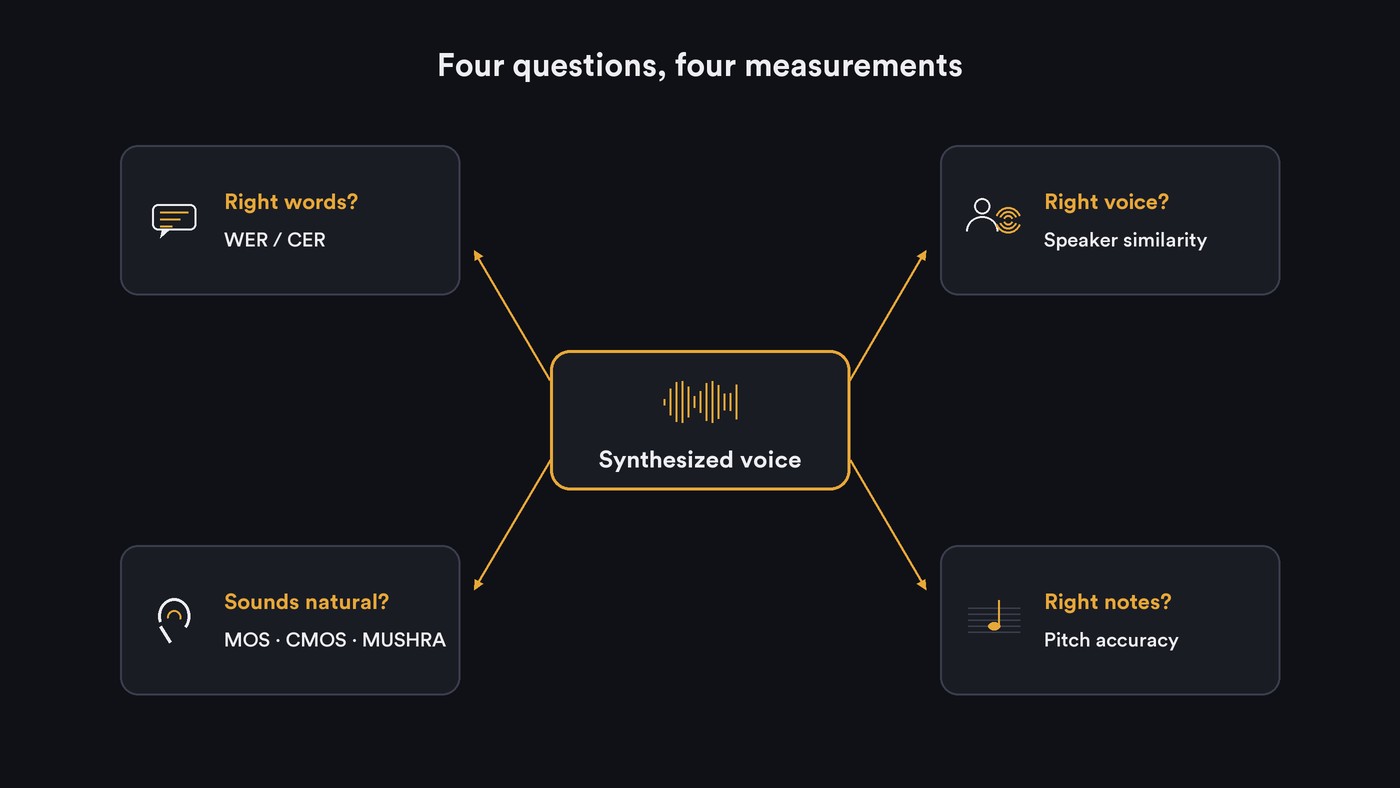
Accuracy splits into four questions, each with its own measurement:
- Right words? Word or character error rate.
- Right voice? Speaker similarity.
- Natural and clean? Listening tests, or a model that predicts them.
- Right notes, for singing? Pitch and timing against the score.
A system can win one and lose another: a flat, carefully articulated voice can have a low error rate and still sound robotic, for reasons we cover in what makes an AI voice sound robotic versus authentic.
Subjective listening tests: MOS, CMOS, MUSHRA and preference tests
Listening tests stay the reference because the target is human perception.
MOS under ITU-T P.800
ITU-T P.800 defines absolute category rating: listeners hear one sample at a time and rate it Excellent (5), Good (4), Fair (3), Poor (2) or Bad (1). Their mean is the mean opinion score. P.800 was written for telephone transmission; speech synthesis papers report MOS on the same scale.
P.800 wants listeners who haven't done a listening-opinion test for a year or heard the sentences before, and sessions ideally under 20 minutes. Ask one question per test, such as naturalness, and mix in natural recordings so raters have a real top end.
CMOS: comparison category rating
Annex E of P.800 defines comparison category rating. Listeners rate the second sample of a pair against the first, from +3 (Much Better) to −3 (Much Worse). Order is randomized, so flip the sign of reversed trials before averaging into CMOS. CMOS suits comparing a new model with your current one when both score close on MOS.
MUSHRA under ITU-R BS.1534
ITU-R BS.1534-3, the MUlti Stimulus test with Hidden Reference and Anchor, has listeners rate several versions of one item on a 0 to 100 scale while switching freely against the open reference. Hidden among them are the reference itself and at least two anchors, the original low-passed at 3.5 kHz and at 7 kHz. A trial holds at most 12 signals, anyone who rates the hidden reference below 90 on more than 15% of items is excluded, and under tight control no more than 20 assessors are often enough.
The recommendation itself records "that the name MUSHRA is often misused for tests not using reference and anchors". Without them, it's just a slider test.
Preference (AB) tests
Two versions, pick the better one. P.800's pair comparison procedure (Annex F) is forced choice, balances A-B and B-A orders, and asks for at least six listeners, preferably twelve or more.
Intelligibility: word and character error rate
Run the synthesized audio through a speech recognizer and compare its transcript with the input text. Word error rate counts substitutions, deletions and insertions, divided by the words in the reference. Character error rate does the same per character, which suits languages written without spaces, such as Mandarin. The Seed-TTS-eval repository is a public recipe: Whisper-large-v3 for English, Paraformer-zh for Mandarin.
Where it misleads:
- Recognizer errors count against the voice, so compare systems only with the same recognizer.
- Normalization: "Dr." against "doctor", digits against words. Normalize both sides the same way.
- It ignores naturalness: a correct but lifeless reading scores well.
- Sung lyrics are harder to recognize than speech: use a human recording of the same lyrics as your baseline.
Speaker similarity: cosine similarity between speaker embeddings
For cloning and zero-shot synthesis, a speaker-verification model turns each clip into an embedding that summarizes the voice. Cosine similarity between the generated clip and a real recording says how close the voices are; higher is closer. Seed-TTS-eval uses WavLM-large fine-tuned on speaker verification.
Scores from different verification models aren't comparable. If the reference is the clip you used as the prompt, the score can reward copying its microphone and room, so also score against a different recording of the same person. And a match isn't permission: clone only voices you have the right to use.
Automatic MOS predictors and their limits
- UTMOS is the UTokyo-SaruLab system for the VoiceMOS Challenge 2022 (paper), which asked for predicted ratings of samples from earlier Blizzard Challenges and Voice Conversion Challenges, in an in-domain and an out-of-domain track. UTMOS had the highest score on several metrics in both.
- DNSMOS is a no-reference metric that, according to its paper, was designed to evaluate noise suppressors. It doesn't judge pronunciation, prosody or whose voice it is.
ITU-T P.800.2 adds that objective models give repeatable results, yet different models can predict different MOS values for the same conditions. Use a predictor as a regression alarm between versions of your own system, label it predicted MOS, and never average it with listener scores.
Signal-level metrics: mel cepstral distortion and F0 error
Both compare the output with a real recording of the same sentence by the target speaker.
- Mel cepstral distortion (MCD) measures the distance between mel-cepstral coefficient sequences; lower is closer. The pymcd package documents three variants: plain (equal lengths, the shorter clip padded), DTW (aligned by dynamic time warping) and DTW-SL (also weighing the length difference). A figure without its variant can't be compared.
- F0 error compares pitch contours, usually as root-mean-square error plus a voiced/unvoiced error rate.
A sentence has many valid readings, so a natural but different intonation raises both errors, and expressive or zero-shot output rarely has a matching recording. They're most useful where one right answer exists, such as a vocoder rebuilding the same utterance.
Common test sets
- LibriSpeech test-clean: the clean test split of an OpenSLR corpus of about 1,000 hours of read English.
- LibriTTS test-clean: per OpenSLR, LibriTTS is about 585 hours of read English at 24 kHz, derived from LibriSpeech for TTS research, split at sentence breaks, noisy utterances excluded.
- VCTK (version 0.92, University of Edinburgh): 110 English speakers with various accents, about 400 sentences each.
- Seed-TTS-eval: 1,000 English samples from Common Voice, 2,000 Mandarin samples from DiDiSpeech-2, a Mandarin hard-case list and voice conversion sets.
Read speech is far from ad reads or lyrics, so add your own sentences and check that no test speakers or sentences were in training.
Singing-specific checks: pitch against the score
For singing, the score is the ground truth. Extract the pitch contour from the sung output, convert it to cents and compare it frame by frame with the score. The mir_eval melody metrics define the usual measures: raw pitch accuracy is the share of voiced reference frames within half a semitone (a default tolerance of 50 cents), raw chroma accuracy forgives octave errors, and voicing recall and false alarm check that the voice sings only where the score has notes.
Vibrato and slides drift from a flat score on purpose, so compare against a human singer's take of the same score. Our guide to speech synthesis versus singing synthesis explains why singing needs its own checks.
How to read a vendor's voice synthesis benchmarks
The key rule comes from ITU-T P.800.2: "it is not meaningful to directly compare MOS values produced from separate experiments, unless those experiments were explicitly designed to be compared, and even then the data should be statistically analysed to ensure that such a comparison is valid." Two vendors' MOS figures from their own tests don't rank them. Ask:
- Listener MOS or predicted MOS? If predicted, which model.
- How was the listening test run? Listeners, votes per condition, standard deviation, the question asked, natural recordings in the mix.
- Which recognizer, normalization and test set produced the WER?
- Which verification model and reference clips produced the similarity?
- Did the "MUSHRA" test have a hidden reference and anchors?
- All outputs or picked demos? Ask for every output on a public set.
A small evaluation plan your team can run
- Build the set for your languages and use case: around 100 sentences, half from a public set such as LibriTTS test-clean, half from your domain (names, numbers, lyrics). For cloning, hold back recordings of each target voice.
- Generate once per sentence with fixed settings and keep every output.
- Automatic pass: WER or CER with one fixed recognizer, similarity against the held-back recordings, predicted MOS as an alarm, raw pitch accuracy against the MIDI score for singing.
- Listening test: MOS with natural recordings mixed in, plus CMOS against your current system. Match loudness, randomize order, keep clips short (P.800.2 notes samples usually run 6 to 10 seconds) and use listeners new to the sentences.
- Report mean, standard deviation and votes per condition with tool versions, and rerun the same plan at every model update.
Emotional delivery needs tests of its own; see how AI voice synthesis models handle emotional inflection.
Where Soundverse fits
Soundverse is an AI music platform that takes you from idea to audience, built for independent artists who release music. AI Singing Generator sings your lyrics as an a cappella vocal with nothing behind it, so you can track pitch against your score without separating stems. Train Voice Clone builds a clone from one take with 15 seconds or more of singing, after you confirm it's your voice; score it against takes you held back. Analysis One, available on every plan, reads gated LUFS for loudness-matching clips, and Audio Transcription writes out sung or spoken audio with timing for every word, handy for spotting misread lines. Licensing is set by plan: the Free plan is for personal use, and the Creator plan comes with a royalty-free license.
FAQ
What is a good MOS score for a synthetic voice? There's no universal cut-off. P.800.2 explains that MOS depends on the experiment, including the other conditions in it, so judge a system against natural recordings rated in the same test.
Is WER enough to measure voice synthesis accuracy? No. It checks the words, not naturalness, identity or emotion, and a monotone voice can score well. Pair it with a listening test and a similarity score.
Can UTMOS or DNSMOS replace a listening test? No. They're fast regression checks shaped by what they were built for: VoiceMOS Challenge ratings for UTMOS, noise suppression for DNSMOS. Confirm big decisions with listeners.
Sign up for Soundverse free to put your own lyrics and voices through the plan above. More guides on the Soundverse blog.