What Is the Difference Between Parametric and Concatenative Synthesis?
Parametric vs concatenative synthesis: unit selection and diphones vs HMMs and vocoders, their artifacts, and how singing synths like VOCALOID evolved.
Parametric vs concatenative synthesis comes down to what the system stores. Concatenative synthesis stores real recordings and splices small units of them together, so it sounds natural until a join slips. Statistical parametric synthesis stores a model of the voice and rebuilds audio through a vocoder, so it bends easily but sounds buzzier and duller.
Both came out of speech research, both shaped the first singing synthesizers, and neural networks replaced both. Below is how each one works, what it sounds like when it fails, and how singing software moved from one to the other, drawn from the papers and official histories linked here and checked on 19 November 2026. For the whole modern pipeline from text to waveform, see how AI voice synthesis actually works.
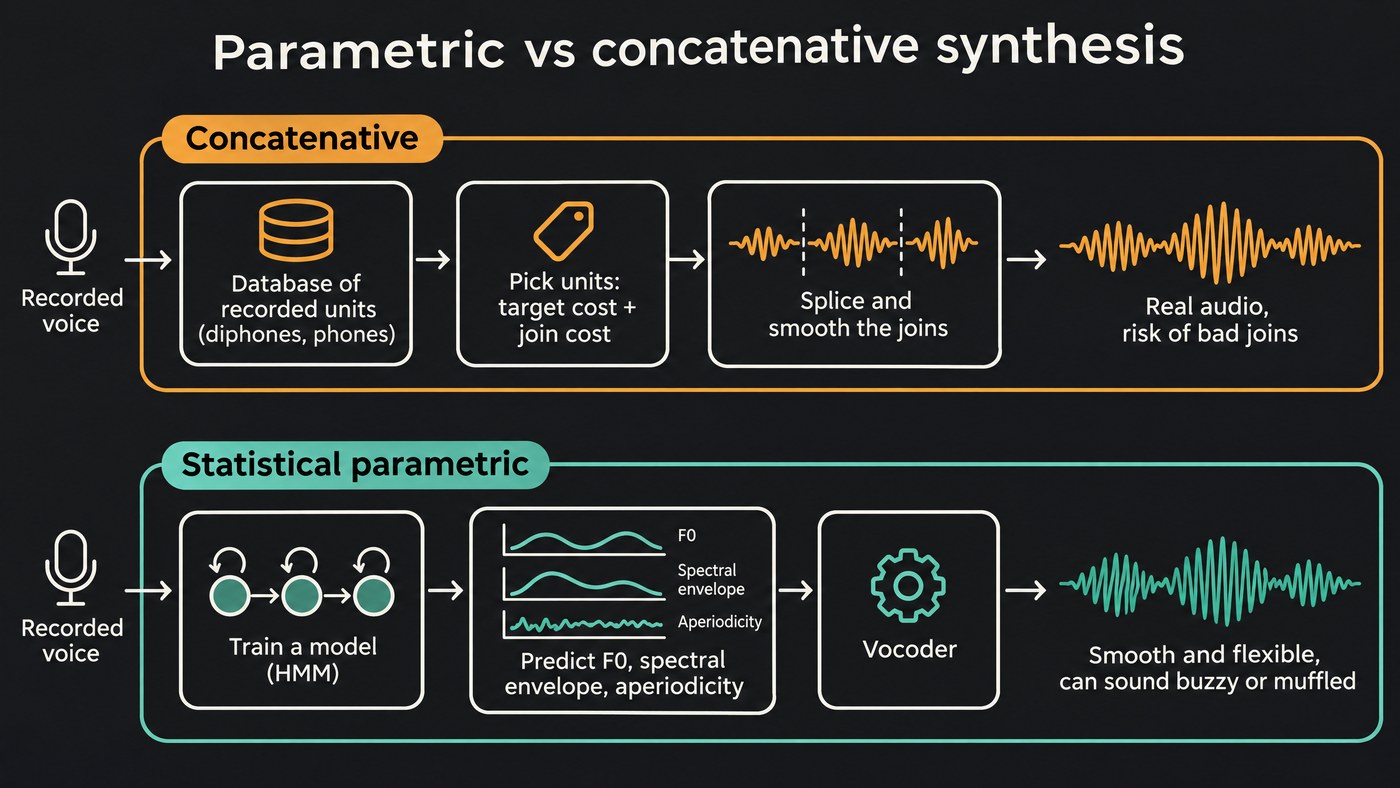
How concatenative synthesis works: diphones and unit selection
Concatenative systems build new speech or singing out of pieces of old recordings. There are two main styles.
Diphone synthesis uses a fixed inventory: one recorded example of each transition between two sounds, cut so that each piece runs from the middle of one sound to the middle of the next. The joins then land in the steady part of a vowel or consonant, where they are easiest to hide, and the hard part, the transition, stays as recorded. Kevin Lenzo and Alan W. Black described the whole process of designing, recording and building such voices at ICSLP 2000, including ten diphone sets of one American English speaker for the Festival Speech Synthesis System. With one example per transition, every unit has to be bent to the pitch and length the sentence needs, and the more it is bent, the less natural it sounds.
Unit selection swaps the small fixed inventory for a large database with many candidates for each unit. In their 2009 review in Speech Communication, Heiga Zen, Keiichi Tokuda and Alan W. Black describe the selection model Andrew Hunt and Black presented in 1996 for the CHATR system. Each candidate gets a target cost (how well it matches the unit the sentence needs) and a concatenation cost (how well it joins its neighbors), and the system searches for the sequence with the lowest total.
Because the output is real recorded audio, little modified, quality comes straight from the recordings, and the review notes that a larger database gives better coverage. By 2009, the review says, unit selection had dominated speech synthesis for a decade.
How statistical parametric synthesis works: HMMs and vocoders
Statistical parametric synthesis stores statistics instead of waveforms. In the hidden Markov model (HMM) version, context-dependent models learn the spectrum, the excitation (pitch, or F0) and the duration of each sound from a recorded voice. At synthesis time, the system generates a smooth trajectory of those parameters and hands them to a vocoder, which turns numbers back into sound.
A vocoder of this kind describes a voice with three things. The WORLD vocoder by Masanori Morise estimates F0, aperiodicity (the noisy, breathy part) and the spectral envelope, then resynthesizes speech from only those parameters. Zen and colleagues list STRAIGHT among the higher-quality vocoders that were built into HMM systems to reduce their buzz.
The payoff is control. The 2009 review calls flexibility in changing voice characteristics, speaking styles and emotions the main advantage of the parametric approach, done by transforming model parameters. A model can also be adapted to a new speaker from a small amount of speech, and statistics allow smoother joins than spliced recordings.
Strengths and artifacts of parametric vs concatenative synthesis
Concatenative
- Strength: at its best, it is a real person's recorded voice, breath and texture included.
- Bad joins: a click, a pitch jump or a vowel that changes color mid-word. Zen, Tokuda and Black put the risk plainly: "Even though this may be a rare event, a single bad join in an utterance can ruin the listeners' flow."
- Coverage gaps: when a sentence needs contexts the database barely has, quality can drop sharply.
- Locked style: since the selected pieces are mostly unmodified, the output keeps the style of the recordings. A new style or emotion means recording more, which the review calls very difficult and costly.
Statistical parametric
- Strength: consistent, smooth and easy to change.
- Buzz: the review says the basic HMM system sounds buzzy because its vocoder uses a simple pulse train or white noise as the excitation.
- Muffled sound: averaging over-smooths the parameter trajectories, so fine detail is lost and cannot be recovered at synthesis.
- Lower naturalness: the review names three factors that degrade quality, the vocoder, acoustic modeling accuracy and over-smoothing, and notes that in past Blizzard Challenge evaluations its naturalness was still far from natural speech.
A producer's shorthand: concatenative problems are local, a glitch on one syllable. Parametric problems are global, the whole voice sounding slightly buzzy and dull.
The two also met in the middle. The review describes clustering-based unit selection systems that use HMM-style state clustering, and lists numerous possible hybrids between the two approaches.
Why neural synthesis replaced both
Neural networks replaced the parametric approach's weak stages one at a time while keeping its main idea: a model, not a database.
- The acoustic model. In a 2013 ICASSP paper, Heiga Zen, Andrew Senior and Mike Schuster at Google replaced the decision trees, which they found inefficient at modeling complex context dependencies, with a deep neural network. Their DNN systems outperformed HMM systems with similar numbers of parameters.
- The vocoder. WaveNet, posted to arXiv on 12 September 2016 by Aäron van den Oord and colleagues, Zen and Senior among them, generated the waveform sample by sample. Listeners rated it significantly more natural than the best parametric and concatenative systems in both English and Mandarin.
The result kept parametric flexibility (new voices, styles and emotions from a trained model, with no joins to hide) and won back the detail that averaging and signal-processing vocoders had thrown away. The old ideas didn't vanish. WORLD's F0 estimators, DIO and Harvest, are still listed as pitch-extractor options in the so-vits-svc singing voice converter's README.
How singing synthesizers evolved from concatenation to AI
Singing suits concatenation in one way: the score already supplies pitch and timing, so the system mostly has to connect sounds and hold vowels.
VOCALOID (sample concatenation). Hideki Kenmochi, known at Yamaha as the father of VOCALOID, recounts on Yamaha's research site that the project began in 2000, developed jointly with Pompeu Fabra University in Barcelona. The method focused on the transitions from one phoneme to the next, connecting those with the parts where sounds are held. Yamaha announced VOCALOID in 2003, and the first products came out in 2004 from Zero-G and Crypton. Kenmochi admits they still sounded a bit mechanical, and breath was the stubborn problem: "In the first version, we removed the breath components from the sampled vocals and added them back later, but it still sounded a bit off." The 2007 paper by Kenmochi and Hayato Ohshita at Interspeech is titled plainly: a commercial singing synthesizer based on sample concatenation.
Sinsy (statistical parametric). Keiichi Tokuda, a co-author of the review above, and his colleagues at the Nagoya Institute of Technology applied the HMM approach to singing. Their SSW 2010 paper describes modeling the spectrum, excitation and duration of singing with context-dependent HMMs, generating the waveform from the models themselves, and a free online service, started in December 2009, where users upload scores in MusicXML. Sinsy's site now calls it a DNN/HMM-based singing voice synthesis system.
AI engines. Yamaha's VOCALOID6 product page (checked 19 November 2026) says it uses VOCALOID:AI, an AI-based technology for more natural, expressive singing.
Two of our guides take this further: the differences between speech synthesis and singing synthesis, and how AI voice synthesis generates singing vocals stage by stage. Breath, the part VOCALOID's first version struggled with, gets its own look in whether AI can replicate breathiness and subtle vocal artifacts.
Where Soundverse fits
Soundverse is an AI music platform that takes you from idea to audience, built for independent artists who release music. You don't pick a synthesis method or edit a voicebank. AI Singing Generator sings your lyrics as an a cappella vocal in a style such as pop, rap, rock or choir, or in a voice similar to a reference of at least 30 seconds that you may use. Each take sings about the first 350 characters of your lyrics, and every take comes out differently, so generate again if one misses. AI Speech Generator turns up to 3,000 characters of script per run into narration in built-in voices. For phoneme-by-phoneme editing, a dedicated vocal synth is still the right tool.
This demo shows AI Singing Generator turning lyrics into an a cappella vocal, guided by a vocal reference.
FAQ
Is VOCALOID concatenative or parametric? It began as concatenative: Yamaha's 2007 Interspeech paper describes it as a singing synthesizer based on sample concatenation. VOCALOID6 adds VOCALOID:AI, an AI-based engine.
What is a diphone? A recorded unit that runs from the middle of one speech sound to the middle of the next, so it contains the transition between them. Diphone synthesizers keep one example of each and join them in the steady middle of each sound.
Why does parametric speech sound buzzy or muffled? The buzz comes from simple vocoders that excite the voice with a plain pulse train or noise. The muffled quality comes from over-smoothing, where averaging in the model removes fine detail that synthesis can't restore.
Is formant synthesis the same as statistical parametric synthesis? No. Classic formant synthesizers generate speech from rules and settings written by hand. Statistical parametric synthesis learns its parameters from recordings of a real voice, part of what the 2009 review calls the field's move from a knowledge-based approach to a data-based one.
Sign up for Soundverse free and hear your lyrics sung. More vocal guides on the Soundverse blog.
