Are There Specific Neural Network Architectures Best Suited for Creating Rhythmic Video Output?
Neural network architectures for rhythmic video: beat trackers, audio embeddings, cross-attention, temporal layers, dance and lip-sync models, and metrics.
Yes. The neural network architectures best suited to rhythmic video pair an audio encoder that captures the beat, such as a beat tracker or a pretrained audio embedding, with a generator that attends to that audio frame by frame. Cross-modal transformers and diffusion models lead for dance, audio-attention diffusion for singing faces, and beat-then-edit pipelines for cuts.
Which one is best depends on what should move to the music: the cut, the camera, a dancing body or a singing mouth. Our explainer on how AI video engines interpret rhythm and tempo covers the analysis from the editor's chair. This guide opens the research papers behind each architecture family.
How a neural network hears rhythm
Rhythm reaches a generative model in one of three forms.
- Hand-made features. AI Choreographer (2021) fed its model a 35-dimensional music feature computed with librosa: an envelope, 20 MFCCs, 12 chroma bins, and one-hot flags for onset peaks and beats. The beat is spelled out for the network.
- Learned beat trackers. Recurrent and temporal convolutional networks read a spectrogram and output beat probabilities. Beat Transformer (ISMIR 2022) first splits the mix into instrument spectrograms, then attends across time and across instruments with dilated self-attention that keeps cost linear. Its authors report up to a 4-point gain in downbeat accuracy over temporal convolutional networks.
- Pretrained audio embeddings. Newer systems borrow the hidden layers of a large audio model instead of flagging beats. EDGE uses Jukebox, a generative music model; EMO uses wav2vec, a speech model; the TempoTokens paper uses the BEATs audio encoder. Rhythm is in those embeddings implicitly, mixed with timbre, energy and phonemes.
The trade-off is control. Explicit beat flags are easy to inspect and correct. Embeddings carry more nuance, but you can't point to "the beat" inside them.
How audio steers the video model
Four mechanisms recur across the papers.
- Cross-attention. At every denoising step, the video or motion latents query the audio tokens. EDGE feeds frozen Jukebox embeddings in this way. EMO adds audio-attention layers after each reference-attention layer, and gives every frame audio from a few frames before and after it, because a mouth opens and breathes before the sound arrives.
- Early fusion in one transformer. FACT, the model in AI Choreographer, encodes music with an audio transformer and a 2-second seed motion with a motion transformer, joins them, and runs both through a full-attention cross-modal transformer. Training it to predict several future frames rather than one is what its authors credit for stopping motion from freezing or drifting.
- Temporal attention layers. Rhythm needs frames that know about each other. Video Diffusion Models (Ho and colleagues, 2022) factorize a 3D U-Net into attention within each frame and attention across frames. AnimateDiff packages motion as a plug-in module trained on real videos, and EMO's temporal layers follow its design.
- Adapters into a frozen model. TempoTokens trains a small network that maps BEATs audio features to pseudo text tokens for each frame, so an existing text-to-video model (a 3D U-Net with temporal attention) follows sound without its own weights changing.
Diffusion transformers, introduced for images by Peebles and Xie's DiT, replace the U-Net with a transformer over latent patches. Audio can enter them through the same cross-attention route.
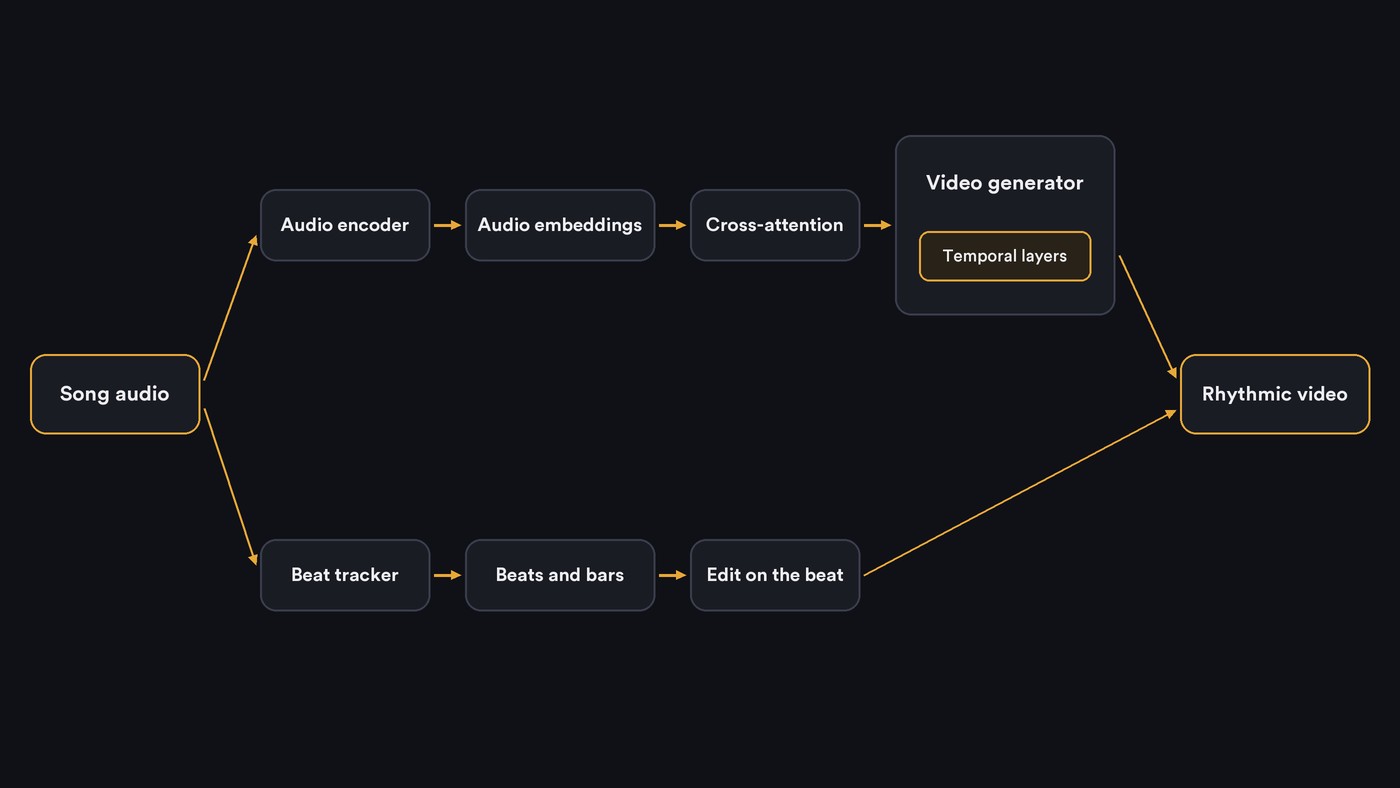
Neural network architectures by job: what each does best
Music-to-dance motion
- FACT learns the link between music and motion inside one cross-modal transformer.
- Bailando (CVPR 2022) stores dance units in a quantized codebook it calls choreographic memory, then composes them with a GPT tuned by actor-critic reinforcement learning on a beat-align reward. Rhythm becomes part of the training objective.
- EDGE (CVPR 2023) is a transformer-based diffusion model on Jukebox features. Its project page shows editing: joint-wise conditioning, in-betweening and continuation. It trains on 5-second clips and chains them into longer dances with temporal constraints.
Best at: a body that moves on the beat. The output is 3D motion that you render or retarget onto a character, so the look of the video comes from a later stage. Our explainer on why AI video generators struggle with human motion covers what goes wrong when a video model draws dancers pixel by pixel.
Audio-driven talking heads and singing portraits
Older systems work in two stages: audio to facial landmarks or 3D face parameters, then a renderer. EMO skips that step, generating video straight from audio with a diffusion backbone, a ReferenceNet to hold identity, wav2vec features through audio-attention, temporal layers, and speed layers that guide how fast the head moves. Its authors show singing as well as speech.
Best at: a mouth and head locked to a vocal. These models aren't built to place cuts. For visemes and lip-sync timing, see how AI-generated visuals synchronize with audio.
Audio-conditioned video diffusion
TempoTokens aims for video aligned with sound both globally and temporally: the right subject for the whole clip, and visible change when a sound happens. Best at: motion that reacts to hits and energy in short clips. These models follow sound events rather than song form, so a chorus isn't a concept to them.
Two-stage pipelines: detect the beat, then edit
Abe Davis and Maneesh Agrawala's SIGGRAPH 2018 paper finds "visual beats" in footage and retimes them: "By warping visual beats into alignment with musical beats, we can create or manipulate the appearance of dance in video." Most music video tools work at this level. A beat and section analysis runs first, shots are generated or chosen per section, and cuts land on bar lines.
Best at: full-length videos with cuts on the beat. It's predictable, editable and works with any video model. Motion inside a shot won't follow the music unless that shot was also conditioned on audio.
In short:
- Cuts and scene changes: beat tracker plus edit pipeline.
- A dancing body: music-to-motion transformer or diffusion.
- A singing mouth: audio-driven portrait diffusion.
- Pulses and camera hits: audio-conditioned diffusion, or effects keyed to onsets.
How rhythm alignment is measured, and its limits
Beat Alignment Score. AI Choreographer introduced it. Music beats come from librosa; kinematic beats are local minima of the motion's speed. For each kinematic beat, the score rewards closeness to the nearest music beat on a Gaussian curve, then averages. The authors made it one-directional on purpose, since a dance needn't hit every beat. Bailando's version measures from each music beat instead.
EDGE's critique. The EDGE authors argue the metric has fundamental issues, because "a perfectly valid dance which aligns with the music in double time or half time will be scored very poorly by at least one of the two metrics." EDGE's own scores beat the real dances, which its authors say may mean the metric loses its meaning once output nears human quality. They put more weight on a user study with 147 raters.
AV-Align. The TempoTokens paper detects audio onsets and peaks in mean optical-flow magnitude, then counts peaks matched within a three-frame window in both directions, scored from 0 to 1. Its limit shows in the paper itself: real VGGSound videos scored 0.51, because sounds can come from things the camera never shows.
Scores catch gross misalignment. None can tell intentional syncopation from a mistake, so watch every result with the sound on.
What this means when choosing a video tool
- Name what should move to the music: cuts, camera, a body or a mouth. Match it to the families above.
- Check whether the model takes your audio as input. If it only takes text and images, all timing comes from the edit.
- Ask to see the beat grid and section map, and correct them before anything is generated.
- Check shot length. Research models often generate short clips and stitch them, as EDGE does; see how the tool joins shots across bar lines.
- Feed a clean stem. Lip sync works from the vocal, so a dry vocal gives the model the clearest signal.
- Test a half-time groove and a tempo change. These trip both trackers and metrics.
- Ask how the vendor judges sync, and treat any single score with caution.
Where Soundverse fits
Soundverse is an AI music platform that takes you from idea to audience. Here is what its music video tools do:
- AI Music Video Generator takes a track you have or a prompt for a new song. Agent One writes the script, quotes the cost for your approval, films each scene and cuts the video to the music. Turn on Lip Sync and the lead sings to camera in time with the vocals.
- Lip Sync turns a character image and up to 15 seconds of vocal into a clip with the mouth moving to your audio. Its page notes that a clean vocal stem syncs far better than a full mix.
- Section Analysis returns section timings plus tempo, beats and downbeats, so cuts can land on the bar.
Licensing is set by plan: the Free plan is for personal use, and the Creator plan comes with a royalty-free license.
This video shows a song, a character image and a prompt becoming a full music video, with planned scenes, a lip-synced performance and cuts to the music.
FAQ
Is a transformer or a diffusion model better for beat-synced video? Both appear in the strongest systems, and EDGE is both: a transformer inside a diffusion model. How the audio enters (cross-attention or early fusion) and whether temporal layers link the frames matter more than the label.
Do text-to-video models follow my song's beat? Only if they take audio as input. Otherwise the timing comes from analysis and editing: beats and sections are detected first, and cuts are placed on them.
What is the beat alignment score? A metric from the AI Choreographer paper that rewards motion pauses landing near music beats. It's useful for spotting off-beat output, but it can penalize valid half-time or double-time dancing.
Why does AI-generated motion feel off on half-time songs? Trackers can lock onto double or half the tempo you hear, and anything timed from those beats inherits the error. Set the BPM yourself when a tool allows it, and check beat one by ear.
Sign up for Soundverse free and map your track's sections and downbeats before you cut a frame. More guides on the Soundverse blog.