How Does Digital Music Distribution Work for Independent Artists?
Digital music distribution explained step by step: what a distributor does, ISRC and UPC codes, store ingestion, royalty reports, payout timing and fees.
Digital music distribution works through a middleman: you upload audio, artwork and metadata to a distributor, which attaches identifying codes (an ISRC for each recording, a UPC for the release), delivers it to Spotify, Apple Music and other stores, then collects your recording royalties from their sales reports and pays you after its fee or commission.
Here is each link in that chain, from Spotify, Apple, IFPI, DDEX and distributor help pages checked on 14 November 2026.
What a digital music distributor does
Most independent artists can't upload straight to Spotify or Apple Music. Spotify's help page for artists says it in one line: "Distributors handle music distribution and pay streaming royalties." The same page notes that most distributors charge a fee or a commission. Apple's guide to distributing on Apple Music encourages independent artists and small labels to work with an Apple-preferred distributor.
A distributor does five jobs for you:
- Takes in your release: audio, cover art, titles, credits, release date and the territories where it should be available.
- Issues or records your codes, so every stream and sale can be traced back to your recording.
- Delivers the release to each store in the format that store reads.
- Handles problems with the store. Apple's guide says "Apple communicates directly with your distributor about any of your music's metadata or asset issues", which is why corrections go through your distributor, not through Apple.
- Collects the money. Stores pay the distributor, and the distributor pays you.
Spotify's royalties guide says recording royalties reach artists through the licensor they chose to deliver their music, typically a record label or distributor.
How Does Digital Music Distribution Actually Work for Independent Artists?
- You upload audio, artwork and metadata. Our guide to what to prepare before uploading has the full list.
- Codes are attached. Each recording gets an ISRC and the release gets a UPC, either yours or ones the distributor issues.
- The distributor reviews it against its own rules and each store's style rules.
- The release is delivered as a data package to each store you picked.
- Each store ingests it: validates the package, processes the audio and schedules your date.
- It goes live. On release day the song appears in each store, attached to your artist profile.
- Usage comes back. Stores count streams and sales, report them to rights holders and pay them.
- You get paid. The distributor matches the reports to your codes, posts earnings to your account and pays out on its own schedule.
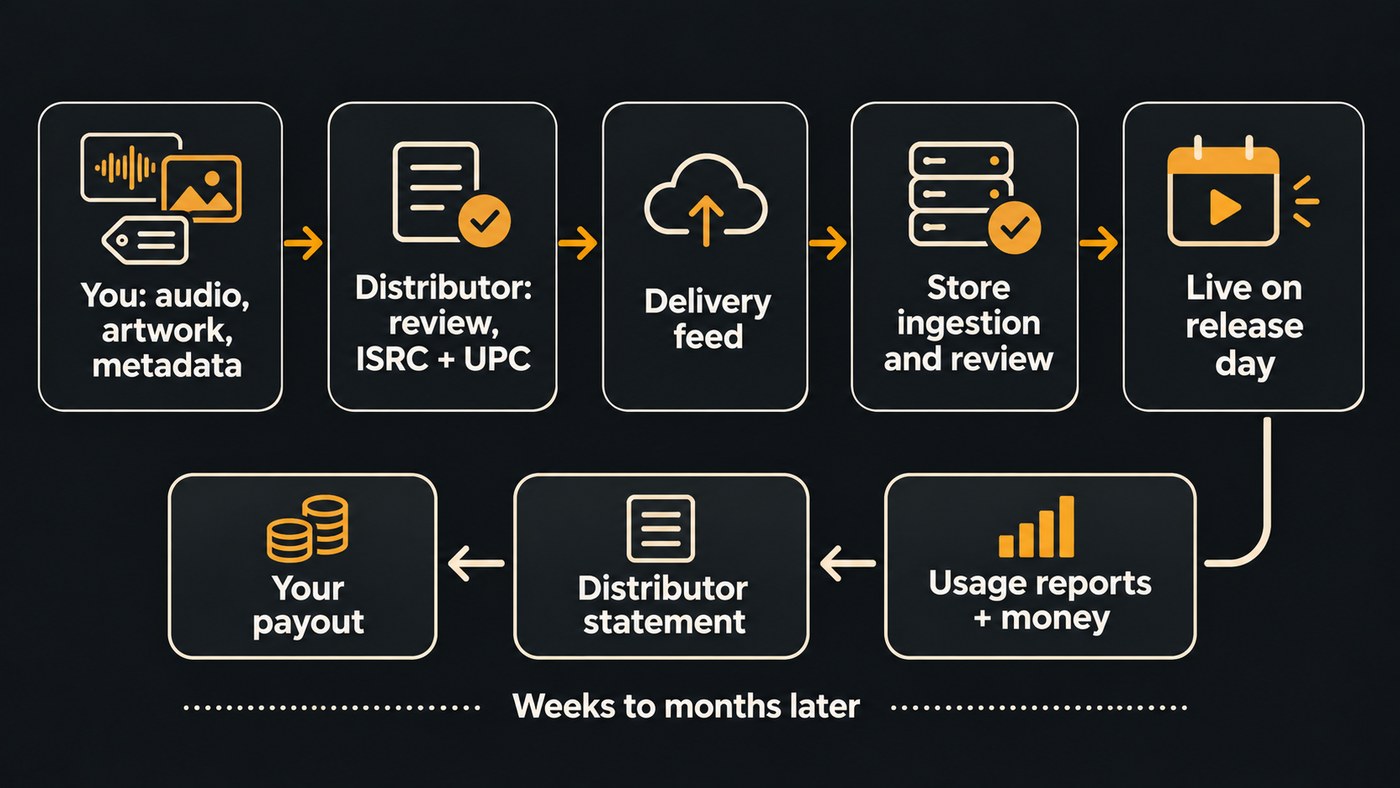
Steps 1 to 6 take days to weeks. Steps 7 and 8 repeat for as long as the music stays up.
Metadata and codes: ISRC and UPC
Two codes hold the whole system together.
- ISRC stands for International Sound Recording Code. IFPI's ISRC FAQs say it applies only to sound recordings; the composition has its own code, the ISWC. An ISRC is built from a prefix code, a year of reference and a designation code, and only the recording rights owner (or an ISRC manager they appoint) may assign one.
- UPC/EAN identifies the product, meaning the single, EP or album. IFPI says each different product needs its own UPC/EAN.
The codes matter for money as much as for listings. When a store reports usage, the ISRC is how a stream gets matched to your recording on your distributor's statement. A wrong or reused code can attach plays to the wrong recording, and untangling that after release takes time.
Metadata such as artist names, titles and credits rides along with the codes, and changes after release mean a redelivery.
Delivery, store review and ingestion
Distributors deliver through standard data feeds, the best known being DDEX's Electronic Release Notification (ERN) standard. DDEX says these messages are usually sent by a record company or distributor to a digital service provider, and carry metadata about the release and its sound recordings plus the terms for when, where and how stores can make it available.
Then the store takes over. Spotify's help page on music that isn't live on release day says Spotify needs five business days to get new music live. Its checklist for late releases shows what ingestion involves: valid XML, audio up to spec, and availability settings with the right date and territories. If a release delivered on time still isn't live, the distributor contacts Spotify's Content Operations Ingestion team.
Apple runs a similar check. It qualifies its preferred distributors partly on a low Apple Music rejection rate, which tells you how much clean deliveries matter.
Each distributor also runs its own review queue before delivery. Our post on music distribution turnaround times has store-by-store and distributor-by-distributor figures.
How stream and sale data flow back
Once your song is live, money moves the other way.
- Stores report usage. DDEX has a separate standard for sales and usage reports, sent by the store to the rights owner, which for you means your distributor.
- Streaming pays by share. Spotify's royalties guide says it pays rights holders based on streamshare, their share of total streams in a given month, and that no major streaming service pays a fixed rate per stream. Rights holders then pay artists and songwriters according to their own agreements.
- Small tracks may earn nothing on Spotify. Since April 2024, a track needs at least 1,000 streams in the previous 12 months to be included in Spotify's recorded music royalty pool, according to the same guide.
- Downloads and other stores come back in the same reports, broken down by store, country and track on your distributor's statement.
How often independent artists get paid
There are two clocks: when stores report, and when your distributor pays.
RouteNote's help article on missing sales (posted 10 March 2026) says partners such as Apple Music, Spotify and Deezer usually release official sales reports within 45 days after the close of each month, so April's earnings show up on June 15th. A few stores report 75 days after month end or quarterly. RouteNote then pays between the 15th and 20th of each month once your balance passes its payout threshold. CD Baby's pricing page advertises weekly payments.
In practice, expect your first streaming earnings around two months after your release month, and some stores later than that.
Spotify's royalties guide adds a warning for small earners: labels and distributors usually require a minimum of $2 to $50 per withdrawal, and banks charge $1 to $20 per transfer. Let a balance build before you cash out.
Fee models: how distributors charge
Distributors make money in three main ways. Prices below are from each company's own page on 14 November 2026.
- Yearly subscription, you keep 100%. DistroKid's pricing page lists Musician at $24.99, Musician Plus at $44.99 and Ultimate at $89.99, billed annually, and says every plan lets you keep 100% of earnings.
- One-time fee plus commission. CD Baby charges $9.99 per single or $14.99 per album once, with no annual fees, and keeps 9% of digital distribution revenue, so you get 91%.
- Commission-only or label-style deals. Spotify's royalties guide describes a range running from traditional label deals, where the label typically takes the majority share in exchange for marketing and A&R support, through 50/50 partnerships, to distribution models where artists keep nearly 100% after fees.
Which costs less depends on how often you release and what you earn. We compare services in which music distributors offer the best royalty splits, and help you pick in how to choose a distributor for your first single.
What digital music distribution doesn't cover
Your distributor collects money for the recording. The song itself, meaning the words and melody, earns separately. Spotify's royalties guide says publishing royalties cover performance and mechanical rights and are paid to publishers, performing rights organizations (PROs) and mechanical agencies based on where the music is played.
So register each song with a PRO such as ASCAP, BMI, PRS or IPRS, and in the US with The MLC for streaming mechanicals, or use a publishing administrator. Spotify's guide also advises agreeing song titles, writer names and splits up front, since typos or missing details can delay or block payments.
Where Soundverse fits
Soundverse is an AI music platform that takes you from idea to audience. It isn't a distributor: delivery to Spotify, Apple Music and other stores runs through a distributor like the ones above.
Soundverse helps with the work around that delivery. Release Planner turns a finished track into a dated, day-by-day rollout split by platform, with pre-save, smart link and playlist pitch deadlines, and can recommend a release day that leaves room for your rollout. It writes the plan; it doesn't post, submit pitches or contact anyone, and it runs on every plan, including Free.
With the Soundverse for Chrome extension, Agent One can upload a track to SoundCloud or a visualizer to YouTube as Private, so you review it before it goes public. It can also go through your distributor dashboard or the stores you name and report which ones show the release.
Licensing is set by plan: the Free plan is for personal use, and the Creator plan comes with a royalty-free license.
This walkthrough shows Release Planner turning a finished song into a day-by-day rollout plan.
FAQ
Do independent artists need a distributor to get on Spotify and Apple Music? In almost every case, yes. Spotify tells artists to work with a distributor, and Apple encourages independent artists to use an Apple-preferred one. Bandcamp, SoundCloud and YouTube take direct uploads.
How long after release do I get paid for streams? Usually about two months after the month the streams happened, sometimes longer. Most stores report within weeks of month end, some quarterly, and your distributor then pays on its own schedule.
Does my distributor collect my songwriting royalties? Not by default. A distributor collects recording royalties. Songwriting royalties go through PROs, mechanical agencies such as The MLC in the US, or a publisher, and some distributors sell publishing administration as a separate add-on.
What happens if my metadata is wrong after the release goes out? Ask your distributor to correct it and redeliver. Stores deal with your distributor on metadata and asset issues, not with you directly.
Sign up for Soundverse free and plan your next release with Release Planner.
More release guides on the Soundverse blog.