Can You Explain How AI Models Interpret Mood-Based Text Prompts?
How AI models read mood-based text prompts: text-audio embeddings, mood tags, valence and arousal, cultural ambiguity and before/after prompts.
AI models interpret mood-based text prompts by association. A text encoder learns, from captions, tags and playlist titles paired with real recordings, which sounds tend to sit next to words like "melancholic" or "euphoric". The generator then leans toward the tempos, keys, dynamics and instruments those words usually described. No model feels the mood.
In practice, mood words carry less information than they seem to, shift meaning across cultures and genres, and blur together when combined. Papers and docs cited here were read on 19 November 2026. For the whole text-to-audio pipeline, see how neural networks generate music from text prompts.
How a mood word becomes sound: joint text-audio embeddings
Many research systems steer generation with a joint text-audio embedding: two encoders, one for audio and one for text, trained so that a clip and a description of it land close together in one space. A mood word gets its meaning from whatever audio it was paired with.
- MuLan. Qingqing Huang and colleagues at Google described MuLan in 2022. It learned from 44 million music recordings, about 370,000 hours, paired with three kinds of loosely related text: video titles and tags, descriptions and comments, and the titles of 171 million playlists. The paper's examples include "The melody is so nostalgic and unforgettable" and playlist names such as "Salsa for broken hearts" and "Piano for study". None of it is guaranteed to describe the music.
- CLAP. LAION's CLAP (Yusong Wu, Ke Chen and colleagues, ICASSP 2023) trained on 633,526 audio-text pairs. Where a dataset only had tags, the team used the T5 language model to turn the keywords into sentences, a step they call keyword-to-caption augmentation.
So "melancholic" ends up pointing at whatever audio people called melancholic. If those clips lean slow, minor, quiet and heavy on piano or strings, the word pulls a new generation the same way. What the model holds is a neighborhood of sounds around each word, shaped by who wrote the captions.
What mood tags look like in real training data
Tag datasets show how loose that vocabulary is. The MTG-Jamendo dataset (Dmitry Bogdanov and colleagues, 2019) holds over 55,000 full tracks released on Jamendo under Creative Commons licenses, with tags supplied by the people who uploaded them. Its data splits use 56 mood/theme tags:
- Moods: sad, melancholic, hopeful, happy, dark, emotional, uplifting.
- Tempo and texture words: fast, slow, soft, heavy.
- Uses: corporate, advertising, film, trailer, christmas.
So a mood word arrives tangled up with use cases and production styles, and every tag covers a whole track, even when the mood changes halfway through.
Valence and arousal: how researchers measure musical mood
Music-emotion research usually maps mood on two axes: valence, how positive or negative an emotion is, and arousal, how much energy it carries. The pair goes back to James Russell's 1980 circumplex model of affect. In practice, happy and energetic sit at high arousal and positive valence, peaceful at low arousal and positive valence, and sad at low arousal and negative valence.
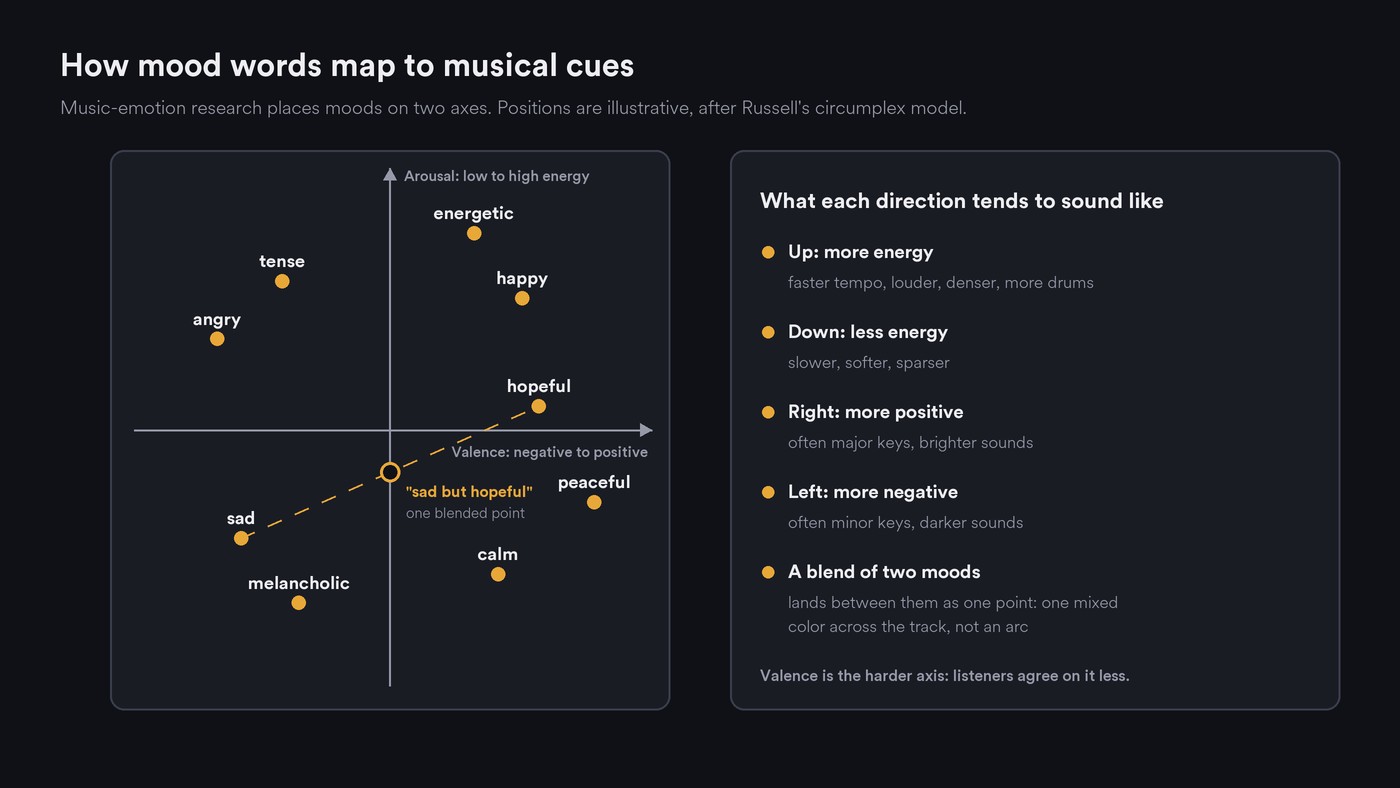
The DEAM dataset (Anna Aljanaki, Yi-Hsuan Yang and Mohammad Soleymani, PLOS ONE, March 2017) rated 1,802 songs and excerpts for valence and arousal twice a second and ran the MediaEval "Emotion in Music" benchmark on them from 2013 to 2015. Its finding matters for prompts: arousal could be modeled with simple timbral features, while no algorithm reached satisfactory performance on valence. As the authors note: "It is known that emotion perception is highly subjective, especially for valence."
A reasonable inference for prompting: energy words such as calm, driving or explosive map onto measurable things like loudness, density and tempo, so expect them to steer a generator more reliably than positive-or-negative words such as bittersweet or hopeful.
Why mood words are ambiguous across cultures and genres
GlobalMood, a 2025 study by Harin Lee and colleagues, tested how stable mood words are. It gathered emotion words from 2,519 people in the US, France, Mexico, South Korea and Egypt for 1,180 songs from 59 countries, then collected 988,925 ratings of those words. The valence-arousal structure held across cultures, but dictionary equivalents didn't always behave alike. Of six terms with direct translations in at least four of the five languages, "calm" agreed best between countries, and "happy" had the lowest between-country agreement. The paper starts from a warning that applies to prompts: "existing datasets predominantly focus on Western songs with terms derived from English, which may limit generalizability across diverse linguistic and cultural backgrounds."
Genre shifts meaning too. "Dark" in techno suggests a minor riff, a heavy kick and little top end; "dark" in a film cue suggests low strings and dissonance. "Chill" can mean lo-fi hip-hop, ambient or deep house. Name the tradition you mean, and the model searches a smaller neighborhood.
What the model can and can't do with "sad but hopeful"
Mixed moods are real in music. Patrick Hunter, Glenn Schellenberg and Ulrich Schimmack (Cognition and Emotion, 2008) played listeners instrumental excerpts with consistent happy cues (fast tempo, major mode), consistent sad cues (slow, minor) or conflicting ones (fast and minor, or slow and major). When tempo and mode conflicted, listeners reported mixed happy and sad feelings at once.
The text side is weaker. A joint embedding squeezes "sad but hopeful" into one point, roughly between its neighbors for sad and hopeful, and small words like "but", "then" or "until" may carry little weight. CompA (Sreyan Ghosh and colleagues, ICLR 2024) tested CLAP-style models on pairs of clips with the same sounds in a different order or with attributes swapped, and found them only marginally better than random chance. Their benchmark uses acoustic events rather than full songs, but the encoders are the same kind.
What to expect in practice:
- Usually works: a blend, such as minor-leaning harmony in a warmer, brighter arrangement that reads as bittersweet.
- Often fails: an arc. "Starts sad and ends hopeful" tends to come back as one even color across the track.
- Rarely works from style words alone: irony, or sad lyrics over a happy beat. Give the words to the lyrics and the sound to the style prompt.
The fix is to translate the mixed mood into conflicting musical cues yourself, as the 2008 study did, and to put any change over time into the structure.
A practical guide to writing mood-based text prompts
- Pair every mood word with musical evidence. Add tempo in BPM, key or mode, two to four instruments and a dynamic level. "Melancholic" plus 70 BPM, D minor, felt piano and cello leaves far less to guess.
- Use one energy word and one feeling word. "Calm, tender" or "driving, defiant" works better than six adjectives pulling in different directions.
- Describe the energy curve. Say where it starts and where it goes: sparse intro, fuller chorus, quiet outro. In song models with section tags, write the mood into each section.
- Build contrast from cues. For bittersweet, ask for a slow tempo with major-key chords, or a minor progression over a steady mid-tempo groove.
- Reference a section type. "Final-chorus energy" or "breakdown feel" points at patterns the model has heard many times.
- Anchor the culture and genre. "Melancholic Hindustani ballad with sarangi and tabla" is narrower than "melancholic".
- Describe what you want present. "Solo piano and strings" works better than "no drums".
- Generate several takes, keep the closest, then change one variable at a time.
Before and after
- Before: sad song. After: slow piano ballad, 68 BPM, D minor, felt piano and solo cello, soft dynamics, close intimate female vocal, melancholic and tender, sparse verses opening into a fuller chorus.
- Before: sad but hopeful. After: indie folk, 84 BPM, verses in A minor with fingerpicked acoustic guitar and a hushed voice, chorus in C major with brushed drums, warm strings and harmonies, bittersweet, last chorus brighter and louder than the first.
- Before: epic music. After: cinematic orchestral, 90 BPM, D minor, low brass, taiko and staccato strings, starts quiet and builds to a triumphant final section, for a game boss fight.
- Before: chill vibes. After: lo-fi hip-hop, 80 BPM, dusty drums, mellow Rhodes seventh chords, vinyl crackle, calm and warm, steady low energy for a study stream.
For ready-made starting points in one genre, see our lo-fi text-to-music prompts.
Where Soundverse fits
Soundverse is an AI music platform that takes you from idea to audience, built for independent artists who release music. AI Music Generator makes instrumentals from a prompt plus tags: up to two genres, one theme, up to three vibes such as Epic, Mysterious or Calm, up to five instruments and a tempo. Its own advice matches this guide: name the genre, mood, main instruments and tempo, and say what the music is for.
AI Song Generator takes a Style of Music prompt and up to five Quick Style tags, and Custom mode sings your lyrics as written, with section tags such as [Verse] and [Chorus]. If one section's mood misses, Inpainting, on the Creator plan and above, rewrites that section and keeps the rest. Soundverse v9 is on Pro and Max, and our v9 prompting playbook shows how we build style prompts. Each run makes one take, so refine and generate again when one misses.
From 0:17, this Create walkthrough shows AI Music Generator turning a text prompt into an instrumental.
FAQ
Do AI music generators understand emotion? They model associations rather than feelings. A mood word works because it appeared next to certain kinds of audio in training data, so the result reflects how people tagged music, habits and biases included.
Why does "happy" often come out generic? Mood tags share datasets with use-case tags like corporate and advertising, and "happy" had the lowest between-country agreement of six common words in GlobalMood. Add a genre, a tempo and specific instruments.
Can I make the mood change partway through a track? Describe the change as structure rather than as one sentence. With section tags you can set the arrangement and mood per section; for instrumentals, generate the parts separately and join them in an editor.
Should I write mood prompts in English? The GlobalMood authors note that most mood datasets use English terms on mostly Western songs. If a mood word in another language misfires, add the musical cues behind it: tempo, mode, instruments and dynamics.
Sign up for Soundverse free and try a mood prompt built the way this guide describes. More prompt guides on the Soundverse blog.