The Soundverse Prompting Playbook: Lyrics, Section Tags and Style Prompts for v9
Lessons from about 200 Soundverse v9 songs: section tags, the Style of Music formula, tempo vs line-count maths, 10 real recipes and a PDF for Claude.
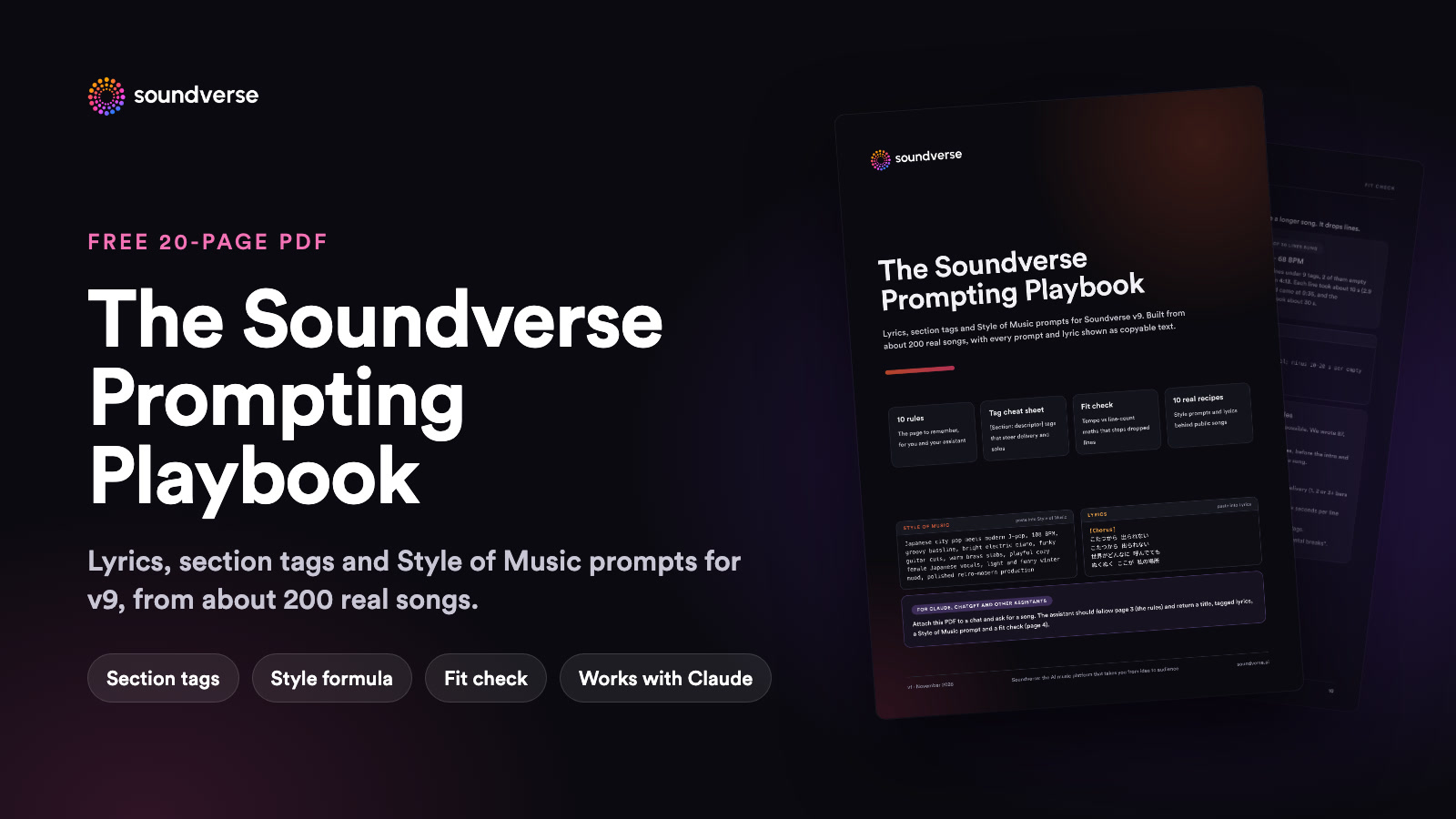
Soundverse v9 sings what you write. In Custom mode it takes your lyrics word for word, and it reads your Style of Music prompt as the brief for everything else: the genre, the tempo, the band, the voice and the mood. When those two fields are right, the first generation is usually close. When they're wrong, you spend tokens finding out why.
This playbook is what we learned from writing about 200 songs on Soundverse v9 in November 2026. They include city pop in Japanese, Afrobeats in Nigerian Pidgin, an 87-line devotional text in Awadhi, Sanskrit chants over drift phonk, growl-only deathcore in Swedish, lofi instrumentals and public-domain lullabies. Every prompt and lyric below is one we actually used, and every song we link to is public on Soundverse, so you can hear what each prompt produced.
The playbook also comes as a free PDF. Attach it to Claude or ChatGPT along with the short instruction message near the end of this post, and the assistant will write lyrics and Style prompts the way this guide describes: tagged sections, a line count that fits the tempo, and a Style prompt with its parts in the right order.
Download the Soundverse Prompting Playbook (PDF)
One tip: PDF viewers can scramble Devanagari conjunct letters when you copy them out of a PDF. If you want to reuse the Hindi, Awadhi or Sanskrit lyrics, copy them from this page instead.
What's inside
- The short version: 10 rules
- The two fields, and what goes in each
- The anatomy of a Style of Music prompt, with a table of the levers you can pull
- A section-tag cheat sheet, including tags that produce instrumental sections
- Writing lyrics for AI singing: line length, syllables, hooks and rhyme
- Tempo vs line count: the maths that stops lines getting dropped
- Languages and scripts
- Ten real recipes (Style prompt, lyrics and the result)
- Instrumentals and known melodies
- A troubleshooting table
- Using the playbook with Claude or ChatGPT, and with the Soundverse connector for Claude
- A pre-flight checklist
The short version: 10 rules
- Lyrics hold the words and the structure. Style of Music holds the sound. Don't put stage directions in your lyric lines, and don't put lyrics in the Style prompt.
- Write the Style prompt in this order: genre and sub-genre, BPM, core instruments, vocal type and delivery, mood and arc, then exclusions.
- Give the tempo as a number ("110 BPM"), not just "fast".
- Tag every section in square brackets and put the delivery or arrangement after a colon:
[Verse 1: Lead Vocals and Male Choir]. - A tag with no lines under it becomes an instrumental section. That's how you ask for a solo.
- Every tag can add a pause or a transition. For long texts, use fewer and bigger sections.
- Make the lyrics fit the tempo. A sung line takes about 2 bars; a rap, growl or fast chant line about 1 bar; a slow mantra line 3 bars or more. Plan for at most about 4 minutes of singing.
- Write each language in its own script in the AI Song Generator. In the melody tools (Melody to Song and MIDI to Song), romanise Hindi.
- Say what you don't want: "no female vocals", "no rap", "short intro", "no long instrumental breaks". Add "every word clear" when diction matters.
- Never use real artist names. Describe the sound instead: the era, the instruments, the vocal texture, the BPM and the mood.
The rest of this post explains each rule and shows where it came from.
1. The two fields: where the words go
Open the AI Song Generator, pick the v9 model and switch to Custom. You get two text fields.
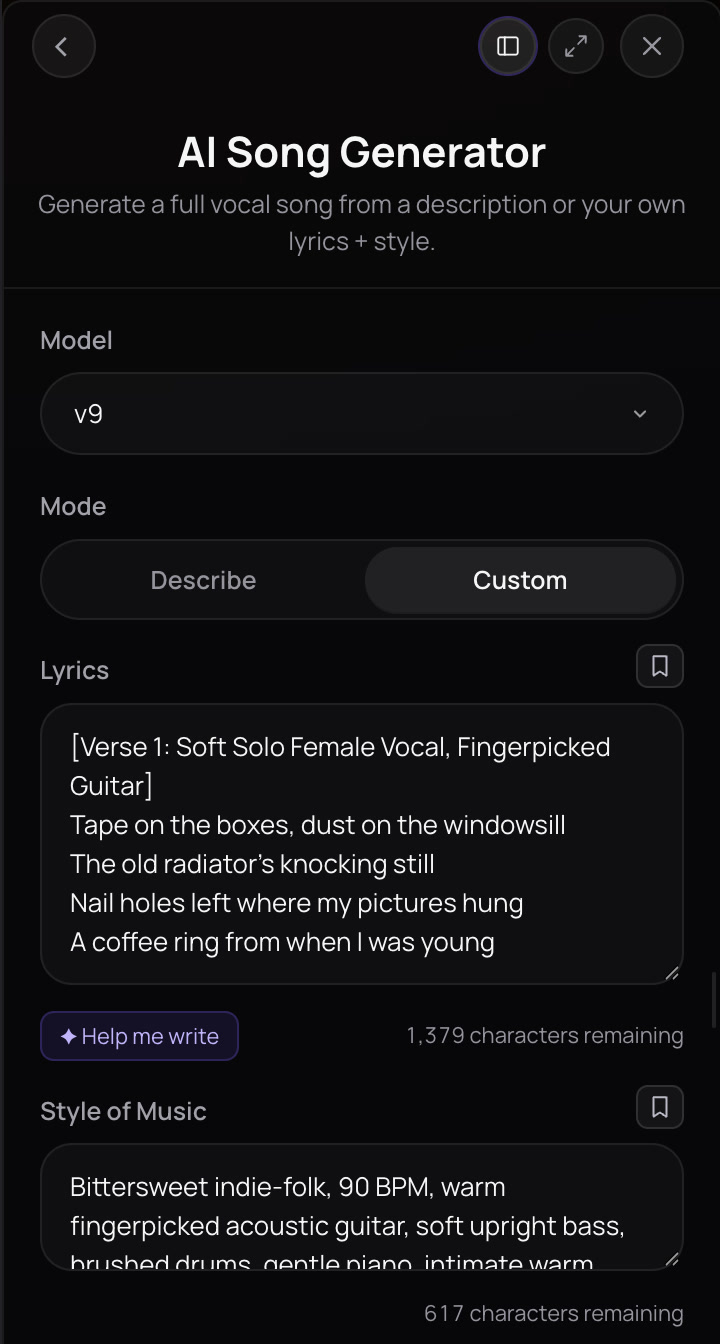
| Field | Placeholder | What goes in it |
|---|---|---|
| Lyrics | [Verse] Write your lyrics here... |
Every word to be sung, in the order it's sung, with section tags in square brackets. Up to 3,000 characters in Custom mode. |
| Style of Music | Enter music styles |
The sound: genre, tempo, instruments, the voice, the mood, the arc and what to leave out. |
A few facts worth knowing before you write:
- One v9 song costs 500 tokens. The Soundverse v9 page notes that a title and cover art come with the song at no extra token cost, and that v9 runs on the Pro plan and above.
- v9 decides how long the song runs. There's no length setting. Our songs mostly landed between about 2:30 and 4:35, and a few short, punchy ones came in under two and a half minutes.
- Longer lyrics gave longer songs, up to a point. Our longest songs ran about 4:30. When a lyric needed more time than that, v9 didn't make a longer song. It dropped lines (see section 5).
- Custom mode sings your words as written. That's why the lyric field is where structure, repeats and delivery live.
- Quick Style pills exist in Custom mode. We typed our own Style prompts every time, because a written prompt can say far more than a pill.
If you only want an instrumental, use the AI Music Generator with v9. It takes a prompt only (see section 8).
2. The anatomy of a Style of Music prompt
Here's the formula behind almost every prompt we wrote:
[genre / sub-genre] + [BPM] + [core instruments] + [vocal type and delivery] + [mood / arc] + [exclusions]
And here's a real prompt split into those parts. It produced a 4:33 song that sang all 87 lines of the Hanuman Chalisa:
Epic cinematic Indian devotional anthem, Awadhi bhajan,                         <- genre / sub-genre
fast-paced 110 BPM,                                                             <- tempo
powerful soaring male lead vocals trading lines with a huge male choir,         <- vocal and delivery
every word clear,                                                               <- clarity
orchestral strings and brass swells, thunderous dhol, taiko and tabla           <- core instruments
percussion, sitar and veena riffs, bansuri flute,
grand film-score build, triumphant and reverent,                                <- arc and mood
short intro, no long instrumental breaks, no female vocals                      <- exclusions
In the Style of Music field it's one line, with no arrows:
Epic cinematic Indian devotional anthem, Awadhi bhajan, fast-paced 110 BPM, powerful soaring male lead vocals trading lines with a huge male choir, every word clear, orchestral strings and brass swells, thunderous dhol, taiko and tabla percussion, sitar and veena riffs, bansuri flute, grand film-score build, triumphant and reverent, short intro, no long instrumental breaks, no female vocals
The levers
| Lever | What to write | Real examples from our prompts |
|---|---|---|
| Genre and sub-genre (always first) | The most specific name you know. Join fusions with "meets" or "with". | "Japanese city pop meets modern J-pop" · "Dark drift phonk" · "Modern Argentine cuarteto" · "Hindi R&B with a retro 80s synthwave sound" |
| Tempo | A number. Add "fast-paced" or "slow" if you want to lean on it. | "fast-paced 110 BPM" · "slow 68 BPM" · "76 BPM slow shuffle" |
| Core instruments | 3 to 6 instruments, each with a texture word. | "heavy distorted 808 bass, distorted cowbell melody" · "piano trio with upright bass and brushed snare" · "amapiano log drums, shakers" |
| Vocal | Gender, register, texture, language, delivery and backing. Usually the most important part. | "a very deep resonant male bass voice chanting the mantra slowly like a meditation" · "playful male Nigerian Pidgin vocals with female backing" · "soft intimate breathy female vocals, close-mic" |
| Mood and arc | Two or three mood words, plus a journey for longer songs. | "slow build from a hushed intro to an overwhelming climax and back to a tender ending" · "light and funny winter mood" |
| Arrangement moments | Name the specific event and where it happens. | "a saxophone solo on the bridge, fade-out outro" · "a long bansuri solo in the middle" · "catchy call-and-response chorus" |
| Production | The finish. | "polished retro-modern production" · "live-room feel" · "lo-fi cold production" |
| Clarity | Ask for it when the words matter. | "every word clear" |
| Exclusions (always last) | "no" plus the thing you don't want. | "no female vocals, no rap" · "no synths, no electronic drums, no drum machine, no 808" · "instrumental, no vocals" |
How long should it be?
Across the 156 song specs we wrote this month, Style prompts ran from 179 to 407 characters. The median was 259, and most fell between about 210 and 310. The 407-character prompt worked fine. Past about 400 characters, though, we started repeating ourselves, so treat roughly 400 as a sensible ceiling.
Habits that helped
- Lead with the genre. Everything after it reads as detail about that genre.
- Always give a number for the tempo. 155 of our 156 specs did, ranging from 62 to 190 BPM.
- Spend most of your words on the vocal. "Male vocals" is a coin toss. "A deep resonant male voice chanting Sanskrit in traditional stotram style, riding the groove, steady and powerful, doubled male choir" isn't.
- Name the language in the Style prompt too: "playful cozy female Japanese vocals" or "cheerful male Argentine Spanish vocals with crowd chants".
- Describe the arc in words when the song is long or cinematic.
- Don't contradict yourself. "No drums" next to "punchy drums" leaves the model guessing.
- Describe the sound, never the artist. Instead of naming a famous 80s star, write: "glossy 80s electric piano chords, gated-reverb snare, rubbery synth bass, a smooth soulful male vocal with silky falsetto ad-libs".
3. Section tags: the cheat sheet
Section tags go in the Lyrics field, on their own line, in square brackets. Add a descriptor after a colon to steer the delivery or the arrangement of that section.
[Section]
[Section: descriptor]
| Tag | What we used it for | Real tag from our songs |
|---|---|---|
[Intro] |
The opening. Lines under it are sung as the intro; with no lines it plays as an instrumental. | [Intro: Doha, Solo Male Vocal] · [Intro: Deep Male Stotram Chant] |
[Verse 1], [Verse 2]… |
The story. Usually 4 lines. | [Verse 1: Lead Vocals and Male Choir] · [Verse 1: Guttural Growls] |
[Pre-Chorus] |
A 2-line lift into the chorus. | [Pre-Chorus] |
[Chorus] / [Hook] |
The repeated part. Write it out in full every time. | [Hook: Shouted Gang Vocals] |
[Bridge] |
A change of feel before the last chorus. | [Bridge: Soft, Emotional, Solo Deep Voice] |
[Build] / [Climax] |
Cinematic rises. | [Build: Orchestra Rises] · [Climax: Full Orchestra and Massive Choir] |
[Breakdown] |
Metal and EDM drops. | [Breakdown: Low Gutturals] · [Final Breakdown: Huge Slow Slam, Low Gutturals] |
[Chant] |
Repeated mantra or stotram blocks. | [Chant] |
[Interlude] with no lines |
An instrumental break or solo. | [Interlude: Emotional Bansuri Solo over Strings] |
[Final Chorus] |
The last, biggest chorus. | [Final Climax: Full Orchestra, Choir and Bansuri] |
[Outro] |
The ending. Add lines for a sung ending. | [Outro: Doha, Full Choir] · [Outro: Solo Deep Voice and Bansuri, Fading] |
Three things tags do that you should plan for
1. An empty tag becomes an instrumental section. In our orchestral Hare Krishna chant, [Interlude: Emotional Bansuri Solo over Strings] with nothing under it produced an instrumental bansuri solo of about 10 to 20 seconds between sung sections. That's how you get a solo, a drop or a breather.
2. Every tag can add a pause or a transition. Ten short sections means up to ten transitions. For long texts, use fewer and bigger sections. The Hanuman Chalisa fit into one 4:33 song because its 87 lines sat under just 7 tags: an intro, five verses of 16 or 17 lines each, and an outro.
3. Descriptors steer delivery, section by section. The words after the colon are where you put "Solo Male Vocal", "Full Choir", "Guttural Growls", "Shouted Gang Vocals", "Soft, Emotional" or "Fading". Use them to change texture between sections while the Style prompt sets the overall sound.
Skeletons you can copy
A pop or rock song
[Verse 1]
(4 lines)

[Pre-Chorus]
(2 lines)

[Chorus]
(4 lines, hook in lines 1 and 3)

[Verse 2]
(4 lines)

[Pre-Chorus]
(2 lines)

[Chorus]
(the same 4 lines, written out again)

[Bridge]
(2-4 lines)

[Final Chorus]
(the same 4 lines)
A cinematic chant with instrumental solos
[Intro: Emotional Bansuri Solo, Hushed Strings]

[Verse 1: Solo Deep Male Chant]
(4 lines)

[Verse 2: Low Male Choir Joins]
(4 lines)

[Climax: Full Orchestra and Massive Choir]
(4-6 lines)

[Interlude: Emotional Bansuri Solo over Strings]

[Outro: Solo Deep Voice and Bansuri, Fading]
(2 lines)
Growl-only metal
[Verse 1: Guttural Growls]
(4 short lines)

[Hook: Shouted Gang Vocals]
(4 short, shoutable lines)

[Verse 2: Harsh Screams]
(4 short lines)

[Breakdown: Low Gutturals]
(1-2 lines)

[Final Hook: Shouted Gang Vocals]
(the same 4 lines)
Blank templates
[genre / sub-genre], [NN] BPM, [instrument + texture], [instrument + texture], [instrument + texture], [gender + register + texture + language] vocals [delivery], [backing vocals], [mood], [arc], [one arrangement moment], [production], no [x], no [y]
[Verse 1: (delivery)]      4 lines, ~10 syllables
[Pre-Chorus]               2 lines
[Chorus: (delivery)]       4 lines, title twice
[Verse 2]                  4 lines
[Pre-Chorus]               the same 2 lines
[Chorus: (delivery)]       the same 4 lines
[Bridge: (delivery)]       2 lines
[Final Chorus]             the same 4 lines
4. Writing lyrics for AI singing
Good lyric craft still applies: a clear idea, concrete images and a hook people can sing back. On top of that, a few habits make lyrics land better on v9.
Line length and syllables
We timed the sung lines in about 30 of our songs against their tempos. The pattern was consistent:
| Delivery | Bars per line | Syllables per bar | Example |
|---|---|---|---|
| Sung melodic lines (pop, R&B, jazz, blues, EDM, reggaeton) | about 2 (some EDM and future-bass hooks stretched to 4) | about 4 to 7 | "朝の空気が 冷たくなって" (Japanese city pop, 108 BPM): about 1.9 bars per line |
| Rap, growls and fast chant | about 1 | about 9 to 13 | Hanuman Chalisa at 110 BPM: a median of 2.24 s per line, which is 1 bar |
| Slow mantra lines | about 3 | about 5 to 6 | Hare Krishna at 68 BPM: about 10 s per 16-syllable line, which is 2.9 bars |
| Long compound verse lines | 5 or more | about 6 to 7 | 32-syllable Sanskrit stotram lines at 140 BPM: about 9.3 s each |
Our syllable counts are approximate (scripts differ), but the bar counts come straight from the timings. What that means in practice:
- For a sung pop line, aim for about 8 to 12 syllables. Most of our pop lines were around 10.
- Keep line lengths similar within a section. Even lines give even phrasing.
- If you want a fast, dense delivery, write it as rap or chant and say so in the Style prompt ("rhythmic spoken-growl delivery", "bilingual male rap with swagger").
Structure and repetition
- Verses of 4 lines, a 2-line pre-chorus and a 4-line chorus was the shape of most of our songs. It's familiar to listeners and to the model.
- Write every repeat out in full. We always pasted the whole chorus again rather than writing a shorthand like "repeat chorus". (We didn't test the shorthand, so we can't tell you what it does.)
- Put the title in the hook and repeat it. "こたつから 出られない" appears twice in its chorus. "December don dey come" opens and closes its chorus.
- For metal, make the hook short and shoutable. "Mörker! Mörker!" works better as a gang shout than a long sentence does.
- Rhyming couplets (AABB) keep the phrasing tidy. Most of our verses used them.
What not to put in the lyrics
- Instructions. "(sing this softly)" as a lyric line risks being sung. Put it in the tag:
[Bridge: Soft, Emotional]. - Artist names, brand names and real people. We kept all three out of every song.
- More lines than the tempo can carry. See the next section.
5. Tempo vs line count: the maths that stops dropped lines
This is the part most guides skip, and it's the reason a slow chant can lose half its words.
Two songs that taught us the rule
Hanuman Chalisa, 110 BPM. 87 lines of Devanagari in 7 sections, with "fast-paced 110 BPM ... short intro, no long instrumental breaks" in the Style prompt. Result: a 4:33 song that sang all 87 lines. The first word came at 0:27, and the median line took 2.24 s (1 bar).
Hare Krishna, 68 BPM. 30 short, repeated mantra lines in 9 sections, including two empty solo sections. Result: a 4:13 song that sang only 18 of the 30 lines. Each line took about 10 s (nearly 3 bars). The first word came at 0:35, and the instrumental gaps between sung sections added about 30 s more.
Both songs ran past four minutes. The difference was entirely seconds per line multiplied by the number of lines.
The formula
In 4/4 time:
seconds per bar  = 240 / BPM
seconds per line = bars per line x 240 / BPM
lines that fit   = singing time / seconds per line
The longest singing time we saw was about 4 minutes: Hanuman Chalisa ran from 0:27 to 4:31. The median across our songs was nearer 2:40, because most lyrics didn't need more. From the full 4 minutes you have to subtract the intro (a median of 17 s before the first word in our songs, and up to 55 s in metal) plus 10 to 20 s for each empty instrumental tag.
A quick rule for long songs: lines that fit ≈ BPM ÷ bars per line.
- Hanuman Chalisa: 110 ÷ 1 ≈ 110 lines. We wrote 87, and all 87 fit.
- Hare Krishna: 68 ÷ 2.9 ≈ 23 lines, before subtracting the intro and the solos. We wrote 30, and 18 were sung.
Planning table
| BPM | 1 bar | 1-bar line (rap, fast chant) | 2-bar line (sung pop) | 3-bar line (slow mantra) | Max 2-bar lines in ~4 min |
|---|---|---|---|---|---|
| 70 | 3.4 s | 3.4 s | 6.9 s | 10.3 s | ~35 |
| 80 | 3.0 s | 3.0 s | 6.0 s | 9.0 s | ~40 |
| 90 | 2.7 s | 2.7 s | 5.3 s | 8.0 s | ~45 |
| 100 | 2.4 s | 2.4 s | 4.8 s | 7.2 s | ~50 |
| 110 | 2.2 s | 2.2 s | 4.4 s | 6.5 s | ~55 |
| 120 | 2.0 s | 2.0 s | 4.0 s | 6.0 s | ~60 |
| 128 | 1.9 s | 1.9 s | 3.8 s | 5.6 s | ~64 |
| 140 | 1.7 s | 1.7 s | 3.4 s | 5.1 s | ~70 |
The last column is a ceiling, not a target. Our pop songs used 22 to 28 lines and sang for roughly 2:30 to 3:15.
When the text is fixed (prayers, poems, the full lyrics of a long song)
- Count the lines.
- Pick the delivery (1, 2 or 3+ bars per line).
- Pick a BPM high enough that lines × seconds per line is comfortably under 4 minutes, after the intro.
- Use as few section tags as you can, and no empty solo tags.
- Add "short intro, no long instrumental breaks" to the Style prompt.
6. Languages and scripts
We wrote lyrics in more than 40 languages and dialects this month, each in its own script, in the normal AI Song Generator. They included Hindi, Awadhi and Sanskrit in Devanagari, plus Bengali, Telugu, Tamil, Kannada, Malayalam, Punjabi, Marathi, Urdu, Nepali, Assamese, Odia, Japanese, Korean, Mandarin, Cantonese, Thai, Vietnamese, Arabic, Russian, Ukrainian, Turkish, Indonesian, Filipino, Spanish (including Argentine Spanish), Portuguese, French, German, Dutch, Swedish, Norwegian, Finnish, Polish, Swahili and Nigerian Pidgin.
What we learned:
- Write the lyrics in the language and script you want sung. The v9 page says this too, and also notes that Soundverse publishes no language list, so try a short verse first in a less common language.
- Name the language and the regional flavour in the Style prompt, for example "male Nigerian Pidgin vocals", "Awadhi bhajan" or "cheerful male Argentine Spanish vocals".
- The melody tools are different. In Melody to Song and MIDI to Song, Hindi written in Devanagari came out unintelligible, while romanised Hindi was sung recognisably. Romanise Hindi for melody-led songs.
- For smaller languages, have a native speaker listen before you release. It's cheap insurance.
7. Ten real recipes
Each recipe shows the exact Style of Music prompt, an excerpt of the real lyrics and what came back. All the songs are public on Soundverse.
Recipe 1: Acoustic jazz ballad (English), The Kitchen Light
Shows: exclusions that keep an acoustic song acoustic, and concrete images in the lyrics.
Intimate acoustic jazz ballad, 62 BPM, piano trio with upright bass and brushed snare, breathy tenor saxophone answering the vocal, live-room feel, tender expressive female vocal, late-night grief and warmth, no synths, no electronic drums, no drum machine, no 808
[Verse 1]
It's two a.m., the kettle sighs
The house is quiet as a held breath
Your apron's hanging where it was
Like you just stepped out for a minute, nothing less

[Chorus]
So I leave the kitchen light on
The way you always did for me
Coming home late in the winter
You'd be waiting with the tea
Now I'm the one who's waiting
For a step I know won't come
But I leave the kitchen light on
'Cause the dark won't feel like home
Listen to The Kitchen Light on Soundverse
Recipe 2: Japanese city pop, こたつから出られない (Kotatsu kara Derarenai)
Shows: a fusion genre, a native script, and a short repeated title hook. The song ran 3:28.
Japanese city pop meets modern J-pop, 108 BPM, groovy bassline, bright electric piano, funky guitar cuts, warm brass stabs, playful cozy female Japanese vocals, light and funny winter mood, polished retro-modern production
[Verse 1]
朝の空気が 冷たくなって
窓の外は 灰色の空
みかんとお茶を テーブルに並べて
もぐりこんだら もう終わり

[Pre-Chorus]
ちょっとだけ ちょっとだけ
五分だけって 言ったのに

[Chorus]
こたつから 出られない
こたつから 出られない
世界がどんなに 呼んでても
ぬくぬく ここが 私の場所
Here's how it was made, step by step, in Soundverse:
Listen to Kotatsu kara Derarenai on Soundverse
Recipe 3: Afrobeats with amapiano log drums (Nigerian Pidgin), December Don Dey Come
Shows: a call-and-response chorus, lead and backing vocals named in one phrase, and a regional language. The song ran 3:14.
Afrobeats with amapiano log drums, 112 BPM, shakers, warm bass, bright guitar licks, piano chords, catchy call-and-response chorus, playful male Nigerian Pidgin vocals with female backing, festive Lagos end-of-year vibe, polished modern Afropop production
[Verse 1]
November never finish, my mind don travel
I don dey plan my outfit, e no go be trouble
Uncle wey dey abroad say him dey land for Lagos
Na so the gist begin, everybody dey happy o

[Pre-Chorus]
Savings wey I gather, I go spend am well
Small chops, jollof rice, the aroma go tell

[Chorus]
December don dey come, e don dey come
Owambe dey call me, I must to run
We go dance till morning, no wahala
December don dey come, make we jolly
Listen to December Don Dey Come on Soundverse
Recipe 4: Hindi R&B with a retro 80s synthwave sound, रात की ड्राइव (Raat Ki Drive)
Shows: a long, detailed prompt (407 characters) that places arrangement moments: harmonies on the chorus, a sax solo on the bridge and a fade-out. It also describes an era without naming anyone. The song ran 3:53.
Hindi R&B with a retro 80s synthwave sound, 96 BPM, warm analog synth pads, gated-reverb snare, punchy 80s drum machine, rubbery synth bass, shimmering arpeggios, glossy 80s electric piano chords, nostalgic 80s Hindi film disco touches, a smooth soulful male Hindi vocal with silky falsetto ad-libs, lush stacked harmonies on the chorus, neon night-drive mood, a saxophone solo on the bridge, fade-out outro
[Verse 1]
मरीन ड्राइव पे चाँद अकेला
लहरों पे लिखा है नाम तेरा
कैसेट में बजता वो गाना पुराना
हल्की सी बारिश, हल्का सा बहाना

[Chorus]
रात की ड्राइव, तू और मैं
सी-लिंक पे चमके सितारे कई
धीमी सी धड़कन, धीमी रफ़्तार
रुक जा ज़रा, ये रात है उधार
Listen to Raat Ki Drive on Soundverse
Recipe 5: A long sacred text in one song, श्री हनुमान चालीसा (Shree Hanuman Chalisa)
Shows: how to fit 87 lines. That takes a fast tempo, few sections, a descriptor per section and "no long instrumental breaks". The song ran 4:33.
Epic cinematic Indian devotional anthem, Awadhi bhajan, fast-paced 110 BPM, powerful soaring male lead vocals trading lines with a huge male choir, every word clear, orchestral strings and brass swells, thunderous dhol, taiko and tabla percussion, sitar and veena riffs, bansuri flute, grand film-score build, triumphant and reverent, short intro, no long instrumental breaks, no female vocals
[Intro: Doha, Solo Male Vocal]
श्रीगुरु चरन सरोज रज निज मनु मुकुरु सुधारि
बरनऊं रघुबर बिमल जसु जो दायकु फल चारि
बुद्धिहीन तनु जानिके सुमिरौं पवन कुमार
बल बुद्धि बिद्या देहु मोहिं हरहु कलेस बिकार

[Verse 1: Lead Vocals and Male Choir]
जय हनुमान ज्ञान गुन सागर
जय कपीस तिहुं लोक उजागर
रामदूत अतुलित बल धामा
अंजनि पुत्र पवनसुत नामा
... (16 lines in this section)

[Verse 2: Lead Vocals and Male Choir]   ... 16 lines
[Verse 3: Lead Vocals and Male Choir]   ... 16 lines
[Verse 4: Lead Vocals and Male Choir]   ... 16 lines
[Verse 5: Lead Vocals and Male Choir]   ... 17 lines

[Outro: Doha, Full Choir]
पवन तनय संकट हरन मंगल मूरति रूप
राम लखन सीता सहित हृदय बसहु सुर भूप
Listen to Shree Hanuman Chalisa on Soundverse
Recipe 6: An orchestral chant with instrumental solos, हरे कृष्ण हरे राम (Hare Krishna Hare Rama)
Shows: empty tags as solos, a described dynamic arc, and the tempo lesson from section 5 (only 18 of 30 lines were sung). The song ran 4:13.
Emotional epic cinematic orchestral devotional chant, slow 68 BPM, an emotional bansuri flute solo that opens the song and returns between sections, a very deep resonant male bass voice chanting the mantra slowly like a meditation, a huge low male choir answering, massive film-score orchestra, soaring emotional strings, pulsing string ostinatos, deep brass swells, thunderous taiko and low drums, slow build from a hushed intro to an overwhelming climax and back to a tender ending, reverent, tearful and grand, every word clear, no female vocals, no rap
[Intro: Emotional Bansuri Solo, Hushed Strings]

[Verse 1: Solo Deep Male Chant]
हरे कृष्ण हरे कृष्ण, कृष्ण कृष्ण हरे हरे।
हरे राम हरे राम, राम राम हरे हरे।
(+2 lines)

[Verse 2: Low Male Choir Joins]          (4 lines)
[Build: Orchestra Rises]                 (4 lines)
[Climax: Full Orchestra and Massive Choir]  (6 lines)

[Interlude: Emotional Bansuri Solo over Strings]

[Bridge: Soft, Emotional, Solo Deep Voice]   (4 lines)
[Final Climax: Full Orchestra, Choir and Bansuri]  (6 lines)
[Outro: Solo Deep Voice and Bansuri, Fading] (2 lines)
If we made it again, we'd write about 18 to 20 lines, or keep the 30 and raise the tempo.
Listen to Hare Krishna Hare Rama on Soundverse
Recipe 7: A Sanskrit stotram over drift phonk, शिव ताण्डव स्तोत्रम् फोंक (Shiv Tandav Stotram Phonk)
Shows: a traditional chant style placed over a modern genre, with "no rap, no other words" to keep the vocal on the text. It used 12 long lines in 6 sections, and the song ran 2:41.
Dark drift phonk, 140 BPM, heavy distorted 808 bass, distorted cowbell melody, punchy phonk drums, a deep resonant male voice chanting Sanskrit in traditional stotram style, riding the groove, steady and powerful, doubled male choir, no rap, no other words, no female vocals
[Intro: Deep Male Stotram Chant]
जटाऽटवीगलज्जलप्रवाहपावितस्थले गलेऽवलम्ब्य लम्बितां भुजङ्गतुङ्गमालिकाम्।
डमड्डमड्डमड्डमन्निनादवड्डमर्वयं चकार चण्डताण्डवं तनोतु नः शिवः शिवम् ॥

[Chant]
(2 long lines per section x 4 sections)

[Outro: Deep Male Stotram Chant, drums]
(2 long lines)
Listen to Shiv Tandav Stotram Phonk on Soundverse
Recipe 8: Growl-only deathcore (Swedish), Mörkret klockan tre
Shows: how to ask for harsh vocals only. The song ran 2:58.
Swedish deathcore, 100 BPM, vocals 100% harsh: deep guttural growls, low gutturals and high screams on every line, NO clean singing anywhere, NO melodic or sung vocals, NO choir, no sung chorus, the hook is shouted gang vocals, downtuned 8-string chugs, blast beats, slam breakdowns, heavy modern production
[Verse 1: Guttural Growls]
Klockan tre och solen har gått
Novembermörker, allt är grått
Lysröret blinkar, kaffet är kallt
Burken med D-vitamin, jag tar allt

[Hook: Shouted Gang Vocals]
Mörker! Mörker!
Klockan tre, natten börjar!
Mörker! Mörker!
Ingen sol förrän i mars!

[Verse 2: Harsh Screams]
...

[Breakdown: Low Gutturals]
Fika! Fika!
Annars klarar sig ingen!
An honest tip. Growl-only vocals took a harsh-only prompt and a delivery tag on every section. Our first growl song, a Hindi djent track called Kalanemi, used a harsh prompt without per-section delivery tags, and it still had clean, sung stretches in the chorus. The second take, with a harsher prompt and delivery tags, came out growled all the way through. With that recipe, 7 of the next 8 growl songs passed our growl-only check. The eighth still slipped into several seconds of melodic singing. So listen before you release, and budget for a second take.
Listen to Mörkret klockan tre on Soundverse · Hear Kalanemi
Recipe 9: A lofi instrumental, Rain on the Desk Lamp
Shows: an AI Music Generator prompt with no lyrics, where the scene does the work. The track ran 3:23.
Lofi hip hop, 74 BPM, rainy night jazz-hop, dusty swung boom-bap drums, warm Rhodes jazz chords, soft upright bass, mellow muted trumpet phrases, vinyl crackle, gentle rain ambience, tape wow and flutter, relaxed late-night study mood, instrumental, no vocals
Listen to Rain on the Desk Lamp on Soundverse
Recipe 10: A lullaby on a known melody, Twinkle Twinkle Little Star
Shows: Melody to Song with a sung guide. There's no Style prompt here; the melody and the words are the whole brief. The song ran about 1:06.
Twinkle, twinkle, little star,
How I wonder what you are!
Up above the world so high,
Like a diamond in the sky.
Twinkle, twinkle, little star,
How I wonder what you are!
The guide was a sung-style recording of the public-domain tune, and the lyrics were exactly the six lines that guide carries. It followed the melody closely on the first try. Four of the six lines came out word-perfect by transcription, and soft lullaby diction blurred "little star" in the other two. Section 9 has the rules.
Listen to Twinkle Twinkle Little Star on Soundverse
8. Instrumentals
For music without vocals, use the AI Music Generator with the v9 model. It takes a prompt only, so every lever from section 2 goes into that one prompt. End it with "instrumental, no vocals".
What worked for us:
- Name the lead instrument and its job: "sitar improvising on a dawn raga", "the bansuri bamboo flute is the lead and the star".
- Place the big moments: "cinematic sunrise build and drop", "a long bansuri solo in the middle".
- Use exclusions to protect the lead: "no supersaw, no loud synth lead, no big drops".
- Describe the room and the texture: "vinyl crackle, gentle rain ambience, tape wow and flutter".
Here's a second real instrumental prompt. Bhairav Sunrise ran 3:04:
Indian classical meets melodic techno, 126 BPM, sitar improvising on a dawn raga in the feel of Bhairav, tabla rolls building tension, driving techno kick and rolling bass, shimmering arpeggios, tanpura drone, cinematic sunrise build and drop, instrumental, no vocals
Listen to Bhairav Sunrise on Soundverse
Two more real instrumental prompts. Velvet Lounge ran 4:22 and Tape Ghosts ran 2:38:
Private school amapiano, 113 BPM, deep log drum basslines, crisp shakers and rimshots, jazzy Rhodes and piano chords, soulful saxophone phrases, smooth sophisticated groove, warm late-night lounge feel, instrumental, no vocals
Dark Memphis-style phonk, 140 BPM, eerie cowbell melody, distorted 808 slides, dusty lo-fi drums, chopped and pitched-down vocal fragments built from original nonsense syllables, cassette tape hiss, haunting night mood, instrumental
Tape Ghosts asks for vocal chops "built from original nonsense syllables", which gives it vocal texture without lyrics. Listen to Velvet Lounge · Listen to Tape Ghosts
Naming a raga, a scale or a groove is fine. Naming a performer isn't.
9. Known melodies: Melody to Song
When the tune matters, as with a lullaby, a hymn or your own hummed hook, use Melody to Song. It turns a hummed, sung or played melody of 5 to 60 seconds into a full song that follows it. Lyrics are required, and there's no style field.
What we learned:
- A sung guide beats a MIDI file. Melody to Song with a sung-style guide followed the tune far more closely than MIDI to Song, which re-timed our MIDI and squeezed its range. Twinkle Twinkle and Hush Little Baby matched the melody on the first try. A more ornate classical lullaby didn't: it came back an octave low, with its last two phrases swapped. Simple, clear guides work best.
- Send exactly the lines your guide carries. Extra lines got crammed in at about a second each.
- Don't add bracketed style lines. In the melody tools a bracketed line became an empty section of about 20 seconds of instrumental.
- Romanise Hindi. In the melody tools, Devanagari came out unintelligible while romanised Hindi was sung recognisably, with an accent. Here's the romanised refrain of a traditional aarti that we sent:
Om jai Jagdeesh hare
Swaami jai Jagdeesh hare
Bhakt janon ke sankat
Daas janon ke sankat
Kshan mein door kare
Om jai Jagdeesh hare
- Expect a short intro before the melody. Our guides of about 50 to 60 seconds came back as songs of about 65 to 75 seconds.
- Use melodies you have the right to use: your own, or public-domain tunes.
10. Troubleshooting
| Symptom | Likely cause | Fix |
|---|---|---|
| Lines are missing from the song | More lines than the tempo fits into about 4 minutes | Cut lines or raise the BPM (section 5). Remove empty solo tags. Merge small sections. |
| Long gaps between sung sections | Many tags, empty tags, or an arc that asks for breaks | Fewer and bigger sections. Add "short intro, no long instrumental breaks". |
| The vocal starts late | The median intro in our songs was 17 s, and metal ran up to 55 s | Add "short intro", and avoid an empty [Intro] tag. If the first seconds matter (for a Short or a reel), plan to trim the intro afterwards. |
| Clean singing in a growl song | Harsh vocals were asked for, but not enforced per section | Use a harsh-only prompt with explicit NOs, plus a delivery tag on every section. Listen before release. |
| A female voice appears when you wanted male (or the reverse) | The vocal wasn't pinned down | Describe the voice fully. Add "no female vocals" (or "no male vocals"). Repeat it in the tags: [Verse 1: Solo Male Vocal]. |
| Rap appears in a chant or ballad | Nothing in the prompt ruled it out | Add "no rap". For chants, also add "no other words". |
| Words are hard to make out | Dense lines, soft delivery, or too fast a tempo | Add "every word clear". Shorten the lines. Lower the BPM, or give each line more bars. |
| The genre drifts | The genre came late or was vague | Put the most specific genre name first. Name 3 to 6 signature instruments. |
| Unwanted synths or drum machines in an acoustic song | Nothing ruled them out | "no synths, no electronic drums, no drum machine, no 808" |
| Hindi is unintelligible in a melody tool | Devanagari in Melody to Song or MIDI to Song | Romanise the lyrics. |
| Melody to Song rushes or crams words | More lyric lines than the guide carries | Send exactly the guide's lines. |
| An unexpected instrumental chunk in a melody song | A bracketed style line in the lyrics | Remove bracketed lines in the melody tools. |
| You named an artist | — | Replace the name with the era, instruments, vocal texture, BPM and mood. |
After each take, check four things:
- Lines: were all of them sung? If not, run the fit check again (section 5).
- Start: when does the first word land? Is the intro what you asked for?
- Voice: is it the right gender, register and delivery in every section?
- Words: can you follow every line without reading along?
Then change one lever at a time. If a take misses, change the one part of the Style prompt or the tags that explains the miss, and keep everything else the same. That way you learn what the change did.
11. Make Claude (or ChatGPT) your songwriter with this playbook
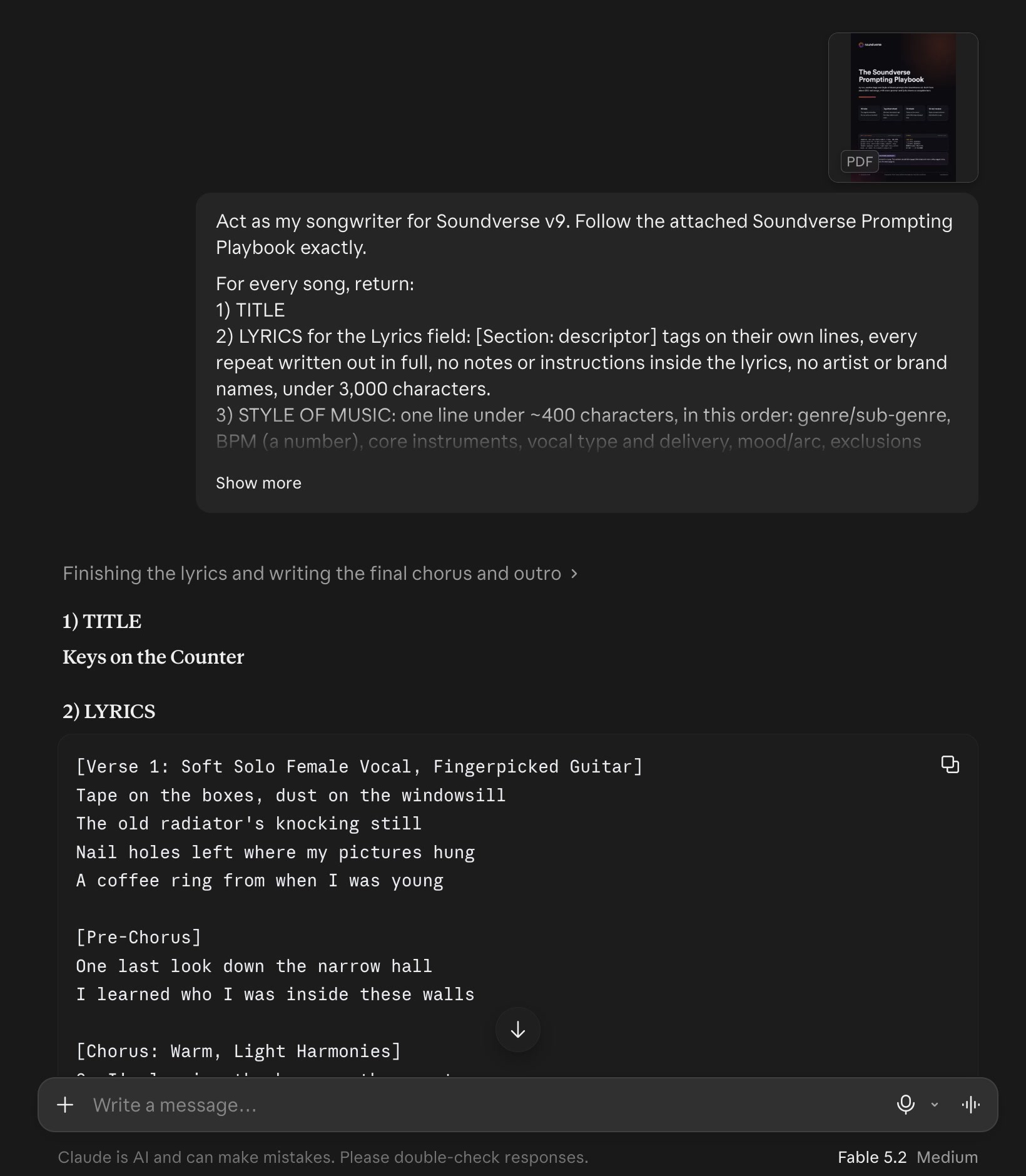
The fastest way to use all of this is to hand it to an assistant. Download the PDF, attach it to a new chat in Claude or ChatGPT, and paste this message with your brief:
Download the Soundverse Prompting Playbook (PDF)
Act as my songwriter for Soundverse v9. Follow the attached Soundverse Prompting Playbook exactly.

For every song, return:
1) TITLE
2) LYRICS for the Lyrics field: [Section: descriptor] tags on their own lines, every repeat written out in full, no notes or instructions inside the lyrics, no artist or brand names, under 3,000 characters.
3) STYLE OF MUSIC: one line under ~400 characters, in this order: genre/sub-genre, BPM (a number), core instruments, vocal type and delivery, mood/arc, exclusions.
4) FIT CHECK: BPM, bars per line, number of sung lines, estimated intro, and estimated singing time. If it won't fit in about 4 minutes (the fit check on page 10 of the playbook), fix the lyrics or tempo before you answer.
5) TWO ALTERNATIVE Style prompts to try if the first one misses.

Rules: write lyrics in the language and script I ask for (romanise Hindi only for Melody to Song or MIDI to Song). For an instrumental, return only an AI Music Generator prompt that ends with "instrumental, no vocals". Describe sounds, never name artists. If my brief is unclear, ask me up to 3 short questions; otherwise just write.

My brief:
Three briefs to try:
A bittersweet English indie-folk song about moving out of my first apartment. Female vocal, around 90 BPM, fingerpicked guitar, a big singalong last chorus. I'm releasing it next month.
Set this whole text (64 short lines, pasted below) as one epic devotional anthem with a male lead and a choir. Every line must be sung, so choose the tempo and sections to make it fit, and show me the maths.
A Japanese city-pop song about catching the last train home, playful female vocal. Then write an AI Music Generator prompt for a lofi instrumental version of the same mood.
Good follow-ups:
- "The chorus isn't hooky enough. Rewrite it with the title in lines 1 and 3, and keep the syllable counts."
- "Soundverse dropped the last 6 lines. Redo the fit check and give me a version that fits."
- "It came back with a female voice. Tighten the vocal description and the section tags."
Paste the lyrics into Lyrics and the Style prompt into Style of Music, choose v9 and generate.
12. Skip the copy-paste: the Soundverse connector for Claude
If you'd rather Claude make the song too, connect Soundverse to Claude. The Soundverse connector lets Claude write songs, pull stems and swap vocals straight from a conversation. Everything it makes is saved to your Soundverse Library, and the songs don't play inside the chat.
- In Claude, open Customize → Connectors (some versions show Settings → Connectors). Click Add, then Add custom connector.
- Name it Soundverse and paste
https://mcp.soundverse.ai/mcp, with no slash at the end. - Choose Use your own OAuth client, paste the Client ID
jt7cp9hv4m9idkuyv2gt0and leave the secret blank. - Connect, and sign in with your Soundverse account.
- In a chat, open + → Connectors and switch Soundverse on.
Each tool can be set to Needs approval (the default), Always allow or Blocked. Any Claude plan works, and the Free plan allows one custom connector. The full guide is on the Soundverse MCP page.
With the connector on, attach the PDF and add one line to the songwriter message: "Then make it on Soundverse with v9, using exactly these lyrics and this Style prompt." Both lullabies we mention here, Twinkle Twinkle and Hush Little Baby, were made this way, through the connector in Claude.
13. Pre-flight checklist
Before you press Generate:
- v9 is selected and you're in Custom mode (or the AI Music Generator for an instrumental)
- The Style prompt starts with the most specific genre name you know
- The BPM is a number
- There are 3 to 6 core instruments, each with a texture word
- The vocal is fully described: gender, register, texture, language, delivery and backing
- The mood is there, plus an arc if the song is long
- The exclusions come last (no female vocals, no rap, short intro, no long instrumental breaks, and so on)
- "every word clear" is included if the words matter
- There are no artist names anywhere
- Every section is tagged, with descriptors where the delivery changes
- Empty tags appear only where you want an instrumental moment
- Repeats are written out in full
- Line lengths are even within each section
- The fit check passes: lines × seconds per line, plus the intro and solos, is under about 4 minutes
- The lyrics are in the right script (romanised Hindi for the melody tools)
- The lyrics are under 3,000 characters
Soundverse is the AI music platform that takes you from idea to audience. Once the song is right, the Soundverse Agent can help you finish it and release it from the same chat. AI Studio and stem splitting are there when you want to go deeper. Start writing in the AI Song Generator.
Keep reading
- How to Write Effective Prompts for AI Music Generation: the basics of genre, mood, instruments and texture
- AI Music Prompt Mistakes to Avoid: eight common errors
- The Ultimate Music Prompts Bible: prompts by genre and sub-genre
- How to Choose an AI Tool That Handles Both Lyric Writing and Full Song Arrangement
- How to Create Language-Accurate Lyrics With AI
- Soundverse MCP: make music in Claude and ChatGPT, step by step