Explain the Difference Between Generative AI for Text and Generative AI for Audio
Generative AI for audio vs text explained: words vs 44,100 samples a second, BPE vs neural codecs, compute, evaluation, errors and conditioning.
The difference between generative AI for text and generative AI for audio starts with the data: a text model predicts word-piece tokens, while generative AI for audio has to produce sound waves sampled 44,100 times a second. That changes tokenization, sequence length, compute, evaluation, the kind of mistakes each makes, and how you steer it.
Both families often use transformers, so the differences lie in what goes in, what comes out and how you judge it. Each point below comes from the original papers and official documentation, read on 19 November 2026.
The data: words versus waveforms
A text model works on symbols from a finite vocabulary, and the meaning survives without the font or the handwriting.
Audio is a continuous signal, stored as a stream of amplitude measurements. The Jukebox paper (OpenAI, 2020) notes that CD quality, 44.1 kHz samples in 16-bit precision, is typically enough to capture the range of frequencies people can hear. Its authors spell out the scale: a four-minute segment has an input length of about 10 million, against about 3 million for a 1024 × 1024 image.
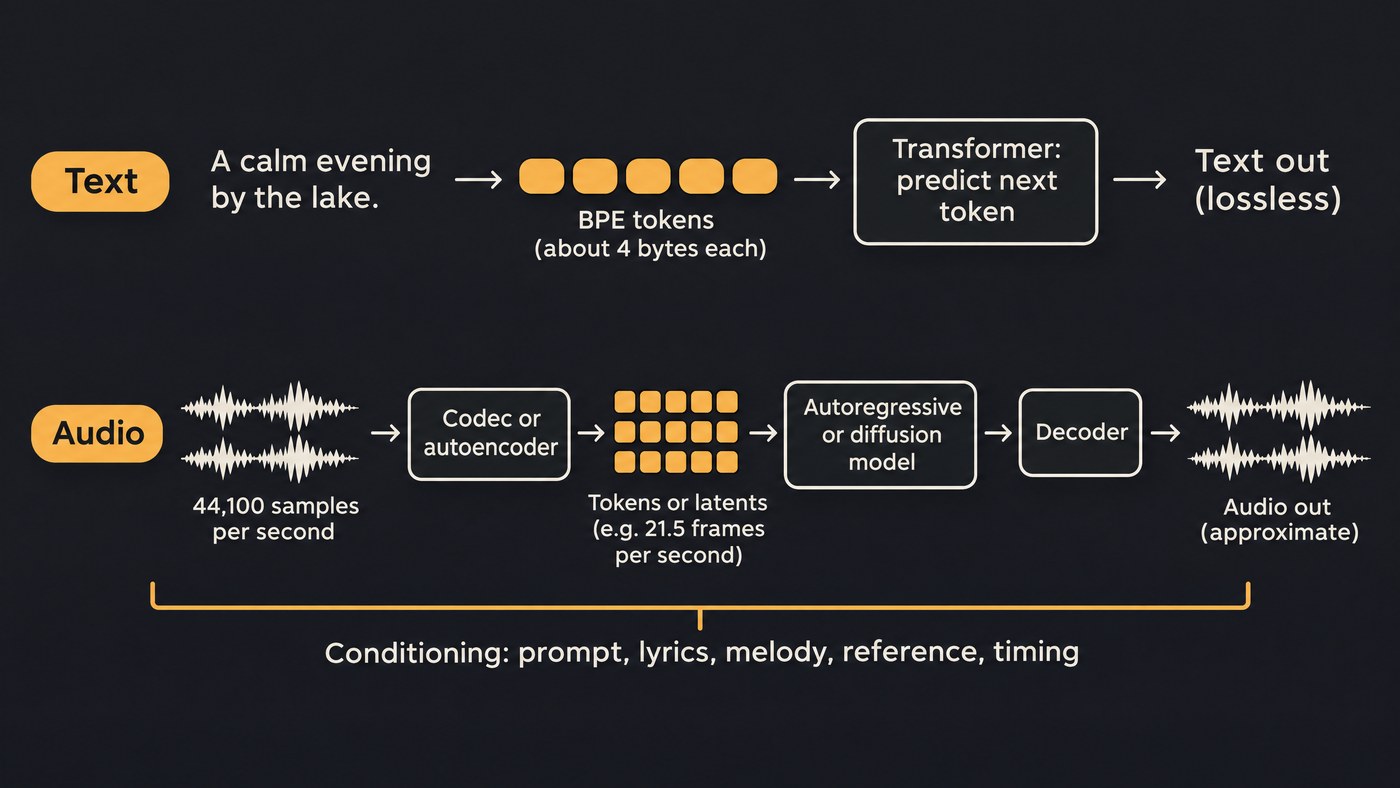
Compare one song. A 1,200-character lyric sheet is roughly 300 tokens, using the rule of thumb in OpenAI's tiktoken documentation of about 4 bytes per token. Three minutes of it in stereo at 44.1 kHz is about 15.9 million samples. That gap drives most of what follows.
Tokenization in generative AI for text and audio: BPE versus codecs and latents
Text models mostly use byte pair encoding (BPE), which merges the character sequences that appear most often into longer units, so common words become one token and rare ones split into pieces. In the tiktoken README's example, "encoding" splits into "encod" and "ing". BPE is reversible and lossless: the tokens turn back into exactly the original text.
Audio has no natural units like words, so models learn a compression:
- Neural audio codecs encode short frames of sound as discrete codes, which a transformer can predict like tokens. Our post on tokenization and music composition in AI walks through SoundStream, EnCodec and DAC.
- Continuous latents skip the discrete step. Stable Audio Open (Stability AI, 2024) uses an autoencoder that turns 44.1 kHz stereo into a latent of 64 channels at 21.5 frames a second. That's about 1,376 numbers a second in place of 88,200 samples, roughly 64 times fewer.
The big difference is loss. An audio codec or autoencoder rebuilds an approximation, so its decoder caps how clean the output can sound, however good the model is. Our guide to the technical factors behind AI audio quality covers where those artifacts come from.
Sequence length and compute
Transformers compare every position with every other. In Attention Is All You Need (Vaswani and colleagues, 2017), Table 1 puts the cost of a self-attention layer at O(n²·d), where n is the sequence length. Double the length and that part of the work roughly quadruples.
Even a long text answer is a few thousand tokens. Raw audio is far longer, so audio systems compress first and generate inside windows: Stable Audio Open makes up to 47 seconds per run. Jukebox shrank 44 kHz audio by 8x, 32x and 128x with a three-level VQ-VAE, and its authors still call music generation extremely computationally demanding as durations grow.
The method often differs too. Text models predict one token after another. Many audio models do the same over codec tokens, but others use diffusion: Stable Audio Open refines the whole latent clip over a series of steps. Over whole songs the problems compound, and our post on the hurdles of long-form AI music explains why structure and tempo slip over minutes.
Time and pitch: structure text doesn't have
Nothing in a sentence is pinned to a clock. In audio, every event happens at a moment in seconds, music sits on a tempo grid, and a vocal has to land each syllable on the beat and in tune while staying intelligible.
Pitch adds a second axis. A text model can write "C major" without being in any key, but an audio model's output has a real key, and a flat note is heard at once.
That's why audio models carry controls text models never needed. Stable Audio Open is conditioned on timing: it fills the length you ask for and pads the rest with silence. Google's Lyria 3.5 documentation for the Gemini API lets you script sections by timestamp, such as "[0:00 - 0:10] Intro", and advises naming instruments, BPM, key, mood and structure in the prompt.
Evaluation: benchmarks versus listening tests and FAD
Text models are often scored automatically, because many tasks have a right answer. MMLU (Hendrycks and colleagues, 2020), for example, tests a model on 57 tasks from elementary mathematics to law. Grading is fast and repeatable.
A guitar tone isn't true or false, so audio researchers use two tools:
- Listening tests, where people rate or compare clips for quality and prompt match. They're slow, costly and depend on who listens.
- Fréchet Audio Distance (FAD), which compares embedding statistics of generated clips with a reference set. It's automatic, but it measures closeness to that set, not whether a song is good.
FAD has known limits. Azalea Gui and colleagues at Microsoft Research wrote in 2023: "The Frechet Audio Distance (FAD) is commonly used for this purpose even though its correlation with perceptual quality is understudied." They found its scores can be skewed by sample size, the embedding model and a biased reference set. For your own tracks, blind A/B listening at matched loudness is still the test.
Errors: hallucinated facts versus audible artifacts and drift
When a text model fails, it usually fails on content. Adam Tauman Kalai and colleagues at OpenAI and Georgia Tech described the pattern in their 2025 paper: "Like students facing hard exam questions, large language models sometimes guess when uncertain, producing plausible yet incorrect statements instead of admitting uncertainty." You catch those by checking a source.
Audio fails in what you hear:
- Artifacts from the codec or decoder: smeared cymbals, a metallic sheen, a dull top end.
- Mangled words: sung lyrics that blur, skip a line or gain syllables.
- Drift: tempo, key or vocal tone wandering over a long take.
- Seams: audible joins where a section was extended or regenerated.
There's no document to check those against, only your ears, so listen on headphones and a phone speaker before you keep a take.
Conditioning: prompts versus prompts plus lyrics, melody and reference audio
A text model takes text, and even attached files and instructions become tokens. Audio models take a bundle:
- A style prompt for genre, instruments, mood and tempo.
- Lyrics, often with section tags. Lyria's documentation marks custom lyrics with [Verse], [Chorus] and [Bridge] and recommends keeping them separate from instructions. Jukebox already conditioned on artist, genre and lyrics in 2020.
- A melody from a hum, a MIDI file or a recording, which pins the tune in time instead of describing it.
- Reference audio that sets a sound or a voice by example.
- Timing, as a target length or timestamps.
Words describe a sound loosely, while a melody or a reference fixes it. The catch is rights: any reference track or voice has to be one you're allowed to use.
Where generative AI for text and for audio meet
- Text models sit inside audio models. Stable Audio Open reads your prompt with a T5-based text encoder of 109 million parameters.
- Text models write and plan. The Jukebox team had their model sing verses generated by GPT-2. In Google's Lyria API, a clip comes back with its generated lyrics and song structure alongside the audio.
- Multimodal models read sound as tokens. Google's Gemini audio documentation says Gemini represents audio as 32 tokens a second, so a minute is 1,920 tokens, after downsampling it to 16 kbps. That suits understanding a recording, not rebuilding a master.
- Agents connect them. A language model plans the steps and calls audio tools to make each part. Our roundup of the best AI music agents shows how that works in practice.
In practice, let text models handle words, plans and briefs, and audio models handle sound. How AI lyric generators influence songwriting looks at the text side.
Where Soundverse fits
Soundverse is an AI music platform that takes you from idea to audience, built for independent artists who release music, and its tools follow the same split. AI Lyrics Writer drafts lyrics from a theme, a mood, a section and a genre, and works on every plan, including Free. AI Song Generator then sings your lyrics word for word in Custom mode, with section tags such as [Verse] and [Chorus].
To steer with more than words, Melody to Song takes 5 to 60 seconds of a hummed, sung or played tune, and Similar Song Generator, on Creator and above, works from 30 seconds of a reference track you have the rights to. Agent One plans the steps and runs the tools from a plain-words request. Soundverse v9 is on Pro and Max.
Licensing is set by plan: the Free plan is for personal use, and the Creator plan comes with a royalty-free license.
This video shows a song made by chatting with Agent One, then edited in AI Studio.
FAQ
Is an AI music generator just ChatGPT for sound? They share ideas such as transformers, but a music generator has to produce millions of samples that land in time and in tune. So it compresses audio into codec tokens or latents first, and many use diffusion instead of next-token prediction.
Why is generating audio slower than generating text? Sequence length. Three minutes of stereo audio is about 15.9 million samples, its lyrics a few hundred tokens, and attention cost grows with the square of length. Compression narrows the gap without closing it.
How do I judge the quality of AI-generated audio? Listen blind and level-matched against a reference track in the same genre, on two or three playback systems. FAD helps researchers compare models across many clips, but it can't tell you whether one take works for your song.
Why does AI music sometimes sing the wrong words? The model has to map text onto timed, pitched sound, and it can blur, skip or add syllables when lines are long or oddly phrased. Shorter lines, clear section tags and a few takes usually fix it.
Sign up for Soundverse free and turn your next lyric into a song. More guides on the Soundverse blog.
