The Best Music Distribution Services That Offer Comprehensive Analytics
Music distribution analytics compared: which distributors document per-store streams, territories, playlists, final statements and reporting lag.
Judged on what their own help and pricing pages document about music distribution analytics on 21 November 2026, the best music distribution services that offer comprehensive analytics are Amuse, RouteNote, TuneCore, Ditto Music and Madverse. CD Baby, DistroKid and LANDR say less in public, and Symphonic, Too Lost and UnitedMasters could not be checked.
Each grade rests only on the service's own pages: what data it promises, whether it separates estimates from paid statements, and whether it states a reporting delay. Soundverse is not a distributor, does not deliver music to stores and offers no distribution analytics; it appears at the end for release preparation only.
What "comprehensive analytics" means for a distributor
A distributor is the one place that can show every store side by side. A complete setup covers eight things:
- Store-by-store streams and downloads, to see where each song works.
- Territories, by country and ideally city, for ads, tours and release timing.
- Playlists and sources: which playlists added the track, and editorial versus algorithmic versus listener plays.
- Daily trends versus final statements. Trends are early estimates; statements are what you get paid on.
- Social and Content ID data: video creations, views and claims.
- Revenue by track and split, with the ISRC on every line; see why ISRC codes matter for tracking streams.
- Exports and APIs, at least CSV or spreadsheet downloads.
- A stated reporting lag, so you know when a number is final.
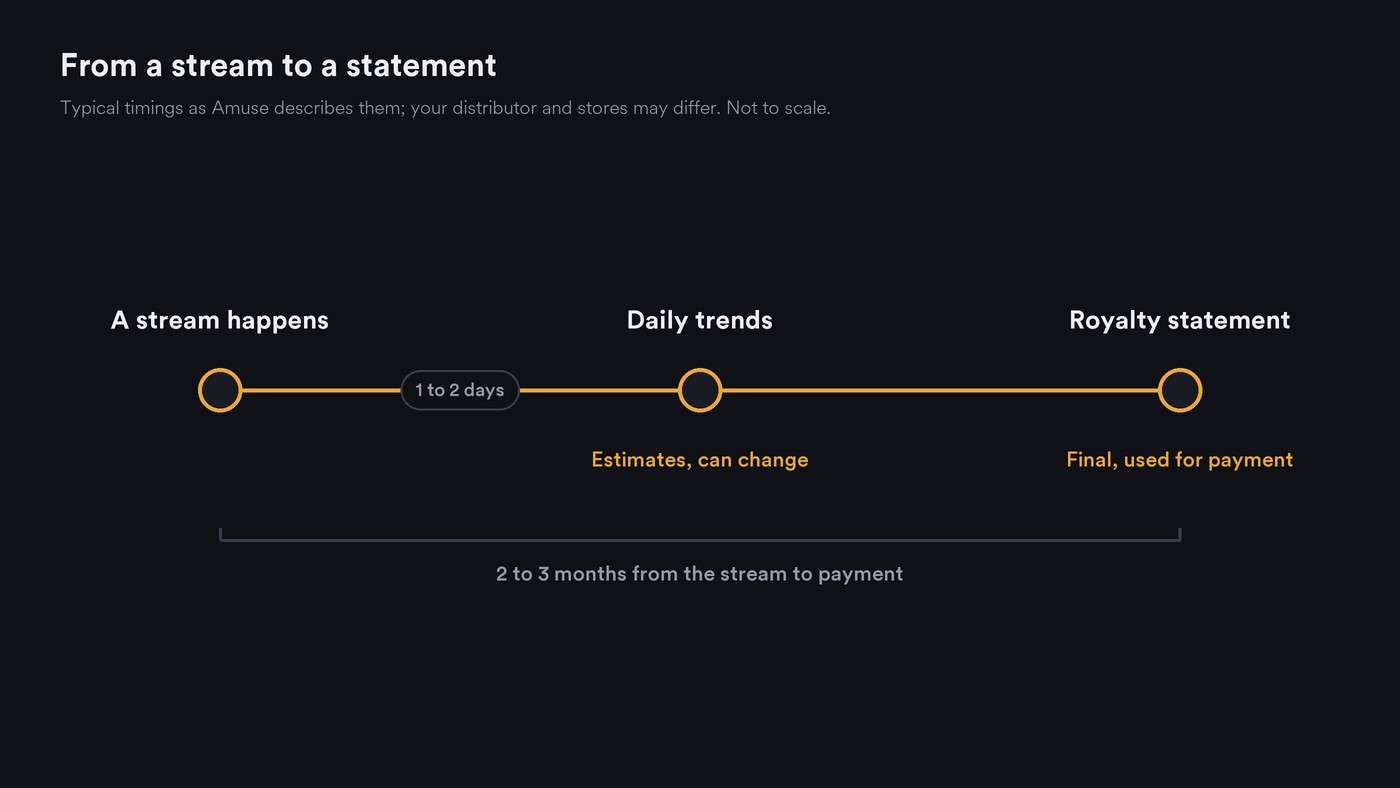
Money always arrives later than streams: Amuse's payments page says stores usually pay two to three months after the streams happen, while trend data runs a day or two behind. How streaming platforms calculate payouts explains why each stream's value varies.
Music distribution analytics, graded service by service
Grades describe documentation, not dashboard quality: Strong means the service explains its data, its breakdowns and its lag in public.
1. Amuse: Strong
Amuse's Insights article is the most complete public description we found. Insights shows streams by store (Spotify, Apple Music, Deezer, Amazon Music, YouTube, TikTok), artist and release, plus Spotify and Apple Music playlist placements: editorial, algorithmic and user. It says stores report with a delay of around one to two days, and it keeps performance apart from money: "While the Insights tab shows how your content is performing, it should not be used to estimate or calculate your royalties."
Money sits in Royalty Analytics and in Financial Statements (.xlsx) with royalty date, service, UPC, ISRC, track, quantity and amount columns. Streaming Insights is listed on every plan, from Artist at $23.99 a year. Best for: managers and agencies who need per-store and playlist data plus clean statements.
2. RouteNote: Strong, with slow money data
RouteNote Trends gives what RouteNote calls real-time data for Spotify, iTunes and Apple Music, broken down by 7 or 30 days, country, track and platform; Premium adds a 90-day view and a fan location map. Final numbers come later: RouteNote says statistics and earnings appear 45 days after the month they were earned, and monthly sales reports download with per-store and per-territory detail. Free distribution keeps 15% of revenue; Premium costs $10 per single upfront, then $9.99 a year. Best for: tight budgets that can wait for final numbers.
3. TuneCore: Good, strongest on social data
The Trends & Analytics Dashboard tracks streams, earnings and audience location on a map, with an Insights tool for monthly trends and a User Generated Content widget that counts likes, comments and creations. TuneCore's 19 February 2025 announcement adds TikTok and Douyin data with daily updates on views, shares, saves and average watch time. The CORE plan, at $22.99 a year on the US pricing page and ₹1,599 a year plus GST in India, lists Advanced Trends & Analytics. Its help centre returned HTTP 403, so we could not read how trends reconcile with sales reports. Best for: artists whose songs travel through short-video apps.
4. Ditto Music: Good, app-first
The Ditto app page lists a per-store breakdown, per-track and per-release filters, week, month, 90-day and year views, top countries and cities, listener demographics and a playlist tracker that shows streams from each placement. The app is free on every plan, and the Starter plan ($19 a year) includes "Analytics & fan data". The page calls the data live but states no lag. Best for: artists who check numbers on a phone.
5. Madverse: Good, India-based
The New Delhi distributor's pricing page lists one dashboard for streams, revenue, audience demographics and DSP performance, plus Royalty Insights broken down by platform, territory and track. Creator costs ₹299 a month; Professional is ₹3,999 a year, shown at ₹2,999 in a sale on 21 November. No reporting lag is documented. Best for: Indian artists who want rupee pricing and royalty data by track.
6. CD Baby: Thin public detail
CD Baby's trending reports page says trending reports are free with distribution and include "key demographic and geographic information". Releases cost $9.99 per single, one time. Its support centre returned HTTP 403, so store coverage and history length are unverified.
7. DistroKid: Thin public detail
On the pricing page, "Daily streaming stats" starts at Musician Plus ($44.99 a year) and "Advanced analytics & stats" plus Spotify and Apple Music monitoring sit in Ultimate ($89.99). The entry Musician plan ($24.99) lists no stats line. DistroKid's help centre returned HTTP 403.
8. LANDR: Thin public detail
The distribution page promises "advanced metrics and trends" on earnings and on where, when and how much songs are played, and an in-app Trends view of streams and downloads, from $24 a year. Nothing on breakdowns or lag.
Could not verify: Symphonic, Too Lost, UnitedMasters
Symphonic's site and blog, Too Lost's help centre and UnitedMasters' help centre returned HTTP 403 on 21 November 2026. UnitedMasters' pricing page loaded (DEBUT+, $19.99 a year) but says nothing about analytics. Ask for a demo login first.
Recommend a Music Distributor That Provides Good Analytics and Reporting
Pick by the job the data has to do:
- An agency or manager with several artists: Amuse Artist Pro (3+ artist profiles, $59.99 a year) for Insights per artist and ISRC-level statements.
- The cheapest route to per-country data: RouteNote Free, accepting the 15% cut and the 45-day wait for statements.
- Songs that live on TikTok and Reels: TuneCore, for the user-generated-content widget.
- Artists releasing mainly in India: Madverse, or TuneCore India for rupee pricing.
Analytics is one factor among several; our guide on how to choose a music distributor for a first single covers the rest. None of the artist-plan pages above documents a public API, so labels that need one should see our roundup of distribution tools for label workflows.
Which Music Distribution Platforms Offer the Best Analytics for Music Producers?
Producers care more about splits than followers. Check three things:
- Split visibility. DistroKid lists royalty splits on every plan; Amuse charges non-Amuse collaborators 15% on its Artist plan and nothing on Plus or Pro; Madverse gives collaborators a free account to withdraw their share.
- Per-track revenue, which Madverse's Royalty Insights and Amuse's statements both show.
- ISRC on every statement line, so a beat or co-write stays traceable across releases.
How distributor analytics differ from Spotify for Artists, Apple Music for Artists and YouTube Studio
Store dashboards show richer audience data for one store; the distributor shows every store and the money.
- Spotify for Artists: stats update once a day, which Spotify's help page puts at "approximately 5 PM ET / 9 PM UTC", with days counted in UTC. Its source-of-streams view separates active sources from programmed ones, demographics cover the last 28 days, and some tables export as CSV.
- Apple Music for Artists: plays count after 30 seconds, data refreshes daily and new data takes 48 hours to show. Apple's analytics page is blunt about money: "Note: While Apple Music for Artists will display your album and song data, contact your distributor for financial or royalty questions."
- YouTube Studio: Insights for Artists needs an Official Artist Channel and counts your music in fan uploads too, and YouTube says ongoing revenue reports "are estimated and subject to change".
Expect counts to differ: each service uses its own day boundary and counting rules, and Amuse notes that a catalogue moved from another distributor only shows streams reported since the move.
A monthly analytics routine
- Download the statement and note which streaming month it covers.
- Reconcile one song against the Spotify for Artists CSV for the same month; small gaps are normal, large ones go to support.
- Check every split reached the right person.
- List your top five countries and flag any newcomer.
- Read sources and playlists: who added you, and whether plays came from listeners' libraries or programmed playlists.
- Check social and Content ID data for new video creations and claims.
- Pick one action for next month, such as an ad country, a pitch or a release date, and write down why.
Where Soundverse fits
Soundverse is an AI music platform that takes artists from idea to audience, but it is not a distributor: it does not deliver music to stores and has no distribution analytics. Its Release Planner page is clear that the planner "cannot see your streaming numbers", so you bring your analytics to it: put your audience size and region in the settings and what worked last time in the brief, and it returns a dated, day-by-day rollout with pre-save, smart link and playlist pitch deadlines. Playlist Pitch Description then writes DSP pitches and curator emails that name real playlists found on the web, each with a link to check.
This walkthrough shows Release Planner turning one track and a few release details into a day-by-day rollout plan.
FAQ
Why don't my distributor's numbers match Spotify for Artists? They count on different schedules: Spotify updates once a day in UTC, while distributors receive store reports with a delay and pay from monthly statements. Compare whole months, not single days.
Which distributor gives the most analytics for free? RouteNote's Free model includes Trends with 7 and 30-day views by country, track and platform, in exchange for keeping 15% of revenue. CD Baby's trending reports come with its one-time release fee rather than a subscription.
Does Soundverse show my streaming analytics? No. Soundverse is not a distributor and cannot see your streaming numbers. Use your distributor and the store dashboards for data, and Soundverse to make and plan the next release.
Sign up for Soundverse free and plan your next release around what your numbers told you. More guides on the Soundverse blog.