What Are the Best Alternatives for AI Voice Synthesis in Creative Projects?
AI voice synthesis alternatives for creative projects: session singers, voice actors, your own tuned voice, vocal chops, choirs, vocoders and AI by job.
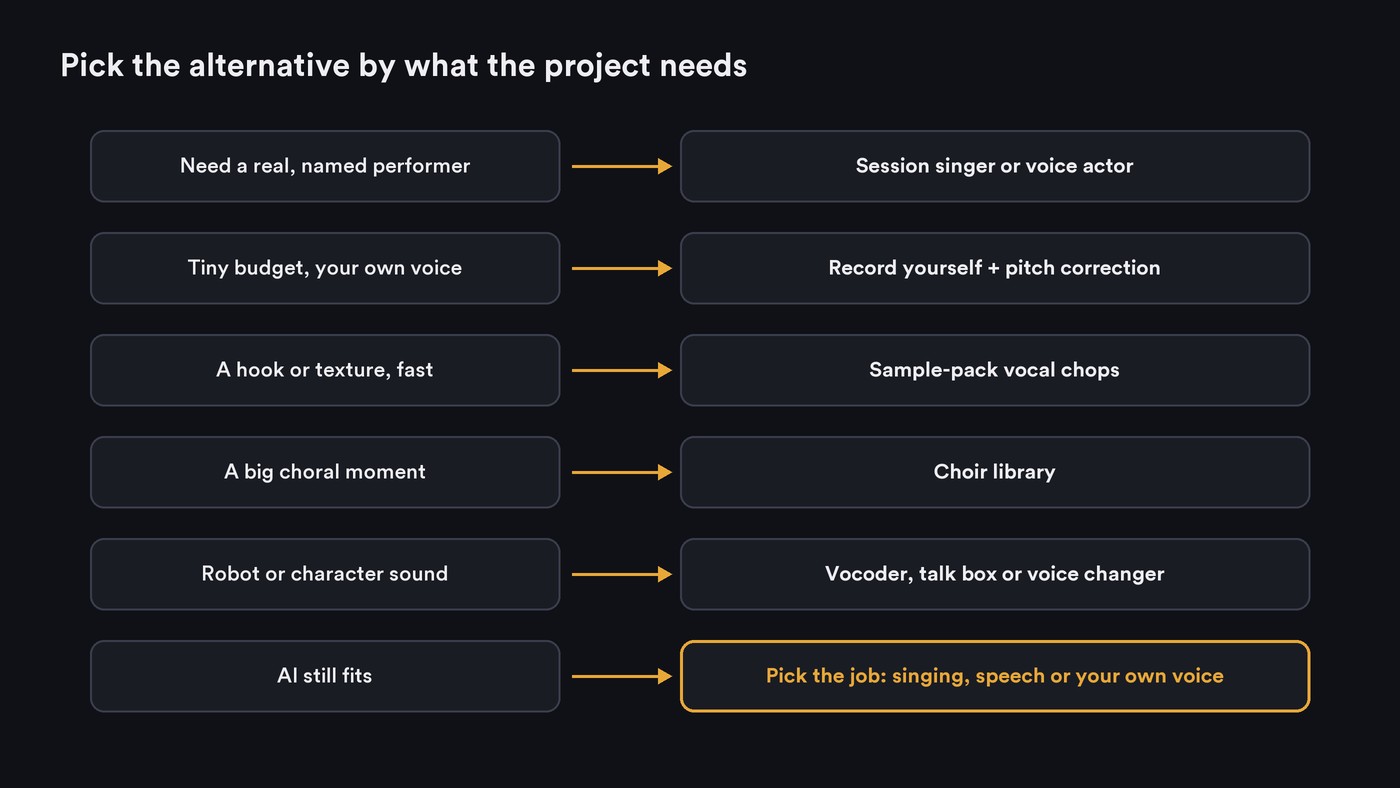
AI voice synthesis alternatives fall into two groups: other ways to get a voice, and other kinds of AI. When synthesis isn't right for a creative project, hire a session singer or voice actor, record yourself with pitch correction, use sample-pack vocal chops or a choir library, or shape a voice with a vocoder, talk box or voice changer.
If AI is still the right call, the alternative is a different AI job: singing synthesis from notes you write, conversion of a read you direct, or a model of your own voice. Choose on six things: budget, timeline, authenticity, consent, rights and language.
This guide is for agencies and production teams picking a voice for ads, brand films, games and explainers. Prices and terms come from each provider's own pages, checked on 21 November 2026, so confirm them before you quote a client. We make Soundverse, so its entries stick to our own feature pages.
Signs AI voice synthesis is the wrong fit
- Authenticity is the brief. If the campaign is built on a real person, a named performer or a community's own voice, a synthetic voice works against the message.
- Consent is unclear. If the client asks for "a voice like" someone recognisable, stop there. Using a real person's voice without permission is a legal and reputational risk; our guide to voice cloning consent laws by country shows where the lines sit.
- The client needs exclusive rights. A sonic logo or jingle the brand will defend for years needs a performance it can own, not a sound other brands can also license.
- The language or dialect is specific. Regional accents, code-switching and slang are where a native speaker beats a model. Check a tool's supported languages before you promise them.
- The client contract rules it out. Some brand agreements restrict synthetic voices, so read the master agreement first.
One signal points the other way: when the deadline is hours, hiring is usually too slow, and a library, a sample or AI wins on timeline.
Hire a session singer or voice actor
Most clients picture this option first.
- Singers on Fiverr. The FAQ on Fiverr's Singers & Vocalists category puts an amateur singer at about $150 to $200 per recording or performance and a highly experienced one at about $400, with $120 as an average for a freelance singer. Revision rounds are set per gig, so agree them before you order.
- Rights on Fiverr. Fiverr's Terms of Service say: "When purchasing on Fiverr, Buyers are granted all rights for the delivered work, unless otherwise specified by the Seller on their Gig page or unless agreed otherwise between Seller and Buyer." The same terms note that some gigs charge extra for a Commercial Use License, and business use needs it where a gig offers one. For client work, buy that extra and save the order page.
- Voice actors on Voice123. Voice123 lets you post a casting project free and negotiate with voice actors directly, or hand over the whole production. It also offers AI voice models that voice actors created and own, a middle path when you need fast pickups and want the real person on the contract.
Best for authenticity, native-language reads and credited talent. Put usage in writing (media, territories, term), cap revisions and plan for days, not minutes.
Record the voice yourself and tune it
For scratch tracks, pitch meetings, founder-voiced brand content or a band singing its own jingle, the cheapest alternative is a microphone and pitch correction. Logic Pro's Flex Pitch shows each sung note like a piano-roll note: you drag its pitch, timing and length, then adjust pitch drift, vibrato, gain, fine pitch and formant shift note by note.
A few habits make this work:
- Record dry, in a quiet room with soft furnishings.
- Sing three full takes and comp the best phrases, rather than chasing one perfect line.
- Tune lightly. Pulling every note dead-centre can make a human voice sound synthetic, which defeats the point.
Rights are simplest here because the performer is you or a colleague; still get a signed release from staff.
Licensed sample packs and vocal chops
For hooks, drops and textures, a vocal sample pack is the fastest alternative and the cheapest per sound. Splice's Sounds Licensing FAQ allows commercial use in music and in video, games, film, TV and radio. Two limits matter for client work:
- Nothing is exclusive. In Splice's words: "You have a non-exclusive license to each sound that you download from Splice Sounds, meaning other users can also use the same sounds as you without infringing on any New Recording or Creative Works you create using that sound and vice versa." The chop in your ad can turn up in a competitor's.
- No name or likeness. You can't use the name or likeness of the person behind a sound, which Splice says can include their voice, without their written permission. Distributors may also ask you to disclose third-party samples, and Splice issues a certified license PDF for that.
Best for background texture, social cutdowns and stingers. Skip it for a sonic logo the brand must own outright.
Choirs and library vocals
A sampled choir gives you a big choral sound without booking a full choir. EastWest's Hollywood Choirs uses WordBuilder 2: you type a word or phrase and the choir sings it, starting from 781 pre-built phrases in English, German, Italian, Spanish and Latin. Its page lists 16 GB of RAM as the minimum, so check the editor's machine first.
Best for trailer builds, game cues and ceremonial moments. For lyric-led lines where every word must land, book real singers.
Vocoders, talk boxes and voice changers on your own voice
For a robot, a character or a retro electronic sound, an effect on a human performance often sounds more deliberate than a synthetic voice.
- Vocoder. Apple's guide to the EVOC 20 PolySynth in Logic Pro explains the idea: the synth plays the notes from your MIDI keyboard while the vowels, consonants and level changes come from a spoken or sung take.
- Talk box. The instrument's sound is piped through a tube into the player's mouth, shaped by mouth movements and picked up by a microphone. It's a performance skill, so hire a player or budget rehearsal time.
- Voice changer. Soundtoys' Little AlterBoy shifts a voice's pitch and formant in real time, locks it to a single pitch for robot effects and takes MIDI to steer the melody. Use it on your own voice, or an actor's with their agreement, to build a character without cloning anyone.
Alternatives within AI: switch the job before the tool
If AI does fit, the better alternative is often a different kind of voice AI:
- Singing synthesis, when you have the melody. ACE Studio's docs describe loading an AI voice on a track and writing a clip of MIDI notes and lyrics. Its License & Copyright page allows commercial use of outputs unless a specific voice or feature says otherwise, so check the voice you choose.
- Converting a read you direct. ElevenLabs' Voice Changer turns an uploaded or live recording into another voice while keeping its tone and delivery, from files under 50 MB and up to 5 minutes long. Your director keeps control of timing and emphasis.
- Your own singing voice, converted. Soundverse Voice Swap re-sings a vocal in another voice model while keeping the performance, including a model of your own voice.
For a fuller roundup, see our AI voice synthesis apps sorted by job and how speech synthesis differs from singing synthesis.
How to choose an alternative for a client project
Answer six questions before you quote:
- Budget: what can the line item carry once revisions are included?
- Timeline: do you have hours (samples, libraries, AI) or days (hiring)?
- Authenticity: does the audience need to know a real person performed it?
- Consent: is every voice yours, your team's, or used with written permission?
- Rights: does the client need exclusive ownership, and does each license cover every medium the work will run in?
- Language: does the accent or dialect need a native speaker?
Where two options tie, pick the one with the simpler paper trail.
Where Soundverse fits
Soundverse is an AI music platform that takes you from idea to audience, built for independent artists who release music. Several of its tools sit between hiring a singer and going fully synthetic.
- Recording yourself: AI Autotune pulls a vocal to key in Natural, Tight or Hard tune styles, and AI Vocal Producer cleans, tunes, times and adds effects to a raw vocal in one run, leveling it to −14 LUFS. Both run on every plan.
- Your own voice: Train Voice Model learns your voice from 10 minutes or more of clean, dry solo recordings, on the Creator plan and above. Start Training stays disabled until you confirm the voice is yours or that the singer gave explicit consent.
- A choir or chop layer: AI Singing Generator sings your lyrics a cappella in styles that include Choir and vocal chops.
Licensing is set by plan: the Free plan is for personal use, and the Creator plan comes with a royalty-free license.
This video trains a voice model on a singer's own clean recordings, then uses it in Voice Swap to re-sing a vocal.
FAQ
Is hiring a session singer better than AI voice synthesis for an ad? When the ad depends on a real performer, a native accent or exclusive rights, yes. Put usage terms in writing and buy any commercial-use extra the gig offers. For drafts and internal pitches, AI or a library is faster.
Can I use sample-pack vocal chops in a commercial? On Splice, yes: its license covers commercial use in video, games, film and TV as well as music. The sounds are non-exclusive, so don't build a sonic logo on one.
Do I need consent to change a voice with a voice changer? Not for your own voice. For anyone else, including a colleague or a hired actor, get written permission that covers the effect and every place the result will run.
What's the cheapest alternative to AI voice synthesis? Recording your own voice and correcting the pitch in software you already have. It costs time instead of money: a quiet room, several takes and careful, light tuning.
Sign up for Soundverse free and try your own voice before you book a session. More vocal guides on the Soundverse blog.