Are There Any Reliable AI Tools for Cloning a Specific Voice for Royalty-Free Music?
Want to clone a voice for royalty-free music? Start with consent, then compare what Kits.ai, ACE Studio, Suno, Soundverse and Voice-Swap allow.
Yes: Kits.ai, ACE Studio, Suno Voices and Soundverse can all clone a voice and let you use what it sings commercially on the right plan. The deciding question is whose voice it is. Each one assumes the voice is yours or that its owner agreed, and no royalty-free license from a tool can replace that permission.
This guide covers whose voice it is first, then what each tool's terms say about a cloned voice, read on each company's own pages on 7 November 2026. For which tool captures a voice most faithfully, see our comparison of AI tools for cloning a specific vocal timbre.
Whose voice is it? Start with consent
"Royalty-free" describes your deal with the software company: you pay for the product or plan and owe no fee each time the song is played. Our explainer on what royalty-free means covers the idea. It says nothing about the person whose voice you cloned. Their permission is a separate layer, and it comes first.
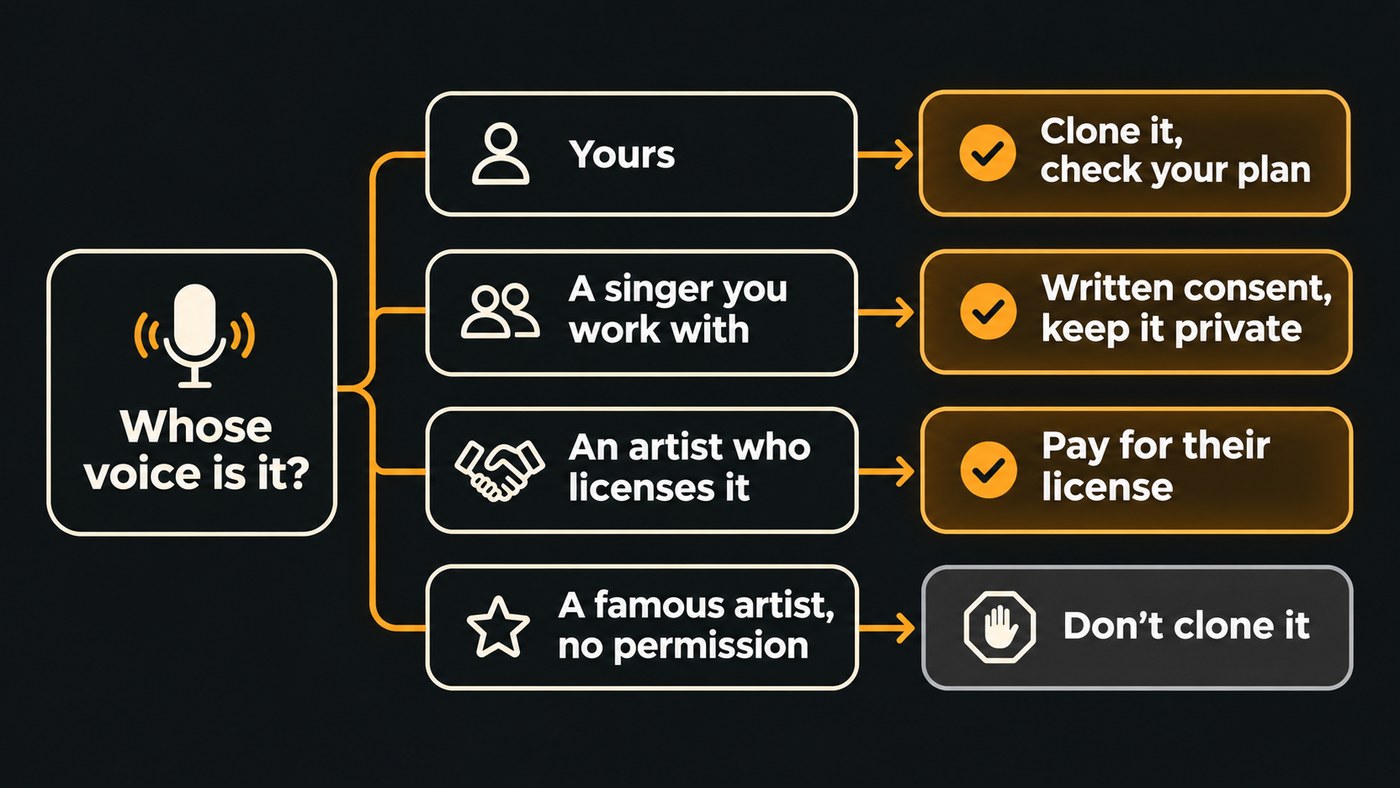
Almost every request falls into one of four cases:
- Your own voice. You hold the voice and the recordings, so only the tool's terms matter.
- A singer you work with. A bandmate, a featured vocalist or a session singer. You need their explicit consent, in writing, before you train anything.
- An artist who licenses their voice. Some services offer professional singers' voices under a license. That's a legitimate route, but you pay for it and the artist sets the terms.
- A famous artist who hasn't agreed. Don't. Spotify's impersonation policy, announced on 25 September 2025, only allows vocal impersonation in music when the impersonated artist has authorized it. Its announcement puts it bluntly: "Unauthorized use of AI to clone an artist’s voice exploits their identity, undermines their artistry, and threatens the fundamental integrity of their work."
The law is moving the same way. On 31 July 2024 the U.S. Copyright Office released its report on digital replicas and recommended a federal law against knowingly distributing unauthorized ones. In the Office's announcement, Register of Copyrights Shira Perlmutter said: "It has become clear that the distribution of unauthorized digital replicas poses a serious threat not only in the entertainment and political arenas but also for private citizens."
One more layer people miss: the recordings you train on. An a cappella pulled from a released song belongs to whoever owns that recording, often a label, even when the singer is happy for you to clone them. Record fresh, dry takes for training instead.
How to get a singer's consent in writing
A text saying "sure, go ahead" won't help when a distributor asks questions later. Put these points in a short agreement, and read our guide on getting permission for voice cloning in music for more:
- Who, what and where. The singer's name, the tool you'll use and the name of the voice model.
- Scope. Demos only, or songs you release? One project, or anything? Which platforms?
- Visibility. The model stays private to your account and nobody else gets to use it.
- Approval. Whether the singer hears each song before release and can say no.
- Payment and credit. A one-off fee keeps the songs royalty-free for you. A royalty share means you owe the singer a cut of every release. Agree how they're credited.
- The end. What happens when the agreement ends: delete the model, stop making new songs, and decide what happens to songs already released.
- What the tool does with the recordings. Some platforms can train their own models on files you upload unless you opt out, so tell the singer before you upload anything.
Keep the signed agreement with the raw recordings. For a release with real money behind it, have a music lawyer read it first.
Which AI voice cloning tools allow commercial use of a cloned voice
Compare five things: whose voice each tool accepts, commercial use of the output, who owns the model, who else can use it, and what happens to your uploads.
Kits.ai
Best for: singers who want a custom model for converting their own takes.
Kits' Terms of Service, last revised on 2 October 2024, cover your own voice or a third-party voice you've been given the authority to use, and they ban impersonating anyone without authorization. A Kits help article dated 5 August 2026 says that if you trained a model on material you have the rights to, you can use its output for personal and commercial use, including distribution and monetization on streaming platforms.
Two clauses matter for a collaborator's voice. The terms say custom voice models are owned exclusively by Kits, which grants you a royalty-free license to use the model and its output. And for accounts created on or after 2 October 2024, Kits may use uploaded voice files and outputs to train its own models unless you opt out by email; files uploaded before you opt out can still be used.
ACE Studio
Best for: producers who want their own voice as a singer they write for in MIDI.
ACE's cloning guide is written for cloning your own voice, and says a cloned voice stays private under your account, with no one else able to access it unless you authorize them. Its license page lets you use outputs in commercial or non-commercial projects unless a specific voice or feature says otherwise. It also makes you responsible for having the rights to any reference audio and to the voices you clone, and ACE doesn't claim copyright ownership of what you make.
Suno Voices
Best for: singers who want full songs in their own voice.
Suno checks the voice is yours. When you create a Voice, it displays a short phrase for you to read aloud, compares that with your singing recording, and asks you to tick a box affirming you have the rights to the voice. In practice, that limits it to your own voice. Voices is included with Pro and Premier and limited on the free tier. Rights follow the plan: per Suno's ownership article, songs made while you're on Pro or Premier are yours with commercial rights that survive cancellation, while songs from the free Basic plan are non-commercial.
One catch, from Suno's Voices FAQ: if you publish or share a song made with your Voice and allow remixing, other users can remix or cover it, so your voice can turn up in their songs.
Soundverse
Best for: independent artists who want songs in their own voice, or in a consenting collaborator's.
Train Voice Clone builds a voice from one take with at least 15 seconds of singing, and the AI Song Generator then sings new songs in it. Train Voice Model learns from 10 minutes or more of clean, dry solo recordings and re-sings existing vocals through Voice Swap. Both need the Creator plan or above.
Both ask you to confirm the voice is yours or that the singer has given explicit consent, and training won't start until you do. Their pages list a consenting collaborator as a supported use. New voice models start Private; make one Public and anyone can pick it in Voice Swap, so keep a collaborator's model Private unless your agreement says otherwise.
Licensing is set by plan: the Free plan is for personal use, and the Creator plan comes with a royalty-free license.
This video records one take, has Agent One clone it, then uses the new voice in the next songs.
Voice-Swap.ai: artist voices under license
Best for: producers who want a specific professional singer and will pay for it.
Voice-Swap's FAQ says audio from its Session Singers can be used commercially without extra payment, though you should generate a free license. Featured artists are different: you request and pay for a license at the rates listed on their pages. It also says you can only upload songs whose copyright you fully own, and can't use someone else's voice without their permission. If you want one particular voice, this is the honest way to get it, though the result usually isn't royalty-free.
How to clone a voice for a song you'll release
- Settle whose voice it is, and get consent in writing if it isn't yours.
- Record new training audio: clean, dry and solo, never vocals separated from a commercial record.
- Pick the plan before you generate, since rights often follow the plan you were on.
- Keep the model private unless the singer agreed to share it.
- Save proof: the consent, a PDF of the terms page on the day, and the tool and date for each song. Then credit the singer as agreed and answer your distributor's AI questions accurately.
Be wary of any tool with no consent step, ready-made models named after famous singers, or terms that don't say who owns the model.
Where Soundverse fits
Soundverse is an AI music platform that takes you from idea to audience, built for independent artists who release music. For a voice you're allowed to use, it gives you two routes. Train Voice Clone turns one take into a voice the AI Song Generator can sing new songs in, and cloning with Soundverse v9 needs Pro. Train Voice Model builds a more detailed model you use in Voice Swap, which keeps the original performance and changes the voice.
Consent is built into both: training stays locked until you confirm the voice is yours or the singer agreed, and new voice models stay Private until you choose otherwise. For a famous artist's voice, a service that offers artist-approved voices, such as Voice-Swap, is the better route.
FAQ
Can I clone a famous singer's voice if I never release the song? It's still a bad idea. Kits' terms ban impersonation without authorization, Soundverse tells you never to use a clone to impersonate a real person, and "just for fun" songs end up online. Use your own voice, a consenting singer, or an artist who licenses their voice.
Is a song made with a cloned voice royalty-free? Only the tool's part is. If you agreed to share royalties with the singer, or licensed an artist's voice, you owe them what you agreed. A royalty-free license also doesn't stop you collecting your own royalties as the writer and artist.
Can I clone a bandmate's voice? Yes, with their explicit consent, on a tool that accepts a consenting third party, such as Soundverse or Kits.ai. Suno Voices is built around your own voice: it matches the singing to a phrase read aloud, and only the account holder can create with it.
Sign up for Soundverse free and try your own voice first. More guides on vocals and rights on the Soundverse blog.