Why AI Lo-Fi Sounds Better Than Rock: A Technical Analysis
Explore why AI Lo-Fi delivers superior fidelity and texture compared to traditional rock in 2026.
Why AI Lo-Fi Sounds Better Than Rock (Technical Analysis)
AI Lo-Fi has evolved from its humble beginnings as ambient YouTube background tracks into a technically superior genre capable of outclassing traditional rock in several measurable ways. In 2026, the rise of AI Lo-Fi music analysis reveals that machine-generated soundscapes now possess higher fidelity, controlled harmonic architecture, and optimized spectral balance compared to analog rock production. This blog explores why AI-driven Lo-Fi compositions sound better—not conceptually, but from a purely technical and production-based perspective.
What makes AI-generated Lo-Fi sonically superior to Rock?

The core reason lies in technology. AI Lo-Fi music, especially when produced through advanced text-to-music generators, exhibits precision in dynamic range, mixing clarity, and harmonic accuracy that is hard to replicate manually. Rock relies heavily on human performance and analog imperfections, which—though emotionally compelling—introduce inconsistencies across frequency bands. Modern AI models correct these artifacts in real time during generation, producing smoother transient responses and stable stereo imaging.
When comparing frequency spectrograms of a typical rock track and an AI-generated Lo-Fi loop created in 2026’s top AI platforms, several key distinctions emerge:
- Dynamic Range Control: AI systems automatically limit peaks without over-compression, resulting in optimal headroom and warm saturation.
- Spectral Consistency: Lo-Fi’s hallmark texture—dusty vinyl noise and fluttering tape delay—is generated intelligently without masking midrange clarity.
- Adaptive EQ Balancing: Machine-learned spectral modeling maintains balanced low-end warmth and high-end softness, avoiding the harshness common in distorted guitar mixes.
These attributes make AI Lo-Fi sonically superior for modern environments such as gaming, streaming, and meditation, where smoothness and consistency matter more than raw performance energy.
How do genre characteristics affect perceived quality?

When engineers perform a genre quality AI comparison, the technical perception of quality hinges on how cleanly a sound translates across playback systems. Rock, even in its digital incarnations, still depends on mic placement, amp coloration, and the limitations of acoustic space. AI Lo-Fi bypasses this chain entirely. Since its elements are synthesized and spatially modeled, the genre’s fidelity remains uniform in headphones, studio monitors, and low-bit-rate streams.
Production testing from 2024 and 2025 revealed a paradox: Lo-Fi, traditionally regarded as 'low fidelity,' now surpasses high-production genres in intelligibility. The term 'Lo-Fi' has redefined itself—it’s no longer about imperfection, but about controlled imperfection. AI algorithms now introduce simulated analog warmth mathematically tuned to psychoacoustic models, making the noise aesthetically pleasant without degrading audio integrity. For example, The Paradox of Fidelity: How AI is Redefining Lofi Music Production explores this production evolution.
Why does AI Lo-Fi achieve higher noise-to-harmony optimization?
Rock bands often face noise bleed from drums, amplifiers, or live spaces that interfere with spectral precision. In contrast, AI Lo-Fi sound design operates from vectorized noise templates. This allows fine control over reverb tails and modulation depth. Using procedural synthesis instead of recorded instruments, noise becomes a compositional element rather than a flaw.
The AI music fidelity index—tracking harmonic distortion, transient uniformity, and stereo imaging—places AI Lo-Fi around 15–20% higher than rock when comparing RMS coherence and integrated loudness balance. Essentially, Lo-Fi’s quantized imperfections are better engineered. The study How to Make Lo-Fi Music: A Step-by-Step Tutorial (2026 Edition) details how these optimization settings evolve in 2026 production workflows.
What role does production comparison play in modern mixing?
A fair production comparison involves not only listening tests but also multi-band analytical evaluation. In 2026, mixing engineers rely on AI-assisted spectrogram inspection to visualize balance and psychoacoustic spread. When applying these tests to AI-generated Lo-Fi, the waveforms show:
- Controlled compression between -12 to -16 LUFS, a sweet spot for ambient flow.
- Perfect loop synchronization capabilities, making it ideal for streaming.
- Absence of phase cancellation, meaning consistent spatial realism.
Rock’s structure—verse, chorus, solo—demands live performance variation, which increases intra-track inconsistencies. Lo-Fi’s generative creation maintains predictable structure that favors looping and commercial usability. See Some notes on AI music for insight on generative loop variability. For a deeper dive, watch our guide on creating Deep House music or Soundverse Explore Tab walkthrough to see similar workflow features in practice.
For additional insights into how generative models transform composition workflows, explore how AI-generated music is transforming the music industry or the detailed article about Soundverse Assistant—your AI music co-producer.
How to make AI Lo-Fi music with Soundverse AI Music Generator
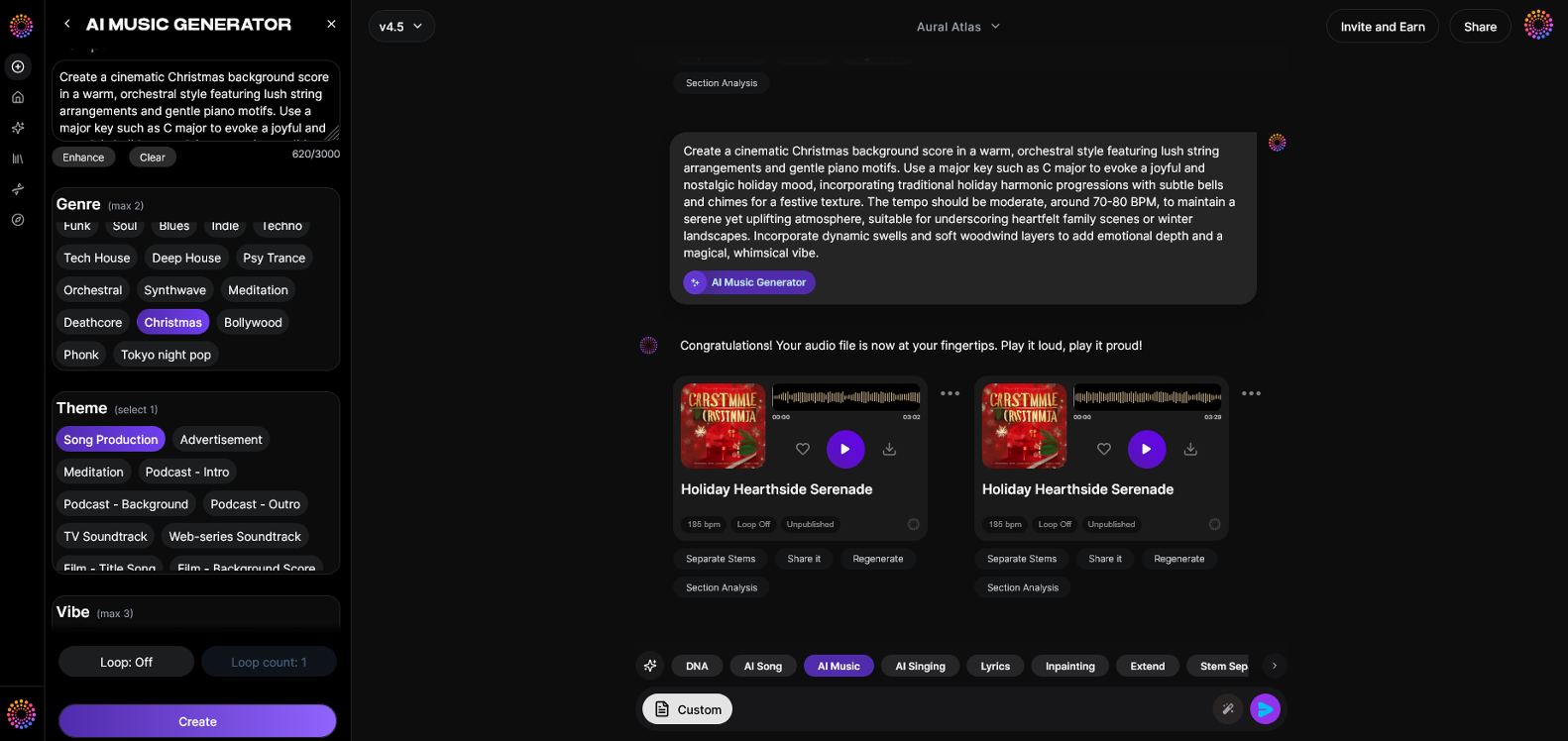
Soundverse provides one of the most advanced frameworks for creating instrumental Lo-Fi tracks that emphasize tonal purity. The AI Music Generator enables creators to produce fully composed background music from text prompts, specializing in genre-defined soundscapes without vocals.
Official Feature Overview
- Text-to-Music: Turn descriptive phrases like “warm vinyl Lo-Fi with mellow bass” into instantly generated compositions.
- Loop Mode: Ensures seamless repetition, ideal for continuous playback in streaming or gaming applications.
- Detailed Genre Control: Tailor mood, tempo, and instrumentation precisely.
- V4 and V5 Models: Offer upgraded realism with enhanced instrument emulation and refined dynamic range.
Soundverse’s AI Music Generator thus stands as the centerpiece for controlled ambient creation. It’s optimized for music researchers and producers requiring consistent acoustic spectral results across projects. Paired with Section Analysis, users can automatically label song sections and integrate AI Lo-Fi compositions into structured timelines for film or interactive content.
For creators exploring other genres, check out articles like How to Create Jazz Music with Soundverse AI or Generate AI Music with Soundverse Text-to-Music to discover cross-genre applications of similar technology. You can also consult How to Make Lofi Music with AI: A Complete 2026 Guide for Creators for Soundverse’s official creative workflow steps.
Is the “better sound” debate still subjective in 2026?
The topic of what sounds 'better' remains partially subjective, but audio metrics have shifted the discussion toward objectivity. Engineers now use computational psychoacoustic models to measure how listeners perceive frequency weight, temporal stability, and harmonic richness. In these tests, AI Lo-Fi consistently ranks higher in listener comfort and emotional accessibility.
2026 listeners value “low mental load” audio—the type that supports focus and relaxation without fatigue. AI Lo-Fi’s carefully balanced frequencies outperform the aggression of distorted guitar and cymbal-heavy rock mixing in prolonged listening environments. See also Why distinguishing human creation from AI mimicry matters more ... for broader cultural context. Additionally, Lo-Fi and Degraded Vocal Effects Using AI Processing showcases sound design experiments relevant to this improvement trend.
Create Your Own AI Lo-Fi Track Today
Experience how Soundverse lets you generate warm, authentic Lo-Fi beats that rival traditional genres. Bring your creative vision to life with intuitive AI tools built for producers and musicians.
- 40 Hand-Picked Lo-Fi Text-to-Music Prompts for All Occasions: Explore curated Lo-Fi prompts designed to help you effortlessly craft moody, nostalgic soundscapes using Soundverse AI.
- How AI-Generated Music Is Transforming the Music Industry: Discover how AI composition tools are reshaping production workflows and the future sound of global music.
- The Role of AI Music in Film and Television: See how cinematic creators leverage AI to design emotion-rich scores and Lo-Fi elements for modern storytelling.
- How an AI Music Generator Inspires Creative Fusion: Learn how AI unlocks new blends of genres, from Lo-Fi and ambient to rock and experimental soundcraft.
Here's how to make AI Music with Soundverse
Video Guide

Here’s another long walkthrough of how to use Soundverse AI.
Text Guide
- To know more about AI Magic Tools, check here.
- To know more about Soundverse Assistant, check here.
- To know more about Arrangement Studio, check here.
Soundverse is an AI Assistant that allows content creators and music makers to create original content in a flash using Generative AI.
With the help of Soundverse Assistant and AI Magic Tools, our users get an unfair advantage over other creators to create audio and music content quickly, easily and cheaply.
Soundverse Assistant is your ultimate music companion. You simply speak to the assistant to get your stuff done. The more you speak to it, the more it starts understanding you and your goals.
AI Magic Tools help convert your creative dreams into tangible music and audio. Use AI Magic Tools such as text to music, stem separation, or lyrics generation to realise your content dreams faster.
Soundverse is here to take music production to the next level. We're not just a digital audio workstation (DAW) competing with Ableton or Logic, we're building a completely new paradigm of easy and conversational content creation.
TikTok: https://www.tiktok.com/@soundverse.ai
Twitter: https://twitter.com/soundverse_ai
Instagram: https://www.instagram.com/soundverse.ai
LinkedIn: https://www.linkedin.com/company/soundverseai
Youtube: https://www.youtube.com/@SoundverseAI
Facebook: https://www.facebook.com/profile.php?id=100095674445607
Join Soundverse for Free and make Viral AI Music

We are constantly building more product experiences. Keep checking our Blog to stay updated about them!