What Is the Current State of Voice Cloning for Professional Music Production?
Voice cloning in music production, late 2026: what works, what still fails, documented pro uses, consent checks, laws in force and a pro checklist.
Voice cloning in music production is dependable today for a handful of jobs: turning a sung guide into a consenting singer's timbre, demo vocals, harmony stacks and language versions. It still needs human editing for expressive detail, drifts across a whole album, and is only ethical with written consent, which a growing set of laws now backs.
We checked every source below on 19 November 2026. The law keeps changing, so treat this as general information, not legal advice.
Two kinds of voice cloning, and why the difference matters
The workhorse in professional sessions is voice conversion: a person sings the part, and a model re-sings that take in another timbre. The phrasing, timing and pitch come from the human performance, so the result is only as good as the guide.
The second kind is singing generation in a cloned voice: a model learns a voice from a sample and then performs new lyrics and melodies itself. It's faster for sketches and gives you less control over each phrase.
Speech clones are a separate thing. ElevenLabs' Professional Voice Cloning docs state that these clones don't currently support singing, so a voice that reads a podcast intro well may fail on a chorus.
What voice cloning in music production does well now
- Timbre transfer from a sung guide. A session singer or the producer sings the part with the right phrasing, and the model carries it into the target voice.
- Demo vocals. Songwriters hear a new song in their own cloned voice, or in a collaborator's voice once that singer has agreed, without booking a session for every idea.
- Harmonies and doubles. Your own model can sing a third above you or a double under the lead. Record a separate guide take for each part: converting one take several times gives identical phrasing that sounds stacked rather than sung. Our guide to AI vocal harmonies covers voicing and mixing.
- Language versions. The artist's own voice carries a translated lyric, with pronunciation corrected by the model.
Who uses voice cloning in professional workflows
Two documented projects show what the work looks like.
Warner Music Nashville, 2024. The Associated Press reported on 6 May 2024 how the label recreated the voice of Randy Travis, who had released no new music in over a decade after a stroke, with him and his wife Mary agreeing to the project. Developers built two models, one from 12 vocal stems and one from 42 stems spanning 1985 to 2013, and producer Kyle Lehning fed in a demo vocal sung by James Dupree. His verdict on the first pass: "it was probably 70, 75% what you hear now." The rest came from picking between the two models and making changes such as vibrato speed and how phrases relax.
HYBE, 2023. The Korea Times reported on 15 May 2023 that HYBE released MIDNATT's single "Masquerade" in six languages using Supertone's voice tools. HYBE said narrator voice data was used so the technology "naturally fixes the pronunciation of foreign languages, while maintaining the artist's singing style and musical expressions." Supertone's voice design technology also created a female voice from the singer's own voice.
Both projects used the artist's own voice with the artist on board, and both needed people to finish the job. Beyond these, most public stories are vendor case studies, which are marketing and worth reading as such.
What still doesn't work reliably
- Expressive edge cases. Belts, cracks, growls, falsetto flips and whispered lines often fall outside the training takes and come out smoothed or glitchy. Breath and rasp go first; see whether AI can replicate breathiness for fixes.
- Messy training audio. Background music, noise, reverb and takes that stay on a few notes all lower quality, as Soundverse's own Train Voice Model page warns.
- Full mixes. Conversion on a finished song separates the lead first, so backing vocals drop out or stay in the original voice; Soundverse's Voice Swap, for one, leaves them out of the result.
- Consistency across an album. A model reacts to the mic, the key and the singing style of each guide. Across an album that drift can be audible, so freeze one model version per project and train separate models for very different styles.
- Legal clarity. Rules differ by state and country, and the federal NO FAKES Act was still a bill when it was last reintroduced (see below).
Consent, licensing and verification frameworks
- Identity verification. ElevenLabs lets you clone only your own voice with a Professional Voice Clone, verified by reading lines aloud; failed attempts can be retried after 24 hours. A person who wants to share a voice verifies it on their own account and shares it privately by link, so the voice's owner keeps control.
- Label opt-ins. Warner Music Group's release of 25 November 2025 on its Suno deal promises artists and songwriters full control over whether and how their names, images, likenesses, voices and compositions are used in new AI-generated music.
- Licensed artist voices. Voice-Swap's FAQ says featured artist voices need a licence you request and pay for, and that you can use its audio in a track only with explicit permission from the artist.
- Consent gates in the tool. Some platforms, Soundverse included, won't start training until you confirm the voice is yours or that the singer agreed.
For how to judge a cloning app on export quality, plugins and checks, see our criteria for professional-grade vocal cloning.
Laws in force, and one that isn't yet
- Tennessee's ELVIS Act (Public Chapter 588) took effect on 1 July 2024. It defines "voice" to include a simulation of a person's voice, creates liability for knowingly making someone's voice or likeness available to the public without authorization, and extends it to anyone who distributes a tool whose primary purpose is producing a particular, identifiable person's voice without authorization.
- The EU AI Act's transparency rules under Article 50 apply from 2 August 2026, according to the European Commission. Providers must mark synthetic audio in a machine-readable way, with a grace period until December 2026 for generative systems already on the market. Deployers must label deepfakes, which include audio that resembles a real person and would falsely appear authentic.
- The US NO FAKES Act would give every person a federal right to control digital replicas of their voice and likeness. Its sponsors reintroduced it in May 2026, so it was still a bill then; congress.gov blocked our reader, so check its status there.
- Other states have their own right-of-publicity laws. Check where the singer lives and where you release.
A practical checklist for pro voice cloning
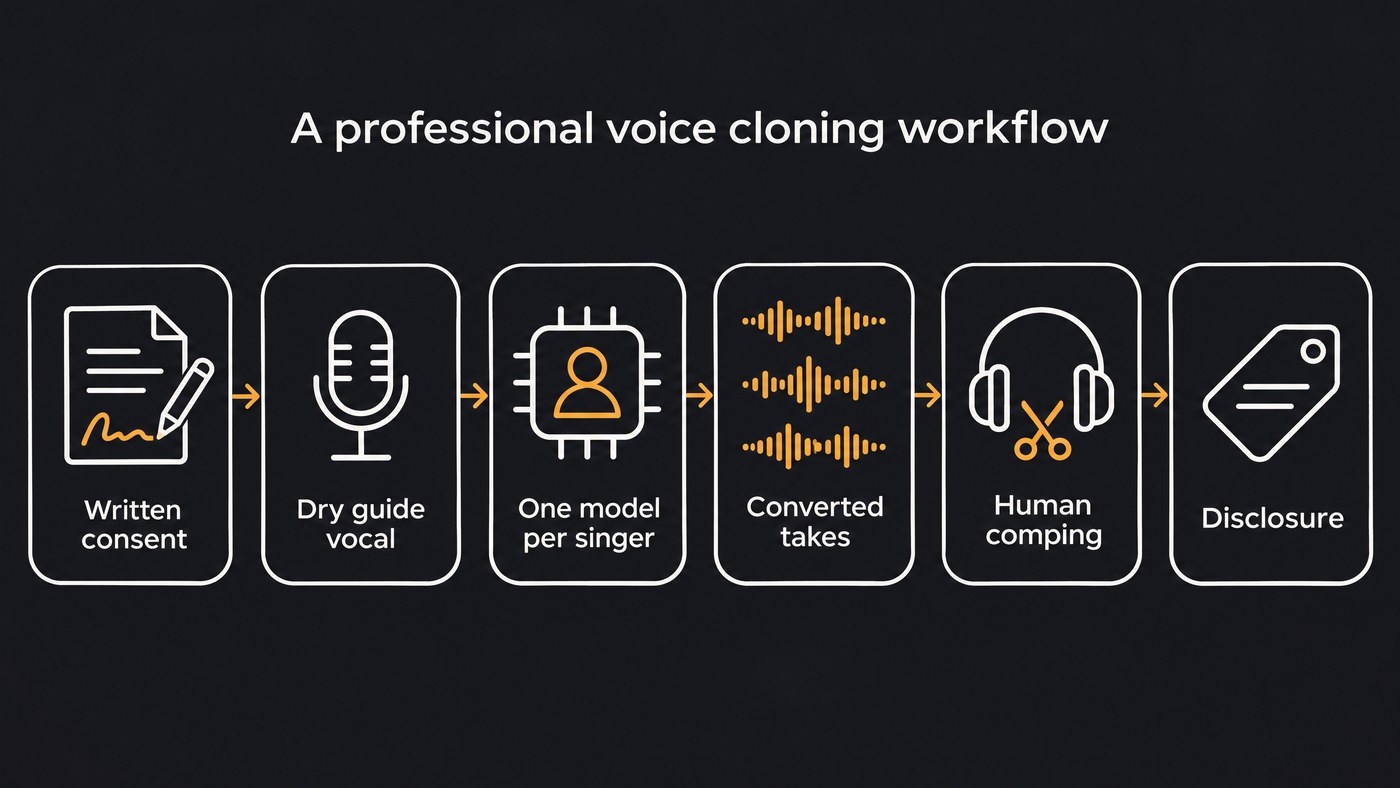
- Written consent. Name the singer, the model, the songs, the uses (demo only, release, ads), territories, term, payment, credit and how the singer can withdraw. File it with the session.
- A dry 48 kHz source. Record 24-bit WAV at 48 kHz in a quiet room, with no reverb, delay or doubling, one singer per file, across the singer's full range.
- One model per singer. Never mix voices in a training set. Name and version each model, and keep separate models for very different styles.
- Human comping. Sing the guide with the phrasing you want, convert several takes, comp the best phrases, fix breaths and vibrato by hand, and have the singer approve the final.
- Disclosure. Credit the AI vocal in your metadata and liner notes, fill in distributor and platform AI fields honestly, and label realistic replicas where the EU rules apply.
- Security. Keep models private, share them only with the people on the project, and revoke access when it ends.
Where Soundverse fits
Soundverse is an AI music platform that takes you from idea to audience, built for independent artists who release music. Train Voice Clone turns one recording with 15 seconds or more of singing into a voice the AI Song Generator can sing new songs in, on the Creator plan and above, with cloning on Soundverse v9 on Pro. Train Voice Model learns from 10 minutes or more of clean, dry solo recordings in clips of at least 60 seconds, trains for 10 to 350 epochs over hours, and starts Private. Voice Swap re-sings a vocal in your trained voice while keeping the performance, with pitch shifts of up to 24 semitones either way. Neither training tool starts until you confirm the voice is yours or that the singer has given explicit consent.
Licensing is set by plan: the Free plan is for personal use, and the Creator plan comes with a royalty-free license.
This video records one take, clones the voice, and uses the clone in the songs made next.
FAQ
Is AI voice cloning good enough for a commercial release? For harmonies, doubles and language versions, often yes, after human comping and editing. For an exposed lead vocal, plan to edit by hand: in the Warner Music Nashville project, the first AI pass was, in the producer's words, about 70 to 75% of the final.
Is it legal to clone a singer's voice if they agree? Clear, written consent that covers the use is the foundation, along with the rights to the recordings you train on, and local publicity laws and platform rules still apply. Without consent, laws such as Tennessee's ELVIS Act create liability.
How much audio do I need to clone a voice for music? It depends on the tool. Soundverse's Train Voice Clone needs at least 15 seconds of singing, and Train Voice Model needs at least 10 minutes of clean, dry solo voice. More varied material across the singer's range gives a more accurate model.
Can I clone a voice from a finished song? Only a voice you have the rights and consent to use. Separated vocals carry bleed and effects, so a dry studio take usually trains a better model.
Sign up for Soundverse free and start with Voice Swap, which runs on every plan. More guides on the Soundverse blog.