What AI Can Sing: Exploring Artificial Intelligence in Music Creation
Discover how AI singing technology revolutionizes music creation in 2026.
What AI Can Sing: Exploring Artificial Intelligence in Music Creation
Artificial intelligence (AI) has become a defining force in the music industry, and by 2026, the concept of machines generating music is no longer experimental—it’s foundational. One of the most fascinating areas within this field is AI singing technology, a branch that focuses on creating human-like vocal performances through algorithms trained on thousands of singing styles, tones, and languages. This revolution doesn’t just mimic voices; it crafts unique vocal textures that blend emotion with mathematical precision.
What is AI Singing Technology and How Does It Work?
AI singing technology combines deep learning, machine learning songwriting techniques, and vocal synthesis to generate natural-sounding vocals from text, lyrics, or even a description of mood and style. The process typically involves training neural networks on vast datasets of recorded human singing. These models learn pitch modulation, rhythm, amplitude, and phrasing, allowing them to reproduce or invent completely new singing styles.
Under the hood, the system analyzes phonemes—the smallest sound units in speech—and matches them to melodic data points. It then predicts how a human would sing those sounds at specific pitches or emotional intensities. The result is a vocal output that feels organic, expressive, and artistically adaptable. This capability makes AI singing technology particularly valuable for music producers, film composers, and creators working on genres ranging from pop and EDM to experimental soundscapes. For a deeper dive, watch our guide on creating Deep House music and how to make music through the Soundverse tutorial series.
What Can AI Sing in 2026?
By 2026, AI’s range has evolved far beyond traditional melodies. Current AI singers can deliver:
- Standard Genres: Pop, rock, rap, jazz, opera, and more.
- Experimental Styles: Whispering, robotic harmonies, ambient drones, or even quirky animal-inspired tones like 'Meow Meow' cat vocals.
- Emotionally Driven Performances: Neural models can now simulate sadness, excitement, or calmness based on text analysis and reference audio.
- Multilingual Output: AI can sing in multiple languages without losing pronunciation accuracy or emotional resonance.
These innovations have turned singing generators into flexible creative partners capable of adapting to nearly any musical setting. Some professionals even use AI voice generators to craft demo vocals before hiring human singers, saving time and resources while ensuring creative direction. Companies like Universal Music Group and LALAL.AI are pioneering collaborations to further refine AI’s integration in global music workflows.
How AI Singing is Changing Music Creation
The relationship between artists and artificial intelligence in music has matured between 2024 and 2026. What was once seen as a novelty—machines singing—has now become an everyday part of professional music workflows. AI doesn’t replace human artistry; it expands it. Producers can experiment faster, and songwriters can receive instantly sung drafts of their lyrics to test emotional flow.
The AI music generation process integrates singing with composition tools, enabling complete song creation from concept to mixed output. For example, platforms like Soundverse unite singing and songwriting features through interconnected modules such as AI Song Generator and AI Singing Generator. These tools help users move from an idea to a finished product without needing traditional instruments or recording setups. Learn more about the AI music industry trends in 2026 and explore Top music startups to watch in 2026.
What Role Does Machine Learning Play in AI Singing?
Machine learning is the backbone of AI singing technology. It governs how the system understands tone, emotion, and musical intention. Through supervised and unsupervised learning techniques, neural models identify correlations between lyric structure, melodic contour, and human vocal delivery.
This data-driven approach leads to models capable of:
- Recognizing genre conventions and stylistic nuances.
- Emulating a singer's vocal tone using reference audio.
- Predicting how different singing techniques—belting, falsetto, vibrato—should sound based on textual emotion.
As a result, every generated performance can be remarkably realistic, allowing artists to explore hybrid styles that merge classical influence with futuristic audio design. Watch the Soundverse “Explore” Tab tutorial to see how creators navigate and customize AI vocal models easily.
What Are the Creative Applications of AI Voice Generators?
The possibilities are vast. Beyond traditional songwriting, AI voice generators are being used for film scoring, character voice creation, and virtual concerts. Game developers use them to give non-player characters (NPCs) dynamic musical personalities. Animation studios employ them to simulate singing performances in multiple languages for global audiences.
Content creators also find immense value in AI-generated vocals when producing royalty-free or copyright-safe tracks for YouTube, podcast intros, and marketing campaigns. For related insights, explore how AI-generated music is transforming the music industry and music industry trends. Learn from platforms that compare the best AI music generators of 2026 to find your ideal production tool.
How to Make AI-Generated Singing Sound More Human
In 2026, making AI vocals sound human hinges on combining several advanced methodologies:
- Reference Matching: AI learns from examples of human singers to transfer tone and timbre.
- Dynamic Emotion Controls: Users adjust melodic variance and expression strength to fine-tune delivery.
- Post-Processing: Artists add production effects—EQ, reverb, saturation—to simulate natural space and mic sensitivity.
Producers often use AI’s acapella output to create chopped vocal samples—a technique popular in electronic production. With tools like the Soundverse Stem Separation AI Magic Tool, creators can isolate or remix generated vocals for new arrangements.
How to Make AI-Generated Songs and Vocals Instantly Using Soundverse
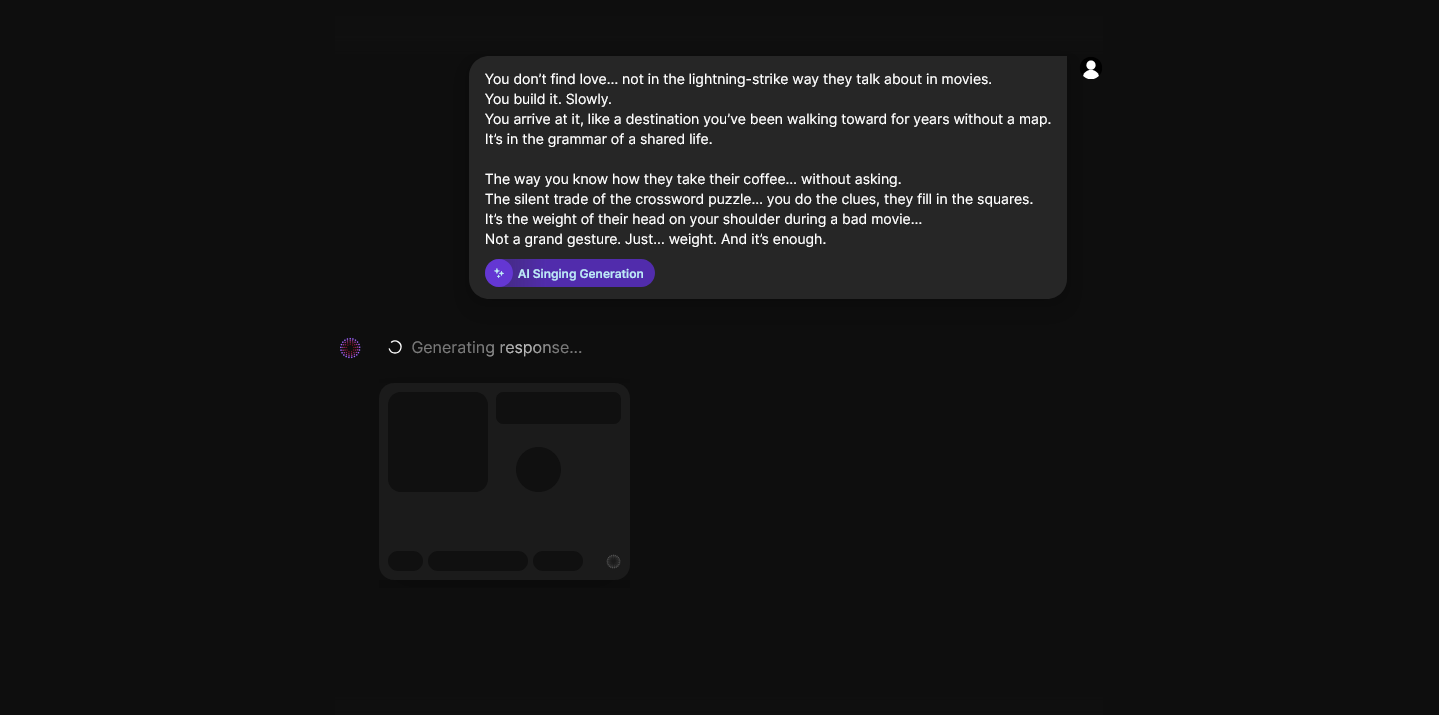
Now that you understand how artificial intelligence in music creation works, here's how to make it instantly using Soundverse.
How to Make AI Singing with Soundverse AI Singing Generator
The Soundverse AI Singing Generator lets musicians and creators generate professional-quality acapella performances directly from written text or lyrics. It supports multiple musical styles—including pop, rock, rap, opera, and ASMR whispering—and even experimental variants like 'Meow Meow' cat textures. With clean acapella output and multilingual capabilities, this feature empowers real artists to shape authentic and imaginative performances.
Core Capabilities:
- Text-to-singing conversion powered by deep learning.
- Style diversity covering commercial and experimental music.
- Reference audio for matching tone or emotional delivery.
- Exportable acapella files ready for mixing and mastering.
Primary Use Cases:
- Vocal references during production.
- Electronic vocal chop creation.
- Character voices for animations or interactive games.
- Multilingual songwriting for global releases.
The Soundverse ecosystem further includes the AI Song Generator for complete song production and the Similar Singing Generator for continuity across multiple vocal tracks. These features make Soundverse the all-in-one destination for AI-assisted music generation. You can also learn about how to make rap music with AI or explore diverse genres through AI music generation prompts to refine your creative approach.
The Future of AI Singing Technology in 2026 and Beyond
Looking ahead, we’re witnessing AI singing becoming smarter and more stylistically nuanced. Neural models are learning not only how to sing but why certain emotional inflections matter. Producers can expect improved personalization—custom voices tailored to specific emotional arcs or musical directions. By 2026, creators have embraced AI not as a novelty but as a co-producer capable of enhancing expressive storytelling through sound.
For those who wish to go beyond the boundaries of what machines can achieve, Soundverse stands as the premier platform bridging creativity and technology. Its focused innovation represents the next era of artificial intelligence in music—where emotion meets computation.
In short, AI singing technology is no longer the future—it’s the present. And with Soundverse leading the evolution, any artist or content creator can transform text into song, imagination into melody, and data into emotional resonance.
Start Creating Music with AI Singing Technology Today!
Unlock your creative potential with Soundverse’s advanced AI singing tools. Generate original vocals, harmonize effortlessly, and bring your musical ideas to life in minutes.
Try Soundverse Free
Related Articles
- AI Ranks Soundverse’s AI Singer #1: The Ultimate AI Singing Platform Dominating 2025 — Discover why Soundverse’s AI singer leads the pack in next-generation vocal synthesis and creative music automation.
- Soundverse Assistant: Your AI Music Co-Producer — Learn how the Soundverse Assistant helps creators streamline production and enhance creativity with intuitive AI collaboration.
- How AI-Generated Music Is Transforming the Music Industry — Explore how artificial intelligence is revolutionizing songwriting, composition, and talent discovery across the music world.
- What AI Can Generate Songs — Understand the capabilities and limits of AI when it comes to composing full songs, melodies, and lyrics.
Here's how to make AI Music with Soundverse
Video Guide
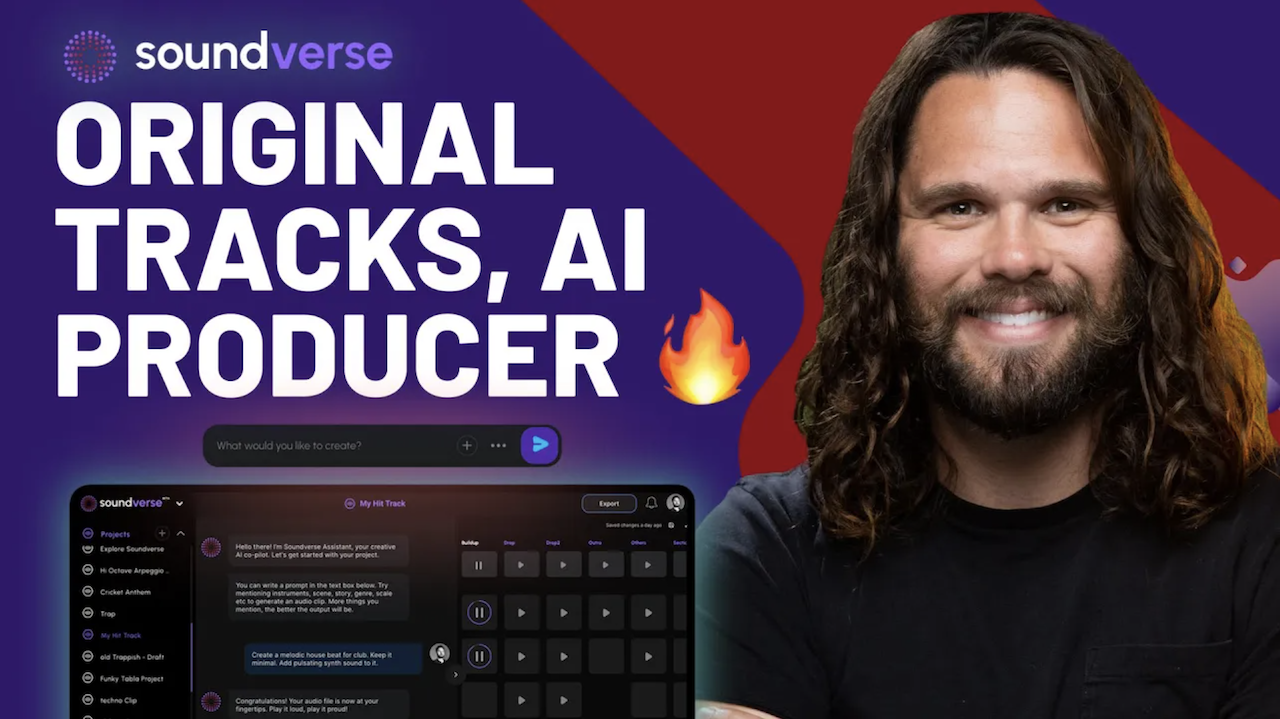
Here’s another long walkthrough of how to use Soundverse AI.
Text Guide
- To know more about AI Magic Tools, check here.
- To know more about Soundverse Assistant, check here.
- To know more about Arrangement Studio, check here.
Soundverse is an AI Assistant that allows content creators and music makers to create original content in a flash using Generative AI.
With the help of Soundverse Assistant and AI Magic Tools, our users get an unfair advantage over other creators to create audio and music content quickly, easily and cheaply.
Soundverse Assistant is your ultimate music companion. You simply speak to the assistant to get your stuff done. The more you speak to it, the more it starts understanding you and your goals.
AI Magic Tools help convert your creative dreams into tangible music and audio. Use AI Magic Tools such as text to music, stem separation, or lyrics generation to realise your content dreams faster.
Soundverse is here to take music production to the next level. We're not just a digital audio workstation (DAW) competing with Ableton or Logic, we're building a completely new paradigm of easy and conversational content creation. TikTok: https://www.tiktok.com/@soundverse.ai Twitter: https://twitter.com/soundverse_ai Instagram: https://www.instagram.com/soundverse.ai LinkedIn: https://www.linkedin.com/company/soundverseai Youtube: https://www.youtube.com/@SoundverseAI Facebook: https://www.facebook.com/profile.php?id=100095674445607
Join Soundverse for Free and make Viral AI Music

We are constantly building more product experiences. Keep checking our Blog to stay updated about them!