How to Properly Credit Royalty-Free Music in Your Projects (2026 Guide)
Learn how to properly credit royalty-free music and creative commons tracks in 2026. Complete guide for creators, editors, and marketers.
How to Properly Credit Royalty-Free Music in Your Projects
In 2026, with creative industries thriving through AI-driven tools and user-generated content, proper music attribution has become both an ethical and professional requirement. Whether you’re producing short-form videos, podcasts, or campaigns, knowing how to correctly credit royalty free music helps maintain transparency and respect for creators, even when no payment is required.
Why Should You Credit Royalty-Free Music?
Royalty-free music doesn’t always mean credit-free. The term simply means you can license the track for use without ongoing fees per play or per view. However, most royalty-free platforms still specify attribution requirements. Proper credit not only acknowledges artists but also reassures clients and audiences that your project uses licensed material responsibly.
Crediting royalty-free music also boosts SEO for creators and helps maintain algorithmic credibility within distribution channels like YouTube and Spotify. Video editors and podcasters who consistently apply correct music attribution develop stronger legal and ethical standing for monetization—especially critical given the increased enforcement of digital rights in 2026.

What Does Proper Music Credit Look Like in Practice?
A proper credit line typically includes:
- Track Title – The name of the song you used.
- Artist Name – The creator or composer.
- Source/Platform – Where you obtained the track (for instance, a royalty-free site or Creative Commons library).
- License Type – Such as CC BY, CC BY-SA, or Royalty-Free License.
Example attribution format:
"Music: 'Across the Dunes' by John Doe, licensed under Creative Commons Attribution 4.0, via Soundverse."
This level of transparency ensures users can trace the audio’s origin and confirm its legitimacy. Always double-check platform-specific requirements before posting, as projects from 2024 and 2025 saw many takedowns resulting from incomplete or incorrect credit lines.
What Is the Difference Between Royalty-Free and Creative Commons Credit?
Creative Commons licensing allows reuse with specific conditions—sometimes demanding explicit author credit or linkbacks. Royalty-free licensing, meanwhile, involves a one-time payment or free download with fewer restrictions.
If you use a creative commons credit, you must include the license version (e.g., CC BY 4.0) and provide a working link to the license terms. In contrast, royalty-free tracks may only require mentioning the source.
For example:
- Under CC BY, you must credit the artist and link to the license as stated in the License Guide - Free Music Archive.
- Under CC BY-SA, you must credit and share derivative works under the same license.
Understanding these nuances helps content creators comply with legal expectations. Explore guides like Copyright Free vs Royalty Free Music: What Creators Should Know for deeper legal distinctions. You can also review general best practices from What is royalty free music? - Storyblocks.
How to Properly Credit Royalty-Free Music in Video Projects
When integrating royalty-free or Creative Commons tracks into video content, placement matters as much as structure:
- Include credits in the description box for social platforms.
- Overlay credits in closing frames for long-form videos.
- If used in short clips, add discrete text overlays or pinned comments.
For YouTube and TikTok creators, attribution improves visibility and algorithmic trust. Platforms in 2026 increasingly scan metadata to ensure legal music use in monetized clips. Learn how effective background music strategies complement video storytelling using guides like Enhancing YouTube Content with Royalty-Free and Copyright-Free Music Using Soundverse AI. For a deeper dive, watch our Soundverse Tutorial Series - 9. How to Make Music and Soundverse Tutorial Series - 10. Make Deep House Music on YouTube.
How to Credit Music in Podcasts and Voice Content
Podcasters must embed music credits within the episode description or voice intro. Spoken acknowledgments work well for short intros (e.g., "Music courtesy of Soundverse creators"), while detailed license text should sit in show notes.
Always check distribution rules. Platforms such as Spotify for Podcasters and Apple Podcasts in 2026 use automated license verification. Missing attribution lines can trigger temporary unavailability or copyright disputes.
Quick tip for podcast creators: Align your content creator music credits with your brand’s ethics statement. It’s not only compliance—it’s professionalism.
You can also explore tools that simplify background matching or genre picking—such as the Soundverse AI Magic suite—which pairs royalty-free music directly with attribution templates.
How Attribution Impacts Search Visibility and Legality in 2026
Properly credited royalty-free music can enhance searchability and protect against accidental copyright infringements. 2026 algorithms prioritize labeled metadata, including license tags, making it easier for creators’ videos and podcasts to be indexed without dispute.
This is particularly vital as AI music generation becomes mainstream. Articles like How AI-Generated Music Is Transforming the Music Industry show how attribution systems now serve as certification for ethically produced audio.
If you ever repurpose tracks—say, edit or remix them—always reapply credit lines and license updates to reflect the new form. Incorrect attribution during remixing can still lead to takedowns or demonetization. See Royalty-Free Music Explained: Complete Guide for Content Creators for extended detail.
How to Make Attribution Consistent Across Multiple Projects
For marketers and agencies handling dozens of videos or audio campaigns per month, consistency is key:
- Maintain a central credit log that records every track used across campaigns.
- Automate credit generation via document templates.
- Use metadata tagging tools or watermarked assets to secure license data.
By 2026, most producers use AI-based analytics to verify license compliance before publishing—a safeguard against client-side disputes. Review the A Guide to Royalty-Free Music (2025) - Tracklib for practical steps.
How to Make Credit Royalty-Free Music With Soundverse Trace
Now that you understand how to properly credit royalty-free music, here’s how to manage attribution seamlessly with Soundverse.
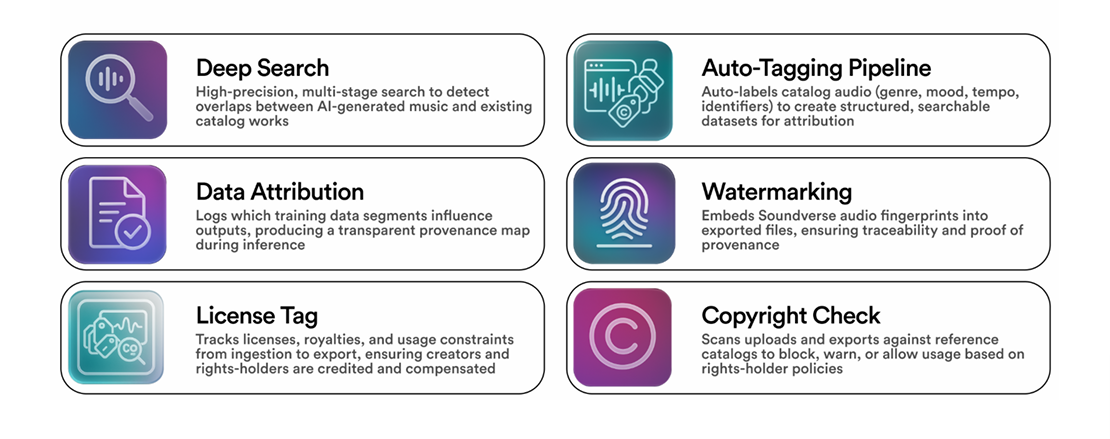
Soundverse Trace acts as a comprehensive trust layer for AI music creation and distribution. It embeds attribution, deep search, and rights protection from dataset creation through final export. Every Soundverse track carries invisible audio watermarks and preserved license tags, ensuring that even remixers and AI generators maintain traceable credit.
How Soundverse Trace Simplifies Attribution:
- Deep Search: High-precision scanning detects overlaps and identifies original data sources (1:1 or 1:N matching).
- Data Attribution: Logs which training datasets influenced the output, guaranteeing ethical reuse transparency.
- Audio Watermarking: Inserts inaudible fingerprints that persist through edits, proving provenance if disputes arise.
- License Tagging: Carries rights metadata across the full lifecycle—from ingestion to export—for flawless attribution.
Combined with the Content Partner Program, rights-holders receive recurring royalties every time attributed audio is used—an innovation aligning with the Ethical AI Music Framework, which ensures integrity amid large-scale AI production.
Soundverse Trace doesn’t require real-time preview or monitoring—it works asynchronously. Upload or record your music, let Trace process attribution, and then export verified results ready for public or commercial use.
For creators constantly managing multiple sound sources, this is the most reliable way to automate credit and maintain professional-grade compliance.
If you’re building multimedia projects—videos, podcasts, or social campaigns—Soundverse Trace delivers transparent documentation that protects both creators and businesses. Explore related guides such as Navigating the World of Royalty-Free and Copyright-Free Music Using Soundverse AI and Soundverse Assistant: Your AI Music Co-Producer for even more integrated workflow automation.
Generate Royalty-Free Music Instantly with Soundverse
Create custom, attribution-ready music in seconds using Soundverse’s powerful AI tools. Perfect for videos, podcasts, and creative projects—no copyright worries, just total freedom.
- Navigating the World of Royalty-Free and Copyright-Free Music Using Soundverse AI: Learn how Soundverse AI simplifies music sourcing and ensures you stay compliant with licensing standards.
- Copyright-Free vs. Royalty-Free Music: What Creators Should Know: Understand the key distinctions between copyright-free and royalty-free tracks to avoid misuse and legal pitfalls.
- Enhancing YouTube Content with Royalty-Free and Copyright-Free Music Using Soundverse AI: Discover how to upgrade your YouTube videos ethically and legally with Soundverse’s AI-powered music tools.
- The Role of AI Music in Film and Television: Explore how AI-generated royalty-free music is shaping modern film and TV soundtracks for creators worldwide.
Here's how to make AI Music with Soundverse
Video Guide
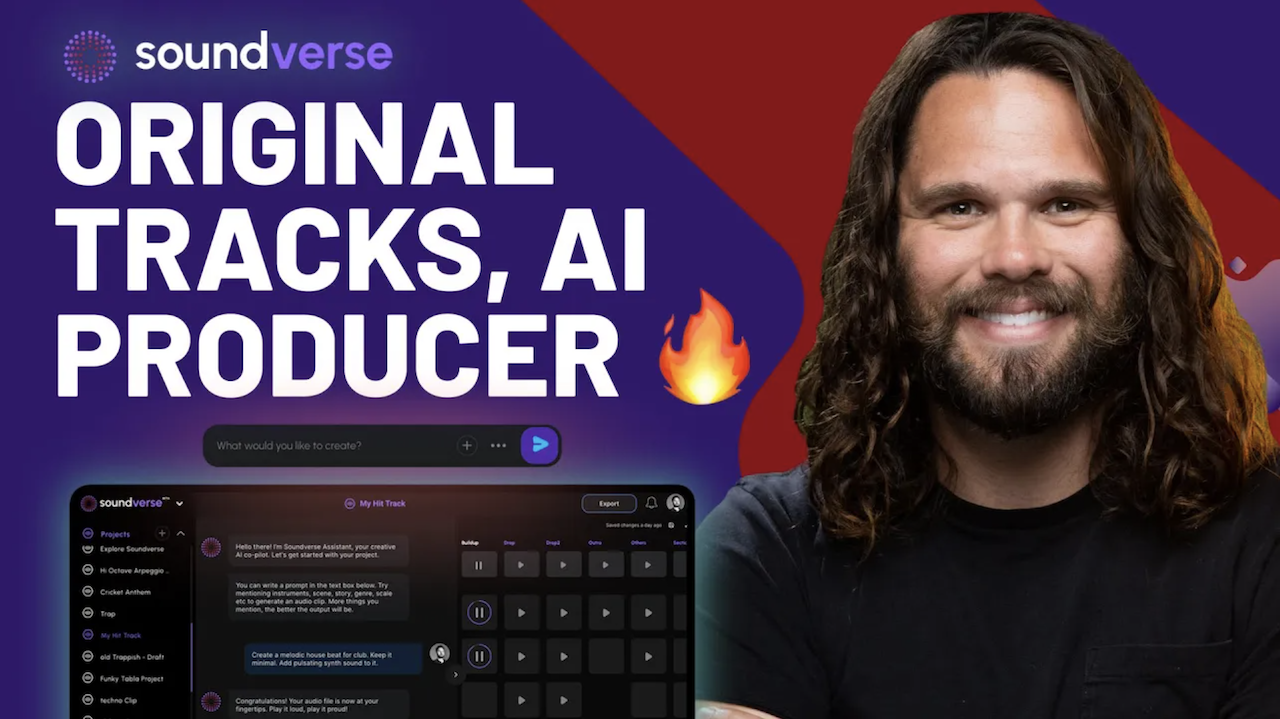
Here’s another long walkthrough of how to use Soundverse AI.
Text Guide
- To know more about AI Magic Tools, check here.
- To know more about Soundverse Assistant, check here.
- To know more about Arrangement Studio, check here.
Soundverse is an AI Assistant that allows content creators and music makers to create original content in a flash using Generative AI. With the help of Soundverse Assistant and AI Magic Tools, our users get an unfair advantage over other creators to create audio and music content quickly, easily and cheaply. Soundverse Assistant is your ultimate music companion. You simply speak to the assistant to get your stuff done. The more you speak to it, the more it starts understanding you and your goals. AI Magic Tools help convert your creative dreams into tangible music and audio. Use AI Magic Tools such as text to music, stem separation, or lyrics generation to realise your content dreams faster. Soundverse is here to take music production to the next level. We're not just a digital audio workstation (DAW) competing with Ableton or Logic, we're building a completely new paradigm of easy and conversational content creation.
TikTok: https://www.tiktok.com/@soundverse.ai
Twitter: https://twitter.com/soundverse_ai
Instagram: https://www.instagram.com/soundverse.ai
LinkedIn: https://www.linkedin.com/company/soundverseai
Youtube: https://www.youtube.com/@SoundverseAI
Facebook: https://www.facebook.com/profile.php?id=100095674445607
Join Soundverse for Free and make Viral AI Music

We are constantly building more product experiences. Keep checking our Blog to stay updated about them!