AI Music Safety & Attribution: Building Trust in 2026’s Creative AI Ecosystem
Explore AI music safety, dataset transparency and ethical AI attribution for creators and developers in 2026.
AI Music Safety & Attribution
In 2026, as AI-generated songs continue reshaping the global music landscape, one question dominates studios, legal offices, and creative labs alike: How do we guarantee AI music safety while preserving artist rights and transparent attribution? The acceleration of machine learning models capable of composing entire scores or replicating artistic styles has created both creative opportunities and ethical challenges. Music copyright attribution, dataset transparency, and intellectual property in AI music are now integral to discussing innovation responsibly.
What is AI music safety and why does it matter in 2026?
AI music safety refers to the protocols, technologies, and standards that ensure the generation of music through artificial intelligence respects copyright, consent, and authenticity. In the years following 2024 and 2025, the proliferation of generative sound models caused widespread scrutiny because many early systems relied on opaque datasets and lacked mechanisms to trace sampled material or influenced works. By 2026, ethical AI in music has become more structured, defined by safeguarding intellectual property and ensuring transparent attribution.
Music industry professionals and AI developers emphasize that safety is not only about preventing plagiarism. It’s about building a trustworthy creative economy where rights-holders receive fair recognition and compensation. Whether a track is composed by human artists using AI assistance, or fully generated by models, knowing its provenance is critical.
For a deeper dive, watch our guide on how to make music or explore the Soundverse Tutorial on Deep House for practical insights into creative AI safety workflows.
How does dataset transparency affect ethical AI music creation?
Dataset transparency is one of the pillars of ethical AI development. Music datasets used to train generative systems often contain millions of tracks from commercial and royalty-free libraries. Without clear labeling or consent verification, the resulting AI-generated songs risk infringing copyrights.
Transparent datasets provide clarity about the source of training audio, licensing conditions, and opt-in status. For developers, this ensures compliance with emerging regulation. For artists, it means their works contribute to AI learning in a consented, traceable manner. In practice, transparency includes maintaining dataset logs, publishing licensing summaries, and incorporating automated attribution tags.
Industry frameworks in 2026 increasingly align with initiatives that make training data visible to end users. Tools such as Soundverse’s Ethical AI Music Framework bridge the gap between innovation and integrity by transforming black-box learning models into auditable pipelines. This ensures every generated note can be traced back to its inspiration without violating privacy or creative ownership.
What challenges still surround music copyright attribution for AI-generated songs?
Music copyright attribution in AI compositions remains complex. Traditional copyright structures assume identifiable authors—humans—but generative systems complicate that definition. In 2024 and 2025, much debate focused on whether AI developers or dataset contributors should hold rights. By 2026, consensus trends toward joint attribution models that combine algorithmic authorship with credited data sources.
Key challenges include:
- Determining creative influence – How to quantify the degree a specific song or sample influenced the generated piece.
- Ensuring accurate royalties – Attribution must link output streams to the right holders automatically.
- Maintaining metadata integrity – As music passes through various platforms, rights data can be stripped or lost.
Ethical attribution systems aim to solve these through automated watermarking and rights tagging technologies. Digital rights managers now deploy AI layers specifically focused on preservation and audit of this metadata from ingestion to export.
How can ethical AI in music balance creativity and compliance?
Ethical AI in music doesn’t aim to restrict creativity; it ensures freedom without exploitation. The movement that emerged in mid-2025, following global lawsuits over unauthorized sampling, encouraged developers to integrate attribution tags directly into model outputs. Musicians embraced AI tools that openly displayed training history instead of hiding it.
An ethically compliant AI environment rests on three structural principles:
- Consent: Artists must opt-in before their work contributes to training datasets.
- Transparency: Users should know what data sources shaped an AI-generated composition.
- Compensation: Rights-holders must receive royalties when their data directly influences new tracks.
This triad reinforces a sustainable creative economy where technological innovation and artist recognition coexist seamlessly.
How are developers ensuring intellectual property protection in AI music?
Protecting intellectual property (IP) in AI music involves embedding traceability at every stage. Models are increasingly designed to log data lineage and retain metadata when exporting songs. Moreover, watermarking has become standard practice since 2025, allowing producers and platforms to authenticate provenance.
In 2026, intellectual property frameworks emphasize interoperability across tools. Developers use API-based systems that allow IP metadata to travel with the content, even across editing software or streaming services. Such methods prevent unauthorized reuse and simplify royalty tracking.
If you’re exploring advanced sound generation, understanding rights tagging and dataset attribution will define professional credibility. For deeper insights, creators can study practical applications through resources such as AI-generated music transformation, royalty-free music guidance, and AI-assisted production frameworks.
For extended learning, check out the Explore Tab walkthrough from Soundverse’s tutorial series.
How to make AI music safety and attribution work with Soundverse Trace
Now that you understand why AI music safety and dataset transparency define 2026’s music standards, here is how to implement them seamlessly using Soundverse Trace.
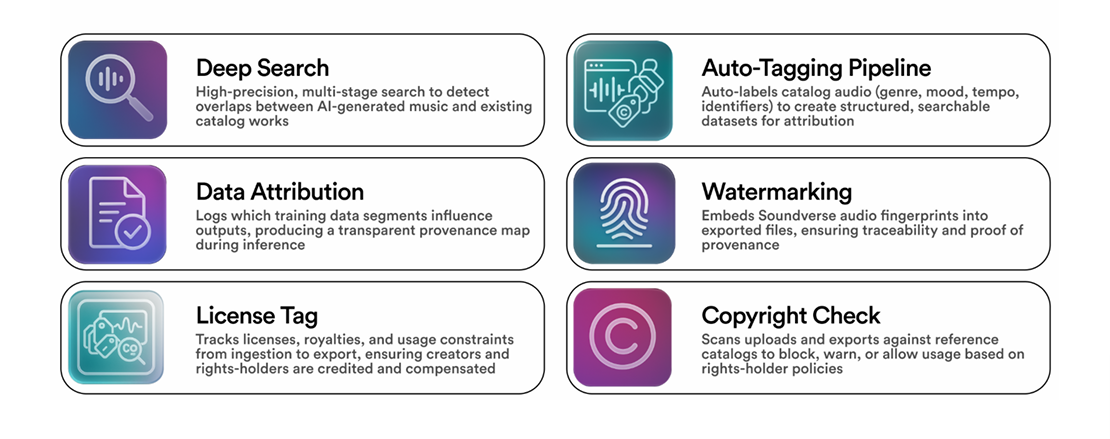
Soundverse Trace acts as a comprehensive trust layer for AI music. It embeds attribution, deep search, and rights protection across the full lifecycle—from dataset creation to export.
Core capabilities include:
- Deep Search: High-precision scanning (1:1, 1:N) to detect overlaps in AI-generated songs and identify potential copyright issues before release.
- Data Attribution: Every piece of training data influencing an output is logged, ensuring verifiable provenance.
- Audio Watermarking: Robust, inaudible fingerprints authenticate origin, making ownership traceable without affecting audio quality.
- License Tagging: Rights metadata persists from ingestion through export, guaranteeing that legal and royalty information never disappears.
Primary use cases:
- Preventing copyright infringement in AI outputs.
- Tracking catalog usage for automated royalty payouts.
- Enabling takedown requests or verification by rights-holders.
For organizations pursuing ethical AI music creation, Soundverse Trace integrates flawlessly with the Ethical AI Music Framework, forming a transparent six-stage pipeline covering consent, attribution, and recurring compensation. Rights-holders can also participate via the Content Partner Program, an opt-in system rewarding contributors with usage-based royalties.
Why Soundverse Trace represents the future of ethical AI in music
Soundverse Trace provides the architecture needed for a safer and fairer music ecosystem in 2026. By embedding accountability directly into audio files, it allows creators, developers, and rights managers to collaborate without trust barriers. As generative sound tools diversify and musicians integrate AI co-producers, attribution remains the backbone of sustainable innovation.
From studios exploring genre fusion—see AI music generators and composers working together—to content creators managing licensing through royalty-free tutorials, the need for safety and transparency has reached mainstream visibility.
Soundverse Trace does not promise real-time preview or live monitoring; instead, it operates asynchronously, processing uploads or recordings and returning comprehensive traceability results. This verified workflow ensures precision rather than speed gimmicks, echoing professional standards.
Create Music Safely with AI Today
Unlock ethical, royalty-free AI music generation and learn how to protect your creative output. Soundverse makes AI music safety simple, powerful, and accessible to everyone.
Related Articles
- Navigating the World of Royalty-Free and Copyright-Free Music Using Soundverse AI — Discover how to ensure your AI-generated tracks stay copyright-safe and royalty-free with Soundverse’s smart tools.
- Enhancing YouTube Content with Royalty-Free and Copyright-Free Music Using Soundverse AI — Learn how creators are protecting their content from copyright claims using Soundverse’s safe AI music features.
- Copyright-Free vs Royalty-Free Music: What Creators Should Know — Understand the crucial difference between royalty-free and copyright-free AI music to safeguard your creative rights.
- How AI-Generated Music Is Transforming the Music Industry — Explore the evolving role of AI in music creation and how safety and attribution standards are shaping its future.
Here's how to make AI Music with Soundverse
Video Guide
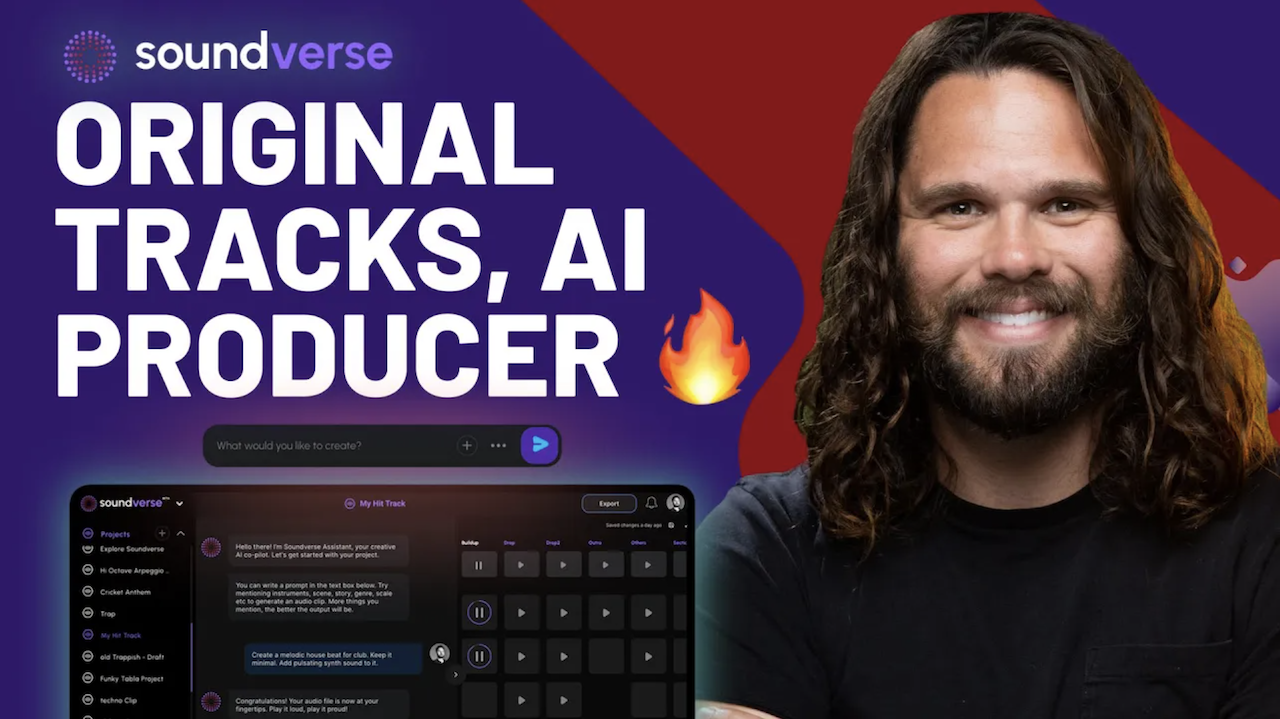
Here’s another long walkthrough of how to use Soundverse AI.
Text Guide
- To know more about AI Magic Tools, check here.
- To know more about Soundverse Assistant, check here.
- To know more about Arrangement Studio, check here.
Soundverse is an AI Assistant that allows content creators and music makers to create original content in a flash using Generative AI. With the help of Soundverse Assistant and AI Magic Tools, our users get an unfair advantage over other creators to create audio and music content quickly, easily and cheaply. Soundverse Assistant is your ultimate music companion. You simply speak to the assistant to get your stuff done. The more you speak to it, the more it starts understanding you and your goals. AI Magic Tools help convert your creative dreams into tangible music and audio. Use AI Magic Tools such as text to music, stem separation, or lyrics generation to realise your content dreams faster. Soundverse is here to take music production to the next level. We're not just a digital audio workstation (DAW) competing with Ableton or Logic, we're building a completely new paradigm of easy and conversational content creation.
TikTok: https://www.tiktok.com/@soundverse.ai
Twitter: https://twitter.com/soundverse_ai
Instagram: https://www.instagram.com/soundverse.ai
LinkedIn: https://www.linkedin.com/company/soundverseai
Youtube: https://www.youtube.com/@SoundverseAI
Facebook: https://www.facebook.com/profile.php?id=100095674445607
Join Soundverse for Free and make Viral AI Music

We are constantly building more product experiences. Keep checking our Blog to stay updated about them!