How to Create Binaural Beats With AI in 2026: Complete Guide for Producers and Meditators
Learn binaural beats AI creation with Soundverse to produce meditation and brainwave music.
How to Create Binaural Beats With AI
In 2026, the fusion between artificial intelligence and music creation has reached new creative frontiers. Among the most fascinating and soothing applications of AI-generated sound is the development of binaural beats AI creation — specially designed sound frequencies that induce relaxation, concentration, or meditative states. Whether you are a professional music producer, a sound designer exploring frequency compositions, or a meditation enthusiast wanting to craft seamless brainwave music ai tracks for personal or commercial projects, AI tools make it possible to generate stunning results quickly and intuitively.
Before diving into the technical steps, let’s understand why binaural beats are so powerful and how AI simplifies their creation.
What are binaural beats and why are they popular in 2026?
Binaural beats are a phenomenon discovered through sound frequency interaction. When two slightly different frequencies are played separately into each ear, the brain perceives a third “phantom” beat—the difference between the two tones. This frequency difference interacts neurologically and can influence states of consciousness. For instance, a 10 Hz difference often corresponds to alpha waves, promoting relaxation; lower frequencies may correspond to delta waves linked with deep meditation or sleep.
In 2026, binaural beats are widely used not only in meditation apps and wellness programs but also in productivity soundtracks, creative focus playlists, and immersive game environments. Thanks to generative AI systems, artists can now produce customized frequency music without relying on traditional synthesizer setups or complex signal processing scripts.
How to make binaural beats with Soundverse AI Music Generator
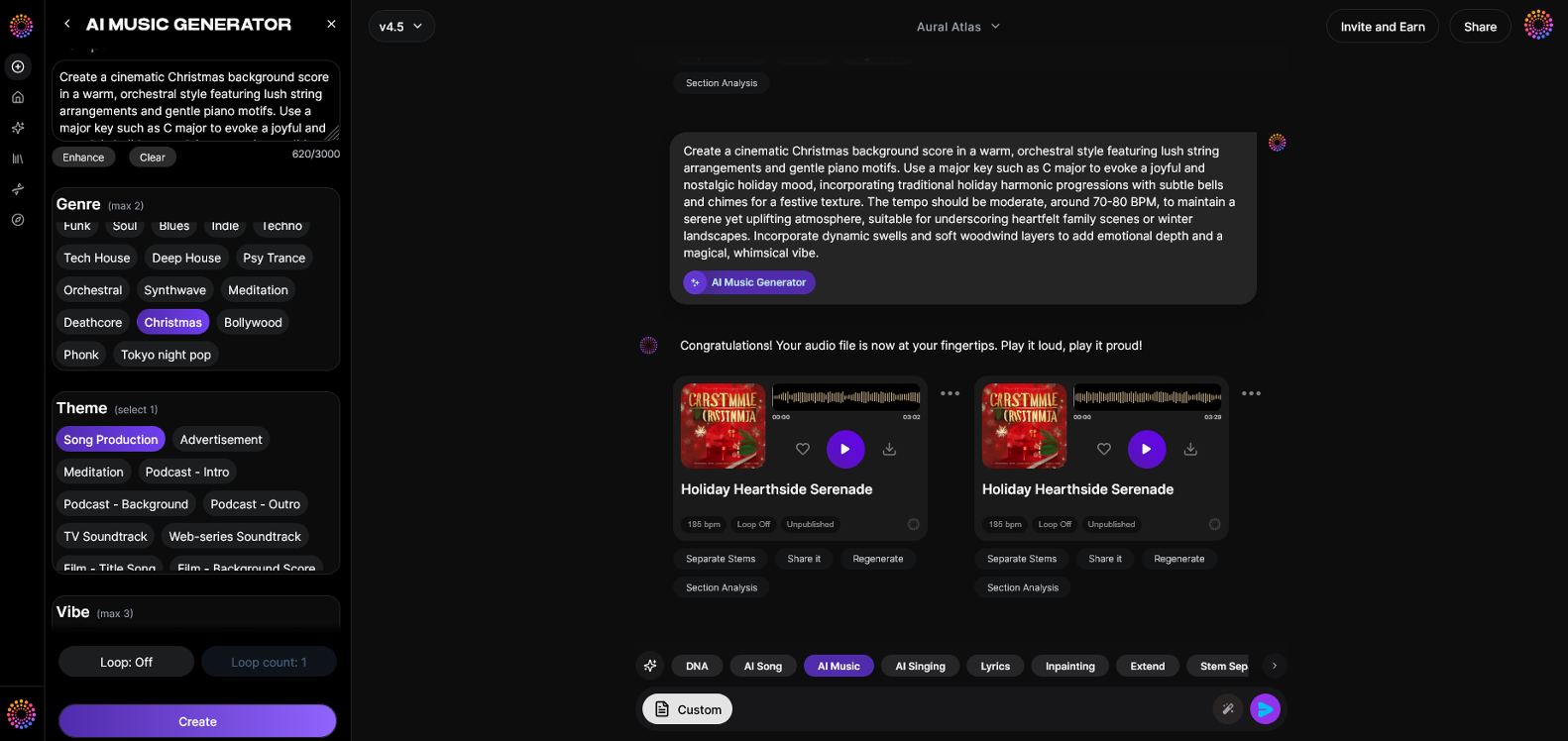
To bring AI efficiency and creativity to binaural beat design, Soundverse introduced its AI Music Generator, a tool that allows users to create fully produced instrumental tracks from simple text prompts.
Feature Overview:
Soundverse’s AI Music Generator enables creators to design rich, soothing soundscapes perfect for meditation and wellness. It features:
- Text-to-Music: Type in your desired mood, genre, or intent, and Soundverse synthesizes a complete instrumental composition.
- Loop Mode: Generates music that can repeat seamlessly — ideal for extending meditation sessions or creating ambient backgrounds.
- Detailed Control: You can fine-tune instruments, genres, and intensity to balance frequencies appropriately.
- V4 and V5 Models: Choose advanced AI versions that refine sound textures for professional use.
Primary use cases include relaxation tracks, video background music, gaming atmospheres, mindful meditation beats, and frequency-based sound therapy compositions.
Now let’s look at the step-by-step method for binaural beats AI creation using Soundverse.
Step 1: Feature Overview
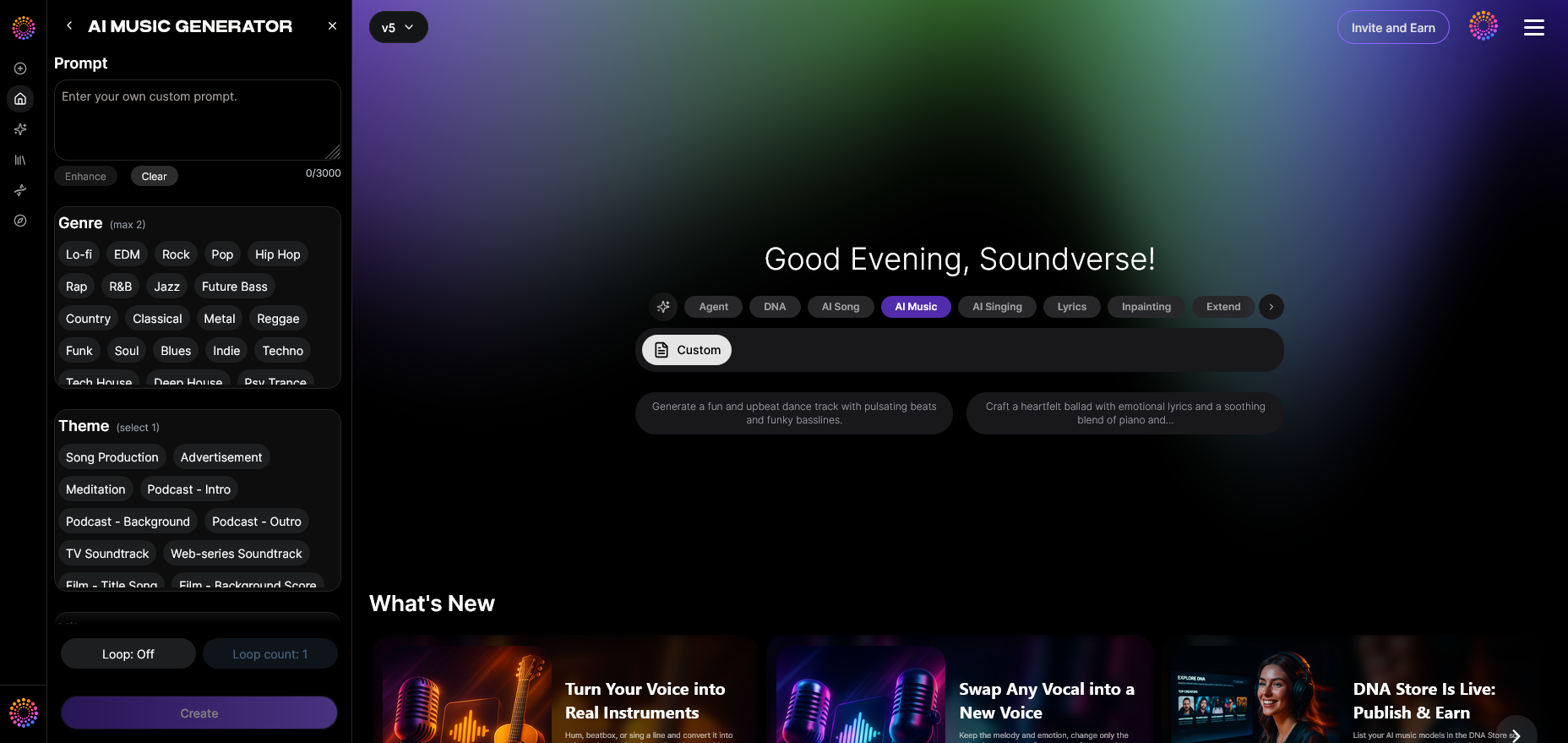
Access the AI Music Generator tool from the Soundverse main dashboard. This is where you start building the binaural beat soundscape. By navigating to the Music Generator section, users can easily select meditation or frequency music categories, setting the tone for their project.
Step 2: Description Input
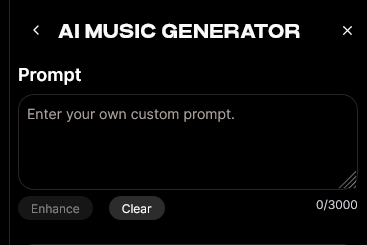
Type in a clear text description of your desired output. For effective brainwave music ai tracks, describe the ambience and emotional target, such as:
- “Soft ambient tones with delta frequencies for deep meditation.”
- “Peaceful rhythmic background featuring subtle alpha waves for calm concentration.”
The AI interprets your description to produce balanced frequencies across stereo channels. You can specify ‘binaural’ or ‘brain synchronization’ cues to help the AI model accent stereo spacing.
Step 3: Style & Duration
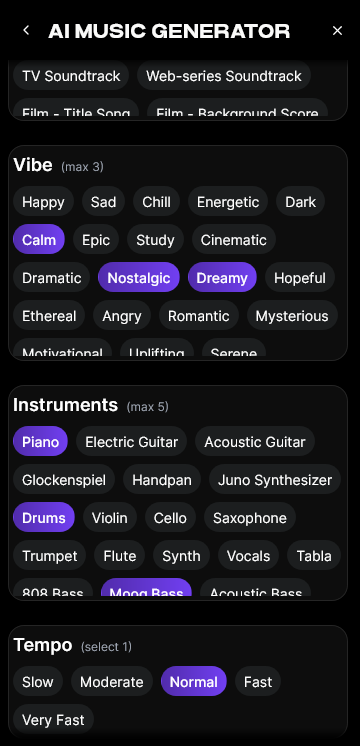
After entering the description, select the music style and duration. For meditation beats, calm genres like ambient, drone, or cinematic minimalism work best. Many creators in 2026 prefer looping 10-to-20-minute tracks, enhanced by Soundverse’s Loop Mode which ensures seamless transitions. Adjusting duration here sets the stage for repetitive entrainment patterns.
Step 4: Generation
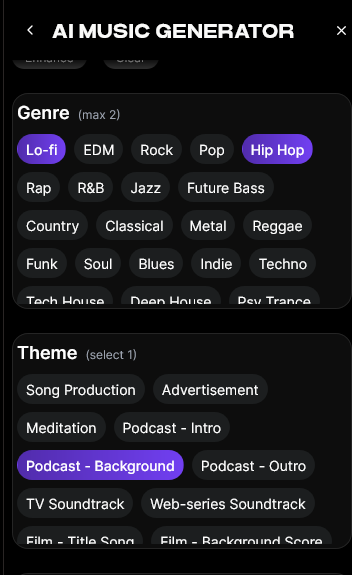
Click “Generate” to let Soundverse process your description. The AI composes a complete instrumental or ambient soundtrack asynchronously — meaning, it takes a few moments to analyze the prompt and render the final file. Within seconds, you’ll receive an intricate stereo composition containing frequency layers optimized for meditative flow. For a deeper dive, watch our guide on creating music with Soundverse or explore the Soundverse “Explore” tab tutorial.
Step 5: Export Options
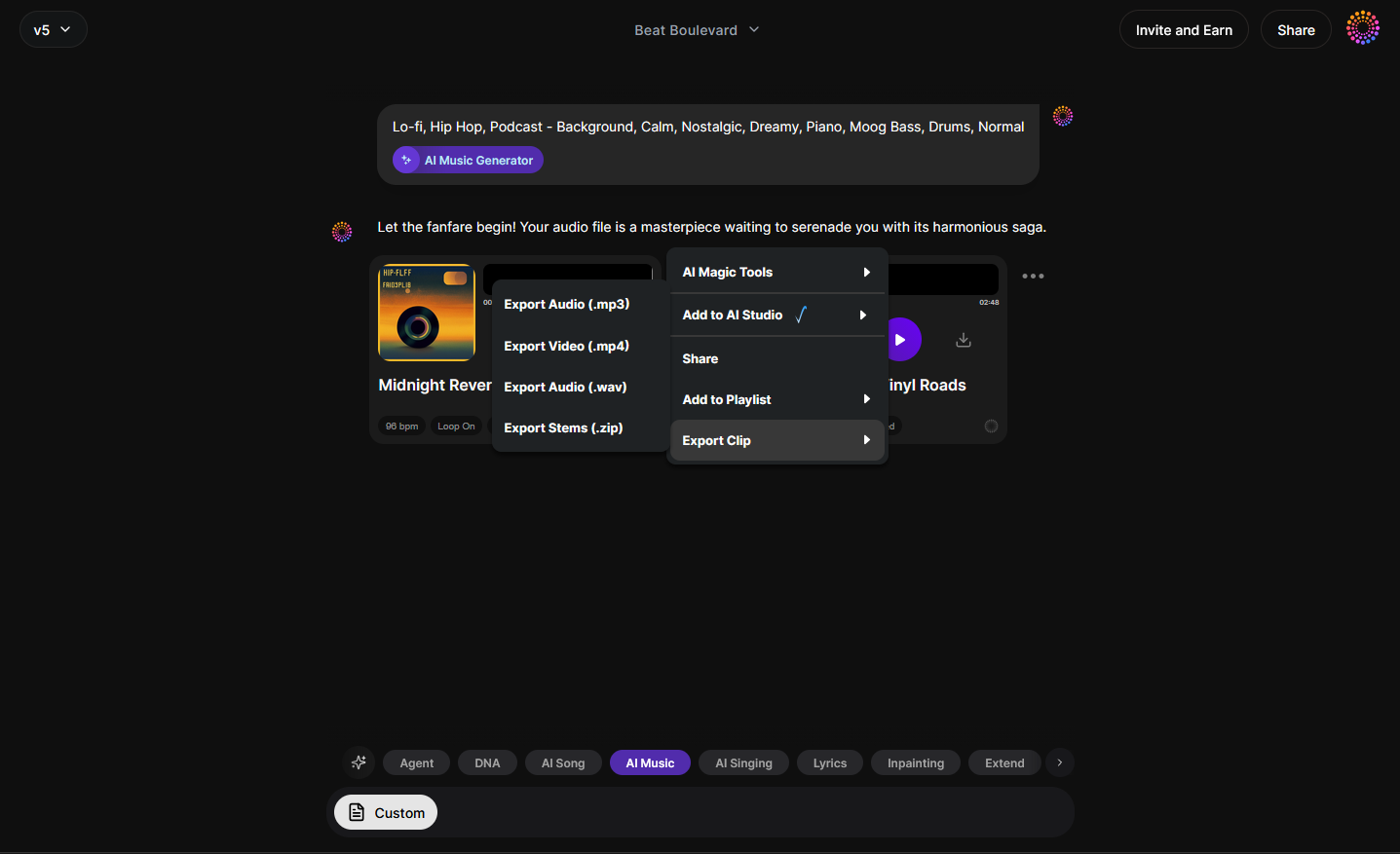
Once generation is complete, you can download the resulting music file. The output is a fully produced instrumental suitable for direct use or further editing. Producers often integrate these AI-generated tracks into digital audio workstations (DAWs) to mix in low-frequency oscillators (LFOs) or additional binaural manipulation. Others directly use the Soundverse loop-ready exports for wellness products or mindfulness applications.
What frequencies work best for meditation beats?
Different meditation objectives benefit from varying frequency bands:
- Delta waves (0.5–4 Hz): Deep sleep, relaxation, subconscious healing.
- Theta waves (4–8 Hz): Creativity, meditation, intuition.
- Alpha waves (8–13 Hz): Calm focus, stress reduction.
- Beta waves (13–30 Hz): Active thinking and alertness.
Through AI prompts, you can instruct Soundverse to emulate these wave states by referencing frequency differences or general emotional effects, rather than entering raw Hertz data. The AI then translates your prompt into tonal and rhythm structures that reflect the chosen intention.
Pro Tips for mastering AI-generated binaural beats
- Use precise text prompts: In 2026, text-to-music generation has become highly responsive. Including emotional cues—such as “serene forest dawn” or “floating in deep space”—can influence the harmonic pattern and overall spatial feel. See more inspiration in 100 text-to-music prompts that will help you create viral music.
- Experiment with loop durations: Test Soundverse’s Loop Mode to maintain a uniform rhythm that keeps entrainment active.
- Combine with external processing: You can enhance generated tracks using binaural panning tools or slight EQ differences between channels.
- Mix with natural ambience: Add samples of rain, wind, or ocean sounds to deepen immersion—a common trend covered in how to create healing meditation music with Soundverse AI.
- Integrate other Soundverse tools: For complex layers, try Similar Music Generator to produce complementary ambient backgrounds or use Voice to Instrument for transforming vocal tones into smooth flute or sitar harmonics.
Why Soundverse leads the AI frequency music scene in 2026
The past two years (2024–2025) shaped a turning point for AI sound design; 2026 has established Soundverse as one of the leading platforms shaping musical wellness experiences. While competitors like Mubert and Soundraw focus on generative loops, Soundverse’s integration of text-to-music and precise parameterization gives creators deeper control. You can read comparisons in Mubert alternatives Soundverse and Soundraw alternative Soundverse to understand how its music generation pipeline differs. Moreover, Soundverse’s evolving AI Magic Tools continue to push creative frontiers across composition, stem separation, and arrangement automation.
How binaural beats AI creation influences the sound industry
Beyond individual use, AI-created frequency music is transforming the music industry’s approach to therapeutic audio. Meditation studios, game designers, and even spa environments now rely on custom loops generated via Soundverse’s AI Music Generator. The intuitive nature of text-to-music systems democratizes access—allowing non-musicians to craft coherent compositions previously requiring deep knowledge of synthesis and psychoacoustic theory.
Additionally, the ability to produce non-vocal, mood-specific pieces aligns perfectly with the growing demand for copyright-free background assets, explored further in navigating royalty-free and copyright-free music using Soundverse AI.
Start Creating AI-Powered Binaural Beats Today
Experiment with sound frequencies and create meditation-ready tracks in minutes using Soundverse’s intelligent text-to-music platform. Unlock your full creative potential—no studio required.
- How to Create Healing Meditation Music with Soundverse AI — Discover how AI can help you craft soothing and immersive meditation music effortlessly.
- 50 Hand-Picked Meditation Text-to-Music AI Music Generation Prompts for All Occasions — Get inspiration from 50 expert-crafted prompts to instantly generate relaxing AI meditation tracks.
- Generate AI Music with Soundverse Text-to-Music — Learn how to turn your ideas into fully composed songs using Soundverse’s intuitive text-to-music generator.
- Soundverse AI Magic Tools: Create Content Quickly with AI — Streamline your music production process with Soundverse’s suite of AI Magic Tools designed for creators.
Here's how to make AI Music with Soundverse
Video Guide
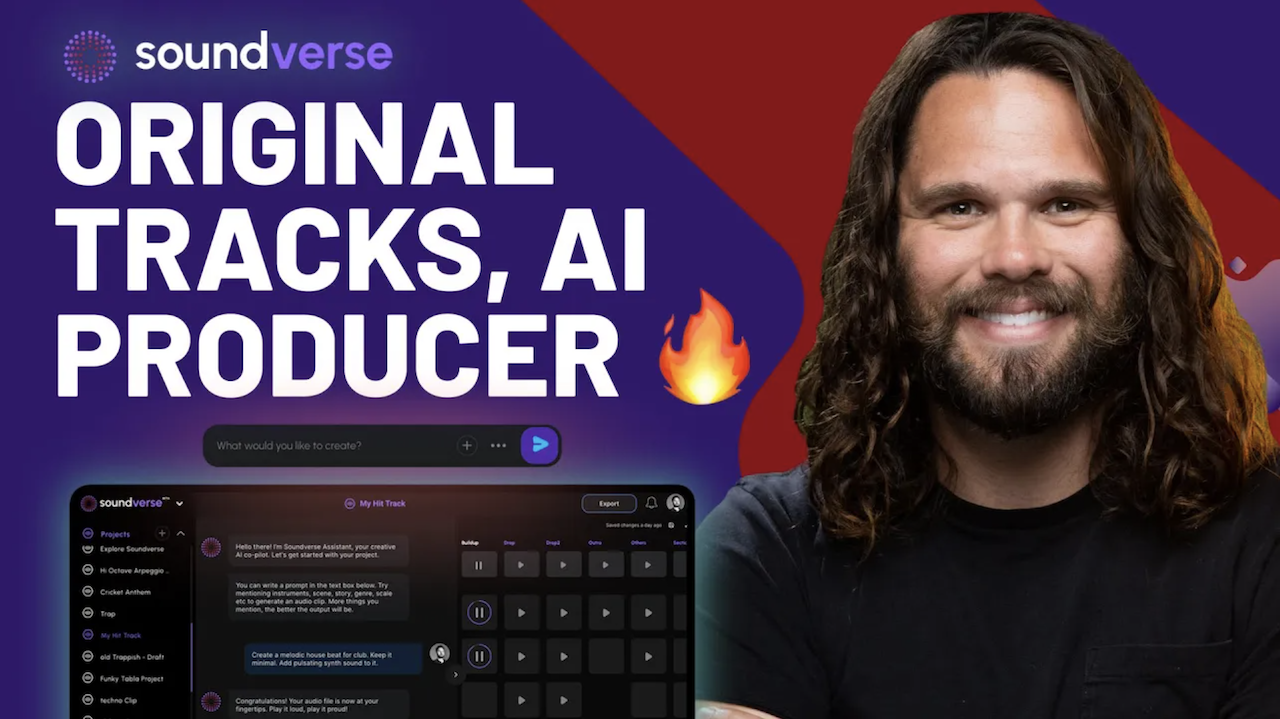
Here’s another long walkthrough of how to use Soundverse AI.
Text Guide
- To know more about AI Magic Tools, check here.
- To know more about Soundverse Assistant, check here.
- To know more about Arrangement Studio, check here.
Soundverse is an AI Assistant that allows content creators and music makers to create original content in a flash using Generative AI.
With the help of Soundverse Assistant and AI Magic Tools, our users get an unfair advantage over other creators to create audio and music content quickly, easily and cheaply.
Soundverse Assistant is your ultimate music companion. You simply speak to the assistant to get your stuff done. The more you speak to it, the more it starts understanding you and your goals.
AI Magic Tools help convert your creative dreams into tangible music and audio. Use AI Magic Tools such as text to music, stem separation, or lyrics generation to realise your content dreams faster.
Soundverse is here to take music production to the next level. We're not just a digital audio workstation (DAW) competing with Ableton or Logic, we're building a completely new paradigm of easy and conversational content creation.
TikTok: https://www.tiktok.com/@soundverse.ai
Twitter: https://twitter.com/soundverse_ai
Instagram: https://www.instagram.com/soundverse.ai
LinkedIn: https://www.linkedin.com/company/soundverseai
Youtube: https://www.youtube.com/@SoundverseAI
Facebook: https://www.facebook.com/profile.php?id=100095674445607
Join Soundverse for Free and make Viral AI Music
We are constantly building more product experiences. Keep checking our Blog to stay updated about them!