Explain How Creators Can Use Voice Cloning to Localize Audio Content
Voice cloning for localization, step by step: clean source, adaptation, cloned-voice synthesis, lip sync, native review, mixing, consent and disclosure.
Voice cloning for localization means cloning a consenting speaker's voice once, translating and adapting the script for each market, then generating the new-language track in that same voice. That is how creators can use voice cloning to localize audio content at agency scale, and the steps around the clone (clean source, timing, native review, mixing, disclosure) decide the quality.
This guide is for agencies localizing podcasts, ads, explainers and social clips; vendor pages and legal texts were checked on 23 November 2026. For what happens inside the model, see how voice cloning works in modern software; for which vendors allow client work, see reliable AI voice cloning services that allow commercial use.
The voice cloning for localization workflow, step by step
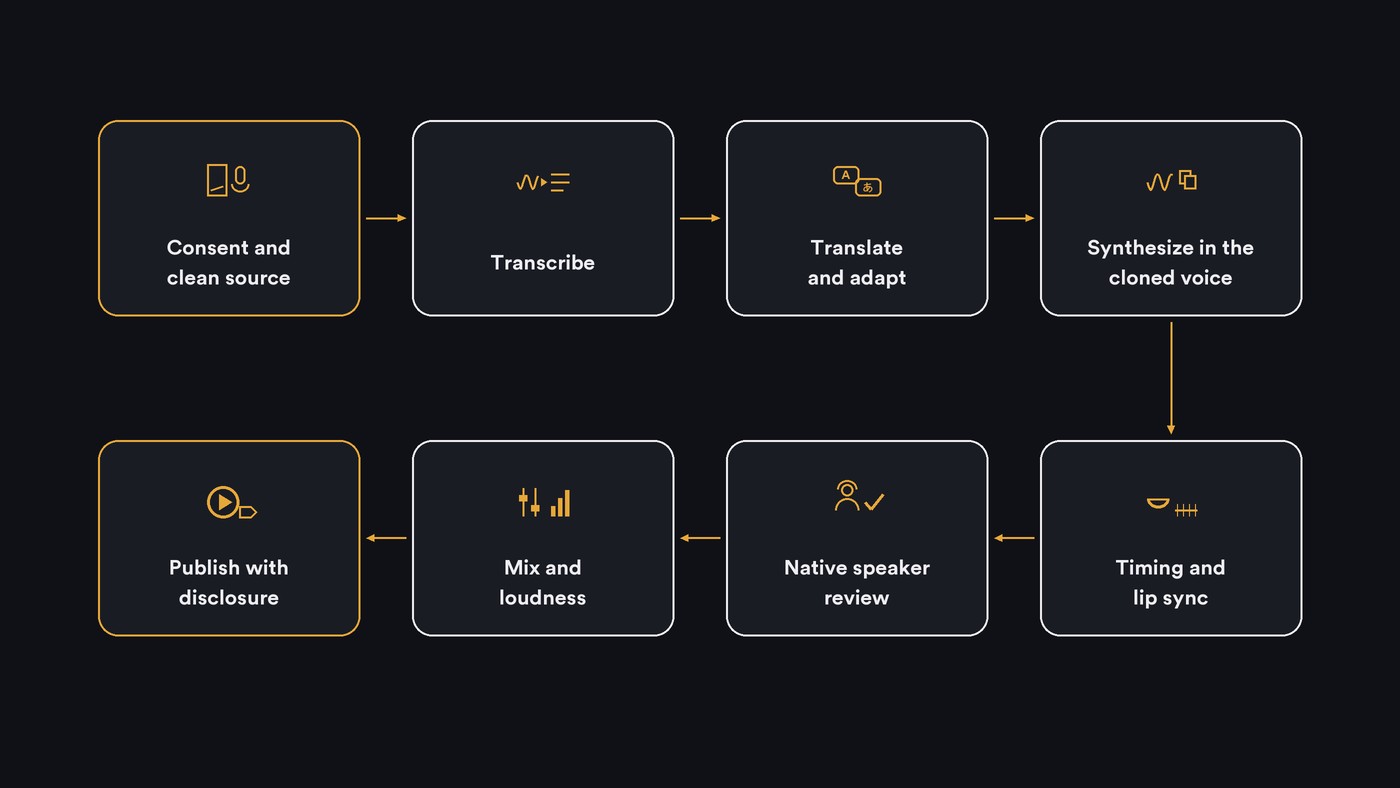
- Get consent, then the cleanest source you can. No clone without the voice owner's written permission (see below). Then ask for a dry dialogue stem, separate from music and effects: a clone built from a busy mix learns the room and the music bleed too. With only a full mix, ElevenLabs dubbing keeps the background audio, and HeyGen offers an optional Remove Background Sound setting.
- Transcribe and lock the source script. Get a timestamped transcript with speaker names, and fix names, product terms and figures by ear before anyone translates. HeyGen warns that a source mixing spoken languages can produce a failed or inaccurate transcript.
- Translate, then adapt for time and culture. Adaptation makes the translation fit the same seconds and the local market: give every line a time budget from the source timestamps and rewrite rather than cram. Localize offers, calls to action, units, prices and legal lines, and decide the register per market (tu or vous, du or Sie, você or tu).
- Synthesize in the cloned voice, line by line. Generate per segment so a fix means one line, not the whole spot.
- Fit timing, and lip sync if the speaker is on camera. In ElevenLabs Dubbing Studio (now in maintenance mode), the default Fixed Generations keep a clip's length, which can speed up or slow down the speech, while Dynamic Generations follow the text but can throw off sync.
- Review with a native speaker of each market, ideally not the translator. They check meaning, register, names, numbers, legal lines, and whether the voice still sounds like the person. Fix the text, then regenerate only that line.
- Mix and match loudness. Lay the new dialogue over the original music-and-effects bed, match the dialogue level to the source version, measure integrated loudness in LUFS and true peak, and deliver to each platform's spec.
- Publish with the right disclosure for each platform and market.
What a cloned voice carries across languages, and what it doesn't
- Timbre and identity: mostly yes. ElevenLabs says its dubbing keeps each speaker's voice identity and emotional tone, and HeyGen says the input speaker's voice is always used for voice similarity.
- Accent: it travels with the voice unless you choose otherwise. ElevenLabs' help centre: "The language is determined by the text, the accent and pronunciation is determined by the voice itself." Its Dubbing page adds that a higher cloning strength (0 to 10, default 7) sounds more like the original speaker but can carry over more of the original accent and sound less natural across very different languages. HeyGen Video Translation makes the same trade-off a menu choice: the base language keeps the speaker's identity and accent, and a localized variant such as English – American prioritizes a native accent. A founder's own accent can be the point; a supermarket ad in Mexico City usually needs to sound local.
- Emotion and delivery: partly. Tone usually survives; pace suffers when a longer translation is squeezed into the same slot. Laughter, whispers and sarcasm need a human ear.
- Names and brand terms: only if you tell the tool. Keep a glossary per client: HeyGen has a Brand Glossary, Rask AI keeps brand terms in a terminology dictionary, and Descript has a Do Not Translate list on Business and Enterprise drives.
Consent and disclosure before anything goes live
Written permission from the voice owner. Name the languages, markets, media and term; give the owner approval over scripts and finals; state the fee; say who can access the voice model and whether it is deleted after the campaign. If the voice belongs to an employee or a hired actor, the contract has to cover synthetic use explicitly.
Platform rules, from their own help pages:
- YouTube. Its GenAI disclosure page requires creators to disclose realistic AI-generated or altered content, including content that makes a real person appear to say or do something they didn't, using the AI use setting in YouTube Studio. The page lists cloning one's own voice for voiceovers or dubs among the things that don't need disclosure. A client's spokesperson or a voice actor isn't the channel owner, so when the clone is theirs, disclose.
- Apple Podcasts. Section 1.11 of its content requirements says creators who use AI to generate audio, including synthetic voices and AI-synthesized replicas of real individuals, must prominently disclose it in the content and metadata of each episode and show.
- Instagram, Facebook and TikTok. Use the AI-content label each app offers when you post. TikTok's help centre refused our connection on 23 November 2026 and Meta's help pages didn't load in full, so we don't quote their rules here.
The EU AI Act. EUR-Lex blocked our request, so this text comes from the European Commission's AI Act Service Desk, consolidated as of 27 July 2026. Article 50(4) says: "Deployers of an AI system that generates or manipulates image, audio or video content constituting a deep fake, shall disclose that the content has been artificially generated or manipulated." Article 3(60) defines a deep fake as content that resembles existing persons and would falsely appear to be authentic, which a real spokesperson's cloned voice in a language they never recorded can fit. The agency running the tool is usually the deployer. Article 50, which applies from 2 August 2026, also makes providers mark synthetic audio in a machine-readable way, and Article 111 gives systems placed on the market before that date until 2 December 2026 to do so. Check EU campaigns with counsel.
Where localized audio breaks
- Idioms. "Hit it out of the park" means nothing in Madrid. Rewrite to the local equivalent or the plain meaning.
- Numbers, dates and units. 03/04 is 3 April in London and March 4 in New York, and "1.500" is fifteen hundred in Berlin or São Paulo. Write figures out in words in the synthesis script so the voice reads them as the market does, and localize currency, phone numbers and URLs.
- Humour. Puns and rhymes rarely survive translation. Write a new joke that does the same job in the same number of seconds, and let the native reviewer judge it.
- Music beds and jingles. A library track may be licensed only for some territories (territorial restrictions in music licensing explains how). A sung jingle needs its own lyric adaptation. And on YouTube, the multi-language audio page warns that a secondary track whose copyrighted content differs from the original audio may be removed, so keep the same bed under every language.
Localization tools compared
What each tool's own pages say, checked 23 November 2026:
- ElevenLabs Dubbing. Translates audio and video, keeps the background audio, detects multiple speakers and lets you set cloning strength; ElevenLabs Productions offers human-verified dubs. For lip sync, it points to its Image & Video, Flows and Studio tools. Best for podcasts and audio-led ads.
- Rask AI. Dubbing with voice cloning and accent adaptation, transcript and translation editing, re-dubs of only the segments you changed, multispeaker lip-sync, subtitles and an API. Best for high-volume video with several speakers.
- HeyGen Video Translation. Re-voices video in the speaker's own voice, with base or localized accent, Audio Only, Speed or Precision engines (lip sync comes with the engine choice), a Brand Glossary and a Proofread step, for up to 10 target languages per job. Best for presenter-led ads and explainers.
- Descript. Dub speech translates the script and re-voices it with stock voices you assign to each speaker, Portuguese among its dubbing languages, with lip sync for single-speaker talking-head video. Best for teams already editing in Descript.
- YouTube multi-language audio tracks. Not a dubbing tool: you upload your own dubbed tracks to one video, if you have access to advanced features. Files must be roughly the same length as the video, viewers hear their preferred language, and long-form videos can carry localized thumbnails.
Where Soundverse fits
Soundverse is an AI music platform that takes you from idea to audience, built for independent artists who release music, so for an agency it covers the music and scratch-voice side of a localization job. Audio Transcription takes files up to 60 minutes and 500 MB, detects the language or uses one you choose, and times every word. Translate Lyrics turns a jingle's lyrics into languages such as Spanish, Portuguese or Hindi, and Match syllables aims for each line's original syllable count, ready for the AI Song Generator. Train Voice Clone builds a singing voice from 15 seconds or more of singing once you confirm consent, and Voice Swap lets ad teams audition a scratch jingle in several voices. AI Speech Generator gives temp reads in its built-in voices. Licensing is set by plan: the Free plan is for personal use, and the Creator plan comes with a royalty-free license. For songs released in several languages, see voice cloning for multilingual songs and global content.
This walkthrough of Soundverse's Edit tools shows Voice Swap from 2:18 and Translate Lyrics from 3:34.
FAQ
Can a cloned voice speak a language the person doesn't speak? Yes, with ElevenLabs, Rask AI or HeyGen. ElevenLabs says any voice can speak any of its supported languages, but the accent comes from the voice, so the result may sound like a fluent foreigner. Have a native speaker judge whether that fits the brief.
Do we have to disclose a dub in the client's own cloned voice? Often. YouTube's own-voice exemption covers the channel owner's voice, Apple Podcasts asks for disclosure of synthetic voices, and the EU AI Act's deep fake rule can apply to a real person's clone. When in doubt, disclose.
What if the voice owner says no? Then don't clone. Cast native voice actors, or use stock voices, as Descript's dubbing does, and disclose synthetic voices where platforms ask.
Sign up for Soundverse free and build your next localized jingle. More guides on the Soundverse blog.