Do I Need a Distributor to Release Songs on Spotify?
To release songs on Spotify, most independent artists need a distributor. Here's why, the alternatives, what Spotify for Artists does and direct uploads.
Yes: almost every independent artist needs a distributor to release songs on Spotify, or a label that works with one, because Spotify doesn't take song uploads from artists. The distributor delivers your audio and metadata, which creates your artist profile, and pays you the recording royalties. Bandcamp, SoundCloud and YouTube are different: they take direct uploads.
Below is why, what your alternatives are, what Spotify for Artists can and can't do, and how to choose a route. Everything is from Spotify's and each platform's own help pages, checked on 14 November 2026.
Why Spotify requires a distributor
Spotify's help page on creating an artist profile gives the reason in one line: "We require all music to be uploaded via labels and distributors to make sure everything's properly licensed."
The same page says your artist profile is created automatically when your music is first delivered, and that you can't create one yourself. So the distributor's delivery is what puts you on Spotify at all, profile included.
Its Getting music on Spotify page adds the money side: distributors handle music distribution and pay streaming royalties. Spotify pays the distributor, and the distributor pays you. Most distributors charge a fee or a commission, which Spotify suggests you research before you pick one.
Could you ever upload straight to Spotify?
Briefly, yes. In 2018 Spotify began testing a feature that let independent artists upload their music directly. On July 1, 2019 it announced that it was closing the beta, and its post on the decision explained why: "The most impactful way we can improve the experience of delivering music to Spotify for as many artists and labels as possible is to lean into the great work our distribution partners are already doing to serve the artist community."
Artists who had released through the beta had to move their music to another provider. Since then, delivery has gone through labels and distributors only.
The alternatives to a standalone distributor
The question is really which kind of licensor delivers your music. You have four realistic options.
- A DIY distributor (often called an aggregator). You sign up, upload your release and pay a yearly fee, a per-release fee or a commission. This is the route most independent artists take. Our guide to the best platforms to get your music on Spotify and Apple Music compares the main services and their prices.
- A preferred distributor. Spotify's provider directory lists distributors that it says meet its standards for delivering music, and on 14 November 2026 it tagged DistroKid, CD Baby, TuneCore, Amuse, LANDR and RouteNote, among others, as preferred. One practical perk, per Spotify's page on getting access to Spotify for Artists: if you deliver through a preferred provider, you get access automatically when you submit a request.
- A record label. Spotify's help page notes that a signed artist's label likely already works with a distributor that can deliver the music. A label deal usually brings funding or marketing in exchange for a larger share of your royalties, so read who owns the masters before you sign.
- Distribution built into a platform you already use. SoundCloud's pricing page lists "Distribute to 50+ platforms" among the features of its paid plans, with 2 distributed and monetized tracks a month on Artist and what it calls full distribution capabilities on Artist Pro. The page doesn't name the stores, so confirm Spotify is on the list before relying on it.
All four end the same way: one licensor delivers your song to Spotify. Send each recording through one of them only, so your stats and royalties stay in one place.
What Spotify for Artists does and doesn't do
Spotify for Artists is the dashboard you use once your music is on Spotify. Spotify describes it as the place to see audience stats, promote your music and manage your profile.
What it does:
- Claim and customize your profile with images, playlists and merch. To claim before your first release goes live, you need your Spotify artist link, which your distributor can give you once it has delivered your music.
- Pitch one unreleased song at a time to Spotify's playlist editors. Its pitching guide says a song pitched at least 7 days before release goes to your followers' Release Radar.
- Show your audience stats once the music is live.
- Take music video uploads, a feature the pitching guide says is in beta.
What it doesn't do:
- Upload songs. Audio still arrives from your label or distributor.
- Pay you. Your recording royalties come from your distributor or label.
- Guarantee anything from a pitch. The pitching guide says plainly that pitching doesn't guarantee playlist placement.
Platforms that take direct uploads without a distributor
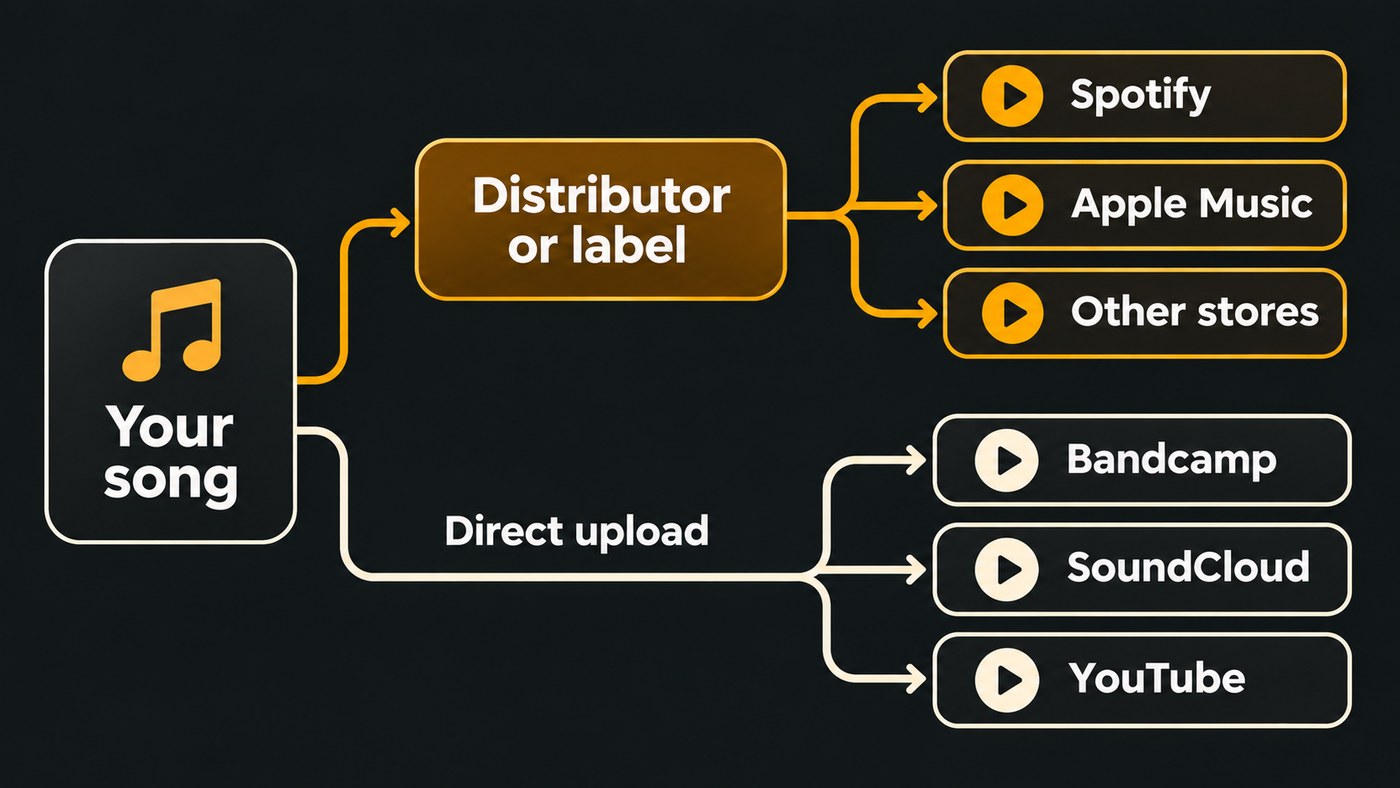
You can put music online today without a distributor, just not on Spotify.
- Bandcamp. Its page for artists says artist accounts are free, you set your own prices, and Bandcamp takes 15% on digital music and 10% on merch, with payment processing fees on top. It says an average of 82% of each sale reaches your PayPal account, typically within 24 to 48 hours.
- SoundCloud. A free account lets you upload up to 2 hours of audio, the Artist plan 3 hours, and Artist Pro is unlimited, according to its pricing page.
- YouTube. Anyone can upload a video, lyric video or visualizer to their own channel. An Official Artist Channel is another matter: YouTube's eligibility rules require at least one official music release on YouTube delivered by a music distributor or label.
These sit well alongside a distributor. A common setup: sell on Bandcamp, post demos and early versions on SoundCloud, upload a visualizer to YouTube, and let a distributor handle Spotify and the other streaming stores.
How to decide what you need
- You want your song on Spotify, Apple Music and the other stores: use a distributor. Check that it appears in Spotify's provider directory, and note whether it is tagged preferred.
- You mostly want fans to buy from you: start on Bandcamp, then add a distributor when you want streaming too.
- You already release on SoundCloud: compare its Artist plans with a standalone distributor on how many tracks you can send each month and which stores receive them.
- A label is interested: ask who will deliver your music, who will own the masters and what share you keep.
For the side-by-side questions, read how to choose a distributor for your first single. Before you upload, use our list of what to prepare before music distribution, and see typical turnaround times to set a realistic release date.
Where Soundverse fits
Soundverse is an AI music platform that takes you from idea to audience. It isn't a distributor: delivery to Spotify and the other stores runs through a distributor today.
What Soundverse covers is the work around that delivery. Release Planner turns your finished track into a dated, day-by-day rollout split by platform, with pre-save, smart link and playlist pitch deadlines, and can recommend a release day if you haven't picked one. With the Soundverse Computer Use Extension in Chrome, Agent One can upload a track to SoundCloud or a visualizer to YouTube as Private, so you check it before it goes public. It can also go through your distributor dashboard or the stores you name and report which ones show your single.
Licensing is set by plan: the Free plan is for personal use, and the Creator plan comes with a royalty-free license.
This video shows Agent One researching channels and playlists, planning a release in Google Sheets and uploading a visualizer to YouTube as Private.
FAQ
Can I upload my songs directly to Spotify? No. Spotify requires music to come through labels and distributors. It tested direct uploads in a beta and announced the beta's closure on July 1, 2019.
Is a distributor the same as an aggregator? In practice, yes. Both words describe a service that delivers your releases to many stores at once and passes on the royalties they pay. Whatever a service calls itself, check that it delivers to the stores you want.
Do I need a distributor to use Spotify for Artists? You need music on Spotify first, because your profile only exists once a release has been delivered. You can claim it before release day with the artist link your distributor gives you once delivery is done.
Is SoundCloud a distributor? SoundCloud is mainly a platform you upload to directly. Its paid Artist and Artist Pro plans add distribution to other platforms, which makes it a distributor for those tracks.
Sign up for Soundverse free and plan the rollout for your next single.
More release guides on the Soundverse blog.