Why Attribution Is the Missing Layer in Most AI Music Tools
Explore why AI music attribution is the missing ethical link in 2026 and how Soundverse Trace solves it.
Why Attribution Is the Missing Layer in Most AI Music Tools
Introduction
In 2026, artificial intelligence continues to disrupt the music industry, empowering creators and technologists to craft songs in seconds using text prompts, trained models, and synthetic audio engines. Yet, with all the progress in generative creativity, one foundational element remains elusive — AI music attribution. While most tools can generate authentic soundscapes, few can explain where those sounds came from, who influenced them, or how rights should be shared. This lack of visibility creates ethical, legal, and financial risks for artists, developers, and the platforms that depend on AI-generated music.
That’s where attribution becomes not just a technical necessity, but an ethical imperative. Let’s explore why attribution is the missing layer in most AI music tools, the broader implications for data transparency, creator credit, and copyright compliance — and how Soundverse’s Trace feature redefines accountability in AI-generated music.
Why is AI music attribution so important in 2026?
AI music attribution is the process of identifying and documenting the sources that influence an AI-generated output — including datasets, samples, and model parameters. In 2024 and 2025, the music industry faced mounting criticism for allowing unlicensed content to fuel massive AI training datasets. Songs created by AI often contained subtle resemblances to copyrighted works, leaving artists uncompensated and creators vulnerable to infringement claims.
By 2026, transparency has emerged as a non‑negotiable value in music technology. For AI developers and digital rights professionals, attribution means:
- Data Transparency: Revealing which datasets were used in model training and output generation.
- Accountability: Linking AI decisions to verifiable data sources.
- Creator Credit in AI Tools: Ensuring that human artists, composers, and producers receive proper acknowledgment and, when applicable, royalties.
Without AI music attribution, creators and companies operate in a “black box” — uncertain about who owns what and who deserves credit. This gap undermines trust across innovation ecosystems, from AI startups to major record labels.
What happens when AI music tools lack transparency?
The absence of attribution doesn’t just lead to moral ambiguity; it translates into tangible risks:
- Copyright in AI Music: When systems cannot explain how certain melodies or styles were generated, copyright disputes become nearly impossible to resolve.
- Monetization Chaos: Streaming platforms and distribution services struggle to define royalty splits for AI-assisted works.
- Stifled Artistic Collaboration: Artists resist participating in AI collaborations if credit and compensation lack clarity.
- Regulatory Pressure: In 2026, regions such as the EU and the U.S. are formalizing AI transparency laws mandating dataset disclosure and provenance tracking.
Transparency and accountability used to be an afterthought for AI music tools. Now, they have become critical competitive advantages.

How does AI-generated music accountability shape creative ethics?
AI-generated music accountability is the framework that establishes moral and operational responsibility for both model creators and end‑users. Music AI ethics now includes:
- Dataset Consent: Whether human creators permitted their works to be used in model training.
- Attribution Visibility: How easily a system can trace influences between data inputs and generated outputs.
- Royalty Distribution: A mechanism to ensure rightful ownership and compensation.
Platforms that embed accountability into their pipelines not only mitigate legal risk but also enable sustainable creativity. Ethical AI platforms like Soundverse have championed this shift since the introduction of its Ethical AI Music Framework, ensuring every contribution can be tracked, credited, and monetized.
Why do most AI music generators fail to offer robust attribution?
Despite all advancements, most AI music tools on the market — from Mubert to Suno — still struggle to achieve full attribution. Common reasons include:
- Opaque Datasets: Training data often originates from mixed or unlabeled sources.
- Lack of Metadata Continuity: Even if data is tagged at ingestion, metadata rarely survives to the final exported file.
- Computational Complexity: Tracking millions of micro‑samples across generations is technically challenging.
- Business Incentives: Some vendors prefer opacity to protect proprietary model architectures.
This lack of data transparency not only hurts musician communities but also undermines cross‑industry trust in AI music systems.
What solutions exist for transparent and ethical AI music creation?
Between 2024 and 2025, the industry experimented with watermarking, dataset registries, and blockchain verification. However, these solutions were fragmented. In 2026, the next generation of AI tools demands an integrated trust infrastructure that unites attribution, rights protection, and creative integrity — all within one pipeline.
That vision is realized in Soundverse Trace.
How Soundverse Trace fixes the attribution gap in AI music
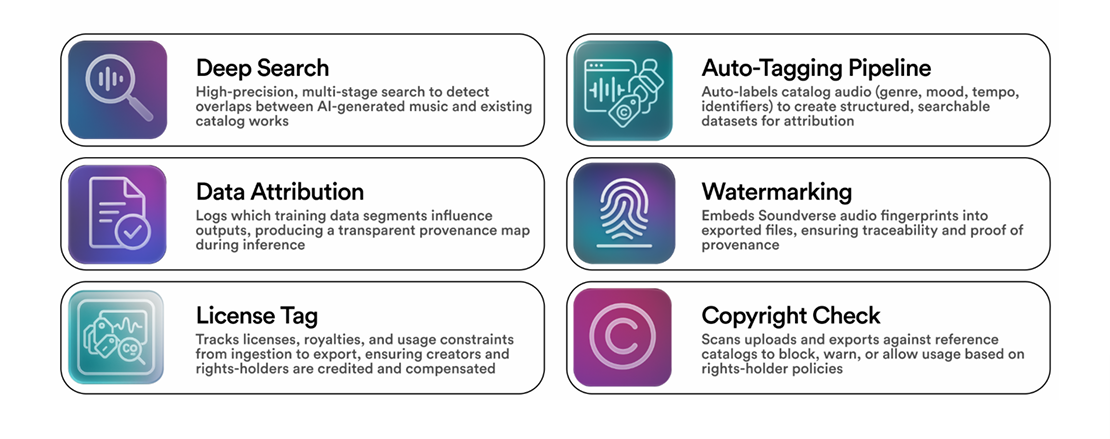
Soundverse Trace is a comprehensive trust layer designed to embed attribution, deep search, and rights protection throughout the entire AI music lifecycle — from dataset creation to final export. It represents the maturity of Soundverse’s commitment to ethical AI and transparency.
Core Capabilities
- Deep Search: Trace performs high‑precision 1:1 and 1:N scanning to detect overlaps between AI outputs and existing catalogs. This ensures creators can verify originality or identify potential infringements.
- Data Attribution: Logs precisely which training data sets influenced the generated track, giving developers and rights‑holders full visibility into contribution lineage.
- Audio Watermarking: Integrates inaudible fingerprints into each audio file, allowing for reliable provenance verification even if the song is remixed or distributed across platforms.
- License Tagging: Preserves and propagates rights metadata from ingestion to export, preventing data decay and ensuring compliance.
Use Cases
- Preventing Copyright Infringement: Detect overlaps before release, reducing takedown risk.
- Tracking Catalog Usage for Royalties: Enable recurring usage‑based payouts to content partners.
- Verifying Provenance: Confirm the originality and lineage of AI-generated tracks.
- Automating Compensation: Streamline creator crediting and royalty distribution.
By combining these capabilities, Soundverse Trace adds accountability and creator credit in AI tools, aligning with best practices proposed by the Content Partner Program, which pays rights‑holders based on verified attribution data.
For a deeper dive, watch our tutorial on making music with Soundverse.
How does Soundverse Trace complement other Soundverse innovations?
Soundverse Trace integrates seamlessly with other ecosystem features that have reshaped how creative professionals navigate AI music production. For example, Soundverse Magic Tools empower creators to experiment rapidly, while STEM Separation AI enhances post‑production flexibility. Together, they ensure that every generated or remixed track benefits from the same ethical framework — traceable, transparent, and licensed.
This synergy reflects a broader philosophy: innovation should never come at the expense of integrity. In 2026, success in the AI music market is not solely determined by creative results but by the system’s ability to prove where those results came from.
What does the future of AI music ethics look like?
Looking ahead, music AI ethics will prioritize attribution as the foundation of trust and collaboration. Platforms that ignore attribution risk regulatory backlash, artist boycotts, and audience skepticism. Those that adopt traceability will attract larger partnerships, licensing deals, and government incentives.
Furthermore, hybrid licensing models are emerging, where AI compositions contain human and AI elements with shared royalties tracked through attribution systems. This hybrid model aligns with Soundverse’s Content Partner Program, which redefines how artists are compensated for AI‑driven creativity.
By 2026’s end, attribution will no longer be a niche feature — it will be an operational requirement for every serious AI music developer and digital rights organization.
Start Creating Authenticated AI Music Today
Join Soundverse to generate original AI music with built-in attribution tracking and transparent creation history. Empower your content with ethical, traceable sound powered by next-gen AI tools.
Sign Up Free
Related Articles
- How AI-Generated Music Is Transforming the Music Industry — Explore how artificial intelligence is changing the landscape of music production, collaboration, and creative ownership.
- Navigating the World of Royalty-Free and Copyright-Free Music Using Soundverse AI — Learn how to find, create, and license music ethically with Soundverse’s powerful AI tools for creators.
- AI Music Generator and Human Composers: A Future Together — Discover how AI and human creativity can coexist to build a more transparent and collaborative musical future.
- Copyright-Free vs Royalty-Free Music: What Creators Should Know — Understand the difference between copyright-free and royalty-free music and how attribution plays a key role in ethical music creation.
Here's how to make AI Music with Soundverse
Video Guide

Here’s another long walkthrough of how to use Soundverse AI.
Text Guide
- To know more about AI Magic Tools, check here.
- To know more about Soundverse Assistant, check here.
- To know more about Arrangement Studio, check here.
Soundverse is an AI Assistant that allows content creators and music makers to create original content in a flash using Generative AI.
With the help of Soundverse Assistant and AI Magic Tools, our users get an unfair advantage over other creators to create audio and music content quickly, easily and cheaply.
Soundverse Assistant is your ultimate music companion. You simply speak to the assistant to get your stuff done. The more you speak to it, the more it starts understanding you and your goals.
AI Magic Tools help convert your creative dreams into tangible music and audio. Use AI Magic Tools such as text to music, stem separation, or lyrics generation to realise your content dreams faster.
Soundverse is here to take music production to the next level. We're not just a digital audio workstation (DAW) competing with Ableton or Logic, we're building a completely new paradigm of easy and conversational content creation.
TikTok: https://www.tiktok.com/@soundverse.ai
Twitter: https://twitter.com/soundverse_ai
Instagram: https://www.instagram.com/soundverse.ai
LinkedIn: https://www.linkedin.com/company/soundverseai
Youtube: https://www.youtube.com/@SoundverseAI
Facebook: https://www.facebook.com/profile.php?id=100095674445607
Join Soundverse for Free and make Viral AI Music

We are constantly building more product experiences. Keep checking our Blog to stay updated about them!
Image Steps: []