Why AI Excels at Electronic Music but Struggles With Live Instruments
Learn why AI music production thrives in electronic genres but faces limitations with real instruments in 2026.
Why AI Excels at Electronic Music but Struggles With Live Instruments
Artificial intelligence has reshaped the music industry in profound ways. By 2026, AI music production has evolved from a curiosity into a mainstream creative ally for producers and composers. From electro-pop and ambient soundscapes to game audio and cinematic loops, AI systems are generating full instrumental works from nothing more than text prompts. Yet despite these impressive advancements, there’s still one frontier where AI noticeably struggles—the realm of live acoustic instruments. This blog explores why AI excels at electronic music creation, where its genre difficulty appears, and how production quality differs when AI faces the complex textures of human-played instruments.
Why is AI so good at creating electronic music?
Electronic music is inherently digital. Its synthesis, sequencing, and texture layers align perfectly with the computational logic behind AI algorithms. When an AI system processes electronic genres, it’s not confined by the unpredictability of real-world physics or human performance imperfections. Instead, it manipulates data—frequencies, envelopes, and patterns—to form precise outputs.
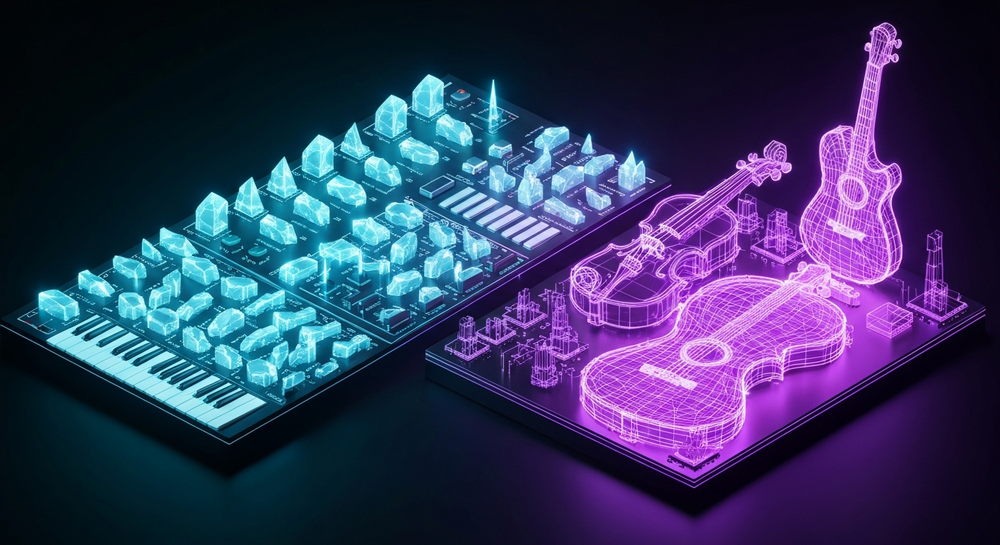
In electronic production, every sound is programmable. This makes text-to-music generation remarkably efficient. In 2026, most AI platforms including Soundverse’s AI Music Generator, empower users to craft EDM, ambient, lo-fi, or techno tracks by describing mood, tempo, and instrumentation in words. The output feels authentic because the sonic palette is entirely synthetic. The AI doesn’t have to emulate a physical space or emulate finger pressure on guitar strings—it just computes frequencies that align with the user’s prompt.
This is precisely why synthetic genres such as EDM and chillwave dominate AI music platforms. They rely on patterns, loops, and mathematical repetition—areas where AI excels. Electronic genres are modular; their components can be deconstructed and reconstructed algorithmically. A beat is quantized, basslines follow predictable rhythmic structures, and harmonic progression can be derived from learned datasets.
For electronic producers in 2026, the integration of AI music production tools speeds up workflow, allowing creative iteration without manual sound design. Producers can even cross-reference resources like How to Create EDM with Soundverse AI to learn text prompt strategies for crafting genre-specific results.
Why does AI struggle with live instruments?

Replicating the organic complexity of live instruments introduces genre difficulty for current AI. Acoustic performance involves microvariations—tiny shifts in tone, timing, and resonant decay—that aren’t easily predictable. These imperfections are essential to emotional connection. When a human plucks a guitar string or bows a violin, subtle friction, breath control, and physical tension influence tonal outcome. Translating that into data requires more than spectral analysis—it involves modeling human intention.
In 2026, despite improvements from models like Soundverse V5 and other generative systems, AI still faces limitations when tasked with reproducing natural timbres convincingly. Even instruments like acoustic piano or cello, which have predictable harmonic behavior, reveal slight unnaturalness in AI reproductions. The softness and dynamics of a live performance challenge the system’s capacity to simulate time-dependent expression.
Another issue is production quality. While AI-generated electronic music achieves clean, balanced mastering thanks to synthetic sound consistency, live instrument recreations can sound either too sterile or too mechanical. The expressive range—vibrato intensity, string tension response, or air pressure through a flute—requires high-dimensional sensory data beyond what most models process efficiently.
For this reason, most AI platforms specialize in instrumental generation without vocals or live recording synthesis. Soundverse’s AI Music Generator emphasizes loops, beats, and backgrounds rather than full live instrument simulations. It fills the need for high-quality electronic production but clearly acknowledges the realistic genre difficulty of replicating human instrumental flair.
How do AI limitations affect music producers and engineers?
Understanding AI’s limitations around live instruments helps producers and engineers decide when and how to integrate AI into their workflow. In 2026, hybrid production is common—combining AI-generated electronic bases with human-recorded layers enhances realism and emotional impact. Music engineers often use AI to generate a foundation, then record live instruments to enrich texture.
For projects like film scoring or video game composing, where loop-based sections or background tonalities are prevalent, AI shines. But for acoustic genres—folk, jazz, classical—the human touch remains irreplaceable. Even though Soundverse supports detailed genre and mood definitions, its optimal results occur within synthetic realms where production quality is easier to control.
For context, check industry discussions at Music Industry Trends and How AI Generated Music is Transforming the Music Industry to see how composers adapt to these changing tools.
For a deeper dive, watch our guide on how to make music or explore the Deep House tutorial from the Soundverse YouTube Series.
What technologies drive AI’s success in electronic genres?
The core strength of AI music production lies in data and algorithmic scalability. Electronic genres are heavily characterized by waveform synthesis, modulation automation, and predictable rhythm grids—all areas that align with machine learning’s architecture. Neural networks can identify and reproduce these rhythm patterns with remarkable precision.
Soundverse’s advanced model versions (V4 and V5) use high-resolution data mappings to control musical attributes like tempo, rhythm intensity, and filter sweeps. Each model learns from millions of synthesized examples, refining its understanding of structure rather than raw acoustics.
For electronic sound creation, production quality depends on the precision of digital simulation rather than the natural imperfections of organic acoustics. That’s why AI renders electronic tracks with consistent tonality, clean soundscapes, and effective looping options—ideal for background music, advertisements, and meditation tracks. Related blogs such as Soundverse AI Revolutionizing Music Creation for New-Age Content Creators showcase how creators leverage these strengths for brand sound identities.
How to make electronic music with Soundverse AI Music Generator
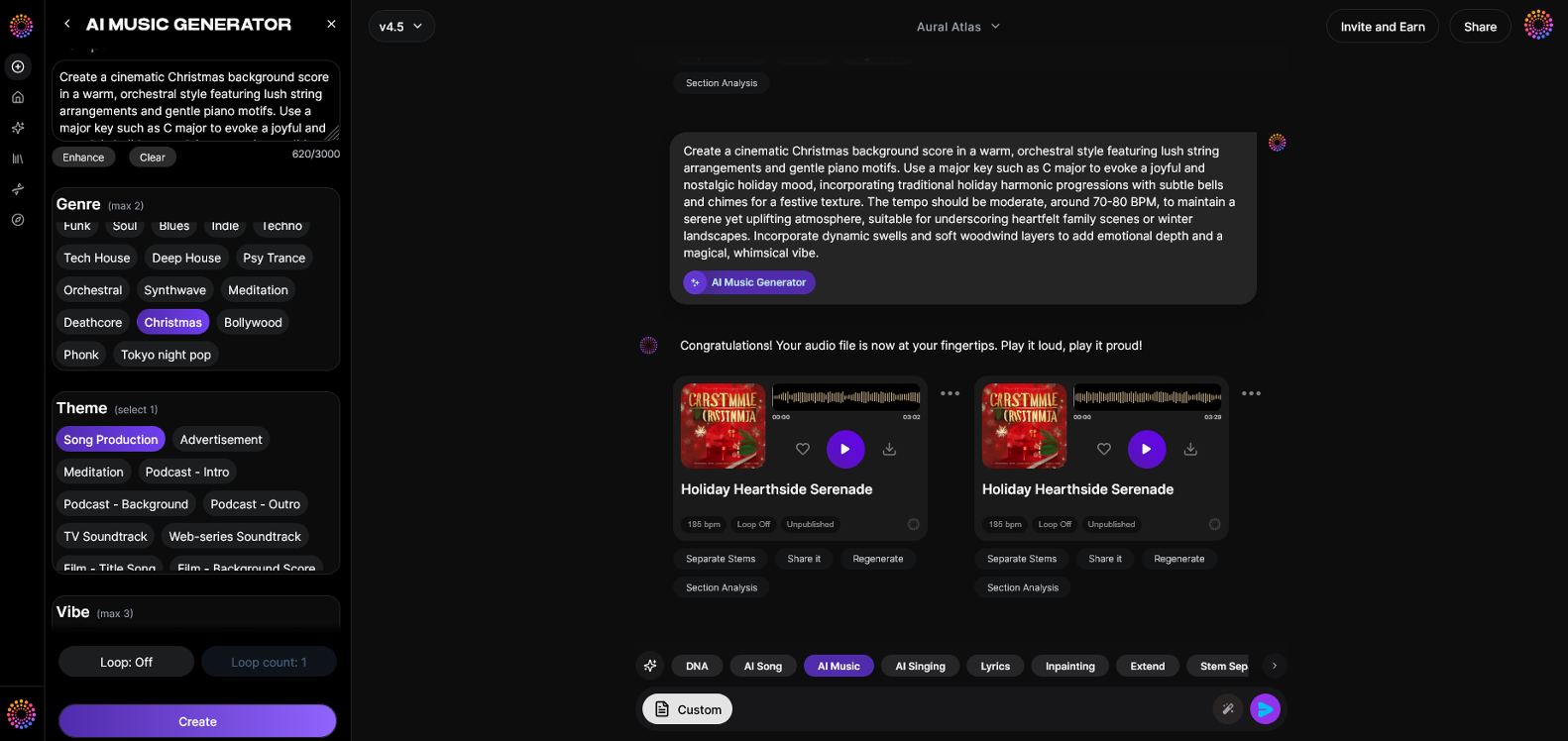
Soundverse offers a streamlined process for AI music production. Its AI Music Generator allows creators to build complete instrumental tracks from short text prompts. The feature is designed for seamless electronic generation with precision control over genre, style, and looping.
Soundverse AI Music Generator Overview
Soundverse’s core capability focuses on text-to-music creation, enabling producers to specify beats, soundscapes, or ambient loops. With the Loop Mode feature, users can design endlessly repeating backgrounds perfect for games or podcasts. The system includes detailed genre and mood control, allowing dynamic combinations across multiple electronic styles. Users can also select between V4 and V5 models to adjust production complexity or tone detail.
Primary Use Cases Include:
- Video background tracks
- Game soundtrack loops
- Meditation and wellness atmospherics
- Advertising and commercial scoring
Soundverse doesn’t provide real-time generation; instead, it processes uploaded or prompted data asynchronously. This ensures accurate rendering and consistent mix balancing—a crucial aspect of production quality.
To extend creativity beyond purely electronic forms, creators can explore complementary tools:
- Voice to Instrument, which converts vocal input like humming or beatboxing into realistic instrumental sounds (though results remain digitally processed).
- Melody to Song Generator, which transforms simple melodic recordings into full arrangements with added vocals built around the core melody.
Together, these connected tools illustrate how AI can bridge compositional inspiration with structured production.
Will AI eventually overcome genre difficulty?
As research evolves, models that capture temporal expressiveness and physical interactions are emerging. Hybrid AI techniques in 2026, using physics-informed sound engines, attempt to replicate genuine acoustic responses—such as wood resonance or string tension. However, perfection in this domain remains elusive.
Even the most advanced neural processing requires enormous datasets and contextual imitation to mirror live human nuances. The more expressive the instrument, the harder it becomes to reproduce. Some technologists predict breakthroughs by 2028–2030 using embodied acoustical models. Until then, AI music production remains dominant in electronic spaces.
Producers often mix AI and human elements strategically. You can read case examples in Soundverse AI Magic Tools: Create Content Quickly with AI, which demonstrates workflow techniques for hybrid creation.
Start Composing Smarter with AI-Powered Music Tools
Harness the creative power of Soundverse to produce professional-quality electronic music, generate stems instantly, and unlock new possibilities in AI music production.
Related Articles
- How AI-Generated Music Is Transforming the Music Industry: Discover how artificial intelligence is redefining music creation, performance, and distribution across genres.
- AI Music Generator and Human Composers: A Future Together: Explore how AI and human artists can collaborate to create music that blends precision with emotional depth.
- The Role of AI Music in Film and Television: Learn how AI is shaping background scores and elevating storytelling in modern visual media.
- Soundverse AI Revolutionizing Music Creation for New-Age Content Creators: Unveil how Soundverse empowers creators to craft unique, royalty-free tracks effortlessly using advanced AI tools.
Here's how to make AI Music with Soundverse
Video Guide
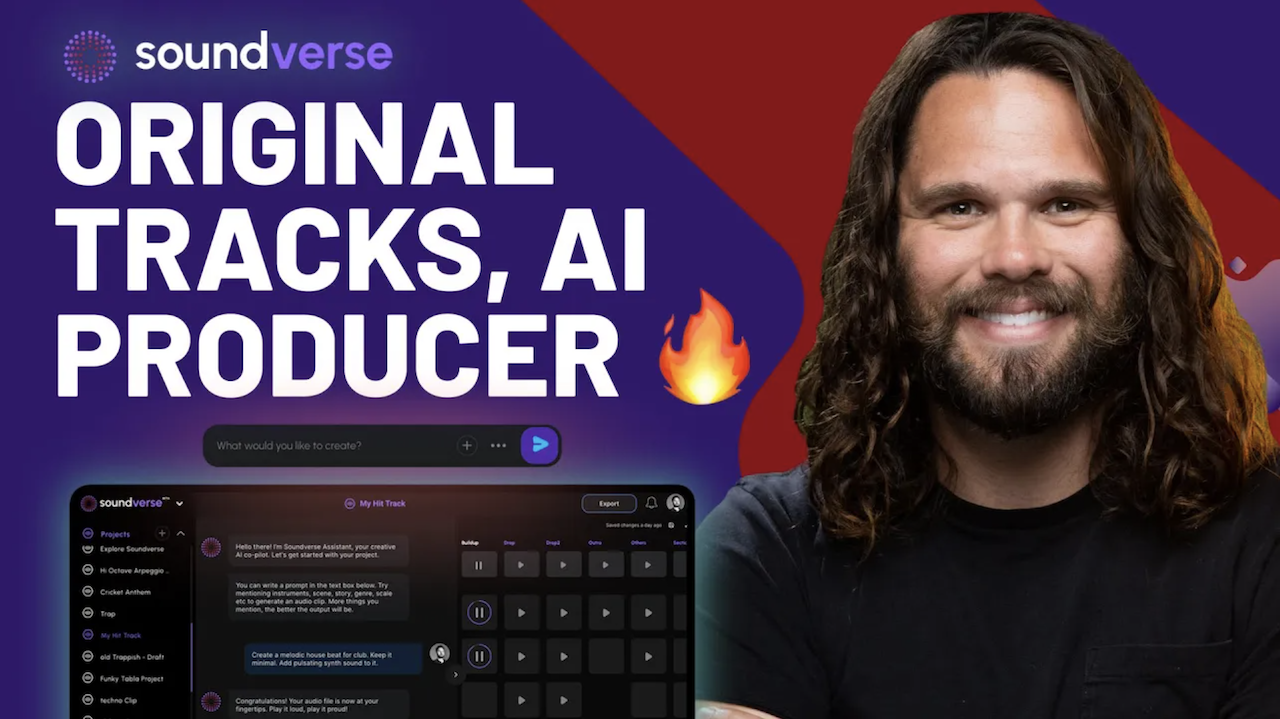
Here’s another long walkthrough of how to use Soundverse AI.
Text Guide
- To know more about AI Magic Tools, check here.
- To know more about Soundverse Assistant, check here.
- To know more about Arrangement Studio, check here.
Soundverse is an AI Assistant that allows content creators and music makers to create original content in a flash using Generative AI. With the help of Soundverse Assistant and AI Magic Tools, our users get an unfair advantage over other creators to create audio and music content quickly, easily and cheaply. Soundverse Assistant is your ultimate music companion. You simply speak to the assistant to get your stuff done. The more you speak to it, the more it starts understanding you and your goals. AI Magic Tools help convert your creative dreams into tangible music and audio. Use AI Magic Tools such as text to music, stem separation, or lyrics generation to realise your content dreams faster. Soundverse is here to take music production to the next level. We're not just a digital audio workstation (DAW) competing with Ableton or Logic, we're building a completely new paradigm of easy and conversational content creation.
TikTok: https://www.tiktok.com/@soundverse.ai
Twitter: https://twitter.com/soundverse_ai
Instagram: https://www.instagram.com/soundverse.ai
LinkedIn: https://www.linkedin.com/company/soundverseai
Youtube: https://www.youtube.com/@SoundverseAI
Facebook: https://www.facebook.com/profile.php?id=100095674445607
Join Soundverse for Free and make Viral AI Music

We are constantly building more product experiences. Keep checking our Blog to stay updated about them!