What Role Does Latent Space Play in the Generation of Complex Musical Arrangements?
Latent space in AI music explained for producers: VAEs, diffusion latents, stem-aware models, MusicVAE interpolation, guidance, melodies and arrangements.
Latent space in AI music is the compressed map of music a model learns, where generation happens: the model writes or denoises a short code, and a decoder turns it into notes or audio. For complex arrangements, the latent decides whether drums, bass, harmony and melody share one code, get a slice each or are built around one another.
The papers cited were read on 19 November 2026 and describe published research models, not how any commercial product works.
What is a latent space in AI music?
An autoencoder has two halves. The encoder squeezes music into a short code, the latent, and the decoder rebuilds the music from it. A variational autoencoder (VAE) also shapes that space so that any nearby point decodes to something plausible, which lets you sample new music and move between pieces.
Latents come in three main forms:
- Symbolic latents. Google Magenta's MusicVAE (Adam Roberts and colleagues, ICML 2018) encodes a 2-bar or 16-bar note sequence as one 512-dimensional vector. It describes notes, not sound.
- Continuous audio latents. Stable Audio (Zach Evans and colleagues, ICML 2024) uses a VAE that shrinks stereo 44.1 kHz audio 1,024 times along the time axis into 64 channels, an overall compression of 32 times. A diffusion model then generates in that space.
- Discrete codec tokens. Codecs turn audio into numbered tokens for language models to predict, covered in our explainer on tokenization and music composition.
Diffusion adds one more latent: the random noise a generation starts from, which can itself be steered.
How arrangement layers are represented in latent space
An arrangement is several parts that must agree on beat, key and harmony. Published models hold those parts in four main ways.
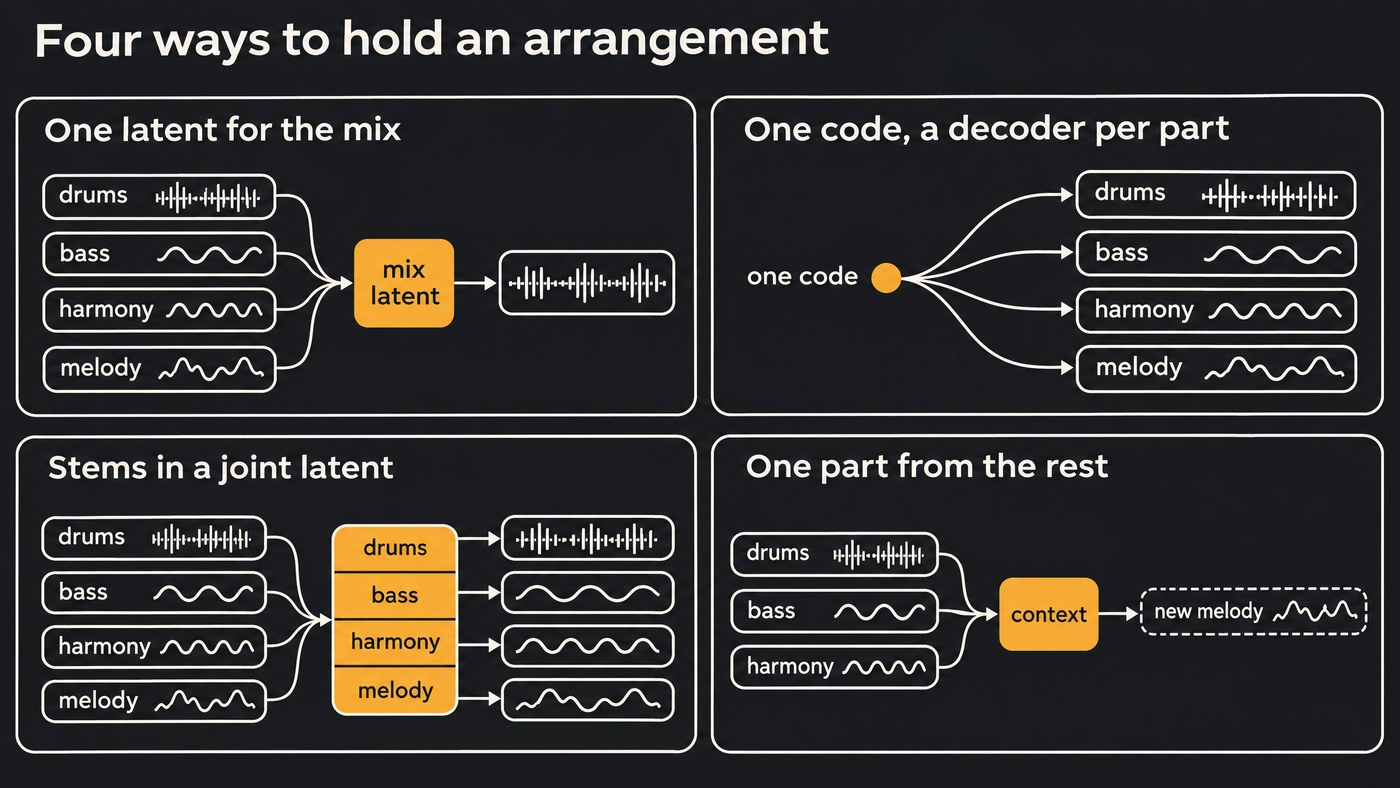
One latent for the whole mix
Stable Audio's latent encodes the finished stereo mix. Drums, bass and vocals share the same 64 channels, so the arrangement is implicit: you can describe it in the prompt, but there's no separate handle for the bass. The authors report that it can produce structured music with an intro, development and outro. To work with parts, you separate stems afterwards.
One code, a decoder per instrument
MusicVAE's "trio" model writes 16 bars of melody, bass and drums from a single latent. A "conductor" network turns the code into one embedding per bar, and a separate decoder for each instrument writes its notes from those embeddings. Because one code drives all three, the parts move together.
The hierarchy paid off. Working from its own predictions rather than the correct notes, the trio model reconstructed melody, bass and drums with 75%, 77% and 86% accuracy, against 58%, 57% and 64% for a flat decoder.
Stems as slices of a joint latent
Giorgio Mariani and colleagues' Multi-Source Diffusion Models (ICLR 2024) learn the joint distribution of four stems (bass, drums, guitar and piano) directly on waveforms. One model can generate all four, separate a mix, or fill in missing parts, which they call source imputation, such as a piano part that suits the drums.
Multi-Track MusicLDM (Tornike Karchkhadze and colleagues, 2024) moves the same idea into a latent. Each stem gets its own slice of a 3D latent, and the model generates any subset of tracks given the others, such as piano for an existing bass and drum part.
One new part from the rest
Diff-A-Riff, from Javier Nistal and colleagues at Sony Computer Science Laboratories (2024), generates one instrument at a time to fit a musical context. Training picks a target track and mixes a random subset of the remaining tracks as the context, both in the same latent: 64 values, 12 times a second, for 48 kHz audio. It can also follow a text prompt or an audio reference.
Interpolation and latent arithmetic: what MusicVAE showed
Two moves make a good latent useful to a producer.
Interpolation. Encode two melodies, walk a path between their codes, and decode points along it. Mixing the notes directly produced harmonic and rhythmic dissonance in the MusicVAE tests, while the latent path stayed musical. Describing the midpoint of two example melodies, the authors write: "The interpolation synthesizes semantic elements of the two melodies: a similar repeating pattern to A, in a higher register with intermittent sparsity like B, and in a new shared musical key."
Attribute vectors. Average the codes of melodies that share a trait and you get a direction for that trait. MusicVAE built vectors for five simple ones: C diatonic membership, note density, average interval, and 16th-note and 8th-note syncopation. Adding or subtracting a vector produced the intended change with few side effects, though some traits were linked: more density meant less 8th-note syncopation.
Audio models use interpolation in training as well. MusicLDM (Ke Chen and colleagues, 2023) beat-aligns training tracks of similar tempo and mixes them in its latent space, so the model learns to make new music inside the range of its data. The authors report this substantially reduced copying of training material in the outputs.
Conditioning and guidance in latent diffusion
A latent diffusion model starts from noise and removes it step by step, guided by what you give it:
- Text embedded by a model such as CLAP, which maps text and audio into one space.
- Timing. Stable Audio adds when a chunk starts and how long the whole piece is, so asking its 95-second model for 30 seconds gives 30 seconds of audio followed by silence.
- Audio context, as in Diff-A-Riff.
Classifier-free guidance (Jonathan Ho and Tim Salimans, 2022) sets how hard the model follows those inputs. During training, the conditions are sometimes dropped (Stable Audio drops them 10% of the time). At generation, the model makes a conditional and an unconditional prediction and moves further in the direction of their difference. A higher scale sticks closer to the prompt and gives less variety; Stable Audio uses 6 over 100 steps.
Guidance can also act on the starting noise. DITTO (Zachary Novack and colleagues, ICML 2024) optimizes the initial noise latent until the output matches a target melody, an intensity curve or a structure such as ABBA, with no retraining. The authors write that "a wide-array of semantically meaningful fine-grained features can be manipulated purely through exploring the diffusion latent space without ever editing the pre-trained diffusion base model." The cost is speed: optimizing at generation time is slower than guidance by design.
What role does latent space play in the generation of synthetic melodies?
In a symbolic model, a melody is a point in latent space. Sampling a random point writes a new melody, and the hierarchical decoder is what keeps 16 bars coherent. MusicVAE's authors note that recurrent VAEs tend to ignore the latent code, a failure called posterior collapse. The hierarchy pushes the decoder to use it: sampled 16-bar melodies were reconstructed with 81% accuracy, against 62% for the flat model.
Moving through the space edits a melody. Interpolation blends two tunes, and attribute vectors make one denser, sparser or more syncopated. An earlier paper by Jesse Engel, Matthew Hoffman and Adam Roberts (2017) learned latent constraints, regions of the space that produce a wanted attribute, and showed conditional generation of note sequences without retraining.
A full-mix audio latent has no dedicated melody axis; the tune is bound up with timbre and every other part. So audio systems steer melody from outside. DITTO matches a 12-pitch-class chromagram, and other tools take a hummed line or a MIDI file as a condition.
Limits of latent space for complex arrangements
- Mixes don't add up in latent space. Multi-Track MusicLDM beat Multi-Source Diffusion on most tasks but struggled to separate sources, which its authors attribute to a latent where mixtures and stems don't keep a linear relationship.
- Short windows. Multi-Source Diffusion trained on about 12 seconds at 22 kHz, and Multi-Track MusicLDM on 10.24-second clips at 16 kHz. Holding a full song together is a different problem, covered in our guide to the technical hurdles of long-form AI music.
- Scarce stem data. Both rely on Slakh2100, 145 hours of multitracks synthesized from MIDI with virtual instruments, chosen because it is larger than other multi-source datasets. Diff-A-Riff trained on 12,000 proprietary multitracks.
- Entangled traits. As MusicVAE's density and syncopation showed, one move in latent space can shift two qualities.
What this means when you arrange with AI
- Generate parts in context instead of full mixes when the arrangement matters, so each new layer is made to fit what's there.
- Give the model a constraint: a melody, a MIDI file or a reference part.
- Change one thing at a time, since traits are linked.
- Check separated stems for bleed before you rebalance them.
- Plan the sections yourself. Our guide on how to arrange a song covers the craft side.
Where Soundverse fits
Soundverse is an AI music platform that takes you from idea to audience, built for independent artists who release music. Its tools line up with the arrangement workflows above.
AI Stem Generator, on Creator and above, makes one new part that fits a source track you pick, such as drums, bass, strings or a vocal, as its own audio track. Stem Separator splits a mix into 2 or 6 stems, or, on Creator and above, a maximum split with every part on its own and a MIDI file for each. Melody to Song takes 5 to 60 seconds of a hummed, sung or played melody plus your lyrics and builds a full song that follows your tune; Soundverse v9 is on Pro and Max.
This tutorial shows AI Stem Generator building an instrumental around a vocal, in the style you choose.
FAQ
Is a latent space the same as tokens? Not quite. Tokens are a discrete latent: each short frame of audio becomes one or more numbers from fixed codebooks, which suits language models. Continuous latents, like Stable Audio's 64-channel VAE latent, are vectors of real numbers, which suit diffusion and smooth interpolation.
Can AI generate separate stems instead of a full mix? Yes, in research models built for it. Multi-Source Diffusion and Multi-Track MusicLDM generate several stems together, and Diff-A-Riff adds one part to an existing context. Full-mix generators need source separation afterwards.
Why does a latent interpolation sometimes sound wrong? The decoder only produces plausible music where it has seen data, and traits in the space are linked. MusicVAE's latent interpolations stayed musical where note-by-note mixing didn't, but pushing an attribute too far still changes other qualities.
Does a higher guidance scale make better music? It makes music that follows the prompt more closely, with less variety. Ho and Salimans describe guidance as a trade-off between sample quality and diversity.
Sign up for Soundverse free and build your next arrangement one part at a time. More guides for producers on the Soundverse blog.
