What Music Gets Selected for AI Training in 2026?
Learn how AI selects music for training in 2026 with ethical licensing and Soundverse's transparent framework.
What Music Gets Selected for AI Training?
Artificial intelligence has become deeply woven into music creation, distribution, and analysis. As of 2026, the question of what music gets selected for AI training is no longer purely technical — it’s ethical, commercial, and cultural. With the rise of large-scale text-to-music models and artist-specific AI systems, the management and curation of AI music training data have become central to sustainable innovation.
What defines AI music training data?
AI music training data refers to the collection of audio recordings, metadata, stems, lyrics, and performance information used to teach machine learning models how music works. This data enables models to understand tempo, melody, harmony, rhythm, genre conventions, and even production signatures from real-world examples. In 2026, ethical sourcing and transparency are the most crucial dimensions of this process.

How is music dataset licensing changing in 2026?
In previous years, many AI developers relied on unlicensed scraping of streaming platforms, triggering controversy and litigation. But as of 2026, global policy frameworks demand proper music dataset licensing. Rights holders now negotiate deals with AI platforms so datasets can be used with express consent. (Saving Country Music's New Policy on AI Music for 2026)
Licensing agreements typically specify:
- Duration of rights use for training purposes.
- Attribution requirements for derivative outputs.
- Royalty structures and recurring payments.
- Territory restrictions.
This shift helps AI researchers and music industry executives maintain compliance while ensuring musicians benefit from their contributions.

Who decides which tracks go into AI training sets?
The training data selection process is no longer arbitrary. Music data curators, rights managers, and in-house AI ethics boards collaborate to decide what can be included. They evaluate:
- Legal permissions – Is each track fully cleared and licensed?
- Dataset diversity – Does the selection balance genres, eras, and cultural regions?
- Technical quality – Are files high-resolution and properly annotated?
- Usage purpose – Will the data power generative models, recommendation engines, or stylistic analysis?
In practice, AI music training relies on annotated, structured, and verified audio corpora rather than scraping or crowd-sourcing. The industry learned from 2024–2025 lawsuits that unlicensed content could compromise model validity and public trust.
How is AI music catalog acquisition managed?
Building AI-ready music catalogs involves complex negotiations between record labels, licensing agencies, and tech organizations. AI music catalog acquisition focuses on properly converting traditional rights catalogs into machine-readable, ethically compliant datasets.
By 2026, most major AI platforms source datasets through:
- Opt-in artist programs allowing musicians to license their catalogs for AI learning.
- Joint ventures between labels and AI companies for shared ownership models.
- Aggregation partners who convert legacy archive metadata into usable forms for machine learning.
Some platforms also rely on third-party dataset providers specializing in machine learning audio data preparation. These providers handle waveform normalization, metadata enrichment, and copyright validation processes. (The Complete Guide to AI Music Creation in 2026 - Soundverse AI)
What is the role of copyrighted music and AI?
The intersection of copyrighted music and AI has been the most disputed area in creative technology. While AI models can analyze and learn stylistic elements from licensed tracks, generating direct reproductions remains prohibited. Thus, ethical frameworks dictate that outputs must be original compositions inspired by licensed inputs, not replicates.
Where misuse occurs — such as AI-generated pieces mimicking specific recordings — mechanisms like watermark tracing and attribution audits ensure accountability. Rights protection technologies now identify unauthorized overlaps between model outputs and copyrighted sources. This capacity has become essential across the industry as creators look for fair participation and transparency. (The Problem With AI Music Nobody Talks About (2026 Predictions))
Why ethical transparency in training matters
Ethical transparency in dataset management determines whether artists perceive AI as ally or adversary. When models learn from music without consent, creators lose control over their brands, styles, and value. Transparent pipeline design makes sure their identity and creative labor remain recognized.
In 2026, enterprise clients and research groups prioritize transparent pipelines and licensing due to growing global regulation. Countries like the UK, Japan, and the US have mandated disclosure of data sources used for AI model development. This places industry leaders in favor of systems that document and audit every training phase.
How does Soundverse lead in ethical AI music training?
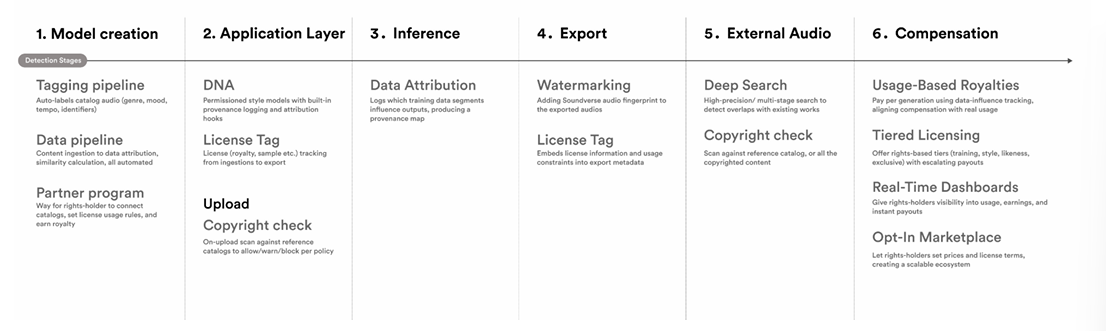
How to make ethical AI music training with Soundverse The Ethical AI Music Framework
Soundverse introduced The Ethical AI Music Framework, a comprehensive infrastructure that bridges innovation and artist integrity. Instead of relying on opaque black-box systems, it provides a transparent, six-stage pipeline that ensures consent, attribution, and recurring compensation throughout the entire AI creation cycle.
The six stages include:
- Licensed Data Sourcing (No scraping) – Soundverse builds datasets exclusively from permissioned catalogs submitted via partnerships. Every element of its AI music training data is traceable.
- Permissioned Models (DNA) – The Soundverse DNA system represents personalized model training based on licensed artist styles. This feature creates new compositions ethically, allowing artists to monetize their sonic identity.
- Explainable Inference (Attribution) – It attaches provenance markers to outputs, ensuring users know which data sources influenced each generation.
- Traceable Export (Watermarking) – Every exported track from Soundverse contains hidden markers linking it to its authorization record.
- Deep Search (External Scanning) – This step uses comparison technology to prevent unlicensed content contamination.
- Recurring Compensation (Partner Program) – Rights holders earn continuous royalties proportional to dataset utilization. The Content Partner Program automates recurring payouts tied to attribution data.
Together, this system assures full ethical compliance and provides a model other AI platforms can emulate. Unlike earlier tools that relied on publicly scraped material, Soundverse formalized collaboration between artists and AI engineers.
The framework complements other Soundverse solutions including Soundverse Trace, the attribution layer connecting data to export, and Soundverse DNA, the artist-trained generator ensuring copyright-safe outputs. These innovations sustain trust between creators and systems while maintaining licensing transparency.
For more detailed insight into how Soundverse’s AI generation works, explore how AI-generated music is transforming the music industry or discover practical tutorials such as How to Create Country Music with Soundverse AI for user experience perspectives. For a deeper dive, watch our guide on creating Deep House music, or tutorial on using Soundverse's Explore tab.
How are AI developers adapting to licensed ecosystems?
Since regulation matured in 2025, companies that previously relied on open web scraping have shifted toward partnership-driven development. Many startups now collaborate directly with labels through platforms like Soundverse to obtain verifiable data channels. Research institutions also benefit because ethically sourced datasets increase research credibility.
Moreover, professionalization of dataset management gives rise to roles like “AI Catalog Curator” and “Music Rights Technologist.” These specialists mediate between creative rights and data engineering operations. (AI Music Creation 2026: Hybrid Workflows for Composers)
What’s next for AI music datasets?
By late 2026, multi-modal AI systems integrating lyrics, melodies, and performance gesture data will demand even more robust licensing frameworks. The fusion of audio, text, and visual registries will motivate record companies to expand licensing protocols beyond sound alone.
Soundverse is positioned to serve as the nucleus for this convergence — not by owning the rights, but by maintaining ethical mediation among all participants. (The Future of Music Production Is Human - Sonarworks) (How Udio's 2026 Licensing Shift Changes the AI Music Landscape)
Start Creating with AI Music Tools Today
Unlock the full potential of your musical creativity using Soundverse AI. Generate high-quality tracks, explore innovative soundscapes, and customize compositions powered by intelligent algorithms.
Try Soundverse Free
Related Articles
- How AI-Generated Music Is Transforming the Music Industry: Discover how AI is reshaping music creation, from production workflows to artist collaborations.
- AI Music Generator and Human Composers: A Future Together: Explore how AI complements human creativity in composing, producing, and evolving musical styles.
- Navigating the World of Royalty-Free and Copyright-Free Music Using Soundverse AI: Learn how AI simplifies access to legal, royalty-free music for creators and brands.
- The Role of AI Music in Film and Television: Gain insight into how AI-generated music enhances scenes, mood, and storytelling in visual media.
Here's how to make AI Music with Soundverse
Video Guide
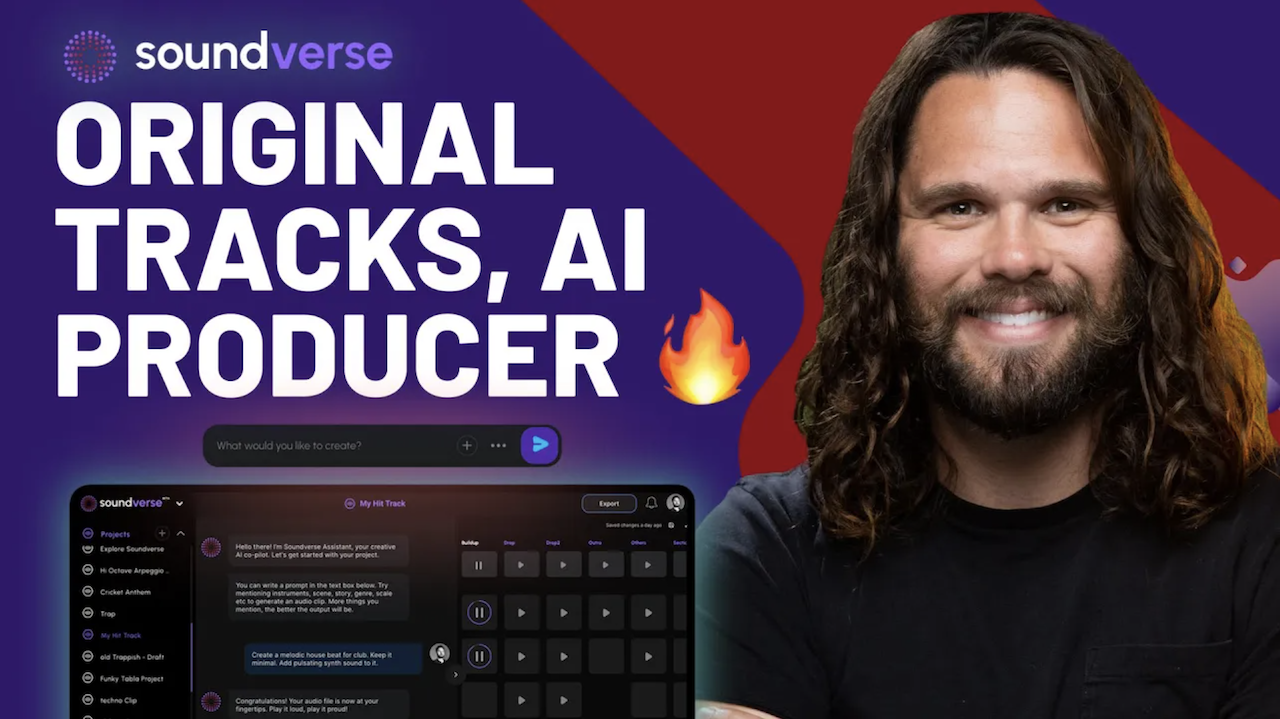
Here’s another long walkthrough of how to use Soundverse AI.
Text Guide
- To know more about AI Magic Tools, check here.
- To know more about Soundverse Assistant, check here.
- To know more about Arrangement Studio, check here.
Soundverse is an AI Assistant that allows content creators and music makers to create original content in a flash using Generative AI. With the help of Soundverse Assistant and AI Magic Tools, our users get an unfair advantage over other creators to create audio and music content quickly, easily and cheaply. Soundverse Assistant is your ultimate music companion. You simply speak to the assistant to get your stuff done. The more you speak to it, the more it starts understanding you and your goals. AI Magic Tools help convert your creative dreams into tangible music and audio. Use AI Magic Tools such as text to music, stem separation, or lyrics generation to realise your content dreams faster. Soundverse is here to take music production to the next level. We're not just a digital audio workstation (DAW) competing with Ableton or Logic, we're building a completely new paradigm of easy and conversational content creation.
TikTok: https://www.tiktok.com/@soundverse.ai
Twitter: https://twitter.com/soundverse_ai
Instagram: https://www.instagram.com/soundverse.ai
LinkedIn: https://www.linkedin.com/company/soundverseai
Youtube: https://www.youtube.com/@SoundverseAI
Facebook: https://www.facebook.com/profile.php?id=100095674445607
Join Soundverse for Free and make Viral AI Music
We are constantly building more product experiences. Keep checking our Blog to stay updated about them!