What Is Stem Separation? Understanding the Technology Transforming Music Production in 2026
Learn what stem separation is and how Soundverse Stem Separator enables precise audio editing for producers and creators.
What Is Stem Separation?
In 2026, stem separation has become one of the most significant breakthroughs in modern music production and sound engineering. The ability to take a fully mixed song and dissect it into individual editable components—called stems—has transformed how producers, DJs, content creators, and educators interact with sound. From remixing classics to isolating vocals for podcasts, stem separation technology is redefining creative control.
What is stem separation in music?
Stem separation refers to the process of breaking down a mixed audio track into separate components such as vocals, drums, bass, guitar, and other instruments. Each of these components is known as an 'audio stem.' Historically, this capability was limited to studio sessions where producers had multitrack recordings. However, with modern AI audio tools, it’s now possible to perform stem separation on any mastered or mixed track.
In traditional mixing workflows, producers required access to multitrack stems directly from recording sessions. This was often impractical for remixing or sampling existing songs. AI-driven stem separation changed that by allowing full songs—even recordings from streaming URLs or live performances—to be algorithmically dissected. More about this process can be found in Music Source Separation - Wikipedia, which explains how demixing and audio source separation evolved.

How does stem separation work?
Stem separation works through advanced machine learning models trained to recognize patterns within audio waves. These systems analyze timbre, frequency ranges, and spatial cues to identify which parts belong to specific instruments or vocals. The AI then extracts these elements and reconstructs them as independent audio stems.
The process typically involves three phases:
- Spectral analysis: The AI observes frequency content across the entire track.
- Source identification: It learns to group frequencies that likely belong to the same source (for example, vocals vs. drums).
- Stem reconstitution: Each group is output as a separate channel or file, allowing users to edit or remix them individually.
In 2026, technologies using deep neural networks and hybrid convolutional transformers have made separation precise enough for professional studio use. This means minimal artifacts or distortion when isolating delicate instruments like violins or vocals. Learn more through a Studio One Pro Stem Separation Tutorial that showcases how current tools perform realtime stem separation.

Why is stem separation important for music production?
The rise of stem separation in 2026 has altered how artists and engineers approach creativity. Here are key benefits driving adoption:
- Remixing and sampling freedom: DJs and producers can create new versions of songs without relying on original multitracks.
- Vocal isolation for creators: You can remove vocals to make karaoke tracks or isolate them to enhance live performances. Audio Separation Full Guide and Review 2026 offers deeper insights on this.
- Sound clean-up for video editors: Audio editors often use stem separation to remove background noise or correct balance issues.
- Educational analysis: Music schools use separated stems to teach mixing principles by examining how instruments interact in context.
- Restoration and archival work: Engineers can restore old recordings by isolating damaged layers and rebalancing them.
What are audio stems?
Audio stems are individual layers of sound extracted from a larger mix. Each stem represents a distinct part of the song that can be edited independently. The most common stems include:
- Vocals: Lead and backing vocals.
- Drums: Kick, snare, cymbals, and percussion.
- Bass: Low-end frequencies defining rhythm and groove.
- Guitar or melodic instruments: Harmonic foundations and riffs.
- Accompaniment or effects: Pads, keys, ambiance, and other supportive textures.
Having access to stems allows producers to apply effects, reverb, or compression to one element without affecting the rest of the track. This granular approach enhances precision in mixing and mastering. See What Are Stems (Trackouts) In Music Production? for additional context on stem benefits.
How AI audio tools power stem separation in 2026
AI audio tools have become indispensable across the industry. Platforms now interpret complex mixes with near-human sensitivity, detecting subtle differences between instruments occupying similar frequencies. The most advanced systems offer six-stem separation capabilities, ensuring even minor layers are preserved.
Compared to earlier tools available in 2024, today’s systems achieve higher fidelity and faster processing using cloud-based computation. They efficiently handle file uploads, URL sources, or even direct recordings, making the process accessible to professionals and enthusiasts alike.
As discussed in Soundverse’s AI Magic Tools article, the convergence of stem separation with composition and arrangement tools is accelerating music innovation globally. Similar developments can be seen across other creative AI applications, like those highlighted in Music Industry Trends.
For those looking for practical inspiration, watch our guide on creating Deep House music and how to make music tutorials from Soundverse’s channel to see AI-produced stems in action.
What are the main challenges with stem separation?
Stem separation technology isn’t without its challenges. Despite sophisticated modeling, instrument bleed—where one sound leaks into another—is still possible, particularly in live recordings or dense mixes. Overcoming this requires balanced algorithms and clean source material.
Moreover, ethical considerations arise when remixing copyrighted content. Producers must ensure they respect intellectual property laws when repurposing stems. This challenge is explored more deeply in Navigating Royalty-Free and Copyright-Free Music. As the industry evolves, creative rights management continues to adapt alongside emerging technologies.
Applications of stem separation in modern sound engineering
The uses of stem separation extend far beyond musicianship. Professional sound engineers apply this technology in fields such as:
- Podcast production: Isolating voices and removing ambient noise.
- Film and TV sound design: Extracting dialogues to redesign soundscapes.
- Live performance preparation: Generating backing tracks for tours.
- Educational environments: Analyzing arrangement structures.
This versatility demonstrates why AI sound editing tools are central to 2026’s music landscape, influencing everything from bedroom production to Hollywood post-processing. Learn how live mixing systems integrate these tools in HANCE 2.0: Realtime Stem Separation - Hello, Music Industry.
How to make stem separation with Soundverse Stem Separator
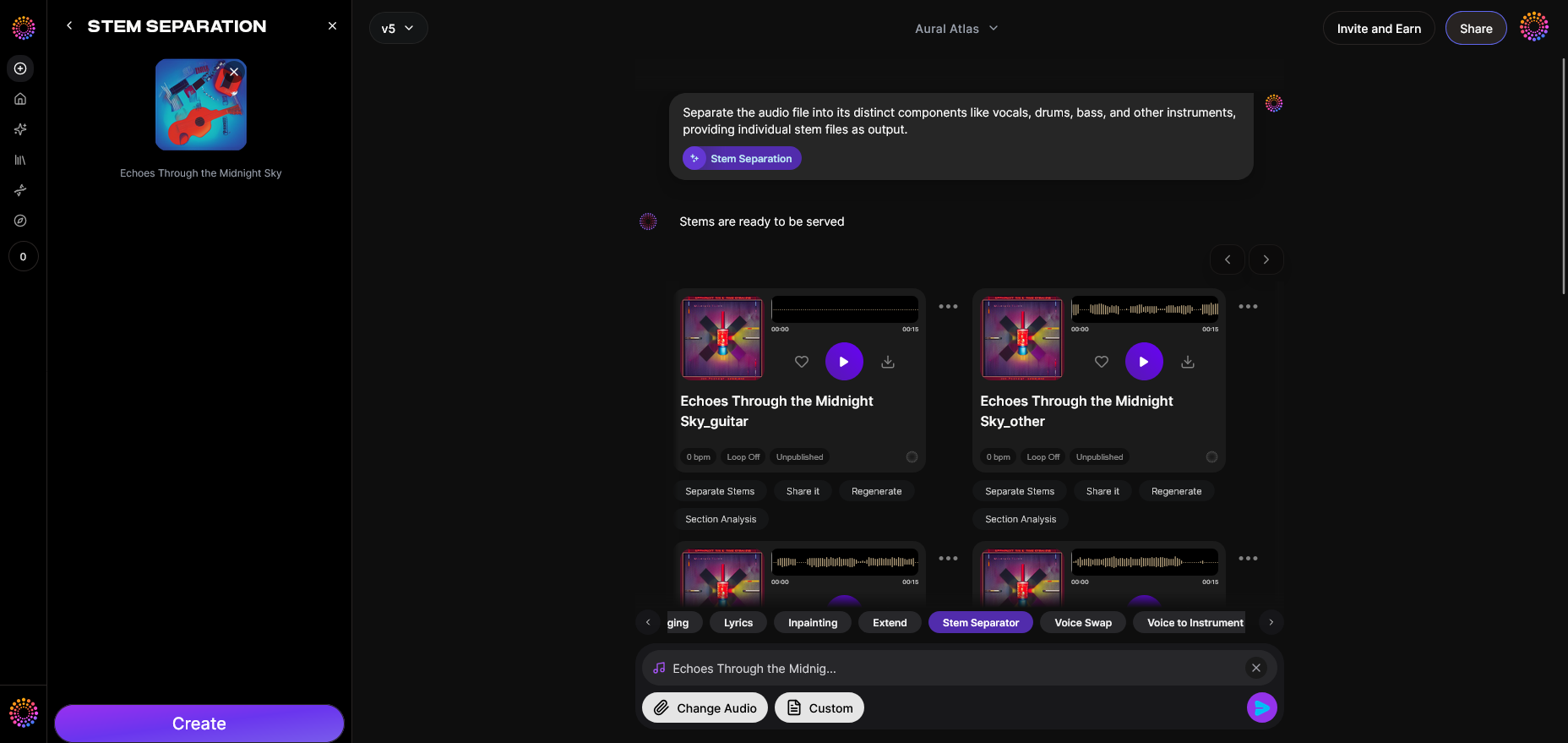
Now that you understand stem separation, here is how to create it instantly using Soundverse.
The Soundverse Stem Separator is an advanced tool designed to dissect mixed audio into up to six distinct and editable stems—Vocals, Drums, Bass, Guitar, and Accompaniment among others. Its core capabilities include 6-stem separation, support for URL, file, and recording inputs, and high-quality isolation ensuring professional-level results. Learn more at How to Separate Vocals and Instrumentals: A Complete 2026 Guide.
With Soundverse Stem Separator, users can perform:
- Remixing and sampling: Extract portions of popular tracks for creative reinterpretation.
- Backing track creation: Make karaoke or live performance tracks by isolating vocals or instruments.
- Educational analysis: Observe how professional mixes are built and learn structure down to the instrument level.
- Audio cleaning: Improve recording clarity by removing unwanted sections.
Soundverse integrates seamlessly with other tools such as Section Analysis, which labels song parts like Intro, Verse, and Chorus for precise editing roadmaps, and Arrangement Studio, a collaborative workspace allowing users to reconstruct or remix songs using the generated stems.
If you’ve ever wanted to experiment with remixing or learn mix structures firsthand, Soundverse offers an intuitive workflow through URL upload, direct recording capture, or file-based input. Processing is performed asynchronously to ensure the highest quality isolation.
You can read more about this technology in Soundverse Introduces Stem Separation AI Magic Tool and explore related guides like How to Create EDM with Soundverse AI or How to Create Jazz Music with Soundverse AI.
Try Stem Separation with Soundverse Today
Unlock the full potential of your music by instantly separating vocals, drums, and instruments using Soundverse’s AI-powered stem separation tool. Perfect for remixing, sampling, and creative experimentation.
Related Articles
- Soundverse Introduces Stem Separation AI Magic Tool — Discover how Soundverse's AI Magic Tool makes professional-grade stem separation accessible to every musician and creator.
- What Are Song Stems and Why Do You Need Them — Learn the importance of song stems and how they empower producers to remix and enhance music with precision.
- Soundverse AI Revolutionizing Music Creation for New Age Content Creators — Explore how Soundverse is changing the creative process for modern content creators through advanced AI tools.
- How AI-Generated Music Is Transforming the Music Industry — Get insights into how AI music generation is reshaping production, collaboration, and the future of music.
Here's how to make AI Music with Soundverse
Video Guide
Here’s another long walkthrough of how to use Soundverse AI.
Text Guide
- To know more about AI Magic Tools, check here.
- To know more about Soundverse Assistant, check here.
- To know more about Arrangement Studio, check here.
Soundverse is an AI Assistant that allows content creators and music makers to create original content in a flash using Generative AI. With the help of Soundverse Assistant and AI Magic Tools, our users get an unfair advantage over other creators to create audio and music content quickly, easily and cheaply. Soundverse Assistant is your ultimate music companion. You simply speak to the assistant to get your stuff done. The more you speak to it, the more it starts understanding you and your goals. AI Magic Tools help convert your creative dreams into tangible music and audio. Use AI Magic Tools such as text to music, stem separation, or lyrics generation to realise your content dreams faster. Soundverse is here to take music production to the next level. We're not just a digital audio workstation (DAW) competing with Ableton or Logic, we're building a completely new paradigm of easy and conversational content creation.
TikTok: https://www.tiktok.com/@soundverse.ai
Twitter: https://twitter.com/soundverse_ai
Instagram: https://www.instagram.com/soundverse.ai
LinkedIn: https://www.linkedin.com/company/soundverseai
Youtube: https://www.youtube.com/@SoundverseAI
Facebook: https://www.facebook.com/profile.php?id=100095674445607
Join Soundverse for Free and make Viral AI Music

We are constantly building more product experiences. Keep checking our Blog to stay updated about them!