What Is Copyright-Free Music? A 2026 Guide for Content Creators
Learn what copyright-free music is and how Soundverse Trace ensures legality and trust in AI-generated music for creators.
What Is Copyright-Free Music?
In 2026, content creation has evolved into a dynamic ecosystem where music plays a vital role in storytelling, branding, and emotional connection. Whether you’re a YouTuber, filmmaker, podcaster, or digital marketer, finding the right music for your project can transform how audiences engage with your content. But with the complexity of music licensing laws, creators often face a common challenge: how to use music legally without overspending or violating copyright. This guide explores the concept of copyright-free music, breaks down related categories like royalty-free, public domain, and Creative Commons music, and finally introduces how Soundverse Trace empowers creators to use and generate music safely and transparently.
What does "copyright-free music" mean in 2026?
Copyright-free music refers to musical works that are not restricted by any copyright protection. In most cases, this means that the copyright period has expired, or the creator has explicitly released the work into the public domain. For example, music whose copyright term has ended—often decades after the creator’s death—can be freely used, shared, and modified without paying royalties or requesting permission.
However, in 2026, the term is often misunderstood. Many websites promoting "copyright-free music" actually distribute royalty-free tracks, which still have ownership and licensing conditions attached. The difference lies in legal freedom: copyright-free music has no rights holder enforcing limits, while other licenses often come with usage terms.
How is copyright-free different from royalty-free music?
Royalty-free music allows creators to use songs without paying continuous royalties, but you usually need to purchase a one-time license or abide by specific platform rules. For example, a filmmaker may purchase a royalty-free soundtrack for a movie trailer. Once paid, they can reuse it without further fees. Yet, the original composer still holds copyright.
In contrast, copyright-free music is not owned by anyone—no payments or permissions required. Platforms that distribute royalty-free tracks often market themselves as alternatives to full copyright control. For creators who want flexibility but also quality recordings, royalty-free options are often more versatile.
If you’d like to learn more about how these categories compare, Soundverse published an in-depth blog on copyright-free vs royalty-free music that breaks down these licensing models and how they affect your content workflow. For a deeper dive, watch our guide on creating Deep House music and how to make music tutorials on the Soundverse YouTube channel.
What are public domain songs?
Public domain songs are compositions whose intellectual property rights have expired or were waived by the creator. This means you can record, modify, distribute, and even monetize them without asking for permission. Classics, folk songs, and historical compositions often fall under this category. In 2026, many archives and digital libraries now curate public domain tracks adjusted for modern audio standards.
For example, orchestral recordings from early 20th-century composers are popular sources of free background music. Filmmakers use these pieces to enhance storytelling without legal complications. But it’s important to verify that both the composition and the recording are truly in the public domain—sometimes the music is old, but the recording is new and copyrighted.
What is Creative Commons music?
Creative Commons (CC) licenses allow artists to give permission for certain uses while retaining ownership. Some CC tracks are free for commercial use with attribution; others limit derivative works or restrict modification. There are multiple types of CC licenses:
- CC BY: Users can remix and reuse the music as long as they credit the original artist.
- CC BY-SA: Requires sharing derivatives under the same license.
- CC BY-NC: Allows non-commercial use only.
- CC0: Fully copyright-free, similar to public domain.
Creative Commons music has become essential for YouTubers and podcasters. It gives structure to collaboration: creators can respect original authors while benefiting from legally reusable material. Platforms integrated into modern workflows often support automatic detection or confirmation of license terms before publishing. You can explore these categories visually through the Soundverse Explore Tab tutorial to see how Soundverse manages licensed sounds.
Where can creators find free background music?
Free background music libraries have exploded in 2026, driven by the growing demand from short-form video platforms, podcasts, and indie films. Major sites offering free or royalty-free tracks include:
- Free Music Archive (FMA) – Offers curated CC and public domain tracks for creators.
- Incompetech (https://incompetech.com) – Known for a large library of licensed compositions under CC BY.
- Bensound (https://bensound.com) – Provides royalty-free tracks for creative projects.
- Mixkit (https://mixkit.co) – Offers high-quality free background music for video editing.
- Soundverse (https://www.soundverse.ai) – A next-generation AI music ecosystem generating original, license-tagged tracks with embedded rights metadata.
For creators exploring AI-powered sound generation, related Soundverse posts such as Generate AI Music with Soundverse Text-to-Music and How AI-Generated Music Is Transforming the Music Industry provide deep insights.
Why does copyright-free music matter for creators in 2026?
The era of user-generated media demands speed, clarity, and legal safety. With new video platforms, extended reach through social ads, and global content syndication, any misuse of copyrighted sound can result in takedowns or monetary penalties. Copyright-free and royalty-free tracks provide security and creative freedom.
Here are the reasons creators in 2026 prioritize copyright-free sound:
- Legal Safety: Eliminates risk of copyright strikes or removal.
- Budget Efficiency: Saves money otherwise spent on recurring license fees.
- Creative Flexibility: Enables remixing, editing, and reusing music in diverse formats.
- Scalability: perfect for high-volume creators producing multiple videos or episodes weekly.
As generative AI music continues to grow, proper verification and attribution have become more critical than ever. Tools like Soundverse’s AI Magic Tools help align creativity and compliance at every stage of production.
How to make copyright-free music with Soundverse Trace
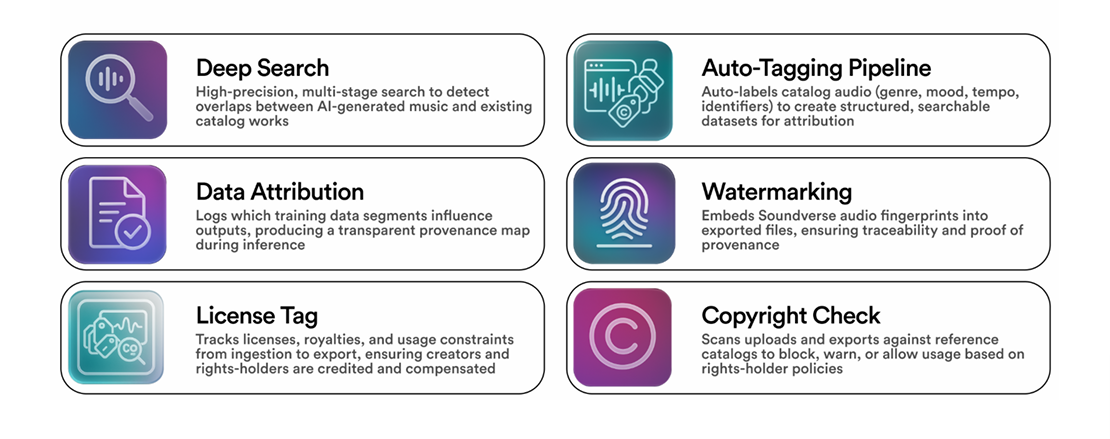
Soundverse Trace is an advanced trust layer developed by Soundverse to solve the growing problem of copyright uncertainty in AI-generated audio. It ensures that creators and rights-holders know exactly how each piece of music was formed—from dataset training to final export.
Core Capabilities of Soundverse Trace
- Deep Search: Uses high-precision scanning (1:1 and 1:N matching) to detect overlaps in musical patterns and verify that generated audio does not infringe existing works.
- Data Attribution: Logs which datasets or training data influenced the final musical output, maintaining full transparency of creative lineage.
- Audio Watermarking: Embeds robust yet inaudible fingerprints to verify authorship and authenticity across platforms.
- License Tagging: Automatically preserves rights metadata during the entire process—from ingestion to published export—ensuring all creators receive credit or royalties if applicable.
Use Cases for Creators
- Prevent Infringement: Automatically detect if AI-generated songs unintentionally copy existing tracks.
- Verify Provenance: Confirms the originality and legal status of each track before release.
- Automate Royalties: Tracks catalog usage for recurring payments or automatic rights-holder recognition.
- Enable Ethical AI: Implements transparency from creation to distribution, supporting fair compensation structures.
With Soundverse Trace, creators can safely produce and distribute AI-generated or AI-inspired music—without fear of losing control or violating licensing regulations. It works asynchronously: you upload or record your music, the system processes it, and returns a verified, rights-tagged file ready for commercial use.
Soundverse Trace operates within the Ethical AI Music Framework, a system designed to replace traditional opaque data models with transparent, consent-based pipelines. This infrastructure ensures every artist’s contribution is respected, marking a turning point toward fairness and creativity in 2026’s AI audio industry. For inspiration, explore how this transparent innovation connects to projects like the Similar Song Generator and Soundverse Arrangement Studio.
Start Creating Copyright-Free Music with AI
Generate unique, copyright-free tracks instantly using Soundverse’s advanced AI music generator. Perfect for content creators, podcasters, and filmmakers seeking worry-free soundtracks.
Related Articles
- Enhancing YouTube Content with Royalty-Free and Copyright-Free Music Using Soundverse AI — Learn how to enhance your videos with copyright-free soundtracks made effortlessly with Soundverse AI.
- Navigating the World of Royalty-Free and Copyright-Free Music Using Soundverse AI — Explore the differences between royalty-free and copyright-free music and how Soundverse simplifies licensing.
- Copyright-Free vs. Royalty-Free Music: What Creators Should Know — Understand the crucial legal distinctions between copyright-free and royalty-free music before using them in your projects.
- Generate AI Music with Soundverse Text-to-Music — Discover how you can create original, copyright-free tracks instantly using Soundverse’s text-to-music feature.
Here's how to make AI Music with Soundverse
Video Guide
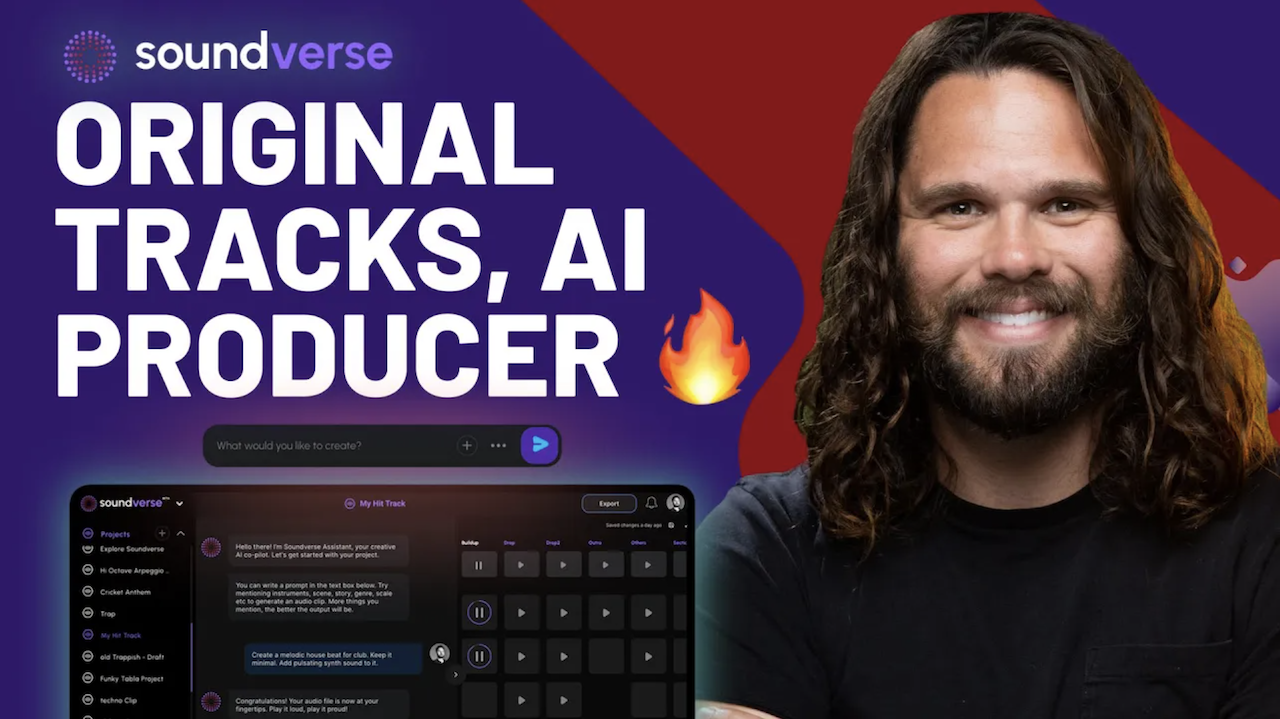
Here’s another long walkthrough of how to use Soundverse AI.
Text Guide
- To know more about AI Magic Tools, check here.
- To know more about Soundverse Assistant, check here.
- To know more about Arrangement Studio, check here.
Soundverse is an AI Assistant that allows content creators and music makers to create original content in a flash using Generative AI. With the help of Soundverse Assistant and AI Magic Tools, our users get an unfair advantage over other creators to create audio and music content quickly, easily and cheaply. Soundverse Assistant is your ultimate music companion. You simply speak to the assistant to get your stuff done. The more you speak to it, the more it starts understanding you and your goals. AI Magic Tools help convert your creative dreams into tangible music and audio. Use AI Magic Tools such as text to music, stem separation, or lyrics generation to realise your content dreams faster. Soundverse is here to take music production to the next level. We're not just a digital audio workstation (DAW) competing with Ableton or Logic, we're building a completely new paradigm of easy and conversational content creation.
TikTok: https://www.tiktok.com/@soundverse.ai
Twitter: https://twitter.com/soundverse_ai
Instagram: https://www.instagram.com/soundverse.ai
LinkedIn: https://www.linkedin.com/company/soundverseai
Youtube: https://www.youtube.com/@SoundverseAI
Facebook: https://www.facebook.com/profile.php?id=100095674445607
Join Soundverse for Free and make Viral AI Music
We are constantly building more product experiences. Keep checking our Blog to stay updated about them!
Image Steps: []