What Is a Verse of a Song? Understanding the Foundation of Music Writing
Learn what a verse of a song is, its role in song structure, and how Soundverse helps you analyze and write better music.
What Is a Verse of a Song?
When you start writing songs, one of the first concepts to master is understanding the verse of a song. Every composition, whether pop, rock, jazz, or country, relies on recognizable sections to build flow and emotional impact. In 2026, with AI music tools simplifying composition analysis, understanding these foundational song parts can elevate your creativity.
What is a verse of a song?
A verse of a song is a core section that provides narrative and emotional depth. It’s where the story unfolds, introducing ideas, feelings, or experiences that lead listeners toward a memorable chorus. In most Western music formats, verses change lyrically between repetitions while often maintaining similar musical phrasing or chord patterns. You can learn more about this common approach from Music 101: What Is a Verse? and Parts of a Song.
For beginner songwriters and music students, the verse functions as the storytelling engine—it draws in listeners with detail and keeps their attention before the hook or chorus gives them something to hold onto. For example, the first verse often sets up the scenario or emotional tone, while the second verse expands or contrasts that theme.
In contemporary songwriting from 2024 to 2026, verses have evolved beyond simple rhyme schemes. Many artists now experiment with rhythmic variation, dynamic builds, and even partial instrument breaks within verses, enriching texture and suspense.

How does a verse fit within song structure?
To understand why verses matter, let’s look at general song structure. Most songs include several key sections:
- Intro – The opener that sets mood and tempo.
- Verse – Carries the narrative or detail.
- Pre-chorus – Transitional buildup into the chorus.
- Chorus – Main hook or emotional climax.
- Bridge – Adds contrast, often shifting melody or key.
- Outro – Brings the song to closure.
In traditional pop forms, verses alternate with the chorus—like: Verse 1 → Chorus → Verse 2 → Chorus → Bridge → Chorus → Outro. By repeating this pattern, you create familiarity while still advancing storytelling. Understanding those relationships helps songwriters control pacing and tension. This pattern is part of what defines Verse-Chorus Form and is central to the song structure concept found throughout popular music theory.

Chorus vs Verse: What’s the difference?
The chorus vs verse comparison is one of the first puzzles new musicians face. While the verse moves the story forward, the chorus encapsulates the emotional core—often summarizing the theme through repetition or melodic intensity.
- Verse: Evolves lyrically, sets up context.
- Chorus: Repeats lyrics and melody, delivers the ‘message.’
In songwriting workshops across 2026, educators often describe the verse as the conversation and the chorus as the declaration. Both elements rely on each other structurally: without a verse, the chorus loses meaning; without a chorus, the verse lacks culmination.
If you’re learning songwriting basics, reading articles like how to make good rap lyrics or how to create country music with Soundverse AI can illustrate how these sections shape various genres.
What are the elements of a song?
Every piece of music involves several key elements of a song: melody, harmony, rhythm, lyrics, and arrangement. The verse interacts closely with each:
- Melody: Usually simple but flexible, letting lyrics shine.
- Harmony: Provides recurring theme through chord sequences.
- Rhythm: Keeps energy consistent or changes to add flavor.
- Lyrics: Drive story details forward.
- Arrangement: Positions verse sections within overall structure.
A great verse balances lyrical content and musical continuity. For example, the verse in an acoustic ballad may minimize percussion to emphasize emotion, while in modern EDM or hip-hop, verses might include dynamic dropouts for tension before the beat returns strong in the chorus.
What makes a good verse?
Writing strong verses requires craft. Here are some lyrics writing tips for 2026 based on evolving composition trends:
- Focus on emotional contrast. Each verse should feel both connected and distinct—advancing story but never repeating identical emotions.
- Maintain conversational tone. Modern listeners gravitate toward authenticity rather than poetic antiquity.
- Use rhythmic hooks. Even without melodic variation, rhythmic phrasing can create interest.
- Bridge to chorus effectively. Finish verses with a line that vividly hints at what the chorus will emphasize.
- Edit for brevity. A verse typically lasts 8–16 bars; filling too much narrative breaks musical flow, as mentioned in What is a Verse in a Song?.
Experimentation is welcome. As shown in tutorials like how to create rap music with AI or generate AI music with Soundverse Text-to-Music, different genres highlight verses differently—rap relies heavily on lyrical density, while pop emphasizes rhythmic phrasing.
How songwriters analyze verse structure in 2026
With AI-assisted analysis becoming standard in music production, understanding verses isn’t just creative—it’s technical. Platforms like Soundverse help musicians visualize composition in precise timestamps, saving hours of manual charting. This evolution helps beginners learn how real songs flow and aids professionals in remixing or sync licensing.
For a deeper dive, watch our guide on creating Deep House music or explore the How to Make Music tutorial on Soundverse’s YouTube channel.
How to understand song verses with Soundverse Section Analysis
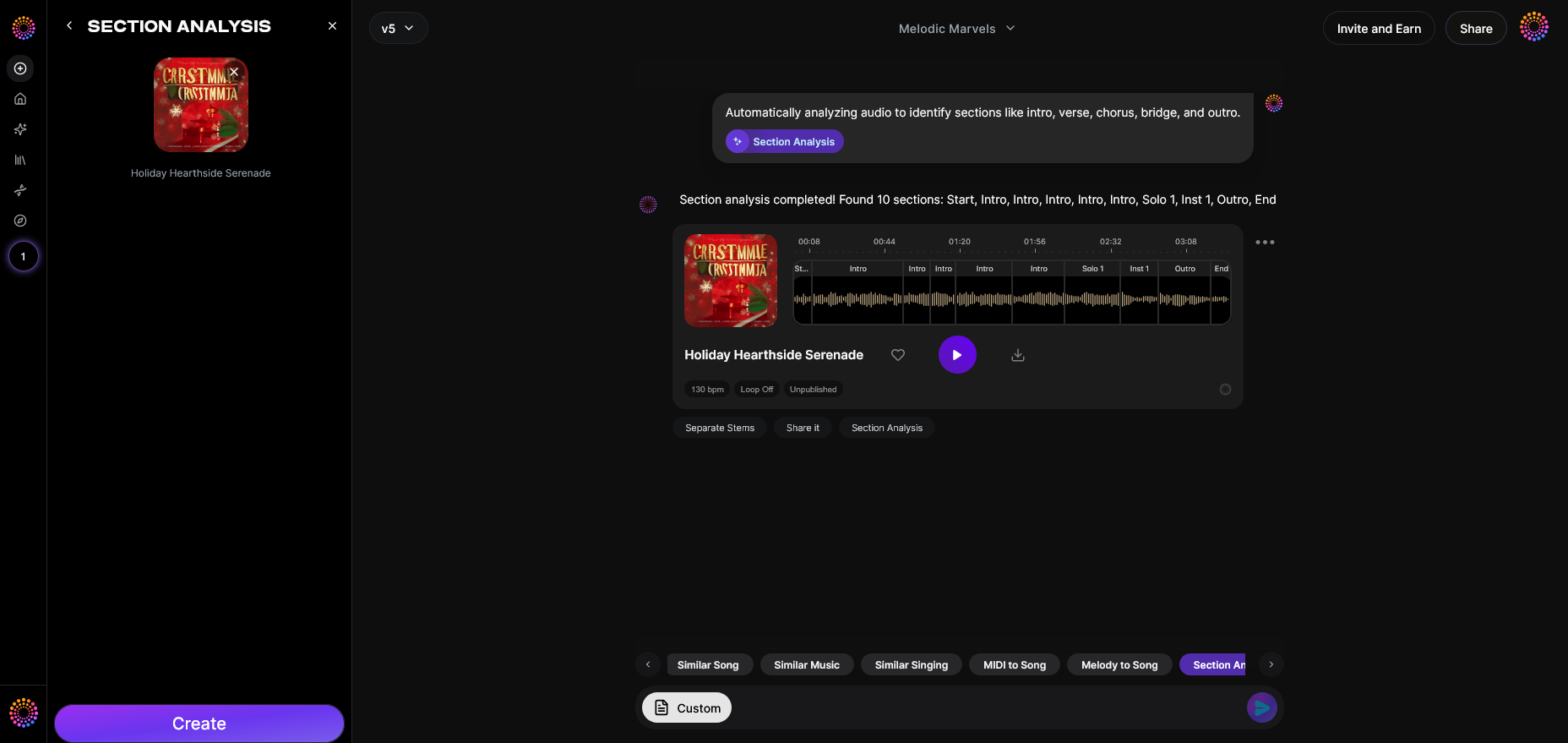
Soundverse’s Section Analysis feature automatically detects and labels the structural sections of a track—Intro, Verse, Chorus, Bridge, and Outro—assigning each a precise timestamp. The tool generates a visual roadmap for editing or remixing.
Key capabilities include:
- Automated structure detection that identifies different song segments.
- Visual roadmap generation allowing clear view of where verses and other sections lie.
- Timestamp export for perfect navigation in editing software.
Main use cases:
- Learning song structure for covers: Understand verse-to-chorus ratios in classics and adapt your vocals or instruments accordingly.
- Remixing and DJ cue points: Use verse timestamps to align transitions or remix loops seamlessly.
- Preparing for inpainting edits: Identify exact verse boundaries when you want to change lyrics or replace vocals.
- Sync licensing assessment: Quickly determine how long each section lasts for film synchronization.
By analyzing verses this way, you can study both narrative placement and musical shift with precision. Soundverse doesn’t preview live audio—it processes uploaded or recorded material asynchronously, returning annotated results after completion.
If you’re exploring more production workflows, read about Soundverse Arrangement Studio or Soundverse AI Magic Tools to expand your composition setup.
Why mastering verse analysis matters for songwriters
In 2026, being able to distinguish and craft effective verses sets accomplished songwriters apart. Understanding structure deepens your ability to edit, remix, and collaborate. With automated tools like Soundverse Section Analysis handling technical detection, you can focus on creativity—writing verses that emotionally resonate and flow naturally.
Create Your Next Song Verse with AI
Turn your lyrical ideas into music instantly using Soundverse’s AI-powered platform. Craft verses, choruses, and entire tracks with ease—no studio required.
- How to Make Good Rap Lyrics — Learn techniques and practical tips for writing impactful rap verses that connect emotionally and rhythmically.
- Generate AI Music with Soundverse: Text-to-Music — Discover how to turn written text into full music compositions using Soundverse’s advanced text-to-music generation tool.
- What AI Can Generate Songs? — Explore how different AI platforms create songs and what sets Soundverse apart in music generation innovation.
- The Benefits of Composing with an AI Music Generator — Find out why using AI for music composition is transforming creativity for artists, producers, and content creators.
Here's how to make AI Music with Soundverse
Video Guide

Here’s another long walkthrough of how to use Soundverse AI.
Text Guide
- To know more about AI Magic Tools, check here.
- To know more about Soundverse Assistant, check here.
- To know more about Arrangement Studio, check here.
Soundverse is an AI Assistant that allows content creators and music makers to create original content in a flash using Generative AI.
With the help of Soundverse Assistant and AI Magic Tools, our users get an unfair advantage over other creators to create audio and music content quickly, easily and cheaply.
Soundverse Assistant is your ultimate music companion. You simply speak to the assistant to get your stuff done. The more you speak to it, the more it starts understanding you and your goals.
AI Magic Tools help convert your creative dreams into tangible music and audio. Use AI Magic Tools such as text to music, stem separation, or lyrics generation to realise your content dreams faster.
Soundverse is here to take music production to the next level. We're not just a digital audio workstation (DAW) competing with Ableton or Logic, we're building a completely new paradigm of easy and conversational content creation.
TikTok: https://www.tiktok.com/@soundverse.ai
Twitter: https://twitter.com/soundverse_ai
Instagram: https://www.instagram.com/soundverse.ai
LinkedIn: https://www.linkedin.com/company/soundverseai
Youtube: https://www.youtube.com/@SoundverseAI
Facebook: https://www.facebook.com/profile.php?id=100095674445607
Join Soundverse for Free and make Viral AI Music

We are constantly building more product experiences. Keep checking our Blog to stay updated about them!