What Is a Verse in a Song? Understanding the Building Blocks of Song Structure in 2026
Learn what a verse in a song is, its role in songwriting, and how Soundverse helps analyze song structure.
What Is a Verse in a Song?
A verse in a song is one of the most fundamental parts of songwriting. For beginner songwriters, music students, and lyric enthusiasts, understanding the verse helps unlock the deeper mechanics of music composition. In 2026, where AI-driven music tools like Soundverse are transforming how songs are analyzed and created, knowing what makes a verse effective is essential for creative growth.
What is a verse in a song and why is it so important?
The verse in a song functions as the storytelling hub. It conveys the song’s narrative, emotions, and tension that eventually lead to the chorus. While the chorus delivers the main hook or message—the part listeners remember—the verse introduces context and progression.

In music composition, every verse typically builds upon the previous one. Despite having similar melodies or chord progressions, verses differ lyrically to keep the story evolving. This creates contrast and keeps the audience engaged. For example, the first verse often introduces the scenario or emotion, while later verses expand or complicate it.
For anyone studying songwriting basics, understanding verses is crucial to mastering song structure. A solid grasp of the verse determines how smoothly a track flows and how effectively it communicates its ideas.
How does the verse fit into overall song structure?
Song structure refers to the blueprint that shapes how the different parts of a song work together—from intro to outro. Standard sections include:
- Intro: Sets the tone and prepares listeners.
- Verse: Delivers the narrative or main lyrical content.
- Pre-Chorus: Builds anticipation toward the chorus.
- Chorus: Presents the central theme or hook.
- Bridge: Provides variation or emotional contrast.
- Outro: Concludes the song.

Understanding how the verse interacts with other parts helps songwriters develop logical arrangements. For instance, a verse may introduce an idea that’s resolved or echoed in the chorus, ensuring dynamic flow.
If you explore trends in modern songwriting, you’ll notice artists increasingly experiment with unconventional structures. Shorter verses and extended pre-choruses, a pattern that began emerging around 2024–2025, have grown dominant by 2026, particularly in pop and electronic genres.
For deeper insights into recent changes in composition, see music industry trends that explore how streaming-driven preferences have reshaped the average song length and section placement.
Chorus vs Verse: What’s the difference?
The main contrast between a chorus and a verse lies in function and feel.
- Verse: Advances the storyline and sets emotional context. It’s often reflective and detailed.
- Chorus: Summarizes the emotional core with repetitive lyrics or melodies. It’s designed to be memorable and impactful.
In practical songwriting, a powerful verse prepares listeners for the chorus payoff. The balance between the two determines how cohesive and compelling a song feels.
By analyzing famous structures, you’ll observe predictable cycles: verse–chorus–verse–chorus–bridge–chorus–outro. This pattern has remained popular across decades because it maintains tension and release—the foundation of musical engagement.
To visualize these structures further, watch our Soundverse tutorial on making deep house music or explore how to create music from scratch.
What makes a verse effective in 2026’s music landscape?
Today’s listeners seek emotional resonance and shorter attention spans have influenced songwriting across genres. A strong verse now needs clarity, rhythmic precision, and concise storytelling.
Here are a few characteristics that make a verse stand out in 2026:
- Conciseness: Each line must carry weight and purpose.
- Dynamic progression: Even if chord patterns repeat, subtle melodic variations maintain interest.
- Thematic continuity: Verses connect logically to choruses, bridges, or outros.
- Authentic tone: With AI-assisted composition tools becoming mainstream, authenticity remains the songwriter’s most valuable asset.
If you’re experimenting with genre-specific styles, exploring AI music generation can help understand how verses evolve within different compositions. For example, learning how to write country or rap songs using the latest tools like Soundverse gives fresh perspective, as shown in guides such as How to Create Country Music with Soundverse AI and How to Create Rap Music with AI.
How to identify the verse in your favorite songs
For beginners, distinguishing verses from other sections may seem challenging. Here’s how to identify them:
- Listen for lyrical variety: The verse often changes with each appearance, unlike the chorus which remains the same.
- Look for melodic consistency: Verses usually share similar chord progressions or melodic rhythm.
- Observe transitions: The verse commonly leads into the pre-chorus or directly into the chorus.
Once you understand these cues, take different genres and compare how each unfolds verses. Ballads, hip-hop tracks, and EDM songs differ in verse placement, but the purpose—to move the narrative forward—remains consistent.
For more learning, see our video walkthrough on the "Explore" Tab to understand how Soundverse helps visualize sections.
How to make verse analysis easier with Soundverse Section Analysis
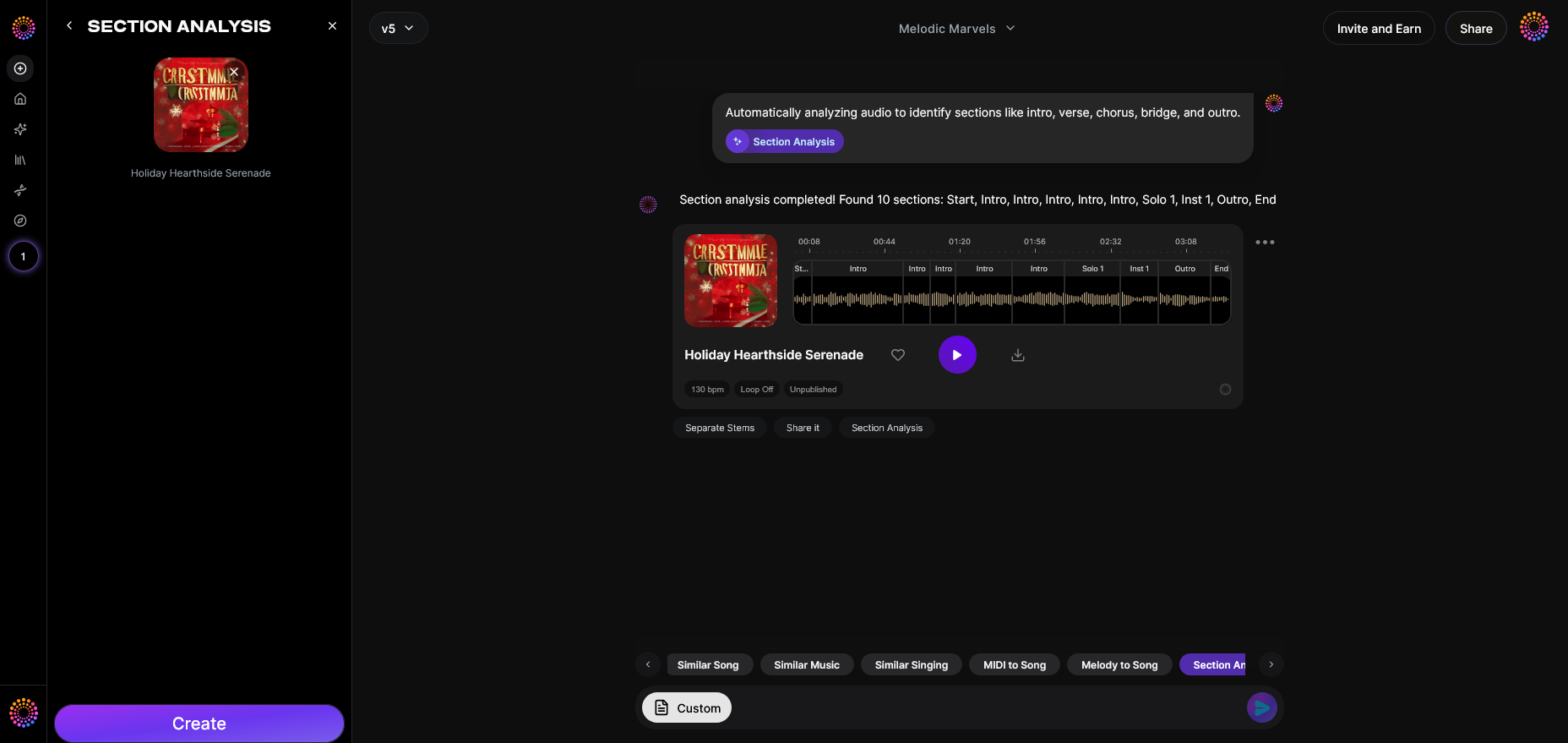
Learning theory is valuable, but technology like Soundverse’s Section Analysis feature makes it even easier to understand song structure in practice.
Soundverse’s Section Analysis automatically detects and labels song sections—Intro, Verse, Chorus, Bridge, and Outro—while providing precise timestamps. This feature creates a visual roadmap that simplifies identifying where each verse begins and ends.
Key Capabilities:
- Automated structure detection: Analyzes uploaded audio and identifies section boundaries accurately.
- Visual roadmap generation: Displays the song flow and section sequence for educational or editing use.
- Timestamp export: Enables direct export of analyzed sections for remixing, cue point setting, or sync evaluation.
Use Cases for Songwriters and Students:
- Learning song structure for covers: See how the verse contributes to overall arrangement.
- Remixing and DJ cue setup: Identify verse transitions for smooth mixing.
- Sync licensing assessment: Quickly check whether a track’s verse-timing aligns with scene requirements.
With Section Analysis, creators gain instant structural awareness of their songs, eliminating guesswork. By combining it with the AI Lyrics Writer tool—which generates lyrics based on tone and genre—you can build entire songs around your analyzed verse sections efficiently.
For creators exploring Soundverse’s broader ecosystem, see resources like Soundverse AI Magic Tools or learn how AI-generated music is transforming the music industry.
How can understanding verses improve songwriting basics?
Mastering the verse is a gateway to mastering all parts of a song. It teaches how melody, rhythm, and lyrics interact under different emotional lenses.
For aspiring producers using AI composition tools, verse understanding enables better creative control. By knowing how verses set up choruses or bridges, you can guide AI systems toward producing coherent structures.
Songwriting in 2026 focuses heavily on balanced section integration. Whether working with Soundverse or other platforms like Mubert or Soundraw, the goal is the same—to produce meaningful songs that blend human emotion with machine precision.
Create Your Own Verses with Soundverse AI
Transform your ideas into melodies effortlessly. Use Soundverse’s AI tools to craft professional-quality verses, choruses, and complete songs—all in minutes.
Related Articles
- How to Make Good Rap Lyrics: Learn how to structure verses that flow naturally and make your rap lyrics stand out with emotion and rhythm.
- Generate AI Music with Soundverse Text-to-Music: Discover how to turn text prompts into fully produced songs using Soundverse’s cutting-edge text-to-music generator.
- What Are Song Stems and Why Do You Need Them: Understand the role of song stems in music production and how they help you remix or fine-tune your verses with precision.
- AI Music Generator and Human Composers: A Future Together: Explore how AI complements human creativity in songwriting and verse composition for a new era of music-making.
Here's how to make AI Music with Soundverse
Video Guide

Here’s another long walkthrough of how to use Soundverse AI.
Text Guide
- To know more about AI Magic Tools, check here.
- To know more about Soundverse Assistant, check here.
- To know more about Arrangement Studio, check here.
Soundverse is an AI Assistant that allows content creators and music makers to create original content in a flash using Generative AI.
With the help of Soundverse Assistant and AI Magic Tools, our users get an unfair advantage over other creators to create audio and music content quickly, easily and cheaply.
Soundverse Assistant is your ultimate music companion. You simply speak to the assistant to get your stuff done. The more you speak to it, the more it starts understanding you and your goals.
AI Magic Tools help convert your creative dreams into tangible music and audio. Use AI Magic Tools such as text to music, stem separation, or lyrics generation to realise your content dreams faster.
Soundverse is here to take music production to the next level. We're not just a digital audio workstation (DAW) competing with Ableton or Logic, we're building a completely new paradigm of easy and conversational content creation.
TikTok: https://www.tiktok.com/@soundverse.ai
Twitter: https://twitter.com/soundverse_ai
Instagram: https://www.instagram.com/soundverse.ai
LinkedIn: https://www.linkedin.com/company/soundverseai
Youtube: https://www.youtube.com/@SoundverseAI
Facebook: https://www.facebook.com/profile.php?id=100095674445607
Join Soundverse for Free and make Viral AI Music

We are constantly building more product experiences. Keep checking our Blog to stay updated about them!