What Is a Splitter? Understanding Its Role in Audio, Network, and Signal Systems
Learn what a splitter is, how audio and network splitters work, and explore Soundverse’s AI Stem Separator in 2026.
What Is a Splitter?
In the expanding world of digital technology, the term “splitter” appears frequently across audio production, networking, and signal management contexts. As 2026 continues to push boundaries in connectivity and AI-based audio engineering, understanding the splitter definition has become more crucial than ever, especially for audio engineers, music producers, and tech enthusiasts aiming for precision in their workflow. This guide explores what a splitter is, how it functions, the different types available, and how Soundverse’s revolutionary Stem Separator feature brings splitter technology into the creative space.
What is the splitter definition in technology?
At its core, a splitter is a device or software tool that takes one input and divides it into multiple outputs. The purpose of this division depends on the use case—whether it’s distributing a network signal, splitting audio channels, or separating data streams. The splitter definition encompasses various categories: audio splitters, network splitters, signal splitters, and cable splitters—all serving the function of enabling simultaneous or isolated usage of a single source.

For instance, in audio production, a splitter allows two or more headphones or monitors to receive the same sound signal. In networking, a splitter enables multiple devices to share a single data line efficiently. Each variant exists to simplify complex connectivity, improve accessibility, or refine control over signals.
What are the main types of splitters?
The modern market in 2026 offers several splitter types, each optimized for different environments.

1. Audio Splitter
An audio splitter divides an audio output into multiple connections. Commonly known as a headphone splitter or Y-splitter, it enables several listeners to share a single audio source or connect multiple external devices like monitors and recording equipment. For professionals, advanced audio splitters help route separate signals across hardware setups without compromising sound quality.
2. Network Splitter
Network splitters, often called Ethernet splitters, allow multiple devices to connect to the same network connection. They’re useful for systems where router ports are limited. These devices improve efficiency in studios and production setups where several tools need internet access simultaneously.
3. Signal Splitter
Signal splitters are used across radio, television, and even optical systems to divide one signal into distinct streams. In broadcast environments, signal splitters ensure that multiple receivers can access the same transmission without degradation.
4. Cable Splitter
A cable splitter is widely used in home entertainment and professional setups. They separate a coaxial input into two or more outputs, letting users connect multiple TVs or streaming boxes to one line.
Each of these splitter types solves a unique technical challenge, but they all share the same goal: enhancing efficiency and flexibility of data or audio signal distribution.
Why are splitters essential in audio production today?
As the music industry evolves rapidly in 2026, the audio splitter remains indispensable. Producers and engineers rely on it for monitoring setups, routing instruments, and controlling multiple audio paths during live performances and recording sessions. For example, an artist might use an audio cable splitter to route one output to studio speakers and another to a mixing console for quick adjustments.
Audio splitters also enable collaborative work. Multiple headphone outputs ensure that musicians and engineers can monitor the same mix simultaneously, fostering synchronization and better creative alignment.
For a deeper dive into creative splitting techniques, watch our tutorial on making music with Soundverse.
What are splitter uses beyond hardware?
Splitters are no longer limited to physical devices. In the age of AI and digital media, the concept has expanded into software-based applications. Software splitters dissect digital signals or data streams for editing, monitoring, and mixing tasks. A prime example is an AI-powered stem separation tool, which acts as a virtual splitter—breaking down complex audio into manageable pieces.
This evolution bridges traditional signal management principles with creative possibilities. Instead of only dividing hardware signals, modern splitters now deconstruct entire sound compositions using deep learning models, revealing the hidden layers of musical productions.
How do software audio splitters redefine music production?
Software-based splitters have transformed how music creators interact with sound. By splitting audio into stems—distinct tracks of vocals, drums, bass, and more—artists can remix, learn from, or enhance existing songs. This process delivers an unparalleled view of mix architecture and facilitates clean audio manipulation.
For those following cutting-edge innovations in AI music generation, software splitters are integral to workflows that prioritize flexibility and creative control. They also allow detailed educational analysis, where students or professionals examine the mix layers of popular tracks without copyright infringement.
To learn advanced mixing approaches, see our video guide on creating Deep House music.
How to make advanced audio splits with Soundverse Stem Separator
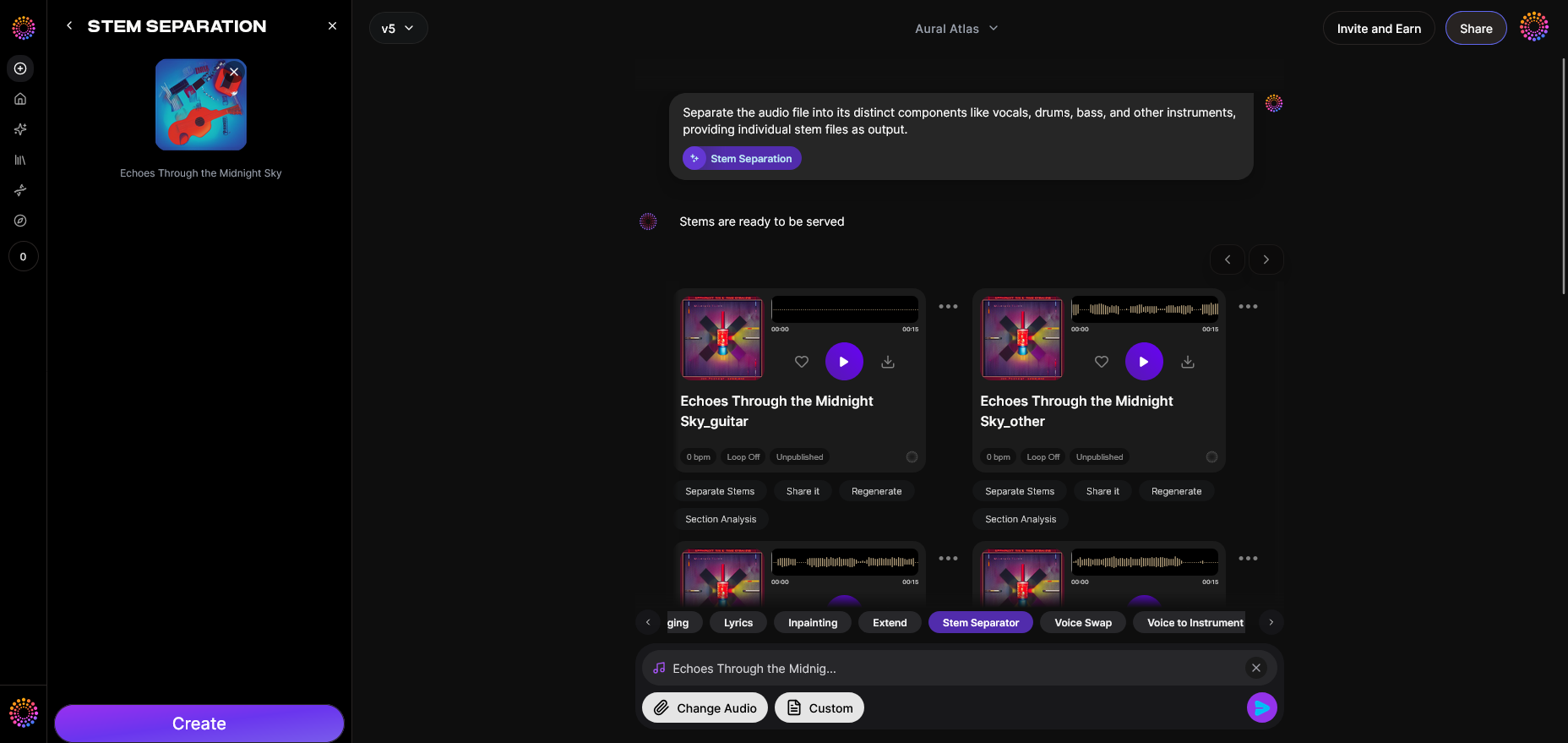
Soundverse’s Stem Separator is a next-generation tool that brings the power of AI-based splitting directly into your browser. Instead of using hardware to split signals, creators can dissect full audio mixes into six individual stems—Vocals, Drums, Bass, Guitar, Accompaniment, and more—ready for editing or remixing.
What the Soundverse Stem Separator offers
The feature uses high-quality isolation algorithms that ensure accurate and clean stem separation. Users can upload a file, record directly, or input a URL of a track, making it capable of handling diverse sources. Once processed, the AI delivers editable stems for:
- Remixing & Sampling: Quickly isolate vocals or instruments for creative reinterpretation.
- Performance Preparation: Create backing tracks for karaoke, live gigs, or dance performances.
- Educational Analysis: Study song structure, instrumentation, and mixing techniques.
- Audio Cleanup: Remove unwanted elements or enhance clarity for editing.
For creators interested in detailed section analysis, Soundverse also offers Section Analysis, which detects parts like Intro, Verse, Chorus, Bridge, and Outro with timestamps—providing an ideal roadmap for editing your isolated stems.
You can read more about Soundverse’s AI advantages in Soundverse Introduces Stem Separation AI Magic Tool or explore related articles like Mubert Alternatives Soundverse and Best Udio Alternative Soundverse AI Free Sign Up to understand how it compares in creative flexibility.
How does Soundverse differ from traditional splitters?
Unlike cable or hardware-based tools, Soundverse does not merely share signals—it completely “splits” sound in a transformative way. Traditional splitters channel data simultaneously between endpoints, while Soundverse dissects audio data with surgical precision. This capability offers not just playback but full control over each audio component.
No real-time monitoring or live preview is used; instead, Soundverse follows an asynchronous workflow: you upload a track, the AI processes it, and then you receive separated stems ready for download and manipulation.
This approach aligns perfectly with modern music editing requirements in 2026, where producers demand isolated components for remixing and licensing-free usage without needing studio-grade hardware.
How are splitter technologies impacting connectivity and creativity in 2026?
By 2026, splitter technology permeates nearly every aspect of digital life. In the network realm, splitters keep devices interlinked with minimum latency. In audio engineering, they remain foundational to production setups. Meanwhile, in AI music environments, splitters redefine creativity itself.
AI-driven tools like Soundverse Stem Separator embody this evolution—bridging signal separation with deep creative exploration. As AI models continue refining their ability to distinguish sound layers, they empower users to produce original remixes, improve vocal clarity, and experiment with new sonic identities.
For more insight into evolving industry standards, check Music Industry Trends to see how technologies like splitters and AI separation dominate recent workflows.
Turn Your Music Ideas Into Reality with Soundverse
Discover how AI-powered tools can help you split, remix, and produce unique tracks effortlessly. Start creating professional-quality music and experiment with creative possibilities today.
Start Creating with AI
Related Articles
- Soundverse Introduces Stem Separation AI Magic Tool: Learn how Soundverse’s innovative stem separation technology helps creators isolate vocals, drums, and instruments with unmatched precision.
- What Are Song Stems and Why Do You Need Them: Understand the concept of song stems and how they enhance editing flexibility and creative remixing in modern music production.
- How AI-Generated Music Is Transforming the Music Industry: Explore how artificial intelligence is revolutionizing music creation, enabling new levels of creativity and collaboration.
- Soundverse Assistant: Your AI Music Co-Producer: Meet your new creative partner that streamlines song creation and helps you produce high-quality music in minutes.
Here's how to make AI Music with Soundverse
Video Guide
Here’s another long walkthrough of how to use Soundverse AI.
Text Guide
- To know more about AI Magic Tools, check here.
- To know more about Soundverse Assistant, check here.
- To know more about Arrangement Studio, check here.
Soundverse is an AI Assistant that allows content creators and music makers to create original content in a flash using Generative AI. With the help of Soundverse Assistant and AI Magic Tools, our users get an unfair advantage over other creators to create audio and music content quickly, easily and cheaply. Soundverse Assistant is your ultimate music companion. You simply speak to the assistant to get your stuff done. The more you speak to it, the more it starts understanding you and your goals. AI Magic Tools help convert your creative dreams into tangible music and audio. Use AI Magic Tools such as text to music, stem separation, or lyrics generation to realise your content dreams faster. Soundverse is here to take music production to the next level. We're not just a digital audio workstation (DAW) competing with Ableton or Logic, we're building a completely new paradigm of easy and conversational content creation.
TikTok: https://www.tiktok.com/@soundverse.ai
Twitter: https://twitter.com/soundverse_ai
Instagram: https://www.instagram.com/soundverse.ai
LinkedIn: https://www.linkedin.com/company/soundverseai
Youtube: https://www.youtube.com/@SoundverseAI
Facebook: https://www.facebook.com/profile.php?id=100095674445607
Join Soundverse for Free and make Viral AI Music

We are constantly building more product experiences. Keep checking our Blog to stay updated about them!